
Dolores Huerta, Co-Founder of the United Farm Workers and Voice of ‘Sí Se Puede’, Dies at 96

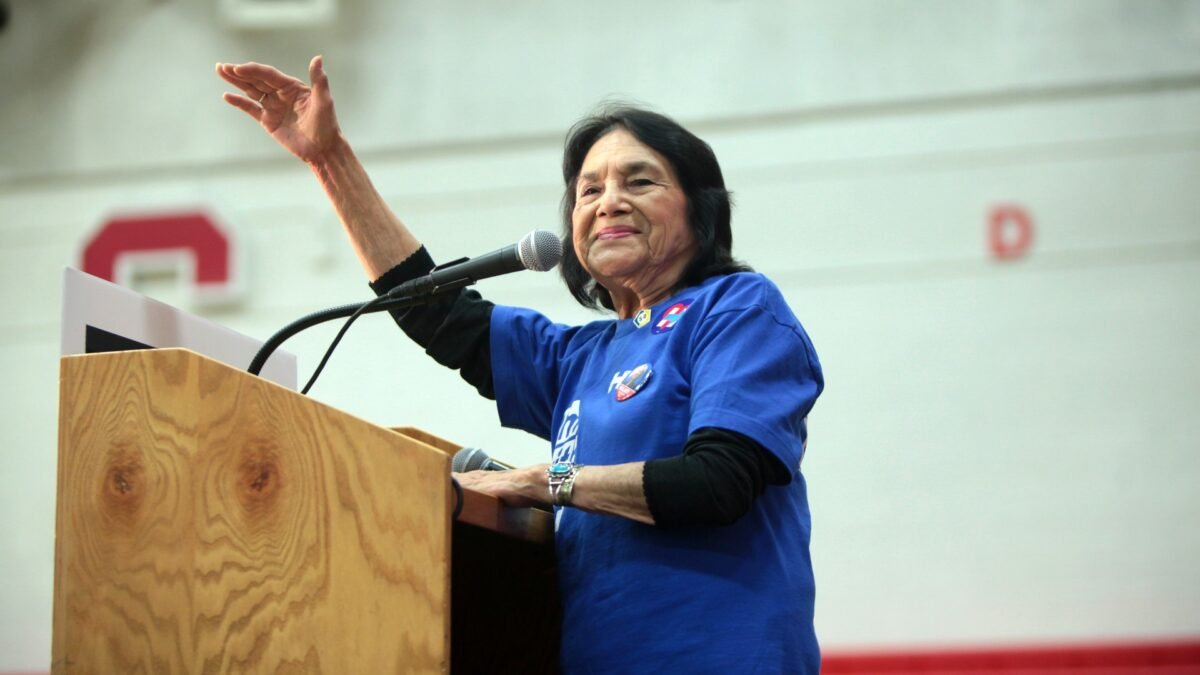
Dolores Huerta, the labour organiser who co-founded the organisation that became the United Farm Workers and gave American politics one of its most enduring rallying cries, died on Wednesday, 28 October, at her home in Bakersfield, California. She was 96.
Her family announced her death in a statement on Wednesday, according to Reuters, and said that plans to recognise and celebrate her life would be announced later. A spokesman for the family said the cause of death was cancer, according to USA Today and the Associated Press. She died at home, surrounded by close family members, according to an obituary published by the Dolores Huerta Foundation.
Huerta spent more than six decades organising farmworkers, negotiating contracts, lobbying legislators and registering voters. She was, in the words of Reuters, one of the foremost women in United States labour history. Yet for much of her career she worked a step behind the movement’s most famous face, Cesar Chavez, doing the negotiating, the lobbying and the boycott organising on which the union’s public victories depended. Her death closes a direct link to the Delano grape strike and the boycott campaigns of the 1960s, and it arrives at a moment when the questions she spent her life pressing — who harvests the food, under what conditions, and with what power to refuse — remain unresolved in the fields where she began.
The announcement and the tributes
“We are deeply saddened to announce that our beloved mother, Dolores Huerta, has passed away today,” her family said in its statement, as reported by CNN. “As you can imagine, this is an incredibly difficult time for us, and we ask for privacy as we grieve this incredible loss to our family. We know that many of you around the world share in our mourning, and we will be following up on plans to recognize and celebrate her incredible life and legacy.”
The United Farm Workers said on Wednesday that the greatest possible tribute to her life would be for her work of organising to continue, according to CNN. In a statement attributed to the union’s president, Teresa Romero, the UFW described Huerta as a tireless advocate for farmworkers, women, immigrants, the LGBTQ+ community and all marginalised people, and as a friend and mentor to generations of organisers, members, volunteers and staff.
“Her life’s work was to empower her community to face and overcome injustices, and she has left farm workers and the entire Latino community stronger and more organized than she found it,” Romero said, according to the UFW. “Her commitment to civic engagement and bringing political power to disenfranchised people is a lesson we all should carry to the ballot box.”
California Governor Gavin Newsom said the state and the country would be in a different place without Huerta’s resolute spirit, her passion for justice and fairness, and her commitment to those overlooked and forgotten, according to USA Today. Former President Barack Obama, who awarded Huerta the Presidential Medal of Freedom in 2012, paid tribute to her as a hero of his, recalling that when she co-founded the National Farm Workers Association in 1962, people asked how she could possibly organise farmworkers who were poor, powerless immigrants. She did it anyway, Obama said, helping thousands of migrant labourers working in brutal conditions to make their voices heard and demand something better.
Thirteen of her children survive her, along with 24 grandchildren, 23 great-grandchildren and seven great-great-grandchildren, according to the obituary reported by USA Today. Vigils were held in several cities on Wednesday evening, including Phoenix and Los Angeles, as labour councils, community groups and elected officials marked a death that many described as the passing of a movement’s living memory.
From a Stockton classroom to the fields
Huerta was born Dolores Clara Fernández on 10 April 1930 in Dawson, New Mexico, according to USA Today. After her parents divorced, she moved with her mother and brothers to Stockton, California, where she grew up surrounded by the state’s vast agricultural industry. Her father had been a miner, labourer, union activist and state lawmaker, Reuters reported. Her mother worked as a waitress, cannery worker and cook before buying and running a hotel in Stockton that sometimes provided food and lodging to farmworkers who could not afford it.
Huerta graduated from Stockton High School in 1947 and earned a teaching certificate before working briefly as an elementary school teacher, according to USA Today. What she saw in the classroom changed the direction of her life. Children arrived at school hungry and without adequate clothing because their parents worked long hours in the fields for poverty wages, her foundation’s obituary records. “I couldn’t stand seeing kids come to class hungry and needing shoes,” she later said, according to Reuters. “I thought I could do more by organizing farmworkers than by trying to teach their hungry children.”
In the 1950s she worked with the Community Service Organization, a California Latino civil rights group, registering voters in Stockton and founding the Agricultural Workers Association in 1960, according to Reuters and USA Today. Through that work she met Cesar Chavez. In 1962 the two founded the National Farm Workers Association, the predecessor of the United Farm Workers. Contemporary accounts describe her as a central figure in the movement from the start, not an assistant to it: she was its lobbyist in Sacramento, its negotiator with growers, and the strategist who carried its boycott campaigns across the country.
The ambition was, by any ordinary measure, implausible. Farmworkers were scattered across enormous agricultural regions, earned little, and had few workplace protections. Many were immigrants. “People thought we were crazy,” Huerta later recalled, according to USA Today. “They asked: ‘How are you going to organize farm workers? They are poor, powerless immigrants. They don’t have any money and they can’t vote.’” Her answer, repeated over six decades, was that power did not begin with money or votes. It began with people acting together.
Delano, the boycott and the contracts
The movement’s defining confrontation began in 1965 in Delano, in California’s Central Valley. Filipino farmworkers launched a strike against table-grape growers, and Huerta, Chavez and their organisation joined them, according to USA Today. Huerta worked alongside Filipino labour leader Larry Itliong during the strike and helped manage the boycott campaigns and negotiate with grape companies.
The dispute spread through one of California’s most important agricultural industries. Workers faced strikebreakers, hostility and violence. Organisers answered with marches, picket lines and the nonviolent tactics associated with the wider American civil rights movement. In 1966, Huerta and Chavez led a march of about 300 miles from Delano to Sacramento to draw attention to the strikers’ demands, a pilgrimage that caught national attention and helped propel a five-year campaign.
Huerta directed the UFW’s national grape boycott from 1965, taking the farmworkers’ cause to consumers around the world, according to the Dolores Huerta Foundation. Not eating a grape — unless it carried a union label — became a political statement in the United States, Reuters reported. Millions of Americans stopped buying California table grapes. One by one, growers began signing contracts. The boycott resulted in the entire California table grape industry signing a three-year collective bargaining agreement with the union in 1970, according to the foundation, giving farmworkers better pay, benefits and protections.
Thanks to the contracts the UFW negotiated, farmworkers won job security, healthcare, retirement plans, a credit union and job-specific benefits such as guaranteed rest periods, toilets in the fields, clean drinking water and protection from pesticides, Reuters reported. The organisation became the United Farm Workers in 1972, according to USA Today, and it picked up support from Martin Luther King Jr. and Senator Robert F. Kennedy along the way. Huerta was with Kennedy at the Ambassador Hotel in Los Angeles on 5 June 1968, after he won California’s Democratic presidential primary, and joined his entourage as it left the stage, USA Today reported. Minutes later, Kennedy was shot in a hotel pantry. He died the following day.
The boycott campaigns also drew fierce opposition. In addition to industry resistance, the UFW found itself up against California Governor Ronald Reagan, who denounced the union as immoral and made a point of eating grapes on television, according to Reuters. That opposition mattered, because it clarified what the boycott really was: not only a dispute over wages, but a contest over whether consumers would accept responsibility for conditions they never saw.
The 1975 law and the negotiator at the table
The movement’s most durable legislative victory came in 1975, when California enacted the Agricultural Labor Relations Act, the first law in the United States that gave farmworkers collective bargaining rights, according to Reuters. Huerta’s work in Sacramento helped bring it about. The Act created a system that guaranteed agricultural workers the right to organise and bargain collectively and required employers to negotiate in good faith, according to USA Today. For workers who had spent years near the margins of California’s prosperity, it created formal mechanisms for challenging working conditions rather than relying only on strikes and public pressure.
The UFW has also credited Huerta’s advocacy with helping to bring an end to the exploitative Bracero programme in the early 1960s, the guest-worker scheme under which Mexican labourers had been brought to the United States on terms the union regarded as exploitative. Later, she spent months in Washington lobbying for the Immigration Reform and Control Act of 1986, which provided legal status to millions of undocumented immigrants, according to USA Today. Her foundation records that she helped fight for the 1986 law, which gave legal status to millions of undocumented people, including hundreds of thousands of farmworkers.
Huerta said that being a woman gave her an edge at the negotiating table with growers. “They really didn’t know how to respond because they couldn’t do the usual forceful type of thing,” she told the PBS programme American Masters, according to Reuters. “And when you would bring up to them and show them the conditions that the workers were working under, and they were kind of embarrassed, actually.” It was a characteristically practical observation. She did not present her sex as a symbol. She treated it as a fact about the room, and used what the room did not expect.
While Chavez recruited, fasted publicly and was embraced by liberal lawmakers and celebrities, Huerta handled negotiating with growers, lobbying legislators and the other business of the union, Reuters reported. In a 2012 interview with PBS, before the later public reckoning with Chavez, she said she had been content for him to take the spotlight because she wanted to focus on helping people rather than gaining fame. “He said, ‘One of us is going to have to be the spokesperson. Are you all right if I’m the spokesperson?’ Of course, I said yes,” she recalled, according to Reuters. That division of labour shaped the public history of the movement for decades. It also meant that the person who built much of its institutional power was, for a long time, the person least likely to be named for it.
Arrest, injury and a wider movement
Huerta was arrested more than 20 times and subjected to death threats and other harassment, according to Reuters. In 1988, while demonstrating outside a San Francisco hotel where Vice President George H. W. Bush was speaking, she was struck with a baton by a police officer, suffering broken ribs and a damaged spleen, Reuters reported. USA Today reported that the beating ruptured her spleen, required emergency surgery and months of recovery, and that she later received an $825,000 settlement from San Francisco, used the money to benefit farmworkers, and saw the city change its crowd-control policies.
Her work extended well beyond organised labour. She advocated for immigrants, women and expanded Latino political participation, spent months lobbying in Washington, and became a mentor to women seeking elected office, working with the Feminist Majority Foundation after taking leave from the farmworkers union, according to USA Today. In 1987 she became a founding board member of the Feminist Majority Foundation, according to her foundation. She stepped down as a UFW officer in 1999 after 37 years, according to USA Today, but she did not step away from organising.
In the early 2000s she created the Dolores Huerta Foundation with her daughters, using prize money from the Puffin/Nation Prize for Creative Citizenship to seed an organisation devoted to grassroots organising, leadership development and civic engagement in California’s Central Valley, according to the foundation. Its work, the foundation says, rests on a simple idea: the people closest to a problem should have the power to solve it. It helps parents, workers, young people and community members organise themselves, speak to elected officials, serve on local boards and commissions, and fight for better schools, cleaner air and water, safer communities and a government that listens to them.
She remained a regular on the college lecture circuit into her 90s, according to Reuters, speaking out against the immigration policies of President Donald Trump and travelling the country during elections to endorse candidates and register voters. Even her 96th birthday celebration in Los Angeles in June 2026 was designed as a fundraiser to continue the foundation’s work across California, according to USA Today. The foundation’s memorial account notes that she could still be found at rallies in her 90s, walking precincts, speaking to young organisers and urging people to vote.
Honours, a slogan and a name on the calendar
Huerta’s honours accumulated steadily, and belatedly. In 1993 she became the first Latina inducted into the National Women’s Hall of Fame, according to the UFW and other accounts of her life. In 1998 President Bill Clinton presented her with the Eleanor Roosevelt Award for Human Rights. In 2012 President Barack Obama presented her with the Presidential Medal of Freedom, the country’s highest civilian award, according to Reuters.
It was at that ceremony that Obama joked about the slogan. Huerta is credited with giving the UFW its slogan, “Sí, se puede” — loosely, “Yes, we can” — which Obama later used during his successful 2008 presidential campaign, according to Reuters. Huerta herself often told the story of its origin in Arizona in 1972, when, after she had outlined the gains the union was winning in California, someone told her with something like pity that the same could not be done in Arizona: “no se puede.” She shot back, “Sí, se puede.” When she relayed the exchange to farmworkers later that night, the room took up the chant, according to the Wall Street Journal. Obama, awarding her the medal, joked: “Dolores was very gracious when I told her I had stolen her slogan.” Huerta had in fact campaigned for Hillary Clinton in the 2008 primaries, against Obama, the Journal noted — a detail that makes the slogan’s afterlife more interesting, not less. It had already escaped its author. That was the point.
Her life became the subject of the documentary “Dolores”, shown at the Sundance Film Festival in 2017, according to Reuters. Murals depicted her. Schools and public buildings carried her name. In 2018, then-Governor Jerry Brown signed legislation designating 10 April, her birthday, as Dolores Huerta Day in California, according to USA Today. Washington state and Nevada followed with their own observances, according to the UFW. The calendar honour matters because it was not only a personal tribute. It put a farmworker organiser’s birthday on the public record of a state whose wealth had been built, in large part, by the labour she organised.
A painful reckoning with Cesar Chavez
The partnership that defined much of Huerta’s public life took on a profoundly different dimension in the final year of her life. In early 2026, Huerta publicly accused Chavez, who died in 1993, of sexually abusing her during their years together in the California labour movement, according to USA Today. She told the New York Times that Chavez raped her in 1966, at the height of the union’s boycott, and that she had also been pressured into sex by him on an earlier occasion in 1960, according to CNN. She said she did not report either incident because of police attitudes towards the movement and because she feared no one in the union would believe her.
“I have kept this secret long enough,” she said in a statement after the Times investigation was published, according to CNN. “My silence ends here.” She had, she said, convinced herself that the assaults were incidents she had to endure alone and in secret. USA Today reported that she said two of her children resulted from sexual encounters with Chavez, including the rape, and that she did not know at the time about allegations that he had abused underage girls. Reuters reported that she was one of a number of women who came forward in 2026 with accounts of sexual assault by Chavez, in some cases when they were minors, and that she said she arranged for the two babies to be raised by others.
Chavez died more than three decades ago and cannot answer the allegations. That fact does not settle them, and it does not dismiss them. It places a particular responsibility on how they are reported: as Huerta’s own account, given in her own words, in the final year of a life spent protecting the movement she helped build. She said she had remained silent because she did not want to hurt that movement. When she spoke, she framed the disclosure as a refusal to carry the secret any longer, not as an attack on the union’s achievements.
The disclosures complicated the history of a movement that both leaders had spent decades building, USA Today observed. Huerta also confronted criticism from women who said sexism and sexual harassment within the union had not always been adequately addressed. Her foundation now publishes a page of sexual assault resources and states that it stands unequivocally with survivors. That, too, is part of the record: an institution she founded responding, in public, to the kind of harm she said she had endured in private.
None of this erases the contracts, the boycott or the 1975 law. It changes how the story of how they were won must be told. A movement built by a woman who was doing the negotiating while a man took the spotlight, and who later said that same man abused her, cannot be understood through hagiography alone. Huerta’s final public act of candour asked her admirers to hold two truths at once: that the movement mattered, and that the people who built it were not exempt from the harms they fought elsewhere.
Analysis: Why It Matters
1. The negotiator history kept in the shadows
Labour history has a persistent habit of remembering the speaker and forgetting the negotiator. Chavez fasted, marched and became the public face of the farmworker movement. Huerta negotiated the contracts, lobbied the legislators and ran the boycott that made the fasting legible to the rest of the country. Reuters’ obituary puts the point plainly: while Chavez recruited and took the spotlight, Huerta handled the business of the union. That is not a footnote. In any campaign, the person who sits across the table determines what survives the press conference.
Huerta’s own explanation — that she agreed to let Chavez be the spokesperson because she wanted to focus on helping people — should not be read as modesty alone. It was also a strategic judgement about a movement operating in a sexist and racist political environment, in which a diminutive, college-educated Latina lobbyist was not the figure growers, legislators or television cameras expected to see. She used that misreading. Growers, she said, did not know how to respond to her, and were embarrassed when she showed them the conditions workers endured. The analysis that follows from her career is uncomfortable for movements that still organise their public memory around a single charismatic figure: the work that changes law is often done by people whose names arrive decades late. Huerta’s death is a reminder to ask, of every celebrated campaign, who negotiated, who lobbied, and who kept the boycott lists.
2. Consumer power as a labour weapon
The grape boycott was, in retrospect, an early and unusually successful experiment in making distant labour conditions a consumer decision. Huerta directed a national campaign that asked millions of people who had never seen a vineyard to stop buying grapes. It worked because the ask was simple, the target was visible, and the moral claim was direct: the fruit on the table had been picked by people denied toilets, drinking water and rest. The 1970 contracts that followed did not arrive because growers suddenly agreed with the union. They arrived because the market for their product had become a referendum on their conduct.
That model has been copied, diluted and commercialised many times since, and it is worth asking what made this version effective. The boycott was tied to a strike, to specific contract demands, and to an organisation that could call it off when those demands were met. It was not a gesture. It had an address, a negotiator and an end point. Modern campaigns that borrow the boycott’s language without its discipline — without a strike to support, a contract to win, or a Huerta to negotiate — should study the difference. Consumer pressure works best when it is the public arm of a labour dispute, not a substitute for one. Huerta understood that distinction because she was running both arms at once.
3. A law is only a starting point
The Agricultural Labor Relations Act of 1975 was a landmark, and landmarks can mislead. A right to bargain collectively is not the same as a contract, and a contract is not the same as enforcement in the field. The UFW’s influence waned after the 1970s even as the law remained on the books, and the union’s own recent campaigns — including its continuing work on heat protections for outdoor workers — show how much of Huerta’s agenda remains contested half a century later. California has outdoor heat-illness rules, yet the union still campaigns for stronger protections and better enforcement, arguing in effect that the distance between a regulation and a shaded rest break can be the distance between life and death.
The lesson is not that the 1975 law failed. It is that laws of this kind require permanent organising to remain real. Huerta acted as if she knew that from the beginning. She did not retire into the role of honoured founder after the Act passed. She lobbied for immigration reform, registered voters, built a foundation to train new organisers, and kept showing up at rallies into her 90s. The tribute that fits her record is therefore not only a day on the calendar. It is the unglamorous work of keeping a right enforceable: inspections, complaints, contracts, and the willingness to strike when the paperwork is ignored. Her career argues that a victory celebrated once is a victory that must then be defended, year after year, by people the public may never name.
4. The reckoning does not erase the record — it completes it
It would be easier, and wrong, to treat Huerta’s 2026 disclosures as a separate story from her organising life. They belong inside it, because they explain something about power that the organising story alone cannot. A movement can win contracts and pass laws while still reproducing, internally, the abuses it condemns externally. Huerta said she stayed silent for decades because she feared harming the movement and because she did not believe she would be believed. Those are not private reasons. They are structural ones, familiar to anyone who has watched institutions protect themselves at the expense of the people inside them.
Her decision to speak at 95, in the final year of her life, reverses the usual order of such disclosures. She had nothing left to gain professionally and a great deal of legacy to risk. That she spoke anyway suggests she understood her own history differently from how it had been told: not as a monument to be protected, but as evidence to be completed. The task for historians, for the UFW and for the foundation she founded is not to choose between the organiser and the survivor. It is to hold both, and to ask what safeguards — inside unions, campaigns and movement organisations — would have made it possible for a woman in Huerta’s position to be believed in 1966, rather than in 2026. A movement that cannot answer that question has not finished the work she started, however many laws it passed.
5. Organising as a transferable skill
Huerta’s most portable legacy may be her method rather than any single victory. She began by registering voters in Stockton. She learned lobbying in Sacramento, boycott organising on the road, and negotiation across tables from growers. In later life she applied the same sequence — listen to the people closest to the problem, organise them, register them, put them in rooms with power — to schools, neighbourhood infrastructure, immigration reform and women’s political leadership. The Dolores Huerta Foundation’s model, which trains parents and young people to serve on boards, speak to officials and run local campaigns, is the Delano method applied to the ordinary machinery of local government.
That transferability is why “Sí, se puede” outlived its original campaign. A slogan that only described a grape boycott would have stayed in the Central Valley. One that described a method — ordinary people acting together can do what experts say cannot be done — could travel to a presidential campaign, a classroom, a housing campaign and a vigil. Huerta’s life suggests that organising is not a talent reserved for exceptional moments. It is a craft, teachable and repeatable, and its practitioners are made by doing it. The foundation’s existence is her bet that the craft will outlive its most famous practitioner. The coming years, in the fields and in the precincts she walked, will test whether that bet was well placed.
What to Watch Next
- Memorial arrangements: Huerta’s family said plans to recognise and celebrate her life would follow. Watch for whether memorial events are centred in Bakersfield and the Central Valley, where her organising life began, and whether they become occasions for renewed organising as well as remembrance.
- Official honours: California already marks Dolores Huerta Day on 10 April. Watch for further state and local tributes, school and street namings, and any federal recognition, and for whether those honours engage with the full record of her life, including her 2026 disclosures.
- The UFW’s next campaigns: The union said the greatest tribute to Huerta would be for organising to continue. Watch its contract campaigns and its work on heat protections and enforcement in California, Oregon, Washington and New York, where the UFW says it now represents thousands of farmworkers.
- How Chavez’s legacy is handled: Institutions that celebrate Chavez — schools, holidays, murals and museums — now face the same question Huerta posed. Watch for whether they acknowledge her account and the accounts of other women, and what that acknowledgement means for how the movement’s history is taught.
- Farmworker conditions this winter and next harvest: The issues Huerta organised around — pay, water, shade, rest, pesticide exposure and the right to bargain — will return with each season. Watch enforcement, contract coverage and heat-illness protections as the practical measures of whether her victories are holding.
Sources
- Dolores Huerta Foundation — In Memory of Dolores Huerta
- United Farm Workers — Statement on the passing of Dolores Huerta
- Reuters — Dolores Huerta, US labor leader and force for human rights, dies at 96
- USA Today — Dolores Huerta, United Farm Workers co-founder and labor pioneer, dies at 96
- CNN — Dolores Huerta, pioneering labor leader and civil rights icon, dies at 96
- Smithsonian Magazine — Dolores Huerta, Farmworker Rights Activist Who Coined ‘Sí Se Puede,’ Dies at 96

About the Author — Abdul Mannan
Related Articles
Grand Jury Declines to Indict Cassidy Hutchinson Over January 6 Testimony in Setback for Justice Department
A Washington grand jury declined to indict former White House aide Cassidy Hutchinson over her January 6 testimony,…
Trump Heads to Texas to Bolster Paxton as Rubio Joins Him at Venezuelan Oil Tanker
President Donald Trump travelled to Texas on Tuesday to campaign for Ken Paxton in a tight Senate race,…
Justice Department Charges James Comey for Third Time Over Alleged 2016 Leak to The New York Times
The Justice Department has charged former FBI Director James Comey for a third time, over an alleged 2016…