
320,000 March Across France in Third Weekend of Youth-Led Protests as Unrest Spreads Across Europe

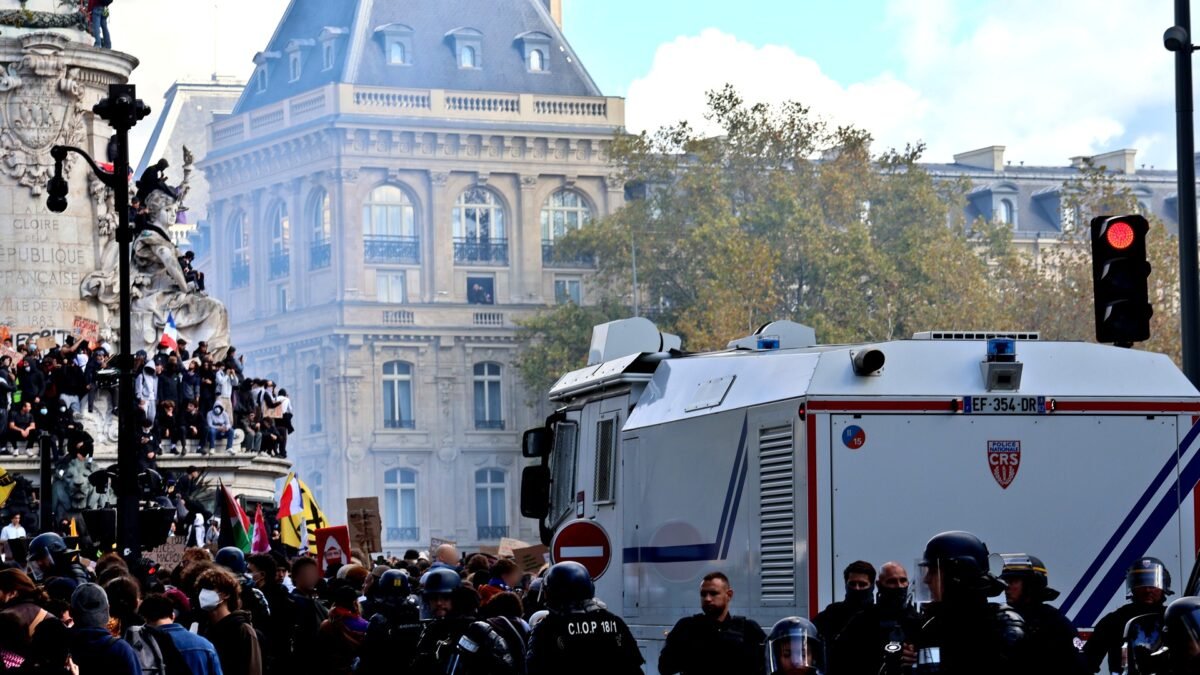
An estimated 320,000 people marched across France on Saturday in a third consecutive weekend of youth-led protests over the cost of living and the state of public education, as the movement that began in French high schools spread to Germany, Italy and Spain. The French Interior Ministry said about 70,000 people turned out for the main march in Paris, where the authorities deployed some 70,000 police officers and gendarmes across the country and pushed demonstrations to the edge of the capital in an effort to prevent a repeat of the rioting and looting that scarred the first weekend of protests.
The day was largely peaceful through the afternoon, according to the Associated Press, but scuffles broke out in Paris and other French cities as the marches ended, with police firing tear gas and protesters throwing fireworks and stones. According to the French Interior Ministry, 27 people had been detained by 2 p.m. local time, fewer than at the same point in the previous demonstrations, and the ministry said the situation appeared generally calm across the country — although officials warned that the greatest risk would come after nightfall on Halloween.
The turnout was lower than on the two previous Saturdays, according to the government’s own figures. More than 550,000 people demonstrated on 17 October, when the protests descended into some of France’s worst rioting in years, and about 410,000 took part on 24 October. Organisers have consistently reported substantially higher turnout figures than the official estimates, according to the Associated Press.
In Paris, thousands gathered at Porte de Bagnolet, on the eastern edge of the capital, where students led the procession hand in hand, according to the Associated Press. Security personnel from the CGT trade union watched the front of the gathering while police assembled on nearby streets. Some participants wore Halloween costumes, including a pirate, Spider-Man and a zombie Michael Jackson inspired by “Thriller”, and demonstrators waited calmly, singing and chanting through megaphones, the Associated Press reported.
The Paris march followed a single route along the capital’s outer boulevards, from Porte de Bagnolet to Porte de Charenton, after police banned union and Yellow Vest marches from the city centre on Friday. France’s top administrative court upheld the ban on a march between the landmark squares of Nation and Bastille, rejecting a challenge from unions, according to reports carried by Devdiscourse. Police also barred entry to the Place de la République and Les Halles — both hit by rioting and looting on 17 October — from 11 p.m. to 6 a.m. on Saturday and Sunday nights. Unaccompanied minors faced a separate 9 p.m. curfew around the Champs-Élysées, after a Paris court on Wednesday suspended an earlier curfew on minors, finding that it seriously and unlawfully infringed freedom of movement.
President Emmanuel Macron said the marches would be kept away from city centres to protect shops, according to the Associated Press. Around 40 metro stations in Paris were closed, according to reports, and the security operation included specialist units, drones, helicopters, dog units, 26 armoured vehicles and 15 water cannons, according to LaPresse.
Evening clashes in Paris, Marseille and Toulouse
As the afternoon marches ended, tensions erupted in several cities. In Paris, clashes kicked off just before 5 p.m. local time when police charged at protesters as they congregated at the end of the protest route at Porte de Charenton, according to The Sun, with police deploying tear gas and rioters throwing rocks and other projectiles. Photographs carried by The Sun, credited to Agence France-Presse, showed a French gendarme engulfed in flames after a petrol bomb was thrown at officers, and police were reported to have been attacked with fireworks.
Tensions also erupted in the southern port city of Marseille, where demonstrators clashed with police, according to The Sun. In Toulouse, police used water cannon against an unauthorised protest that drew several thousand people, mostly young demonstrators, some of them in costume, according to The Sun.
Interior Minister Laurent Nuñez had warned of a “very high risk” of disorder, particularly after nightfall on Halloween. According to CNN, Nuñez warned of separate calls for gatherings across France from 8 p.m. local time “by radical far-left groups and radicalized Yellow Vests”, saying some messages invoked Halloween while calling for “revolution” and “insurrection” and describing them as incitements to serious public disorder. He said those gatherings would be banned.
Halloween added a new complication to the policing operation. In recent days, the word “purge” has circulated across social media platforms, a reference to the dystopian film franchise which depicts a world where all crime is legalised for a 12-hour period each year, according to CNN. “At Halloween, the rules remain the same!” warned the Paris police on X, reminding people that concealing one’s face in public is punishable by a €150 fine, while carrying a weapon, even a fake one, can carry a sentence of up to three years in prison and a €45,000 fine, CNN reported.
The ministry said that as of 29 October, at least 1,193 police officers had been injured since the start of the protests, according to CNN.
How a school protest became a national movement
The protests began in late September, led by high school students demanding improvements to deteriorating school buildings, teacher shortages and a lack of resources, as well as changes to the university admissions system, according to CNN. The rallies began last month with high school students protesting over neglected buildings, teacher shortages and a university admissions system they considered unfair to disadvantaged applicants, according to the Associated Press.
The movement then broadened into something bigger. Labour unions and other groups dissatisfied with President Emmanuel Macron subsequently joined, widening the movement’s demands to the rising cost of living and the state of public services, according to the Associated Press. The Yellow Vests — which began as a movement against soaring fuel prices — are among those taking to the streets, CNN reported. The protests gathered momentum in late September as Macron’s minority government opened talks on its 2027 budget, according to Devdiscourse, and the French government’s promises to reform education and ease fuel costs have failed to calm discontent.
The students’ grievances are concrete and personal. Corentin Cabreux, a 21-year-old student, told the Associated Press that the conditions in his state-run student accommodation illustrated the problems behind the protests. “There are damp stains all along the bottom of my walls, whole sections peeling off, cockroaches everywhere, rats,” he said. He hoped the Halloween demonstration would have a festive atmosphere, challenging the association between the movement and violence, according to the Associated Press.
Aaron Berthier de Grandry, a 15-year-old high school student from the Paris suburb of Nogent-sur-Marne, was planning to join his third consecutive weekend of protests, according to Devdiscourse. “When I was little, I was told young people were the future,” he said — a line that captures the generational charge running through the demonstrations.
The first Saturday, 17 October, was the most violent. More than 550,000 people took to the streets across France, according to the Interior Ministry, and more than 3,000 shops were attacked or looted, with some destroyed, and over 2,700 people were arrested, according to CNN. The images of violence and looting from that day are still haunting French officials, CNN reported. The second Saturday, 24 October, drew about 410,000 people and was largely peaceful, although police made more than 1,300 arrests, according to the Associated Press.
President Macron described the violence as a “collective failure”. “I think no high school student started pushing for their demands expecting to suffer such terrible consequences. And I don’t know a single police officer who signed up to find themselves caught up in such terrible and violent moments either,” he told YouTuber Hugo Travers, according to CNN.
The movement crosses borders
What began in France is now spreading across Europe, carried by the same generation and the same grievances. In Germany, a youth initiative called “Gen Z regelt” — roughly translated as “Gen Z’s got this” — called for protests in around 30 cities “for education, health, climate protection and an affordable life”, and against any return of military conscription, according to the Associated Press. Organisers said more than 180,000 people had registered online, and tens of thousands were expected to turn out across the country, according to CNN.
Demonstrations were planned in major cities including Berlin, Frankfurt, Cologne and Munich, according to CNN. Organisers of “Gen Z regelt” planned the large day of action to coincide with Halloween, to maximise turnout and visibility. “We are young people who no longer want to watch decisions being made about our future without us,” the movement states on its website, according to CNN, adding that the intention is to protest peacefully and instructing participants to keep their faces visible, even in Halloween costumes.
The protest in Berlin appeared much smaller and calmer compared to the scenes seen in Paris in recent weeks. Police at the protest told CNN they estimated some 4,500 people turned out. Extra German police officers were deployed nationwide in preparation, and the luxury shops lining Berlin’s upmarket Kurfürstendamm shopping street boarded up their windows as a precaution, according to CNN. An additional 1,500 police officers were deployed in Berlin, according to the Associated Press.
At Berlin’s Brandenburg Gate, young demonstrators called for increased spending on schools and housing. “We call for more money to be invested in social services and education, as well as in climate protection — in short, in our future — because we are the ones who will be affected by this the longest and who will have to live with it,” said high school student Lara Breitenbach, according to the Associated Press. Janelle Schulz, another Berlin high school student, described similar frustrations. “At my school, the ceiling is collapsing because of water damage, nothing is being done about it, we have a shortage of teachers, the toilets are broken,” she said, according to the Associated Press.
In Barcelona, Spain, Catalan police planned their highest-level alert after an anonymous TikTok network called Blocus urged new gatherings, according to the Associated Press. Rioting there on 24 October resulted in approximately 130 arrests, mostly involving minors. Italian police were also on alert following clashes in Milan, Turin and Bologna, according to the Associated Press. In The Hague, police maintained a strong presence in and around the central shopping area on Saturday following online calls for demonstrations and concerns about rioting or looting, but by mid-afternoon there was little sign of protests and no major disturbances, according to the Associated Press, although many shops had boarded their windows as a precaution. Calls for protests circulated on TikTok in Belgium, the Netherlands, Austria, Switzerland and Portugal, according to the Associated Press.
The political reverberations are already visible. Far-left leader Jean-Luc Mélenchon, whose ratings have risen in recent weeks ahead of next April’s presidential election, marched at the head of the Paris demonstration, according to Devdiscourse. And the movement’s next test is already scheduled: Saturday’s demonstration comes ahead of 5 November, when all eyes will be on a nationwide strike and mobilisation called by the inter-union coalition over rising living costs, according to CNN.
Analysis: Why It Matters
A movement that refuses to fade
Three consecutive Saturdays of mass protest is, by any measure, a sustained movement rather than a moment. The official turnout fell from more than 550,000 to 410,000 and now to 320,000, and the government will inevitably present that decline as evidence that the protests are running out of steam. That reading is too simple. A demonstration that still draws 320,000 people — 70,000 of them in Paris alone — on a Halloween Saturday, after two weekends of widely publicised violence and more than 2,700 arrests, is a movement with deep roots and a durable base. The students who started it in September have been joined by unions, climate activists and the Yellow Vests, and the breadth of that coalition is precisely what makes it hard for the government to dismiss. Movements that are built on a single grievance can be bought off with a single concession; this one is built on a pile of them — crumbling schools, teacher shortages, an admissions system seen as rigged, housing that students describe as infested, and a cost of living that keeps rising. Each of those grievances has its own constituency, and each constituency showed up on Saturday.
The numbers game — and why the official count is not the whole story
Every French protest is fought twice: once on the streets and once over the numbers. The Interior Ministry’s 320,000 is the figure that will be quoted, but organisers have consistently reported substantially higher turnout, and the gap matters politically. Official counts in France have a long history of understating protest size, and the government’s critics will note that the same ministry that counts the crowds also deploys the 70,000 officers policing them. Yet even taking the official figures at face value, the trend tells a more interesting story than simple decline. The first Saturday produced the worst rioting in years; the second was largely peaceful with 1,300 arrests; the third drew a smaller but still enormous crowd with relatively few detentions by mid-afternoon. The movement appears to be disciplining itself — students leading hand in hand, costumes instead of confrontations, organisers in Germany explicitly instructing participants to keep their faces visible. If that discipline holds, the protests become harder for the government to delegitimise, and the falling turnout may reflect not exhaustion but a shift from a street explosion to a sustained campaign. The real test of that theory comes on 5 November, when the unions call a nationwide strike.
A generational revolt with a European echo
The most striking feature of this autumn is not that France is protesting — France protests often — but that the protest has a generational signature and a European address. The movement began with teenagers complaining about their schools, and its language is the language of young people who feel decisions about their future are being made without them. That is the explicit message of Germany’s “Gen Z regelt”, and it is no accident that the German day of action was organised to coincide with Halloween for maximum visibility, or that the calls to gather in Barcelona, The Hague, Milan and Turin circulated on TikTok. This is a protest movement native to the platforms its participants live on, and it is spreading through the same networks that carry music, memes and fashion across borders. The grievances are also strikingly similar from Paris to Berlin: underfunded schools, unaffordable housing, a cost of living that outpaces wages, and a climate future that feels mortgaged. Governments across Europe should be wary of treating this as a French problem. The same week, dockworkers struck across 113 ports in 22 countries against arms shipments and the deaths of seafarers in war zones, according to Reuters — a different cause, but the same continent-wide willingness to take to the streets and the ports. Europe is in a season of protest, and the young are its organisers.
The state’s dilemma: order without legitimacy
The French government’s response has been overwhelmingly a security response: 70,000 officers, banned routes, barred squares, overnight access bans, a curfew for unaccompanied minors, a ban on face coverings, and warnings of “very high risk” disorder. Some of that is plainly justified — 3,000 shops were attacked or looted on 17 October, and 1,193 police officers have been injured since the protests began. But the security response is running into the limits of the law and of public tolerance. A Paris court suspended the earlier curfew on minors on Wednesday, finding it a serious and unlawful infringement of freedom of movement — a reminder that emergency measures must survive judicial scrutiny. The decision to push the Paris march to the city’s outer boulevards, upheld by the top administrative court, kept the centre calm but also kept the protest out of sight of the institutions it addresses. And the sheer scale of the deployment — 70,000 officers to police 320,000 marchers — raises its own question: a state that needs one officer for every four or five demonstrators is a state that has lost the argument before the argument has even begun. President Macron’s description of the violence as a “collective failure” was an unusually candid admission, but candour is not a policy. The government has promised education reform and help with fuel costs, and so far, according to Devdiscourse, those promises have failed to calm discontent.
What November will decide
The calendar now matters as much as the streets. On 5 November the inter-union coalition has called a nationwide strike and mobilisation over rising living costs, and that will be the first test of whether the students’ movement and the organised labour movement can march together rather than merely in parallel. Behind that stands the 2027 budget, the negotiations over which helped trigger the protests in the first place, and behind that stands the presidential election next April, in which Jean-Luc Mélenchon’s rising ratings suggest the protest vote may find an electoral outlet. The government faces a choice it has so far avoided: treat the protests as a policing problem, and risk a fourth, fifth and sixth weekend of confrontation; or treat them as a political problem, and negotiate on the substance — school funding, teacher recruitment, housing, and the cost of living — with the people actually marching. The students at Porte de Bagnolet, walking hand in hand in Halloween costumes, have made their preference clear. They are not asking for a crackdown or a concession; they are asking to be heard. Whether Paris listens will determine whether this autumn is remembered as a season of riots or as the moment a generation entered French politics.
What to Watch Next
- The 5 November nationwide strike: the inter-union coalition’s mobilisation over living costs will show whether the student movement and organised labour can combine into a single force — and how the government responds to a weekday strike after three Saturdays of protest.
- The 2027 budget negotiations: the talks that helped trigger the protests are still under way in Macron’s minority government; any concessions on education funding, teacher recruitment or fuel costs will be read as a direct response to the streets.
- The official inquiry into the 17 October violence: with more than 3,000 shops attacked or looted and 1,193 police officers injured since the protests began, expect scrutiny of both the rioters and the policing tactics, including tear gas, dispersion grenades and water cannon.
- The spread across Europe: whether Germany’s “Gen Z regelt” movement grows beyond its first day of action, and whether the TikTok-driven calls in Spain, Italy, Belgium, the Netherlands, Austria, Switzerland and Portugal produce sustained demonstrations of their own.
- The presidential race: Jean-Luc Mélenchon’s rising ratings ahead of next April’s election, and whether other candidates move to capture the youth and cost-of-living vote that is marching every Saturday.
Sources
- Associated Press — “Police and gendarmes on alert as France prepares for another day of protests”, via Hillingdon Times, 31 October 2026
- CNN — “Protests spread to Germany on Halloween as hundreds of thousands march again in France”, 31 October 2026
- NewsLooks — “France Protests Draw 320,000 as Youth-Led Demonstrations Spread Across Europe”, 31 October 2026
- Devdiscourse — “Isolated clashes in France, as tensions erupt after peaceful marches”, 31 October 2026
- The Sun — “Protesters set officer on fire after hurling Molotov cocktail as cops fire tear gas in France in third weekend of riots”, 31 October 2026

About the Author — Abdul Mannan
Related Articles

US and Russia Veto Each Other’s Western Sahara Plans as UN Mission MINURSO Loses Its Mandate
Russia vetoed a US plan to reshape the Western Sahara mission and Washington vetoed Moscow's rival text, leaving…
Polish President Turns Plane Around and Enters Constitutional Tribunal as Rival Judges Claim Control of Top Court
Karol Nawrocki cut short a trip to Senegal, flew home and pushed his way into Poland's Constitutional Tribunal…
US Approves $2.1 Billion Sale of 500 Patriot Missiles to Ukraine — but Kyiv May Wait Years for Delivery
The US State Department has approved a possible $2.1 billion sale of 500 Patriot PAC-3 MSE interceptors to…