
India’s IT Stocks Post Best Week in 18 Years as Earnings Beat Trumps AI Fears


The week everything finally broke India’s way
After a year in which the words “artificial intelligence” felt like a threat to Indian software services, this week they sounded like an opportunity. India’s information technology shares have just completed their strongest week in 18 years, according to Reuters, with the Nifty IT index climbing 10.4 per cent — a rally powered by better-than-expected quarterly earnings and a dramatic global rotation of capital away from capital-hungry AI hardware stocks and into the less fashionable, but suddenly better-priced, world of software services.
The weekly gain is the index’s largest since the week ended October 31, 2008, when it jumped 11.24 per cent, Reuters reported on Friday. For a sector that has spent months defending itself against the narrative that generative AI will eat the outsourcing business model, the move amounts to a loud market vote: the death of Indian IT has been greatly exaggerated.
The rally comfortably outpaced every other major sectoral index in India. The benchmark Nifty 50 gained roughly 2.6 per cent this week, according to Reuters, while The Hindu BusinessLine reported the BSE Sensex finished the week up 3.11 per cent and the Nifty 50 up 2.77 per cent — the difference between the two figures reflecting the indexes’ slightly different reporting snapshots. On Friday alone, the Sensex settled 413.66 points, or 0.56 per cent, higher at 74,729.27, and the Nifty 50 added 148.80 points, or 0.65 per cent, to close at 23,146.15, The Hindu BusinessLine reported.
Tech Mahindra leads the charge
The week’s standout was Tech Mahindra, which surged 8 per cent on Friday — 8.45 per cent on the BSE close, per The Hindu BusinessLine — after the company reported a 32.7 per cent jump in consolidated net profit to ₹1,585.6 crore for the September quarter of FY27. Revenue from operations grew 15.6 per cent year-on-year to ₹16,180 crore, while dollar revenue rose 6.7 per cent to $1,693 million. The company’s EBIT margin improved to 14.8 per cent from 14.4 per cent in the June quarter, according to brokerage research published by HDFC Sky.
Tech Mahindra sweetened the report with shareholder-friendly announcements: an interim dividend of ₹15 per share and a 1:1 bonus issue — its first since 2015 — subject to shareholder approval, with bonus shares worth up to ₹490 crore. Strong volume growth, cost savings and a depreciating rupee all contributed to lifting operating profit, The Hindu BusinessLine reported. The dividend’s record date is October 23, with payment due by November 13.
Wipro added 5.8 per cent on Friday, according to Reuters, after reporting stronger-than-expected quarterly revenue. The company’s consolidated net profit slipped 1.4 per cent year-on-year to ₹3,200.6 crore, but revenue rose 9.06 per cent to ₹24,752.7 crore, and IT services revenue grew 8.95 per cent to ₹24,667 crore, Angel One reported. The IT services segment’s operating margin dipped 20 basis points to 16.5 per cent. For the December quarter, Wipro guided IT services revenue in a range of $2,571 million to $2,625 million, implying sequential growth of minus 1.5 per cent to plus 0.5 per cent — a cautious outlook that investors largely looked past, comforted by signs that delayed large deals could support growth in coming quarters, Reuters noted.
Industry heavyweights joined the advance. Infosys gained 3.9 per cent and Tata Consultancy Services rose 4.2 per cent on Friday, with HCLTech adding 1 per cent, according to Reuters. Upstox reported that TCS’s consolidated net profit surged around 15 per cent to ₹13,884 crore for the quarter, with total contract value — the total deal value secured — jumping to $9.6 billion. TCS’s AI-related revenue stood at $3.1 billion in the September quarter, crossing 10 per cent of overall revenue, Upstox reported. HCLTech, for its part, revised its FY27 revenue guidance upward, now expecting growth of 2.5 to 4 per cent year-on-year in constant currency terms.
Not every name participated. Persistent Systems fell 3.3 per cent on Friday after brokerages flagged margin pressures stemming from higher amortisation costs, Reuters reported — a reminder that the rally is being earned one set of results at a time, not granted to the sector on faith.
The “reverse AI” rotation
The second engine of the rally has nothing to do with any single company’s results. This week, investors sold off the world’s most expensive artificial-intelligence hardware names and rotated into Indian software shares as a relative safe haven. Reuters described the dynamic as a global selloff in AI-linked stocks prompting investors to turn to Indian shares.
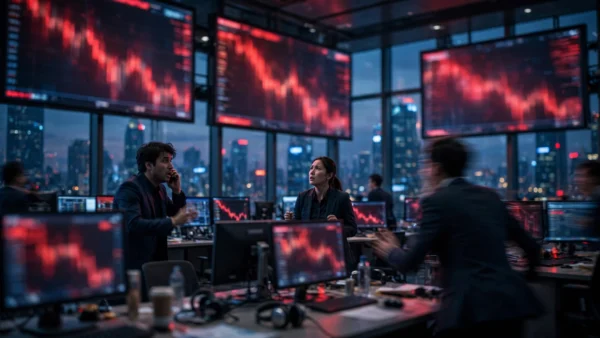
The timing is hard to miss. On Thursday, Asia’s AI-hardware trade collapsed: South Korea’s KOSPI plunged roughly 8 per cent, triggering circuit breakers, with Samsung Electronics down about 9.5 per cent and SK Hynix down about 11 per cent; Japan’s Nikkei fell around 5 per cent; the Philadelphia Semiconductor Index dropped 4.3 per cent in the United States; and CoreWeave had shed 15 per cent a day earlier as hot US inflation data revived fears that the Federal Reserve could still hike rates on October 27–28. As Angel One put it in research published this week, a global selloff in capital-intensive chipmakers caused investors to shift capital, and Indian IT services firms — asset-light, cash-generative and cheap relative to hardware makers — became the refuge.
The currency helped too. The rupee, which ended Friday up 0.1 per cent at 94.96 to the US dollar, according to The Hindu BusinessLine, remains near historically weak levels — a structural tailwind for India’s dollar-billing software exporters, which convert overseas earnings into more rupees when the currency depreciates. As Angel One noted, the weaker rupee, combined with internal cost-control measures, directly lifted operating margins across the major firms this quarter.
Bank of America’s weekly flow data captures the mood swing at the global level. Investors poured $64.5 billion into stock funds in the week to Wednesday, the bank said, per Reuters, with technology stocks taking $10.7 billion — pushing tech inflows to a record $196 billion so far this year. US stocks absorbed $39.1 billion, a record $636 billion year-to-date. Bonds drew $11.8 billion, with Treasuries extending their inflow streak to a 16th straight week, while money-market funds — cash — shed $53.1 billion. Emerging markets took in $17.7 billion, including $8.6 billion to China.
Meanwhile Brent crude, the global oil benchmark, slipped 0.30 per cent to $105.6 a barrel, easing some inflation pressure for fuel-importing India, The Hindu BusinessLine reported.
Analysis: Why It Matters
The most important thing about this week is not the number — 10.4 per cent, or the 18-year framing — but the story the market is telling underneath it. For more than a year, the dominant question hanging over Indian IT has been whether generative AI destroys the outsourcing model. If AI can write code, answer client queries and automate testing, what are clients paying Infosys and TCS for? The sector has traded at a discount on exactly that fear. This week, the market offered a provisional answer: clients are paying for someone to manage the AI transition — and the firms selling shovels are starting to report real shovel revenue.
The $3.1 billion figure from TCS matters enormously in this context. When AI-derived revenue crosses 10 per cent of a company’s top line, it is no longer a pilot project or a marketing slide; it is a business line. Infosys management has made similar claims about AI revenues. The skepticism was never entirely fair — the same AI that threatens coding jobs also generates enormous demand for systems integration, data engineering and the messy work of embedding models inside legacy banks and insurers — but it took hard quarterly numbers to move the narrative. Tech Mahindra’s profit jump of nearly a third, Wipro’s revenue beat and HCLTech’s guidance upgrade arrived in a single week, and the sector re-rated.
There is also a harder, more cynical reading of the week. Thursday’s hardware rout showed that the AI buildout trade is really two trades: one in the physical infrastructure — chips, memory, data centres — and one in the software services that sit on top of it. When Gartner warns about an infrastructure-revenue gap and investors worry about who is financing the largest infrastructure buildout in US history, the hardware side gets crushed. The services side, which collects recurring revenue without pouring tens of billions into concrete and GPUs, suddenly looks like the prudent way to stay exposed to AI. The “reverse AI” rotation is less a philosophical conversion than a search for the cheapest seat on the same train.
That distinction carries a warning. If the AI-financing scare turns out to be the start of a genuine demand slowdown rather than a repricing of who builds the infrastructure, services order books will eventually feel it too — enterprise IT budgets are cyclical, and deal delays were already visible this quarter. Wipro’s own cautious December-quarter guidance, projecting sequential growth as low as minus 1.5 per cent, is a reminder that revenue is not guaranteed to keep surprising to the upside. Persistent Systems’ Friday slide is the exception that proves the rule: brokerages are still punishing margin pressure, not blindly buying the sector’s story.
Finally, the week illustrates how much of global equity investing has become an exercise in relative positioning rather than absolute conviction. The money that lifted the Nifty IT index did not arrive because investors suddenly believed Indian IT was undervalued in isolation; it arrived because, in a week when Asian chipmakers lost hundreds of billions in market value, Indian software firms looked like the least dangerous place to keep AI exposure. Rotations are powerful, but they are fickle. Sustained outperformance will need something this week provided only partially: multi-quarter evidence that AI grows the services pie rather than shrinking it.
What to Watch Next
- Remaining Q2 results and guidance: Watch for Infosys’ own full quarterly numbers and any commentary on AI deal pipelines — and whether HCLTech’s upgraded 2.5–4 per cent guidance proves conservative.
- The Fed’s October 27–28 meeting: Hot US CPI data revived expectations of another rate hike, which is partly what crushed hardware stocks. Any dovish or hawkish surprise will move both the rupee and the rotation trade.
- Wipro’s December-quarter delivery: The company’s guided range implies sequential growth anywhere from minus 1.5 per cent to plus 0.5 per cent. A print at the top end would confirm the delayed-deals thesis; the bottom end would revive demand fears.
- Hardware-sector stability: If the Asian chip rout stabilises — TSMC already reported “very strong” AI demand despite its shares falling — the rotation into IT services could pause or reverse. Samsung and SK Hynix’s rebound levels are the signal to watch.
- The rupee: At 94.96 to the dollar, the currency remains a margin lever. Any sharp reversal — say, on global risk-on flows into India — would compress the tailwind that flattered this quarter’s profits.
Sources
- Reuters — India’s battered IT stocks head for best week in 18 years on earnings boost
- The Hindu BusinessLine — Sensex gains 413 pts, Nifty ends at 23,146 led by IT stocks
- Angel One — IT stocks rally for 4th day: why Infosys, TCS, Tech Mahindra shares are rising
- Upstox — Nifty IT up 9% in five days: what’s driving the momentum?
- Reuters — Investors bought stocks and bonds, shed cash in past week, say BofA

About the Author — Abdul Mannan
Related Articles

Fed Chair Warsh Keeps Rate Path Open at IMF Meeting as Markets Rally on the Calm
Federal Reserve Chairman Kevin Warsh declined to signal an October rate move at the IMF meetings in Bangkok,…

Netflix Cuts About 6% of Workforce in Biggest Layoff Since 2022 Amid Attention Battle
Netflix is cutting roughly 1,000 jobs — 6% of its workforce — in its biggest layoff since 2022,…
Asian Chip Stocks Crash as KOSPI Trips Circuit Breaker and Nikkei Tumbles on AI Financing Fears
South Korea's KOSPI plunged about 8% on Thursday, tripping circuit breakers as chip giants collapsed, while Japan's Nikkei…