
Satellite Images Reveal Iran Racing to Build Huge Underground Facility Between Isfahan and Natanz Nuclear Sites

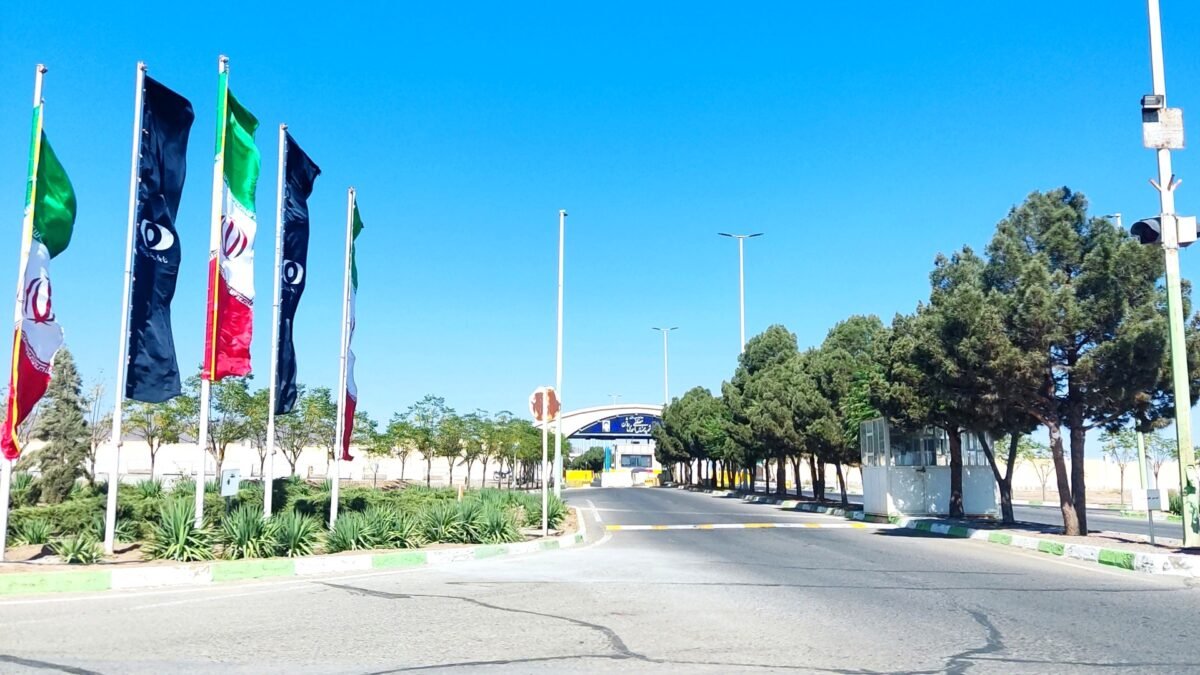
Iran is rapidly building a large fortified underground facility inside a mountain in central Iran, midway between two of its most important nuclear sites, according to new satellite imagery published by a Washington-based research institute on Wednesday. The discovery, reported by The Jerusalem Post and the Hindustan Times on Thursday, adds a new and unsettled question to a war in which the location of Iran’s nuclear material is already unknown to international inspectors.
The Institute for Science and International Security said the facility, at Behjatabad, north of the city of Isfahan, is being built at an unusually fast pace. Satellite images from Vantor Technologies, the latest taken on 24 November, show graded roads climbing a mountain valley to four active tunnel entrances, a fifth entrance that appears to have been backfilled, and a support complex below the mountain that includes an administrative headquarters, a covered vehicle parking area and two security checkpoints between inner and outer perimeter walls. The institute said Iran had recently begun installing an outer perimeter security barrier and that, when complete, the site would probably cover about 5,000 hectares, or roughly 12,000 acres.
The institute was careful about what the images do not prove. Its purpose, it said, is not clear at this point, and more information is needed before an accurate assessment can be made. But given the site’s security measures, the nature and pace of construction, and Iran’s previous construction practices, the institute said the facility could serve several military purposes, including those related to missiles or other major weapons systems. It added, in terms that have now been repeated across the coverage, that a nuclear purpose could not be ruled out.
That single sentence is what gives the discovery its weight. Iran has built many underground facilities of this kind across the country, and the institute said so itself. What sets Behjatabad apart is the speed at which it is going up, its position exactly between the Esfahan nuclear site and Pickaxe Mountain near Natanz — about 62 kilometres from each — and the fact that it is being dug deeper into a mountain, and faster, than anything of its kind seen before.
What the satellite images show
The chronology assembled by the institute from Sentinel-2 imagery reviewed by Vantor gives the project a precise shape. The first signs of construction appeared between 7 and 12 December 2025, when land was cleared in what would become the facility’s administrative and entrance area. On 11 January 2026, a new road or path was being built from the administrative area towards the future tunnel complex. On 3 April 2026, the first signs of activity appeared at what would become the eastern tunnel area. A spoil pile — the excavated rock and earth dug out of the mountain — was observed on 28 April. By 12 June, a second tunnel area, in the western portion of the complex, had begun to emerge.
The annotated images published on Wednesday show the project well past the land-clearing stage. Roads climb the valley to the tunnel mouths. A spoil pile sits to one side, with a concrete batching point nearby, and access roads run down to the entrance area and a secondary support area. Rows of blue-roofed buildings mark the administrative headquarters, with a covered vehicle parking area and two security checkpoints between the inner and outer perimeter walls. The institute said the latest image, provided by Vantor on Tuesday, showed the location of the key areas within the facility and the progress of the construction under way.
The site was first spotted by Ben-Zion Makles, an Israeli open-source intelligence researcher, in imagery from Planet Labs, the American space-imaging company. A separate analysis by Sam Lair, a missile researcher at the United States-based Foreign Policy Research Institute, published on the Arms Control Wonk website on 19 November, examined the same site from Planet Labs imagery and reached a similar reading of the construction, while putting the number of planned tunnel entrances at five, split between the eastern and western arms of a small mountain valley near Behjatabad. The two counts are not in conflict: the institute’s latest annotated images label four entrances as active, with a fifth backfilled entrance visible at the lower right of the frame.
The coordinates published by the Arms Control Wonk analysis place the site at 33.148 degrees north and 51.782 degrees east, in the mountains north of Isfahan. That is roughly 50 kilometres north of the city as the crow flies, in the same central Iranian plateau that holds the country’s most sensitive nuclear infrastructure.
How deep the tunnels could run
The most striking claim in the analysis so far concerns depth. Lair estimated how far below the surface the tunnels could reach by cross-referencing the satellite images with topographic elevation maps available in Google Earth. Tunnels dug straight back into the mountainside, he wrote, would sit about 150 metres below the surface. If they turned inward, towards the heart of the mountain, as Iran typically designs its underground facilities to complicate attacks, they could be deeper still, reaching 200 metres or more.
For comparison, the enrichment plant at Fordow — the underground facility that American and Israeli warplanes struck in June 2025 — was estimated to be around 80 to 100 metres deep. If Lair’s estimate is right, Behjatabad could be roughly twice as deep as Fordow, and therefore considerably harder to reach with the ground-penetrating munitions that were used against Fordow. That is a conclusion with obvious military consequences, and it is one reason the discovery has travelled so quickly from a specialist research blog to the front pages of newspapers in Jerusalem, Delhi and London.
There is also a telling detail in the imagery. According to the Arms Control Wonk analysis, the Iranians initially tried to dig into the western side of the mountain but gave up after a few months. The colour of the spoil from those abandoned tunnel entrances is a very different colour — red or burgundy, rather than the grey and gold from the entrances still under construction — and the fact that work there was halted suggests the geological conditions on that face may have been unfavourable for tunnelling. The builders, in other words, hit a problem, abandoned one approach and found another way into the mountain. That is the behaviour of a project with a deadline, not a speculative one.
Construction began in January 2026, according to the Arms Control Wonk analysis, and it has continued without pause during the war. The digging, the analysis found, continued throughout the June 2025 air war and through the wider war that has followed. New paved and unpaved roads have been built around the tunnel openings, along with support buildings, excavation work areas, spoil heaps and what appears to be a concrete production area. Activity can be seen at the tunnel mouths, at the spoil piles and at the storage and concrete production site.
What the facility might be for
Lair’s own assessment, on the evidence available so far, is that the site is most likely a new missile base for the Islamic Revolutionary Guard Corps Aerospace Force. The tunnel entrances and the location, he wrote, are similar to those seen at underground facilities throughout Iran. But he was explicit that this is a guess, and that a more confident assessment will have to wait for permanent above-ground infrastructure characteristic of missile bases, such as checkout buildings and garages, to be built at the site. Should the Iranians complete the work without adding those features, he wrote, analysts will have to reconsider what to make of the new underground facility.
The Institute for Science and International Security was more cautious still, declining to settle on any single purpose. Its statement listed missiles and other major weapons systems as possibilities, and said a nuclear purpose could not be ruled out. That caution matters, because the distinction between a missile base and a nuclear facility is the difference between a serious military development and a potential proliferation crisis. Neither assessment claims to know which it is. Both agree that the scale, the security and the speed point to something Iran regards as strategically important.
One thing the reporting makes clear is that Behjatabad is not the only such project. A separate assessment published by the Centre for Strategic and International Studies on 9 September 2026 found that construction work on Pickaxe Mountain — the underground facility near Natanz, about 62 kilometres from Behjatabad — had intensified significantly this year, with tunnel entrances reinforced, internal roads upgraded and excavated soil removed from the site. Iran, as the institute put it, is known to have established a multitude of dispersed underground facilities of this type. The pattern is a deliberate one: spread the most sensitive capabilities across many hardened sites, so that no single strike can remove them.
The inspectors’ blind spot
The Behjatabad discovery lands at a moment when the world’s ability to say what Iran is doing with its nuclear programme is weaker than at any point in the history of the safeguards system. The International Atomic Energy Agency, the United Nations nuclear watchdog, has told its Board of Governors that it cannot verify the whereabouts or the status of roughly 440.9 kilograms of uranium enriched to 60 per cent purity — a level close to weapons grade. That stockpile was last measured before the June 2025 strikes. More than a year later, its amount and its location cannot be confirmed.
According to a joint statement by France, Germany, the United Kingdom and the United States to the Board of Governors this month, the agency has received no information from Iran regarding the status of its declared nuclear facilities and nuclear material, and has not been granted access to the requested facilities. Since February 2026, the only in-field verification activity has been at the Bushehr nuclear power plant. Iran, the statement said, should not expect praise for such inspections while continuing to refuse inspections at every other declared facility.
The agency’s report, the four governments said, makes the highly significant statement that it is not able to conclude that there has been no diversion of declared nuclear material from peaceful nuclear activities in Iran. For a year and a half, the agency has lost continuity of knowledge regarding Iran’s previously verified stockpile of highly enriched uranium. To quote the director general’s report, the agency’s lack of access to verify this material “is a matter of serious proliferation concern and compliance with Iran’s NPT Safeguards Agreement, and needs to be rectified with the utmost urgency”.
Director General Rafael Grossi has told the Board that the agency is increasingly concerned about its lack of access to, and information about, Iran’s fourth declared enrichment plant, in Isfahan. The agency has said it does not know the underground facility’s exact location, its operational status, or whether it contains nuclear material, and that the immediate resumption of verification activities is critical. Tehran first declared that plant — the Isfahan Fuel Enrichment Plant — to the agency on 12 June 2025, one day before Israeli and American airstrikes prevented a scheduled inspection. In September, the Board adopted, by a wide majority, a resolution reporting Iran’s non-compliance with its safeguards agreement to the United Nations Security Council and the General Assembly.
It is important to be precise about what connects, and what does not connect, these two stories. The agency has not said that Behjatabad is the Isfahan Fuel Enrichment Plant, and the two should not be conflated. The enrichment plant’s location remains unknown to the agency, and Behjatabad is a newly identified construction site whose purpose is unconfirmed. What connects them is the context: a country that is building hardened underground facilities at an unusual pace is, at the same time, refusing the inspectors access to the facilities it has already declared. The combination is what alarms the Board, and it is what makes a discovery like Behjatabad harder to read calmly than it would be in a period of full transparency.
Iran’s position, as set out in a letter to the agency and in statements by its ambassador in Vienna, is that talks on restoring normal monitoring cannot go ahead while its facilities face threats of further American military attacks. Tehran has told the agency in writing that it will not accept being bombed on the one hand while being asked, in a tone of entitlement, to provide detailed information about its materials and sites and grant unrestricted access to them. Grossi, for his part, has urged Tehran to take incremental, technical and gradual measures to allow inspectors back into key sites without further delay, and has said the agency stands ready to return at short notice.
A war that never stopped
The June 2025 air war, in which American and Israeli aircraft struck Fordow, Natanz and Isfahan over twelve days, was supposed by some to settle the question of Iran’s nuclear programme by force. It did not. The broader war that erupted in February 2026 has continued since, with attacks on shipping in the Strait of Hormuz reaching their highest level since the war began, a United States naval blockade of Iranian ports, and repeated exchanges of fire between Iran, its regional allies and their adversaries. This week alone, Iran’s Revolutionary Guards said two oil tankers had hit sea mines near Oman’s Khasab port, and Yemen’s Houthis said they had struck Saudi Arabia’s largest oil refinery at Ras Tanura.
Against that background, the Behjatabad construction takes on a second meaning. It is not only a question about what Iran might put inside a mountain. It is evidence of how Iran has responded to being bombed: by digging deeper, faster, and in more places. The June strikes damaged the known facilities. The response, visible in the satellite record, has been to build new ones that are harder to find, harder to reach and harder to destroy. Pickaxe Mountain is being hardened. Behjatabad is being dug at twice the depth of Fordow. And the work has not paused for the war; if anything, the war has accelerated it.
The diplomacy, meanwhile, has not kept pace. President Donald Trump has warned of new strikes on Iran after the new year, and has dismissed Tehran’s negotiators in terms that suggest little faith in the talks. Qatari mediators have delivered proposals between the two sides, and there have been reports of a draft arrangement under which uranium would be moved abroad and the Strait of Hormuz reopened within seven days, but no agreement has been reached. The agency’s Board meets in Vienna, the Security Council has been notified of Iran’s non-compliance, and the inspectors remain locked out of every declared facility except Bushehr.
Analysis: Why It Matters
The first thing to say plainly is that nobody outside Iran knows what Behjatabad is for, and any report that presents it as a confirmed nuclear site is overstating the evidence. The institute that published the imagery said so. The missile researcher who analysed it said so. The honest position is that a large, hardened, deeply buried facility is being built at great speed between two nuclear sites, and that its purpose is, for now, a matter of informed judgement rather than fact. That uncertainty is itself the story, because it is the uncertainty that drives the decisions of everyone else.
Consider what each possible answer would mean. If Behjatabad is a missile base, as the Foreign Policy Research Institute’s analysis considers most likely, then Iran is doing what any state under sustained air attack would do: protecting its retaliatory capability by putting it beyond the reach of the weapons that have been used against it. A missile base 150 to 200 metres underground, with five tunnel entrances and a 12,000-acre security perimeter, is a statement that Iran intends to retain the ability to strike back no matter how many of its above-ground launchers are destroyed. That is a military problem for Israel and the United States, but it is not, by itself, a nuclear crisis.
If, on the other hand, the facility has a nuclear purpose — if it is intended to house centrifuges, or to store enriched uranium, or to serve as a new enrichment plant beyond the reach of inspectors and bunker-busting bombs — then the discovery is of a different order altogether. It would mean that Iran is not merely rebuilding what was bombed in June 2025, but building a nuclear infrastructure designed from the outset to be unreachable. The depth matters here more than anything else. Fordow, at 80 to 100 metres, was struck. A facility at 150 to 200 metres would require weapons, or combinations of weapons, that may not exist in any arsenal, or that no government has yet been willing to use. The entire logic of the June 2025 strikes — that air power could remove the nuclear programme — would be called into question.
The third possibility, and the one that deserves more attention than it usually receives, is that the facility’s purpose is deliberately ambiguous. Iran has every reason to let its adversaries wonder. A site that might be a missile base and might be a nuclear facility forces Israel and the United States to plan for both, to spend intelligence resources on both, and to hesitate before striking a target whose contents they cannot confirm. Strategic ambiguity is cheap; certainty is expensive. The speed of construction, the scale of the perimeter and the depth of the tunnels all serve that ambiguity, whether or not it was the original intention.
There is also a harder question, about the verification system itself. The International Atomic Energy Agency was built on the premise that states declare their facilities and inspectors verify them. That premise has now failed in Iran for eighteen months. The agency does not know where 440.9 kilograms of uranium enriched to 60 per cent purity is, or whether any of it has been diverted. It does not know the location of a declared enrichment plant. It has been granted access to one civilian power station and nothing else. In that environment, a satellite image of a new hole in a mountain is not merely a news story; it is, for the moment, the only form of verification available. Open-source researchers, commercial imaging companies and think tanks have become, by default, the inspectors of last resort.
That is a fragile arrangement. Commercial imagery can show that earth is being moved, but it cannot show what is inside a tunnel. It can count entrances, but it cannot count centrifuges. The institute and the Foreign Policy Research Institute have been careful to say what they do not know, and their caution should be respected. But the gap between what satellites can show and what inspectors could establish is precisely the gap in which miscalculation happens. A government that cannot see inside a mountain must decide whether to act on the worst case or to wait for evidence that may never come. That is the dilemma Israel and the United States now face, and it is the dilemma that makes the next few months dangerous.
Finally, there is the question of timing. The construction began in December 2025, before the broader war erupted in February 2026, and it has accelerated through the war rather than pausing for it. That sequence suggests the decision to build Behjatabad was taken before the current phase of the conflict, and that the war has confirmed rather than caused it. Iran’s leadership appears to have concluded, after the June 2025 strikes, that its nuclear and missile infrastructure could only survive underground, and that the deeper and the faster it dug, the safer it would be. If that reading is right, then Behjatabad is not a reaction to a single crisis. It is a long-term strategy, and it will not be reversed by a single round of negotiations or a single round of strikes.
What happens next will depend on three things, and all three are worth watching closely. The first is the imagery itself: whether the above-ground infrastructure that would identify the site as a missile base — the checkout buildings and garages the Arms Control Wonk analysis describes — begins to appear, or whether the site remains a set of tunnel mouths with no signature at all. The second is the diplomacy: whether the Qatari-mediated proposals produce any arrangement that restores even partial inspection access, and whether the threat of new American strikes after the new year hardens Tehran’s position further or brings it back to the table. The third is the agency’s own reporting: whether Grossi’s next report to the Board contains any new information about the 440.9 kilograms of enriched uranium, or whether the blind spot simply grows wider. Any one of those three developments could change the meaning of Behjatabad. Until then, the mountain north of Isfahan will keep being watched, and the question of what is being built inside it will remain unanswered.
Sources
- Arms Control Wonk — “A New UGF Near Isfahan” (Foreign Policy Research Institute analysis by Sam Lair, 19 November 2026)
- GlobalSecurity.org — Iran War 2026, Overhead Imagery Digest, 26 November 2026 (Institute for Science and International Security imagery and assessment)
- UK Government — Quad statement to the IAEA Board of Governors, November 2026 (France, Germany, the United Kingdom and the United States)
- Nuclear Engineering International — “IAEA presses for Iran inspections”
- Hilal Times — “Satellite images reveal Iran building underground facility north of Isfahan”

About the Author — Abdul Mannan
Related Articles
Erdogan Completes Ratification of Mecca Defence Pact as Pakistan, Saudi Arabia and Turkey Meet in Islamabad
Turkey's president formally approved the Mecca Joint Defence Agreement on Friday, completing ratification as defence and foreign ministers…
Houthis Strike Aramco’s Jazan Refinery, Killing One Worker, as Saudi Arabia Pounds Yemen in Escalating Oil War
A projectile struck Aramco's Jazan refinery on Thursday, killing a Nepalese worker and injuring several others, a day…
Two Italian Technicians Killed as Iranian Drones Strike Kuwait Air-Defence Site and Force Flight Diversions
Two Italian technicians were killed and two people wounded when Iranian drones struck an air-defence surveillance station in…