
Iraqi Troops Enter Kataib Hezbollah Stronghold as Jurf al-Sakhar Reopens After 12 Years

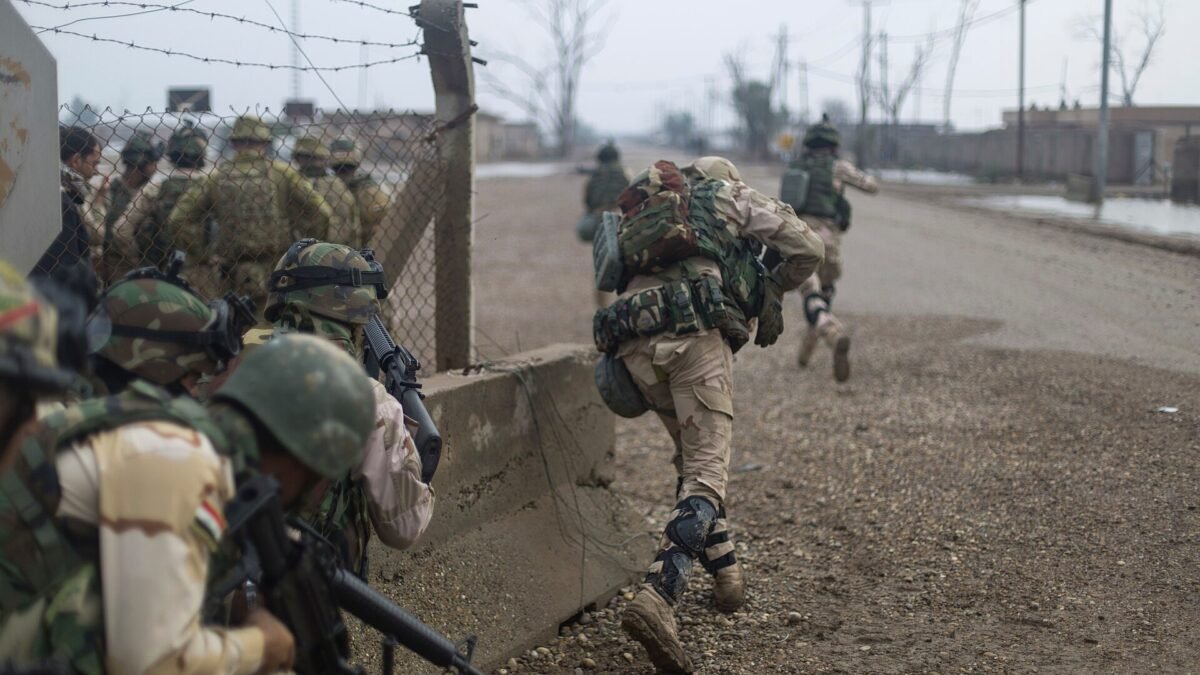
Iraqi security forces moved into Jurf al-Sakhar on Friday, taking up positions in the centre of a town that the Iraqi state has been barred from entering for about 12 years, under a compromise deal with the Iran-backed Kataib Hezbollah militia that ended a week-long standoff without the armed confrontation both sides had been preparing for.
A convoy of vehicles flying Iraqi flags made its way towards the town on Friday morning, Reuters reported from Jurf al-Sakhar, and soldiers took up positions in the centre after senior Iraqi security officials told a press conference that government forces would protect the city. Members of Kataib Hezbollah stood near their flags as the troops arrived, according to the same report, a scene that captured the uneasy bargain at the heart of the deal: the state is entering, but the militia has not left.
Prime Minister Ali al-Zaidi addressed the forces entering the town as they moved in, telling them they were “not waging war”. “Everyone present there are your brothers,” he told the troops, according to Al Jazeera, “the sons of this nation, and their blood is our blood.” He insisted, however, that his decision to restrict weapons to state control was final.
“Today is a historic moment in which the Iraqi Armed Forces prove that they are the nation’s shield, safety valve, and the guardian ensuring security stability for the Iraqi people,” Sabah al-Numan, spokesperson for the commander-in-chief of the Iraqi armed forces, told the press conference, according to Reuters.
The deployment is the first time federal forces have entered Jurf al-Sakhar, a town in Babil province about 50 kilometres south of Baghdad, since Kataib Hezbollah took full control of it after helping to recapture it from the Islamic State group more than a decade ago. Al Jazeera puts the distance at about 60 kilometres; the two figures reflect different measuring points on the road south-west from the capital, and the town’s position on the pilgrimage route to Karbala is not in dispute.
Whether the entry holds will be decided in the weeks ahead. Under the compromise sealed late on Thursday, Kataib Hezbollah’s fighters are expected to withdraw from the area to other parts of the country within a month, Al Jazeera reported, and a security headquarters will open in the town on Saturday to oversee the handover. But the militia’s leadership has not publicly confirmed that it accepts the handover in those terms, and its fighters were still standing by their flags as the army arrived. The deal defused a confrontation. It has not yet resolved it.
What the deal puts on the ground
The force entering Jurf al-Sakhar is deliberately mixed, and its composition tells its own story about the limits of what Baghdad has achieved. According to Al Jazeera, a combined force comprising an Iraqi army brigade, a Federal Police battalion and an Energy Police regiment will provide protection for the oil pipelines in the area. Two brigades from the Popular Mobilisation Forces, the state umbrella grouping that includes some Kataib Hezbollah fighters, will also participate.
That last detail matters. The Popular Mobilisation Forces, known as the PMF, were set up in 2014 to fight the Islamic State group and were subsequently recognised as an official security force, with fighters receiving state salaries. Kataib Hezbollah forms several battalions within the PMF, and some of its members, including some designated as terrorists by the United States, hold senior positions in the organisation. Technically the group is under the command of the prime minister as part of the PMF, but Reuters notes that it often operates outside the chain of command and has defied and challenged government statements calling for an end to attacks on United States forces.
Lieutenant General Ahmed Hatem Hamid said on Friday that a control headquarters had been established in Jurf al-Sakhar and that the Federal Police would control the facility, according to the Iraqi News Agency. Reuters, in a separate account of the same day, reported that the deal would include the opening of a security headquarters in the town on Saturday to oversee the handover, and that Iraq’s energy police had begun securing an oil pipeline in the area. The two accounts are consistent if read together: a control headquarters was established on Friday, with the formal security headquarters opening the following day.
The oil pipeline is the reason the town matters to Baghdad in the first place. The crisis began with an investigation into an oil-smuggling network that Iraqi officials say siphoned off hundreds of millions of dollars’ worth of state-owned oil through Jurf al-Sakhar, using tapped pipelines, small illicit refineries and tanker trucks. Iraqi media citing intelligence and ministerial findings have put the annual value of the theft at nearly two billion dollars, a far larger figure than the “hundreds of millions” cited by Reuters. The two figures are not necessarily contradictory: one is the value of oil traced to the network in the investigation, the other an estimate of the annual scale of the theft, and both are attributed in this article rather than stated as settled fact.
Nine senior security and oil officials have now been dismissed following the investigation, Reuters reported on Friday, and suspects have been referred to the judiciary. An investigative committee entered the zone on 13 November, and the prime minister held an emergency meeting the following day at which nine officials in Babil province were dismissed, including the police chief and the director of the Oil Pipelines Company.
A week that brought Iraq to the edge
The standoff unfolded at speed. On Monday, the government announced that it would take control of Jurf al-Sakhar after the probe raised suspicions that the group had stolen hundreds of millions of dollars’ worth of Iraqi oil via illicit oil refineries, and gave the group a deadline of Friday to leave the town. The announcement followed the leak of a top-secret Iraqi Interior Ministry intelligence report, dated 9 November, detailing thefts since 2021, identified through satellite imagery, in which pipelines were tapped and oil moved in tanker trucks towards Baghdad. The report did not name Kataib Hezbollah, blaming instead “one of the armed factions”, but the government’s move left no doubt about which faction it meant.
The militia’s response was defiant. Abu Ali al-Askari, a senior Kataib Hezbollah commander, told Agence France-Presse on Tuesday that a withdrawal “will never be realised”, “not even over our dead bodies”, called the prime minister “an adventurer heading toward inciting discord”, and said that “Iraq is on the cusp of a major crisis”. He blamed the United States envoy Tom Barrack for the pressure and claimed there had been understandings in September about the group’s weapons. The militia mobilised about 8,000 fighters, according to reports at the time, and the prospect of an armed clash between government forces and one of Iraq’s most powerful armed factions became real enough that senior Shi’ite political leaders intervened to broker a compromise.
The mediation was delicate and prolonged. Baghdad-based security and strategic analyst Fadel Abu Raghif told Al Jazeera that the deal came after lengthy and delicate talks with Kataib Hezbollah, following “in-depth negotiations, and after wrangling and a tug of war that lasted about two months or so”. The gravity of the situation was underlined by the arrival in Baghdad on Monday of Esmail Qaani, the commander of Iran’s Revolutionary Guards’ Quds Force, to help defuse tensions with Kataib Hezbollah, according to Iraqi Shi’ite political figures cited by Reuters. Qaani, who succeeded Qassem Soleimani after Soleimani was killed in a United States drone strike in January 2020 alongside the Kataib Hezbollah leader Abu Mahdi al-Muhandis, met the militia’s secretary general, Abu Hussein al-Hamidawi, and senior Shi’ite figures including Hadi al-Amiri. Participants in the talks called the outcome “positive” in a statement on Thursday.
The deal that emerged was a compromise in the full sense of the word. Kataib Hezbollah’s fighters would move to other areas of the country, government forces would enter the town, and a joint operations centre would open at 6am local time on Friday, with federal units moving in at the same time, according to the armed forces commander-in-chief. But the militia chief told his fighters to resume normal duties without explicitly confirming that the group would hand over control of the town, leaving the exact terms of the handover unclear. That ambiguity is the central unresolved question of the day: the state has entered Jurf al-Sakhar, but whether Kataib Hezbollah has genuinely surrendered it remains to be seen.
The prime minister’s position is also more fragile than the triumphant language of the press conference suggests. Al-Zaidi took office in May with the backing of the United States president, Donald Trump, and has been under sustained pressure from Washington to disarm the militias that have struck United States troops and facilities in Saudi Arabia and the United Arab Emirates in solidarity with Tehran since the United States and Israel launched attacks on Iran at the end of February. Trump has pressed him directly on the issue, and the pressure from Washington and its Gulf allies is understood to have driven the push on Jurf al-Sakhar, according to Al Jazeera.
Al-Zaidi’s approach has been to change the question rather than to force it. In July he gave the militias a deadline of 30 September to hand over their weapons. When that passed, he set a new deadline of June 2027 in an interview with the New York Times on 21 September, saying of disarmament: “This is not something that is optional. It is a necessity.” The language has also shifted, from “disarmament” to “organisation and management” of weapons, and the plan now in place runs on a nine-month timetable, with weapons to come under state control by 30 June 2027, a 90-day good-faith pause, and a handover beginning in January, with those who refuse to comply to be “deemed outlaws”. The Coordination Framework, the Shi’ite political alliance that underpins the government, is divided on the issue, with figures including Nouri al-Maliki, Hadi al-Amiri, Qais al-Khazali and Ammar al-Hakim mediating between the prime minister and the militias.
Jurf al-Sakhar: the town the state could not enter
To understand why the entry of a few hundred soldiers into a small town matters, it is necessary to understand what Jurf al-Sakhar has been for the past 12 years. The town, also known as Jurf al-Nasr, covers about 345 square kilometres in Babil province, on the pilgrimage route to the holy city of Karbala, and was once home to military-industrial complexes built under Saddam Hussein. The Islamic State group seized it in 2014. It was recaptured by the Popular Mobilisation Forces, and Kataib Hezbollah took full control, renamed it Jurf al-Nasr, and barred state institutions from entering.
About 140,000 residents were displaced and have been kept out for a decade, according to figures cited in the reporting on the crisis. Reporting from Babil province on Friday, Al Jazeera’s Samer Al Kobeisi said the departure of Kataib Hezbollah would allow the reopening of an area that has been closed for about 12 years, according to the government. The town also became known for illegal fish farms, run in the area’s waterways, which became a symbol of the militia’s economic control of the district.
The reopening of the town, if it happens, would therefore be about more than oil. It would be the first return of displaced families to their homes in 12 years, and the first time the Iraqi state has exercised authority in a district that has functioned as a state within a state. That is why the prime minister’s spokesman could describe Friday as a “historic moment” without obvious exaggeration, and also why the test of the deal will be measured in the weeks ahead, in whether the checkpoints are manned by the Federal Police rather than by militiamen, and whether the displaced are actually allowed to return.
Kataib Hezbollah and the state it defies
Kataib Hezbollah, whose name means the Battalions of the Party of God, was founded in the aftermath of the 2003 United States-led invasion of Iraq and quickly developed a reputation for deadly attacks against military and diplomatic targets during the counterinsurgency war and sectarian conflict of the 2000s, using snipers, rockets, mortars and roadside bombs, according to Reuters. It is among the most influential members of the Islamic Resistance in Iraq, the umbrella group of hardline Shi’ite armed organisations supported by Iran, and it is branded a terrorist group by the United States.
The group has refused to hand over its weapons to the state, and it is among those that have claimed attacks on United States forces in Gulf states since the start of the war with Iran. Iraqi security officials say the militias’ arsenals include assault rifles, machineguns, anti-tank guided missiles, mortars, precision-guided rockets, armed drones and some short-range ballistic and cruise missile capabilities. Kataib Hezbollah has its own political party, called Huquq, or Rights, with five lawmakers in parliament. An Iraqi official report said the group also generates cash through businesses such as construction, housing, trade, tourism and currency exchange, though Kataib Hezbollah denies this and says it is dedicated to security.
The group’s semi-official status is the heart of the problem. Pro-Iranian militias, including Kataib Hezbollah, enjoy a standing in Iraq that critics say encourages them to act with impunity. Fighters receive state salaries through the PMF, and members, including some designated as terrorists by the United States, hold senior positions in the organisation. The group has thousands of hardened fighters and no announced leadership structure, and it has repeatedly defied government statements calling for an end to attacks on United States forces.
The risks of confronting the group were demonstrated five years ago, when one of al-Zaidi’s predecessors ordered a similar crackdown on the armed groups and the prime minister’s Baghdad home was hit in a drone strike that the authorities described at the time as an assassination attempt. The risks of not confronting it were demonstrated in August, when Iraqi special forces reporting directly to the prime minister arrested the intelligence chief of the Iran-aligned faction Harakat al-Nujaba on accusations of involvement in drone attacks against United States interests. The detention, which lasted 48 hours, triggered threats of retaliation from the group and prompted intervention by senior Shi’ite politicians to avoid an escalation. A week later, Iraqi special forces arrested four militia members over allegations that they facilitated attacks on United States interests.
Tehran’s entrenchment in Iraq is the wider backdrop. The 2003 invasion toppled Iran’s arch-enemy, the longtime Sunni leader Saddam Hussein, and since then Tehran has steadily entrenched itself in Iraq through strong ties to dozens of heavily armed Shi’ite militias and politicians, according to Reuters. Any direct confrontation with Iran’s heavily armed militia allies in Iraq could be risky, and the compromise over Jurf al-Sakhar was designed, in the words of Reuters, to limit the reach of Iran’s most powerful Shi’ite militia ally in the country without provoking a confrontation.
The wider war next door
The Jurf al-Sakhar deal cannot be separated from the war that has been raging next door for nine months. The United States-Israeli war on Iran, which began at the end of February, has opened new fronts across the region, and the pressure on Baghdad to rein in the militias is inseparable from the pressure on Tehran.
On Friday, as Iraqi troops entered Jurf al-Sakhar, Yemen’s Iran-aligned Houthis threatened to attack Saudi Arabia’s Red Sea ports if Saudi-led coalition forces struck the strategic Red Sea port of Hodeidah. “We warn all employees, workers, and those in the vicinity of these ports to evacuate them immediately and stay away. We also urge all shipping companies to immediately evacuate their ships from these ports,” the Houthi military spokesperson Yahya Saree said in a statement carried by Reuters. The Houthis also warned airlines to avoid Saudi airspace “because it will be the scene of our operations in the coming hours”. The Saudi-led coalition had urged civilians to evacuate areas of the Hodeidah port for their safety, and Saudi air defences intercepted a Houthi ballistic missile aimed at the kingdom’s southern region on Friday, while Saudi airstrikes hit the Yemeni capital, Sanaa.
The Houthis struck the Riyadh skyscraper housing Saudi Arabia’s Public Investment Fund on Thursday, an attack already reported on this site, and the cross-border fighting between the Saudi-led coalition, which backs Yemen’s internationally recognised government, and the Houthis, who control the capital Sanaa, has intensified amid the war on Iran, according to Reuters. The Houthi threat on Friday is a conditional threat, not an attack that has happened, and it should be read as an escalation of rhetoric in a war that is already being fought, rather than as a new front opening.
The American political context matters too. On Thursday, the United States Senate voted 51 to 48 to defeat a war powers resolution that would have directed President Trump to remove United States forces from hostilities with Iran or obtain Congress’s approval, a vote reported on this site earlier today. The vote was the first on the war in either chamber since the midterm elections on 3 November, and it left the president free to continue a war that has now cost the United States more than 48 billion dollars, according to figures cited in the Senate debate. The Senate’s refusal to restrain the war is one reason the pressure on Baghdad is unlikely to ease: Washington’s strategy depends on its regional partners, including Iraq, holding their ground against Iranian influence while the war continues.
Analysis: Why It Matters
The entry is the test, not the deal
The most important thing about Friday is not that a deal was signed, but that soldiers actually entered the town and took up positions in its centre without a shot being fired. Deals in Iraq have a habit of dissolving on contact with reality, and the history of Jurf al-Sakhar is a history of agreements that were never implemented. The compromise reached on Thursday was, by the militia’s own earlier account, something its commanders had sworn would “never be realised”. The fact that it was realised, peacefully, is a genuine achievement for a prime minister who took office only in May and who has staked his authority on the proposition that the state can reassert itself without a civil war. But an entry is not a handover. The militia’s fighters were still standing by their flags as the army arrived, and the withdrawal is expected to take a month. The test will be whether, in a month’s time, the checkpoints are manned by the Federal Police and the oil pipelines are guarded by the Energy Police, or whether the same men are standing in the same places under a different flag.
Qaani’s shadow over the compromise
The presence of Esmail Qaani in Baghdad on Monday is the detail that explains the most about this deal, and it is also the detail that should temper any celebration of it. The commander of the Quds Force, the external operations arm of Iran’s Revolutionary Guards, flew in to defuse a confrontation between the Iraqi state and Iran’s most powerful militia ally in Iraq, and the deal that emerged was brokered by Shi’ite politicians with Tehran’s man in the room. That is not a criticism of the mediation; without it, there might have been a battle. But it is a reminder that the Iraqi state did not impose its will on Jurf al-Sakhar. It negotiated its return with the permission, or at least the acquiescence, of the power that has underwritten the militia for two decades. The question for the months ahead is whether Baghdad’s authority in the town rests on the state’s own strength or on Tehran’s continuing consent, and what happens to that consent if the war with Iran escalates.
The oil money is the point, not the pretext
It is tempting to read the Jurf al-Sakhar crisis as a story about sovereignty, and in part it is. But the trigger was money, and the money is the point. Hundreds of millions of dollars of state oil, by the official account, and perhaps two billion dollars a year, by the intelligence estimates cited in the Iraqi press, were being siphoned out of a single district through tapped pipelines and illicit refineries. That is not a side business. It is a parallel economy, large enough to fund a militia, pay its fighters, and buy political influence, and it is the reason the militia fought so hard to keep the town. The nine officials dismissed, the arrests, and the energy police now securing the pipeline are the practical heart of the deal. If the pipeline stays secured and the revenue flows to the state, the deal will have achieved something real. If the smuggling resumes under a new arrangement, the entry of the troops will have been theatre.
Al-Zaidi’s gamble is bigger than one town
The prime minister has now done something his predecessors either would not or could not do: he has ordered the state’s forces into the stronghold of the country’s most powerful Iran-backed militia, and he has done it without a battle. He has also done it while telling the troops they were “not waging war” and telling the militia’s men that “their blood is our blood”, a form of words that is designed to make a confrontation unnecessary by denying that one is happening. That is a gamble, and it is a large one. If the handover completes, he will have established a precedent that the state can reclaim territory from the militias by negotiation backed by a credible threat of force, and the June 2027 disarmament timetable will suddenly look achievable. If it fails, if the militia reasserts itself or the deal collapses into recriminations, he will have spent his authority on a town he could not hold, and the militias will know it. The drone strike on a predecessor’s home five years ago is a reminder of what failure can look like in Iraq.
What “not waging war” really means
The prime minister’s words to his troops deserve attention, because they reveal the strategy. “Not waging war” is not a description of the situation; it is a decision about how to describe it. By framing the entry as a deployment rather than an operation, and by insisting that the men on the other side are “your brothers”, al-Zaidi is giving Kataib Hezbollah a way to withdraw without admitting defeat, and giving himself a way to claim a victory without having fought a battle. That is how compromises work in a country where the state and the militias share soldiers, salaries, and, in some cases, families. But it is also a form of words that can be used to disguise a retreat. If the militia’s fighters are still in Jurf al-Sakhar in a month’s time, the prime minister will be able to say that no war was waged, and he will be right. The question is whether he will also be able to say that the state has returned.
What to Watch Next
- The security headquarters opening on Saturday: whether it is staffed by the Federal Police and the army, or whether Kataib Hezbollah’s men remain in control of the town in practice.
- The one-month withdrawal timetable: whether Kataib Hezbollah’s fighters actually leave Jurf al-Sakhar for other parts of the country, and where they go.
- The return of the displaced: whether the roughly 140,000 residents kept out of the town for a decade are allowed to return to their homes, and when.
- The oil pipeline: whether the Energy Police keep the pipeline secured and the smuggling network stays shut down, or whether the theft resumes.
- The militia’s own statement: whether Kataib Hezbollah publicly confirms that it accepts the handover, or continues to insist, as its commander did on Tuesday, that a withdrawal will never happen.
- The disarmament timetable: whether the nine-month plan, with weapons under state control by 30 June 2027, survives its first test, and what happens when the 90-day good-faith pause ends.
- The wider war: whether the Houthi threat to strike Saudi Red Sea ports is carried out, and whether the fighting in Yemen and the war on Iran change the calculations of Baghdad, Tehran and Washington over Iraq’s militias.
Sources
- Reuters — Iraqi security forces deploy in Iran-backed militia stronghold
- Al Jazeera (via Bahamas Spectator) — Iraqi forces deploy to Jurf al-Sakhar after deal with Iran-backed group
- WireMinute — Baghdad and Kataib Hezbollah Reach Deal as Federal Troops Prepare to Enter Militia Stronghold
- Institute for the Study of War — Iran Update, November 19, 2026
- Reuters — Yemen’s Houthis threaten to strike Saudi Red Sea ports
- Reuters — Saudi-led coalition says it intercepted Houthi missile targeting southern region

About the Author — Abdul Mannan
Related Articles
US Senate Rejects Bid to End Iran War in 51-48 Vote, Handing Trump a Symbolic Victory After Midterm Rebuke
The Senate voted 51-48 on Thursday to defeat a House-passed war powers resolution, the first vote on the…
Israel Launches First Gaza Ground Operation Since Ceasefire as Tanks Cross the Yellow Line
Israeli tanks crossed the Yellow Line in central Gaza on Wednesday in the first ground operation beyond the…
Trump’s Board of Peace Warns Gaza Ceasefire Could Collapse as Israel and Hamas Both Fail to Honour Deal
The Board of Peace has warned the UN Security Council that the Gaza ceasefire could collapse, accusing both…