
Khawaja Asif Backs Redrawing Pakistan Into 12 Provinces as Debate Over 28th Amendment Gathers Pace

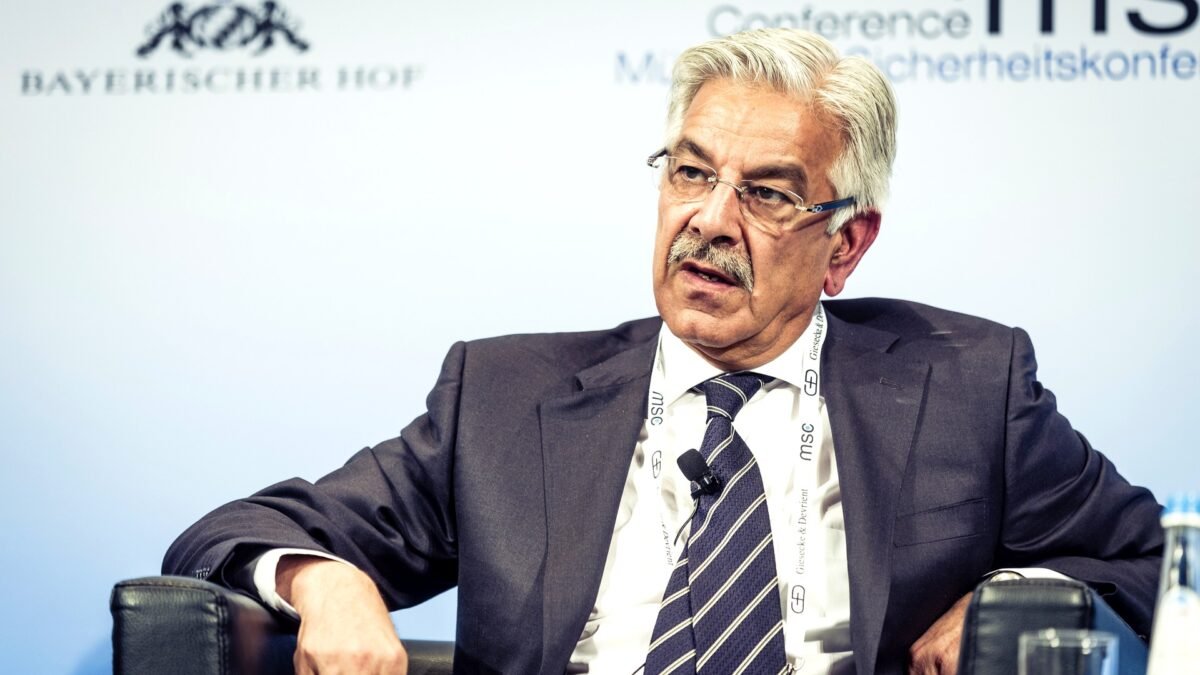
Pakistan’s Defence Minister Khawaja Asif has publicly backed redrawing the country’s map into as many as 12 provinces, giving the most senior government endorsement yet to a proposal that would amount to the biggest reorganisation of the Pakistani state since the 1970s. Speaking to Geo News in his home city of Sialkot on Sunday, Asif said new provinces should be created on administrative grounds rather than on the basis of language, ethnicity or political interest, and revealed that the idea has been under discussion inside government circles for the past two months, according to The News.
“If there is a proposal for 12 provinces, then make it 12, but they should not be created on the basis of language, ethnicity or political interests,” Asif said in the interview, as reported by The News.
His remarks come amid reports that a proposal to reorganise Pakistan into 12 provinces is under active consideration, with a nationwide referendum envisaged ahead of a possible 28th Constitutional Amendment. According to a report published in The News, the proposed arrangement could see Punjab divided into four provinces, Khyber Pakhtunkhwa and Balochistan into three each, and Sindh into two. Sources familiar with the proposal told the newspaper that the amendment could be considered in the first half of 2027, with preparatory steps potentially beginning in the first quarter of the year. The same report stressed, however, that the proposal remains under consideration and that no final decision has been taken on provincial boundaries, administrative structures or the constitutional process.
Asif’s intervention matters because of who he is and where he sits. He is one of the most senior figures in Prime Minister Shehbaz Sharif’s cabinet, a veteran parliamentarian from Sialkot, and a minister whose word carries weight across the ruling Pakistan Muslim League-Nawaz (PML-N). When a defence minister speaks about redrawing provincial boundaries, it is not a backbencher’s musing. It is a signal that the idea has travelled from seminar rooms and television studios into the rooms where decisions are made.
The timing matters too. The debate over new provinces has been building for months, but it has now reached the point where senior ministers are openly arguing about it, disagreeing with each other in public, and accusing coalition partners of double standards. That is how big constitutional changes begin in Pakistan: not with a bill, but with a public argument.
What Asif actually said
Asif’s case, as reported by The News and Pakistan Point, rests on a simple argument: Pakistan has outgrown its four-province structure. The country’s population has passed 240 million, according to the 2023 census, and Punjab alone is home to more than 127 million people — larger than most countries on earth. Asif argued that a growing population requires a more effective system of governance to ensure the provision of public services, and that power should not remain concentrated in the provincial capitals of Lahore, Karachi, Quetta and Peshawar.
He called instead for administrative powers to be transferred to smaller units, and he turned his criticism on the way money flows through the federation. Funds transferred from the Centre, he said, remained at the discretion of provincial governments, even though those funds were ultimately intended for local government institutions — institutions that themselves remained dependent on provincial authorities. In other words, the money meant for towns and districts stops in the provincial capitals, and the people it was meant for never see it.
He also aimed a remark at his own class. “We politicians want to exercise all the power ourselves,” he said, adding that political leaders must recognise that power was a trust bestowed upon them by the people. It was an unusually blunt admission from a serving minister: that the concentration of power is not an accident of history but a habit of politicians, and that breaking it will require politicians to give power away.
Reaching for history, Asif recalled that Pakistan’s provinces had previously been merged under the One Unit scheme before the decision was reversed, and he cited Afghanistan as an example of administrative restructuring, saying its provinces had been increased from around eight or ten to more than 30. The comparisons were doing deliberate work. The One Unit reference reminded his audience that Pakistan has redrawn its internal map before — and survived. The Afghanistan example suggested that more, smaller units are a normal feature of modern administration rather than a radical experiment.
Pakistan Point, reporting the same interview, added that Asif said the proposal concerning the formation of provinces has been under discussion for the past two months, with views being shared from different parts of the country. That two-month timeline is significant. It places the start of serious internal discussion in early September 2026 — around the same time that other senior figures began raising the subject in public.
The 12-province map taking shape
The most concrete version of the proposal now in circulation is the one reported by The News: twelve provinces carved out of the existing four. Punjab, by far the largest province, would be split into four. Khyber Pakhtunkhwa and Balochistan would each become three. Sindh would be divided into two. The arithmetic is neat, but the politics behind each split is anything but.
Punjab’s division has been debated for decades. The southern region, often called Saraiki Wasaib, has long demanded its own province, arguing that Lahore absorbs the province’s resources while the south remains underdeveloped. That demand has cross-party support in principle — the PPP, the PML-N and the PTI have all at various points endorsed a Saraiki province — but it has never survived contact with the politics of actually drawing a boundary. A four-way split of Punjab would go far beyond the Saraiki demand, creating new provinces in the north and centre as well, and would raise immediate questions about the division of the province’s bureaucracy, its police, its courts and its share of federal revenue.
Sindh’s division into two is more explosive still. Any proposal to split Sindh revives the spectre of the demand for a separate urban province centred on Karachi, and of the counter-charge — voiced by Sindhi nationalists — that dividing Sindh is a step towards dismembering it. That sensitivity explains why Asif, in a follow-up post on X reported by Independent News Pakistan (INP), accused the Pakistan Peoples Party of a “double standard” on the issue. The PPP, he said, backs a Saraiki province in Punjab but raises the issue of Sindhudesh — the separatist idea of an independent Sindh — whenever broader administrative restructuring is discussed. “But when there is talk of multiple provinces or administrative units instead of four, the talk of Sindhudesh begins,” Asif said, adding that he believed there was “something else” behind what he described as the PPP’s contradictory position.
Khyber Pakhtunkhwa’s division into three would land in a province already under extraordinary strain. The province has been under governor’s rule and a state of emergency since 11 October 2026, when President Asif Ali Zardari suspended the provincial government led by the Pakistan Tehreek-e-Insaf (PTI) under Articles 232 and 234 of the Constitution. Its elected chief minister, Sohail Afridi, and several cabinet members were taken into preventive custody the same day. Any redrawing of KP’s map would therefore take place in a province whose elected government is currently suspended — a fact that would hand critics an easy argument that the federation is rearranging a province it has already taken over.
Balochistan’s division into three raises different questions. It is Pakistan’s largest province by area and its smallest by population, and its politics are dominated by questions of resources, representation and insurgency. Splitting it might bring administration closer to remote districts, but it would also multiply the number of provincial governments in a province where the state already struggles to project authority across vast distances.
None of these boundaries has been finalised. The News was careful to report that no final decision has been taken on boundaries, structures or process. But the fact that a map with specific numbers — four, three, three, two — is circulating in the press suggests that the conversation has moved beyond the abstract. Somebody, somewhere, has drawn lines.
The PPP row and the devolution argument
Asif’s accusation against the PPP, made in a post on X, opened a second front in the debate. He said he would explain what he believed lay behind the PPP’s position “at some point”, while stressing that “we are Pakistanis, first and last”. The remark was pointed: it suggested that the PPP’s resistance to dividing Sindh is not a matter of principle but of political calculation, and it challenged the party to say openly what it fears.
But Asif’s post contained more than a political jab. He also called for genuine implementation of devolution under the 18th Constitutional Amendment, saying the principle had been established constitutionally but had not been respected in practice. He said the current system had become outdated because of the concentration of powers and argued that authority needed to be transferred to lower levels so that democracy could take root at the grassroots and people could benefit from it.
That is an important distinction, and it may turn out to be the most consequential part of his intervention. Asif suggested that Pakistan could use its existing 36 divisions as the basis for a new administrative arrangement, or develop another geographical structure, and he argued that the devolution of power was “inevitable”. He called for fundamental reforms and said the country needed to move towards administrative units, whether they were called provinces or something else. Interior Minister Mohsin Naqvi has made a similar argument, saying powers should be devolved to lower administrative levels and provinces divided on administrative grounds to improve governance and speed up development.
This framing matters because it offers an escape route from the hardest constitutional problem. Creating new provinces requires amending the Constitution, and that requires two-thirds majorities in the provincial assemblies concerned and in both houses of Parliament. Devolving power to divisions or districts, by contrast, can in large part be done through ordinary legislation and administrative orders. If the government cannot muster the numbers for a 28th Amendment, it could still claim to have delivered the substance of the reform — smaller units, power closer to the people — without the constitutional surgery. Whether that would satisfy the reformers or merely rebrand the status quo is a question the coming months will answer.
How the debate got here
The argument over new provinces did not begin with Khawaja Asif. It began, in its current form, on 30 July 2026, when Interior Minister Mohsin Naqvi argued that Pakistan’s existing governance structure was no longer working. A day later, Lieutenant General Ahmed Sharif Chaudhry, the military’s public relations chief, called for a serious debate on the subject. The involvement of the military’s spokesman gave the debate a weight it would not otherwise have had, and it ensured that the discussion could not be dismissed as a distraction.
In September, Federal Planning and Development Minister Ahsan Iqbal took the argument further, calling for a formal debate on creating new provinces and proposing that Prime Minister Shehbaz Sharif set up a committee to examine the country’s administrative structure. “I would say we need 12-15 new provinces,” Iqbal said, according to The News. He argued that Pakistan’s four provinces had become increasingly centralised and monopolistic over the years, contributing to a breakdown in the delivery of social services such as health and education.
But the government’s own spokesmen were quick to pour cold water on the idea. Rana Ihsaan Afzal Khan, coordinator to the prime minister, told The News that no decision had been taken on creating new provinces or administrative units. “No such committee has been made at the federal level. There is no such talk on any forum officially,” he said. Other officials said there was no formal federal process underway. The gap between what ministers were saying in public and what the prime minister’s office was saying officially became the debate’s defining feature: enthusiasm from individual ministers, caution from the centre.
Asif himself added to the debate last month, when he proposed handing Karachi in Sindh and Gwadar in Balochistan to the federation rather than making them separate provinces. That proposal, reported by The News, would primarily benefit the federal government financially, since the taxes collected from those territories — especially Karachi — would go directly into the federal pool. Critics noted that it would do little to address governance at the municipal level, which is where Karachi’s problems actually live. Umair Javed, who teaches politics and sociology at the Lahore University of Management Sciences, told The News that the proposal “seems completely senseless” as a governance reform, because “the federal government does not have the mandate or the capacity to improve governance at a municipal level”. The same objection applies, in different forms, to every version of the restructuring debate: redrawing boundaries does not, by itself, fix the institutions that operate inside them.
The backdrop to all of this is a year of extraordinary constitutional change. The 27th Constitutional Amendment, signed into law in November 2025, rewrote 48 articles of the Constitution, created a new Federal Constitutional Court above the Supreme Court, and prompted the resignations of two of the country’s most senior judges, Justices Mansoor Ali Shah and Athar Minallah, who called it an assault on judicial independence. The government that passed that amendment with two-thirds majorities in both houses has shown that it can move constitutional mountains when it chooses to. The question now is whether the same coalition can be assembled for a 28th Amendment — and whether the PPP, whose votes would be essential, can be brought along.
There is also the question of timing. Sources cited by The News said the amendment could be considered in the first half of 2027, with preparatory steps potentially beginning in the first quarter. That timetable would place the debate squarely in the run-up to the next general election cycle, when every party will be calculating how new provinces affect its seats, its vote banks and its bargaining power. A referendum, which the reports say is envisaged ahead of any amendment, would add a further layer of politics: a national vote on restructuring would become, in effect, a vote on the government itself.
Analysis: Why It Matters
The governance case is real — and it is not new
Strip away the politics, and the argument for smaller provinces is straightforward. Pakistan is a country of more than 240 million people governed through four provinces, two autonomous territories and one federal capital territory. Punjab alone has more people than all but a handful of countries. A single chief minister in Lahore is expected to oversee the schooling, health care, policing and infrastructure of 127 million people across a territory larger than many European states. It is, on its face, an impossible job, and the results show it: southern Punjab lags the centre on nearly every development indicator, rural Sindh lags Karachi, and the peripheries of every province lag their capitals.
This is not a new observation. The demand for a Saraiki province is decades old. The demand for a Hazara province in Khyber Pakhtunkhwa is older still. The Bahawalpur province movement traces its roots to the princely state that was merged into Pakistan in the 1950s. What is new is that the argument is now being made by the government itself, in the language of administrative efficiency rather than ethnic identity. Asif’s insistence that new units must not be created “on the basis of language, ethnicity or political interests” is an attempt to detoxify a debate that has always been entangled with identity — and it is, at the same time, a recognition that the identity version of the debate is the one that frightens people.
But the governance case has a weakness that its advocates rarely confront. Pakistan’s problem is not only that its provinces are too big; it is that power within them is hoarded. The 18th Amendment devolved vast powers from the federal government to the provinces in 2010, but the provinces never passed those powers down to local governments. Elected local bodies have been suspended, dissolved or starved of funds for most of the past fifteen years. Asif himself acknowledged this when he called for genuine implementation of the 18th Amendment’s devolution. The uncomfortable implication is that the reform Pakistan needs most — functioning local government — does not require redrawing the map at all. It requires provincial governments to surrender power they have held for a decade and a half. New provinces might help. But they might also simply create more capitals in which power can be hoarded.
The constitutional mountain is the real test
Creating a new province in Pakistan is one of the hardest things the Constitution allows. Changing provincial boundaries requires the approval of two-thirds of the provincial assembly concerned, followed by two-thirds majorities in both the National Assembly and the Senate. A referendum, according to the reports, can follow only after the required parliamentary steps. Each of those thresholds is a veto point, and each veto point is controlled by people with reasons to say no.
The PPP’s position illustrates the problem. The party governs Sindh, and any division of Sindh requires the assent of the Sindh Assembly, which the PPP controls. Asif’s public accusation of a “double standard” is best read as pressure: an attempt to make the PPP’s resistance politically costly before formal negotiations begin. But pressure cuts both ways. The PPP’s votes were essential to the 27th Amendment, and they will be essential to any 28th Amendment. A party that feels publicly cornered may simply dig in. The history of constitutional amendments in Pakistan suggests that they succeed when they are negotiated quietly and fail when they are litigated in public.
There is also the arithmetic of the Senate, where smaller provinces would eventually gain representation, and the National Assembly, where the reallocation of seats would shift the balance of power between Punjab and the rest of the country. Punjab currently holds the largest bloc of National Assembly seats, and any division of Punjab would change the internal politics of the PML-N itself, whose base is Punjabi. A party that proposes to divide its own heartland is either extraordinarily confident or extraordinarily divided. Which of those the PML-N is will become clear in the coming months.
The ethnic tripwire
Asif’s insistence that new provinces must not be based on language or ethnicity is the most revealing sentence in the whole debate. It is an admission that the debate cannot escape identity, and a promise that the government will try to keep it from doing so. The promise is easier to make than to keep.
Every proposed division in Pakistan maps, however roughly, onto an ethnic or linguistic community. A Saraiki province is a Saraiki demand. A Hazara province is a Hindko-speaking demand. Dividing Sindh touches the deepest nerve in Pakistani politics: the relationship between Sindhi-speaking rural Sindh and Urdu-speaking urban Karachi, and the unresolved history of the province’s demographic transformation. The word “Sindhudesh” does not enter a debate by accident. It enters because the fear that Pakistan might be divided along ethnic lines is the oldest fear in the country’s politics, older than the 1971 secession of Bangladesh and sharpened by it.
Asif’s answer — that the divisions should be administrative, based on the existing 36 divisions or some other geographical structure — is technically coherent. Divisions are administrative artifacts, drawn by bureaucrats rather than by history. But administrative lines drawn on a map do not stay administrative for long. The moment a new province gets an assembly, a budget and a chief minister, it acquires a political identity, and that identity will be built from whatever language, history and grievance is available. The government can choose the lines. It cannot choose what people make of them.
What the timing tells us
The proposed timetable — preparatory steps in the first quarter of 2027, consideration in the first half of the year — suggests that the government wants the debate to run through the first half of next year without necessarily reaching a conclusion. That may be deliberate. A debate about restructuring is useful to a government even if it never produces a bill: it signals reformist intent, it keeps the opposition talking about the government’s agenda rather than its record, and it gives coalition partners something to argue about other than the distribution of power in the present.
But there is a risk. Constitutional debates in Pakistan have a habit of escaping their authors. The 27th Amendment began as a technical adjustment to the judicial structure and ended with two Supreme Court judges resigning and the creation of an entirely new apex court. A debate about provinces could follow the same trajectory, mobilising forces — provincial nationalists, ethnic movements, opposition parties looking for a cause — that the government cannot control. The fact that the debate is now being conducted through X posts and television interviews rather than through a white paper or a parliamentary committee suggests that nobody is fully in control of it yet.
There is also the question of what else is happening while this debate runs. Khyber Pakhtunkhwa remains under governor’s rule. The PTI’s long march, which began on 4 October, ended in the suspension of an elected provincial government. The Peshawar High Court has removed petitions against the KP emergency from its cause list. In that context, a debate about redrawing provincial boundaries is not an abstract exercise in administrative science. It is a debate about who governs Pakistan’s provinces, and on what terms — and it is taking place while one province is already being governed from Islamabad.
What to Watch Next
- The Prime Minister’s position: Shehbaz Sharif has not yet spoken on the 12-province proposal. Until he does, Asif’s remarks remain the view of a senior minister, not government policy. Watch for any statement from the Prime Minister’s Office, and for whether a committee — the one Ahsan Iqbal proposed — is actually formed.
- The PPP’s formal response: Asif’s “double standard” charge demands an answer. Watch for a statement from the PPP leadership, and for whether the party links its position on new provinces to its support for the government on other legislation. The PPP’s votes will decide whether a 28th Amendment is even possible.
- The 28th Amendment’s shape: If preparatory work begins in the first quarter of 2027, as sources suggest, the first sign will be the circulation of a draft or a white paper. Watch for whether the proposal remains at 12 provinces, and whether the referendum idea survives contact with the Election Commission and the courts.
- The provincial assemblies: Any change requires two-thirds majorities in the assemblies concerned. Watch for resolutions or debates in the Punjab, Sindh, KP and Balochistan assemblies — and for whether the assemblies assert their right to be consulted before Islamabad decides.
- Khyber Pakhtunkhwa: The province is under governor’s rule until at least April 2027. Watch for whether the federal government uses that window to advance restructuring in KP, and for how the PTI — whose government was suspended — responds to a debate about dividing a province it still claims to govern.
- The courts: The 27th Amendment created a Federal Constitutional Court that now hears constitutional matters. Any challenge to a restructuring amendment would land there. Watch for petitions, and for whether the new court treats provincial boundaries as a justiciable question.
Sources
- The News — “Defence minister supports establishing new provinces on administrative grounds” (8 November 2026)
- Pakistan Point — “Pakistan Should Also Create New Administrative Units: Khawaja Asif” (8 November 2026)
- Independent News Pakistan — “Khawaja Asif accuses PPP of ‘double standard’ as debate over new provinces intensifies”
- The News — “Ahsan Iqbal proposes 12 to 15 new provinces, asks PM to set up committee for debate”
- Particle News — “Defence Minister Backs Consideration of Redrawing Pakistan Into 12 Provinces” (8 November 2026)
- The News — “PM Shehbaz renews talks offer to PTI, urges end to Islamabad march” (6 October 2026)

About the Author — Abdul Mannan
Related Articles
Pakistan Unveils New Auto Policy Promising Cheaper Cars, $6 Billion in Exports and a Big Electric-Vehicle Push
The government says car prices will fall gradually, advance payments will be capped at 20 per cent and…
PTI Urges Supreme Court to Enforce Hospital Order for Imran Khan as Health Fears Mount
PTI chairman Barrister Gohar Ali Khan says reports about Imran Khan's health in Adiala Jail are 'not encouraging'…
Pakistan to End Government Cheque Payments on 15 November as PM Shehbaz Orders Roadmap for a Fully Digital Economy
Cheques under the Asaan Assignment Account stop on 15 November and Raast takes over on 16 November, as…