
Kremlin Says Russia Will Resume Three-Way Ukraine Peace Talks in November After Witkoff Meets Putin in St Petersburg

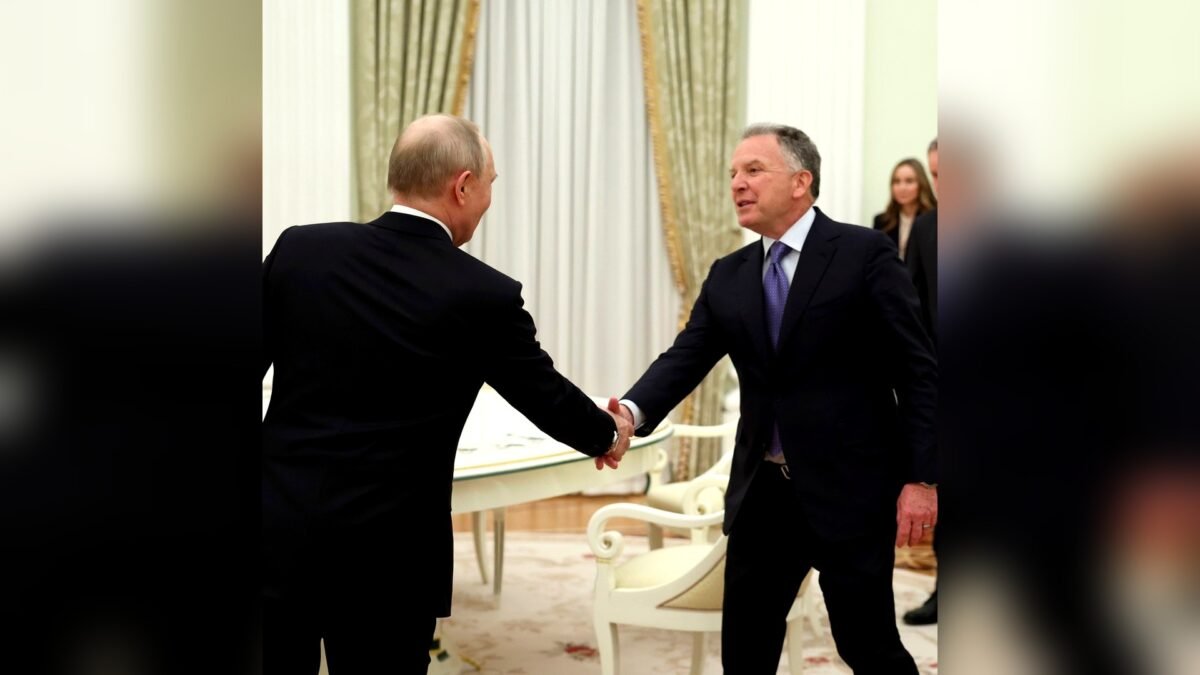
Russia is prepared to return to three-way peace talks with the United States and Ukraine after 10 November, the Kremlin has said, following a three-hour meeting between President Vladimir Putin and Donald Trump’s special envoy Steve Witkoff in St Petersburg — the first concrete signal in months that the stalled negotiation track may be revived.
Kremlin aide Yuri Ushakov told reporters after Wednesday’s talks that Moscow was “ready in principle” to resume the trilateral format, and that the next round could be held in Abu Dhabi, according to CNN. He added that the discussions would focus on building a “security framework” for Russia and Ukraine once the war ends, without offering further detail on what Russia would demand as part of such an arrangement.
The meeting, at the grand Constantine Palace in St Petersburg, was the ninth time Witkoff has met Putin in person, according to Reuters. It came a day after Witkoff’s summit with Ukrainian President Volodymyr Zelensky in Oslo, where he was joined by the leaders of Norway and Finland as well as European officials. A US official told the BBC the technical-level trilateral meeting had been proposed by Witkoff and Trump’s son-in-law Jared Kushner, and accepted by Ukraine in Oslo and by Russia in St Petersburg, according to reporting cited by the Geneva Times.
Witkoff described both sessions as “constructive” in a post on X after the St Petersburg meeting, writing that the discussions would continue with the trilateral talks. “While there is still important work left to do, President Trump remains committed to seeing this war end and achieving a comprehensive, durable peace,” he wrote, according to CNN. A readout from a US official confirmed the meeting took place and said it was aimed at advancing Mr Trump’s efforts to end Russia’s war in Ukraine.
The announcement marks the most significant movement in the US-led diplomatic track since the talks were suspended in February. Three rounds of negotiations had been held earlier this year — twice in Abu Dhabi in January and February, followed by further talks in Geneva — but, as the Press Association reported, little progress was registered beyond exchanges of prisoners of war, with Moscow and Kyiv sticking to their basic demands. The Kremlin blamed the suspension on what it called “massive” Ukrainian strikes on Russia during its parliamentary elections.
A goodwill gesture and a contentious compliment
The St Petersburg encounter opened with a gesture. Russia released Stephen Hubbard, a 74-year-old retired schoolteacher from Michigan who had been detained in Russia for more than four years on charges of fighting as a mercenary in Ukraine, according to Reuters and The Times. President Trump has said the release required no exchange, and it was widely read as a goodwill signal ahead of the substantive talks.
But the diplomacy also produced an awkward moment. Witkoff praised Putin as a “humanitarian” at the start of the meeting, telling him: “You talk so much about Trump being a humanitarian, you are a humanitarian also, sir. I salute you, and I commend you,” according to The Times. The remark drew sharp criticism from Republican supporters of Ukraine in Washington. Senator Thom Tillis of North Carolina posted on X: “WTF, Steve? Look up the definition of ‘humanitarian’. What an embarrassing and outrageous thing to say,” while Senator John Cornyn of Texas wrote simply: “No. Putin is stone cold killer.”
As Witkoff spoke, The Times reported, Russia was continuing its air strikes on Ukrainian cities, killing at least four people — a reminder that the diplomacy and the fighting are proceeding on parallel tracks, each complicating the other.
Kyiv’s response: scepticism with a deadline
President Zelensky, for his part, has welcomed the prospect of talks while questioning their durability. He said on Wednesday that he would like the meeting to happen “no later than the beginning of November,” according to CNN — earlier than Moscow’s proposed date. “Russia said many times it is ready for a meeting and then things changed and got cancelled,” he added. “Let’s see what happens this time.”
In an interview with Fox News earlier in the week, Zelensky said he would accept a ceasefire that freezes the conflict along the current front lines and supported the trilateral talks, provided Ukraine receives strong security guarantees. That position was the backdrop to Tuesday’s Oslo meeting, which US officials described as “productive” and as having made “meaningful progress,” with Ukraine bringing new ideas and proposals to the table, according to Reuters.
The Kremlin’s account of Oslo was less enthusiastic. Ushakov told reporters that Witkoff had briefed Putin on “some new aspects” in the approaches of the Europeans and Kyiv, but that there was not “much substance” in them. The proposals from the Oslo meeting “contained little of real value in the context of resolving the Ukrainian crisis,” he said, according to the Press Association — though he later told Russian state television that Moscow was not “fully satisfied” with the ideas, they were a step in the right direction.
Why the talks stopped — and why they might restart
The trilateral format has a short and mostly fruitless history. The rounds in Abu Dhabi and Geneva earlier this year produced prisoner exchanges but no movement on the core issues, and the channel has been dormant since February, with Moscow for months refusing talks while, as the Geneva Times reported, it believed it was winning on the battlefield and Ukraine faced an acute shortage of interceptors against Russian missile attacks.
Several factors appear to have shifted the calculation. The United States has been visibly pressing both sides: Witkoff and Kushner have shuttled between capitals, and Mr Trump has publicly urged Kyiv to make a deal. Financial markets rose on the news of Wednesday’s meeting, with US equities printing a sharp midday rally as investors priced in the possibility of a ceasefire, according to market reporting — a signal that the diplomatic track now carries real weight in the world’s largest economy.
Moscow’s own conditions, however, are unchanged. According to reporting on the Kremlin’s position, Russia has not indicated any willingness to abandon its core demands: Ukrainian territorial concessions, restrictions on Ukraine’s military, and limits on Kyiv’s relationship with NATO. Zelensky, meanwhile, has insisted that only a summit of leaders can break the impasse, and the two armies remain locked on the battlefield, pummelling each other with daily long-range strikes, as the Press Association noted.
Analysis: Why It Matters
“In principle” is the phrase that does the heavy lifting
The Kremlin did not say Russia will resume talks; it said it was ready “in principle” to do so. That qualifier is doing enormous work. It preserves Moscow’s option to walk away — as it has before — while harvesting the diplomatic credit of appearing constructive. Zelensky’s weary “let’s see what happens this time” is not posturing; it is a record of experience. Announced talks that later evaporate are a recurring feature of this war’s diplomacy, and every cancellation teaches both sides to price the next announcement accordingly. The test is not the press conference; it is whether a date is fixed, delegations are named, and the two sides actually sit down in Abu Dhabi.
The security framework is where the war’s hardest questions live
Ushakov said the talks would focus on a post-war “security framework” for both countries — and that is precisely where every previous round has foundered. A framework for Ukraine means security guarantees with teeth; a framework for Russia means, in Moscow’s telling, constraints on Ukraine’s military and its Western orientation. These are not two halves of the same sentence; they are mutually exclusive demands dressed in the same vocabulary. The technical-level format, however, is a sensible way to start: it keeps the stakes low, the delegations small, and the exits unembarrassed. Working groups can talk about guarantees and monitoring without leaders having to concede anything on camera. If the technical track survives its first session, that alone would be more progress than the February round achieved.
Abu Dhabi again: neutrality with a track record
The choice of Abu Dhabi is deliberate rather than decorative. The Emirates hosted two of the three earlier rounds, and the UAE has cultivated a role as a broker acceptable to both Moscow and Kyiv — close enough to the West to matter, independent enough to be trusted with the logistics of prisoner swaps. Returning there signals continuity rather than reinvention: the parties are not starting over, they are resuming. That matters because it implies the earlier rounds’ working papers still exist and can be dusted off. The downside is obvious: the earlier rounds also produced nothing. A venue that hosts failure twice invites the question of what is different this time — and the honest answer is the American pressure, not the location.
Witkoff’s “humanitarian” moment has a domestic price
The backlash from Tillis and Cornyn is worth more attention than the flattery that caused it. Witkoff’s style — effusive, personal, dealmaker-to-dealmaker — has carried this process further than the formal channels did, and his ninth meeting with Putin suggests a genuine working relationship. But the “humanitarian” compliment, delivered while Russian missiles were killing civilians, handed Kyiv’s supporters in Congress a vivid exhibit for their argument that American diplomacy is going soft on Moscow. The State Department and the White House will now spend days managing that fallout. The practical risk is narrower but real: if Ukraine’s American backers conclude that the envoy has internalised Moscow’s framing, their willingness to fund the guarantees Zelensky says he needs could harden. Diplomacy’s theatre has a budget, and compliments are drawn from it.
The gap that remains: guarantees versus territory
Strip away the choreography and the negotiation is still the same one it has always been. Kyiv will freeze the fighting where it stands if someone credible guarantees that the freeze holds; Moscow will end the fighting if the map is redrawn and Ukraine’s military is capped. Between a front-line freeze and territorial concessions lies the entire war. Zelensky’s demand for a leaders’ summit reflects his belief that only Putin can close that gap — no aide, however senior, can concede territory. Putin’s preference for technical talks reflects the opposite calculation: keep the process alive at a level where nothing irreversible can be agreed. The November date, if it holds, will show which theory is closer to reality.
What to Watch Next
- A confirmed date and delegation list for Abu Dhabi. “After November 10” and “possibly in Abu Dhabi” are still not a meeting. Watch for named negotiators and a fixed calendar.
- Whether Zelensky’s timeline is met. He wants talks “no later than the beginning of November” — Moscow’s “after the 10th” already misses that. The gap itself is a data point.
- The content of the “security framework.” If technical talks begin, the first papers on guarantees and force limitations will reveal whether either side has moved.
- The battlefield during the waiting period. Strikes continued through the St Petersburg meeting. Any pause in long-range attacks would be a stronger signal than any briefing.
- The leaders’ summit question. Zelensky insists only a Putin meeting can break the impasse. Watch whether Washington starts pushing for one — or keeps the process deliberately at technical level.
Sources
- CNN: Russia willing to resume trilateral peace talks in November, Kremlin says after Witkoff meeting
- Reuters: Putin agrees to resume US-mediated Ukraine peace talks in November
- The Times: Trump envoy thanks ‘humanitarian’ Putin after US teacher’s release
- Press Association: Putin agrees to resume talks on Ukraine war with Kyiv and Washington

About the Author — Abdul Mannan
Related Articles
Russia Frees Detained American Teacher Stephen Hubbard as Witkoff Holds Ukraine Talks with Putin
Russia freed 74-year-old American teacher Stephen Hubbard after four years in Russian custody, with Vladimir Putin announcing the…
Indonesia Erupts in Protest as Wildfire Haze Chokes Southeast Asia
Nationwide student protests erupt on President Prabowo's second anniversary as wildfires and toxic haze choke Southeast Asia in…
Georgian Court Begins Hearings on Bid to Ban Five Main Opposition Parties
Georgia's Constitutional Court in Batumi has begun three days of hearings on a ruling-party lawsuit seeking to outlaw…