
Mars’ Giant Valles Marineris Canyon Is Still Tectonically Active Today, Scientists Find

The Finding
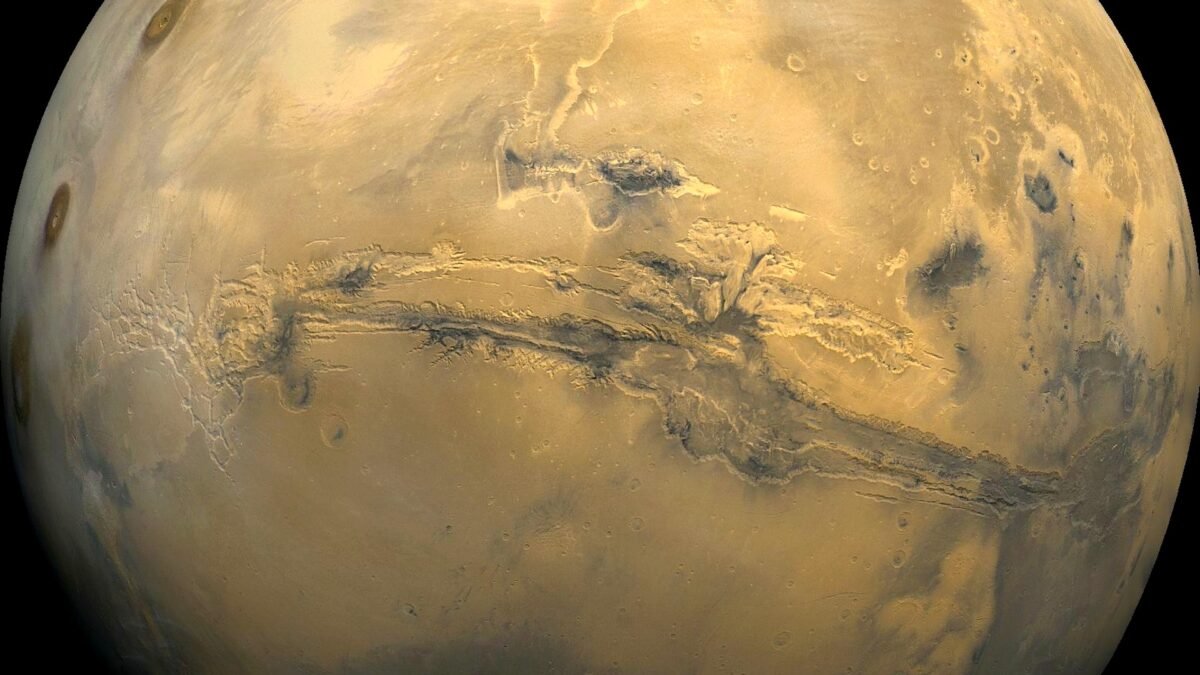
Scientists have found direct seismic evidence that Valles Marineris — the largest canyon system in the solar system — is still tectonically active today, billions of years after it first formed. The result, published in the peer-reviewed journal Nature Communications, comes from a new analysis of a marsquake recorded by NASA’s now-retired InSight lander in August 2021, and it overturns the long-standing picture of Mars as a geologically dead world.
The quake, catalogued as S0976a, was detected on 25 August 2021, the 976th Martian day — or sol — of InSight’s mission. It was unusual in almost every respect. It originated on the opposite side of the planet from the lander, roughly 146 degrees away, making it the only marsquake ever detected in Mars’s western hemisphere, according to independent science reporting on the study. Its seismic waves travelled clean through the planet’s core before reaching InSight’s lone seismometer — a journey that first helped researchers probe the deepest parts of Mars and is now revealing what happened at the quake’s source.
The new study, led by postdoctoral researcher Jung-Hun Song of Imperial College London’s Department of Earth Science and Engineering, concludes that S0976a was caused by rocks sliding sideways along a steep, deeply rooted fault roughly 20 to 40 kilometres beneath western Valles Marineris, near a stretch of the canyon known as Ius Chasma. In the language of seismology, it was a strike-slip event: two blocks of crust grinding horizontally past one another, the same style of faulting responsible for California’s San Andreas earthquakes.
“Valles Marineris is one of the most spectacular geological structures anywhere in the solar system, but until now we didn’t know for certain that its faults are still active,” Song said, according to Columbia University’s announcement of the research. “What we see is that this is not just a ‘dead’ fossil landscape, as faults deep beneath the canyon can still slip and generate marsquakes, long after the geological processes that originally formed them have ceased.”
Reading a Quake From Half a Planet Away
Determining what caused S0976a was a formidable technical challenge. InSight operated a single seismic station, whereas on Earth seismologists locate and characterise earthquakes using networks of instruments spread across continents. With only one ear pressed to the ground, Song’s team had to extract far more information from each recorded wave than a terrestrial analysis would require.
The breakthrough came from waves that had bounced off the Martian surface before reaching the lander — reflected phases known as PP and SS waves. Because these waves arrive from different angles than direct ones, they sample the quake’s radiation pattern the way several widely spaced stations would, allowing the researchers to reconstruct the type of motion at the source. By jointly inverting the P and S phases and testing thousands of possible fault orientations, depths and crustal models, the team found that more than four in five of the acceptable solutions pointed to strike-slip faulting on a steeply dipping fault, according to the paper.
The team then stress-tested every plausible alternative. On Mars, a seismic signal does not automatically mean that a fault has ruptured: meteoroid impacts, landslides and other forms of mass movement can all send vibrations through the crust. The researchers modelled those scenarios and found that none could reproduce the observed waveforms. They also examined satellite images of the likely source region taken after the event and found no fresh impact crater or large new landslide that could account for the signal.
“What makes the result compelling is that several completely different types of evidence point in the same direction,” Song said. “The seismic waves tell us that there was a sideways sliding motion on a fault well below the surface, while the geology seen from orbit shows a region crossed by long-lived fault systems.”
The quake had been noticed before. An earlier analysis published in 2022 had located S0976a — a magnitude 4.2 event, one of the two largest marsquakes ever recorded — in the vicinity of western Valles Marineris, but its cause remained uncertain. The new work is the first to pin the event to an active, deeply rooted fault and to rule out the non-tectonic explanations.
A Canyon Beyond Earthly Scale
Valles Marineris is difficult to comprehend on Earthly terms. The canyon system stretches nearly 3,900 kilometres across Mars — roughly the distance from New York to Los Angeles — reaches up to 600 kilometres wide and plunges more than nine kilometres deep. That makes it nearly nine times longer, more than twenty times wider and about five times deeper than the Grand Canyon at their respective maximum dimensions, according to Columbia University, and it is by far the largest canyon system in the solar system.
Its origins remain debated. Researchers have attributed its formation and early deformation to extensional rifting, gravitational collapse and transtensional stretching, with the stresses involved linked to the formation of the nearby Tharsis rise — the vast volcanic bulge that hosts Olympus Mons. What the new study establishes is that the faults created during the canyon’s formation billions of years ago remain weak enough to rupture under the stresses acting on Mars today.
Those stresses, the researchers say, come from a combination of forces: the planet’s long-term cooling, which slowly contracts its outer shell; stresses associated with the Tharsis volcanic region; and more local effects produced by the canyon itself. The orientation of the faulting in S0976a matches what scientists would expect if ancient, pre-existing structures were slipping again under exactly that combination of modern stresses.
Unlike Earth, Mars has no system of moving tectonic plates continually creating and reshaping major fault zones. Instead, its outer shell behaves more like a single, slowly cooling lid — what planetary scientists call a stagnant-lid planet. That is precisely what makes the finding significant: it demonstrates that a world without plate tectonics can keep breaking along billion-year-old weaknesses, releasing its internal strain in a completely different way from Earth.
The Lander That Keeps On Giving
The InSight mission itself has been silent for years. NASA’s lander — its full name, Interior Exploration using Seismic Investigations, Geodesy and Heat Transport, describes exactly what it did — touched down on Mars in November 2018 carrying SEIS, a French-built seismometer placed directly on the Martian surface. Over four years of listening it recorded more than 1,300 marsquakes before dust accumulating on its solar panels starved its batteries, ending the mission in December 2022.
But its archive has proved to be one of planetary science’s richest gifts. S0976a’s waves, which travelled through the planet’s core, first helped researchers investigate the deepest parts of Mars, including the boundary between its core and mantle. Now the same event is revealing what happened at its source. As the researchers note, the InSight recordings continue to yield discoveries even though the mission ended four years ago.
“S0976a has turned out to be an extraordinary event, playing an important role in our understanding of the Red Planet,” said Doyeon Kim, the study’s senior author and an assistant professor of Earth and planetary science at Imperial. “Its waves traveled through the core and helped us investigate the deepest part of Mars, and now they are telling us what happened at the source itself. From a single marsquake, we can learn both about the center of the planet and about an active fault beneath one of its most remarkable landscapes.”
The result adds Valles Marineris to a small but growing set of regions where InSight data have revealed active faulting on present-day Mars. Different styles of faulting have now been identified beneath the canyon, the Cerberus Fossae fissures and the southern Elysium Planitia plain — suggesting that stresses inside the Martian crust vary considerably from place to place rather than following one simple, planet-wide pattern.
Analysis: Why It Matters
The “dead planet” textbook needs an update
For generations, Mars has been cast as the archetypal dead world: a frozen relic whose geological engines sputtered out billions of years ago, leaving behind a fossil landscape for rovers to read like a history book. This study delivers the strongest seismic evidence yet that the picture is wrong. The distinction matters because it changes how scientists model the planet — not as a finished product but as a body still working through its internal stresses, still capable of surprising us. Textbooks describe Mars as geologically quiet; the data increasingly describe it as geologically patient, releasing its strain in rare, widely spaced events rather than in the constant drumbeat of plate tectonics.
Geology has a long memory
Perhaps the most striking implication is not that Mars quakes, but where it quakes. The faults that ruptured beneath Valles Marineris were established billions of years ago, during the canyon’s formation, and that ancient architecture still controls where the crust breaks today. On planets, as in much of science, the deep past is not past — it is structure. Engineers on Earth know this intuitively: old fault zones are where new earthquakes happen. The new work shows the principle holds even on a world with no plate tectonics to keep renewing the system, and it suggests that mapping a planet’s ancient wounds is the best available guide to where it will break next.
The afterlife of a great mission
There is a quieter lesson here about how science gets done. InSight’s seismometer was switched off in 2022, yet its recordings are still producing major discoveries in 2026. The mission is becoming a case study in the compounding returns of basic science infrastructure: a single instrument, patiently listening for four years, keeps paying scientific dividends years after it fell silent. It is an argument — one that funding agencies periodically need to hear — for building archives as carefully as instruments, because the questions a dataset will eventually answer are rarely the ones it was built to ask.
Practical stakes for the humans who will follow
Mars is not an abstract object of study forever; it is a destination. Space agencies and private companies alike now talk seriously about landing humans on Mars, and every serious plan begins with choosing where to land. Knowing which regions of the planet are seismically active — and how stresses are distributed across the crust — is directly relevant to site selection and habitat design. A marsquake will not flatten a habitat the way a major earthquake can flatten a city, but ground motion, dust mobilisation and slope stability all matter enormously when the nearest repair crew is hundreds of millions of kilometres away. Seismic maps of Mars are, in a very real sense, the first draft of its civil engineering.
If Mars is awake, what else is?
Song’s team explicitly frames the result as an invitation to look again at other supposedly dead worlds. The Moon, Mercury and large asteroids were all long assumed to be seismically quiet, yet Apollo-era instruments recorded moonquakes, and Mercury’s great scarps suggest a crust still contracting as the planet cools. If a planet with no plate tectonics can keep rupturing billion-year-old faults, the census of active worlds in our solar system may be significantly undercounted. The next decade of planetary seismology may be less about confirming that worlds are dead than about discovering they never were — and, as Song put it, the study “opens up exciting possibilities for discovering ongoing seismic activity on other planetary bodies that we might otherwise consider geologically inactive.”
What to Watch Next
- Whether other teams mining the InSight archive find additional western-hemisphere events — S0976a may not remain the only one for long.
- Follow-up modelling on how much of Mars’s present-day seismicity is driven by planetary cooling versus loading from the Tharsis volcanic region.
- Orbital monitoring of Valles Marineris for fresh boulder falls or landslides that could signal recent shaking along the reactivated faults.
- Whether any future Mars mission carries a seismometer to succeed InSight’s SEIS — until one does, the archived recordings remain planetary seismology’s best dataset.
- Comparative studies applying the same single-station techniques to lunar seismic data, testing whether other “quiet” worlds are quietly breaking too.
Sources
- Jung-Hun Song et al., “Active crustal straining and fault reactivation at Valles Marineris,” Nature Communications (2026)
- Columbia Climate School, State of the Planet: “Giant Canyon on Mars Is Still Tectonically Active Today” (19 October 2026)
- Imperial College London News: “Giant canyon on Mars is still tectonically active today”
- ScienMag: “Ancient Mars Faults Still Rupture Today, Seismic Data Reveal”
- EurekAlert: “Two largest marsquakes to date recorded from planet’s far side” (2022, on the original S0976a detection)

About the Author — Abdul Mannan
Related Articles
Japan Launches World-First Mission to Bring Samples From a Martian Moon Back to Earth
Japan's JAXA has launched the MMX spacecraft aboard an H3 rocket, beginning a five-year voyage to collect soil…

Siemens and Nvidia Unveil AI-Driven Factory Automation at Erlangen, Target Up to 80% Automation
Siemens has unveiled new AI-driven manufacturing tools developed with Nvidia at its Erlangen electronics factory, aiming to lift…
RIKEN Scientists Achieve 99.99% Fidelity Controlling Silicon Qubits in Parallel
RIKEN researchers have shown silicon spin qubits can be driven in parallel without losing accuracy, clearing a key…