
Astronomers Find the Most Distant Quasar Ever Seen, Powered by a Black Hole 360 Million Times the Sun’s Mass

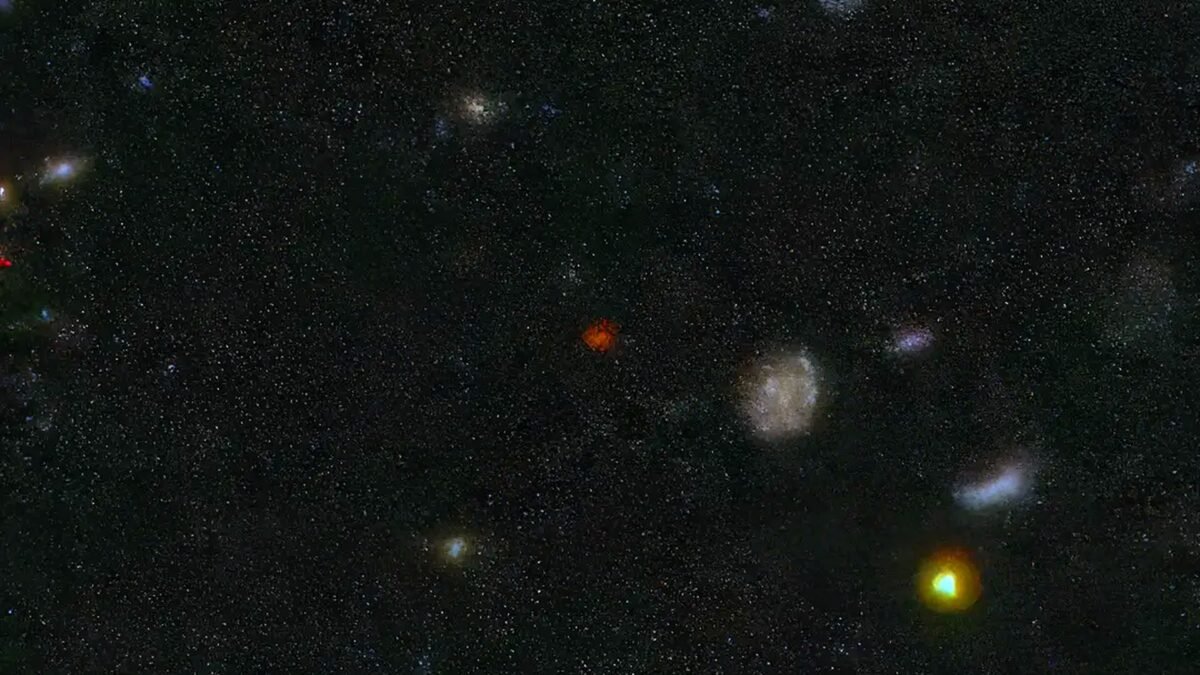
Astronomers have found the most distant quasar ever seen, a blazing galactic core powered by a black hole about 360 million times the mass of the Sun, shining just 630 million years after the Big Bang. The discovery, announced by the European Space Agency on Tuesday, pushes the frontier of the known universe back by 40 million years in a single step and deepens one of the sharpest puzzles in modern astronomy: how did a black hole grow so enormous, so soon after the universe began?
The object, formally catalogued as J1504+6252 and nicknamed Dún Aonghasa, is the first quasar ever identified beyond a redshift of 8, at 8.13. Its light has travelled for about 13.1 billion years to reach us, which means astronomers are seeing it as it was when the universe was less than 5 per cent of its current age. The finding was published on Tuesday in the journal Astronomy & Astrophysics by a team led by Julien Wolf of the European Southern Observatory in Germany, according to ESA.
A quasar is the intensely bright core of a galaxy, powered by gas falling into a supermassive black hole. As the gas spirals inward it forms a disc that heats to extreme temperatures and radiates enormous amounts of energy, outshining the rest of its galaxy by hundreds or even thousands of times. That brilliance is what makes quasars visible across billions of light-years, and it is what lets astronomers use them as beacons to study the first galaxies and the black holes at their hearts.
The new record is striking not only for its distance but for the size of the black hole behind it. According to Reuters, the black hole powering Dún Aonghasa is about 90 times more massive than Sagittarius A*, the roughly four-million-solar-mass black hole at the centre of our own Milky Way. And the object is feeding slowly. That combination — a huge black hole that is currently eating at a leisurely pace — is what makes the discovery so hard to explain, because a slow eater should not have had time to grow so large in the few hundred million years available to it.
A Red Dot Among Millions
The quasar first appeared as a small red dot in data from ESA’s Euclid space telescope, which launched in 2023 to map the dark matter and dark energy that shape the universe. Wolf and his colleagues found it while sifting through about 18 months of observations from Euclid’s Wide Survey, picking it out from millions of objects using the colours expected of a very distant quasar, with machine-learning tools helping to rank the candidates before scarce telescope time was spent on them.
Euclid’s image covers a patch of sky just 30 arcseconds across — roughly the width of a small coin held at arm’s length — and in it the quasar is the red dot at the centre, surrounded by faint galaxies and scattered points of light. It is a modest-looking image for a record-breaking object, and that is part of the point: at such distances, even the brightest objects in the universe arrive as faint smudges of red light, stretched by the expansion of space itself.
Confirming the find took an extensive follow-up campaign. Ground-based telescopes — the W. M. Keck Observatory in Hawaii and the Large Binocular Telescope in Arizona — provided the first hints, and the Hubble Space Telescope added its own evidence, before the James Webb Space Telescope delivered the decisive measurement. Webb’s spectra pinned the redshift at 8.13 and, from the width of emission lines from hydrogen and magnesium gas whirling around the black hole, gave the mass estimate of roughly 360 million Suns.
Redshift is the astronomer’s yardstick for distance in the deep universe. As light travels through expanding space, its waves are stretched toward the red end of the spectrum; the greater the stretch, the older and more distant the source. A redshift of 8.13 corresponds to a universe just 630 million years old, a time when the cosmos was about a twentieth of its present age. The previous record holder, also found by Euclid and announced only in July, sat about 40 million years closer to the present day. The two records before that had each moved the frontier back by about 15 million years or less.
“This time the leap in cosmic time is huge!” Wolf said in an email to the Associated Press. “The previous two records each took us back by about 15 million years or less. This one takes us back by nearly 40 million years, the biggest advance in nearly a decade!”
A Black Hole That Should Not Exist Yet
The puzzle at the heart of the discovery is one of timing. The universe was 630 million years old when the light we now see left Dún Aonghasa. In that brief span, a black hole had already grown to about 360 million times the mass of the Sun and was shining as a quasar — one of the most luminous objects in existence.
“I think it adds to the evidence that some objects in the early universe developed remarkably quickly. Just 630 million years after the Big Bang, this black hole had already grown to about 360 million times the mass of the sun and was shining as a quasar,” Wolf told Reuters.
The difficulty is that black holes grow by eating, and this one is not eating fast. ESA says that unlike other distant quasars, Dún Aonghasa is consuming material at a relatively slow rate, well below the theoretical maximum feeding rate known as the Eddington limit. If it is feeding slowly now, it must have reached its current vast mass during extremely rapid growth episodes very early in its life — bursts of growth that current models struggle to produce.
“Dun Aonghasa gives us a new deadline” for the early universe, Wolf said, according to the Associated Press. “About 630 million years after the Big Bang, its black hole had already grown to about 360 million times the mass of the sun. But how?”
That question matters because it is not an isolated oddity. Astronomers have been finding oversized black holes in the young universe for years, and each one tightens the same constraint. The first quasars were found in the 1960s, and ever since, the existence of billion-solar-mass black holes less than a billion years after the Big Bang has challenged the standard picture of how black holes grow. Dún Aonghasa is the most extreme example yet, because it is the earliest — and because its slow present-day feeding rate rules out the simplest escape, that it is simply eating fast now.
Two Ways to Build a Giant
Astronomers have two main ideas for how such a monster could have formed so early, and the new discovery puts pressure on both of them.
The first is the slow-and-steady route. A black hole could begin as the remnant of one of the first generation of stars — a star perhaps a hundred times the mass of the Sun, which lived fast, died young and collapsed into a black hole of a few tens of solar masses. That seed would then have to grow by swallowing gas and merging with other black holes, steadily, for hundreds of millions of years. The problem, as Reuters reported, is that the observations indicate Dún Aonghasa was consuming material too slowly for this route to have produced its great mass in the time available.
The second idea is more dramatic: the black hole may have been born big. In a scenario called direct collapse, a large cloud of gas in the early universe stays warm enough that it does not break up into smaller clumps and form stars. Instead, much of the gas flows toward the centre, building up a single enormous star that quickly collapses into a black hole far more massive than the remnant of any ordinary first-generation star. Such a seed would start life thousands or even hundreds of thousands of times the mass of the Sun, giving it a head start that makes the later growth far easier to explain.
“Normally, a large cloud of gas cools and breaks up into smaller clumps that form stars. Under the right conditions, the gas could stay warm enough to limit that fragmentation, allowing much of it to flow towards the center. That gas can build up a single enormous star that quickly collapses into a black hole. That black hole would start out far more massive than the remnant of a typical first-generation star,” Wolf told Reuters.
Wolf and his colleagues calculated the conditions under which each scenario could produce a black hole as massive as the one powering Dún Aonghasa, and the new object tightens the constraints on both. The slow-feeding observation is the key new evidence: it suggests that whatever built this black hole did its work early, in rapid episodes, rather than through steady feasting across cosmic time. But direct collapse also needs special conditions — gas that stays hot and does not fragment — and astronomers still debate how often those conditions occurred in the real early universe.
The honest position, and the one the researchers themselves take, is that neither route is yet proven. The discovery does not settle the debate; it sharpens it, by giving theorists a harder deadline and a more awkward set of numbers to match.
The Cosmic Dawn
Dún Aonghasa dates to one of the most dramatic and transformative epochs in cosmic history. After the Big Bang, the universe cooled into a dark, neutral fog of hydrogen gas. Then the first stars and galaxies began to ignite, and their intense radiation slowly burned through the fog, making the universe transparent to light for the first time. Astronomers call this process reionisation, and it was still unfolding when this quasar and its host galaxy were forming.
“This process was still unfolding at the time this quasar and its host galaxy were forming. It is a remarkable epoch to find such an object. The supermassive black hole powering this quasar had already grown to an enormous mass in an extremely short time, which challenges our understanding of how black holes can grow so large so quickly in the early universe,” said Silvia Belladitta, a co-author of the study from the Max Planck Institute for Astronomy in Germany and the INAF Bologna Observatory of Astrophysics and Space Science in Italy, according to Reuters.
Quasars are among the best tools astronomers have for studying this epoch, because they are so bright that they can be seen across almost the whole observable universe. Their light also carries information about the gas it passed through on its way to Earth, letting researchers probe the state of the fog itself. “Studying quasars helps astronomers understand how the first galaxies formed and evolved, and how the supermassive black holes at their hearts grew to such enormous sizes,” Belladitta said.
The epoch matters for another reason. The first billion years set the pattern for everything that followed: the first stars forged the first heavy elements, the first galaxies assembled, and the first black holes began the growth that would eventually produce the giants at the centre of almost every large galaxy today, including the Milky Way. Every object found from this period is a data point about how that assembly happened, and the earliest objects are the most informative — and the hardest to find.
Euclid’s Quasar Hunt
Euclid was not built to hunt quasars. Launched in July 2023, its mission is to reveal the secrets of the dark universe — to map dark matter and dark energy by surveying billions of galaxies across a third of the sky. But the combination of highly sensitive infrared imaging with exceptionally wide sky coverage turns out to be exactly what is needed to find extremely rare and very distant sources, and the telescope has become a formidable quasar-hunting tool almost by accident.
In just a year and a half, Euclid has announced 31 ancient quasars. Its haul of 12 quasars beyond redshift 7 has more than doubled what was known previously at that distance — a threshold that took 15 years to reach with earlier surveys, according to ESA. Dún Aonghasa is the first beyond redshift 8, and at that distance quasars are so rare that at most a few tens are expected in Euclid’s entire survey.
That rarity is what makes the record meaningful rather than merely symbolic. Each new quasar at these distances is not just a curiosity; it is a statistical statement about how many such objects existed in the early universe, and therefore about how black holes formed. If Euclid keeps finding them, the picture of early black hole growth will have to change. If it stops finding them beyond a certain distance, that too will be informative — it will mark the true edge of the era when quasars first switched on.
Theoretical models suggest the first quasars could potentially date to between 270 million and 470 million years after the Big Bang, according to Reuters. Dún Aonghasa, at 630 million years, is still some way from that frontier. “So in short: this is the furthest quasar we have ever seen, but maybe not the furthest there is to find,” Belladitta said.
Wolf agrees that the record may not stand long. “Honestly, the record could fall again in a few months or it could stand for years,” he told the Associated Press. Euclid is still surveying, and its data will keep flowing for years. The same machine-learning search that found Dún Aonghasa among millions of objects is still running, and the team expects Euclid to find multiple more quasars beyond redshift 8 in the years to come.
A Name From the Edge of Ireland
The nickname Dún Aonghasa comes from a prehistoric stone fort perched on a cliff on Inis Mór, the largest of Ireland’s Aran Islands, at the Atlantic edge of the country where land gives way to a vast oceanic horizon. Wolf’s wife and daughter are Irish, and he was awestruck when they visited the fort — a frontier holding “the promise of a vast horizon still to explore,” as the Associated Press described it, just like this quasar.
ESA’s own note on the name makes the same connection: like the ancient structure, J1504+6252 stands at the current observational frontier of quasars, illuminating the threshold to even earlier cosmic times waiting to be explored. It is a fitting name for an object that sits at the edge of what telescopes can see, in both space and time.
The naming is a small human detail in a story about cosmic scales, but it is a revealing one. Astronomers have a long tradition of giving evocative names to the objects they find at the limits of observation, and the names often say as much about the discoverers as about the objects. Here the name captures the experience of standing at a frontier and looking outward — which is, in the end, what the whole endeavour is about.
Analysis: Why It Matters
It is easy to treat a new distance record as a curiosity, a number to be admired and then filed away. That would miss the point of Dún Aonghasa. The record matters because it is a deadline — a hard, dated fact that every theory of early black hole formation must now satisfy — and because the object behind the record is awkward in a way that strains the theories more than a merely distant quasar would.
Consider what the theories must now explain. Within 630 million years of the Big Bang, a black hole reached about 360 million solar masses. It did so while, as far as we can tell from its present behaviour, feeding slowly. And it did so in a universe that was still emerging from its dark age, in which the first stars had only recently begun to shine. Each of those facts is individually surprising; together they form a constraint that is genuinely hard to satisfy, and that is exactly what makes the discovery valuable. Science advances fastest when a clean measurement contradicts a comfortable model, and Dún Aonghasa is a clean measurement.
The most important consequence is for the two formation scenarios. The stellar-seed route now has to explain not just rapid growth, but rapid growth followed by slow feeding — a history of feasts and famine that is possible in principle, since black hole feeding is known to be episodic, but that needs to be shown to work in detail rather than merely asserted. The direct-collapse route, meanwhile, gains support from the sheer earliness of the object, but it still needs the special conditions that prevent gas from fragmenting into stars to have occurred at the right place and time. The discovery does not choose between these ideas, but it raises the bar for both, and that is progress of a real kind.
There is a second, quieter lesson in the discovery, about how modern astronomy works. Dún Aonghasa was found not by a single telescope pointed at a single target, but by sifting millions of objects in a survey designed for a different purpose, then confirming the candidate with four of the most powerful observatories on and off Earth. Euclid found it, Keck and the Large Binocular Telescope gave the first hints, Hubble added evidence, and Webb delivered the mass. That chain — wide survey, machine-learning triage, targeted follow-up across the world’s best instruments — is now the standard way the deepest discoveries are made, and it is worth noticing how much of the achievement belongs to the pipeline rather than to any single observation.
A third point deserves emphasis: the mass figure, about 360 million Suns, is an estimate, not a weighing. It rests on Webb’s measurement of how fast gas is moving around the black hole, converted into a mass using calibrations built from nearby, well-studied black holes. Applying those calibrations to a single spectrum of a very young black hole carries real uncertainty, and the honest reporting of this story keeps the word “about” attached to the number. That uncertainty does not weaken the discovery — the redshift, which is what makes the object a record, is measured precisely — but it is a reminder that the most dramatic number in the story is also the softest, and that future observations may revise it.
Finally, the discovery is a reminder of scale. The light now reaching us left Dún Aonghasa when the universe was 5 per cent of its current age. The Milky Way’s own black hole, Sagittarius A*, is about 90 times less massive. The fort after which the quasar is named has stood on its Irish cliff for perhaps 3,000 years — a span that is, against 13.1 billion years, essentially nothing. Holding those scales together in mind is part of what this kind of astronomy asks of its audience, and it is part of why the story travels so far beyond the specialist journals.
What to Watch Next
The most immediate question is whether the record will fall again soon. Euclid is still surveying, and its team expects to find more quasars beyond redshift 8. Each one will add a data point to the question of how common such objects were in the first billion years, and whether Dún Aonghasa is an outlier or the first of a population.
The second question is the mass. Further Webb observations, and spectra from other instruments, could refine the estimate of the black hole’s mass and its feeding rate, and could reveal more about the host galaxy around it — its stars, its gas, and whether it shows signs of the violent early growth the mass implies. The host galaxy of a quasar at this distance is extraordinarily faint, but Webb has shown before that it can extract information from objects at the edge of visibility.
The third question is the theoretical one. Modellers will now run the numbers again, testing whether stellar seeds with episodic feeding, or direct-collapse seeds, or some combination of the two, can produce a 360-million-solar-mass black hole by 630 million years after the Big Bang while feeding slowly at the moment we happen to observe it. If neither route works comfortably, the discovery may point to something missing in the models — a possibility that would make Dún Aonghasa more than a record. It would make it a clue.
For now, the record stands: the most distant quasar ever seen, a red dot in a Euclid image, shining from a time when the universe was barely out of its infancy, powered by a black hole that should not have had time to grow so large — and yet did.
Sources
European Space Agency — Euclid breaks own quasar record by 40 million years
Phys.org — New quasar record tightens constraints on black hole formation scenarios

About the Author — Abdul Mannan
Related Articles

Meta Launches Muse, Its Personal AI Agent, in the UK With Backing From Britain’s Biggest Retailers
Meta's personal AI agent Muse arrives in Britain today, able to shop, book travel and chase refunds on…
Flower Hidden for 100 Million Years Inside a Kansas Rock Is the Oldest Palm Flower Ever Found
A flower no bigger than a grain of rice, hidden inside a museum rock for more than 130…
Scientists Propose a Hidden Earth-Sized Planet Beyond Neptune That Could Explain the Solar System’s Strangest Orbits
Astronomers have proposed a second hidden planet beyond Neptune — an Earth-sized world nicknamed Planet X2 whose gravity…