
Scientists Propose a Hidden Earth-Sized Planet Beyond Neptune That Could Explain the Solar System’s Strangest Orbits

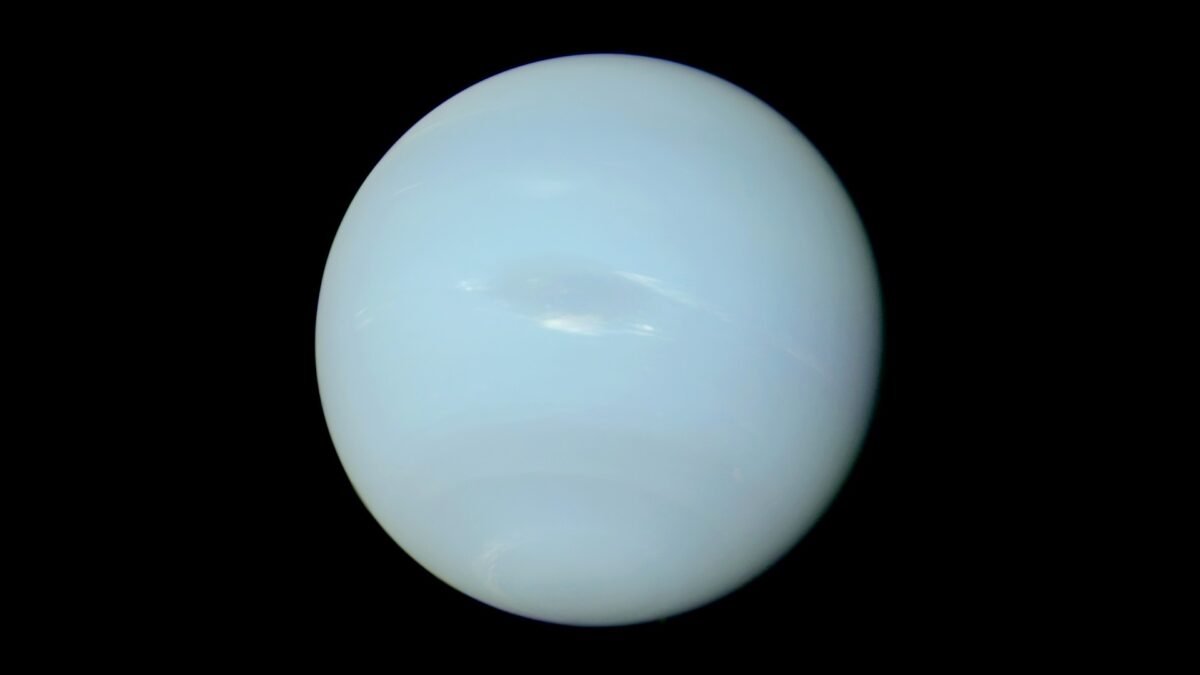
Astronomers have proposed that a second hidden planet could be lurking at the far edge of the Solar System, beyond the orbit of Neptune, according to a peer-reviewed study published on Monday in the journal Monthly Notices of the Royal Astronomical Society. The hypothetical world, nicknamed Planet X2, would be roughly one to two times the mass of Earth, and its gravity could explain some of the strangest orbits ever observed among the frozen objects that circle the Sun far beyond the known planets.
The research, led by Associate Professor Patryk Sofia Lykawka of the University of Southern Queensland and Kindai University in Japan, does not claim to have found a new planet. Nobody has seen Planet X2, and it may not exist at all. What the team has done is run detailed computer simulations of the Solar System’s 4.5-billion-year history and shown that adding such a planet makes the simulated outer Solar System look far more like the real one than models containing only the eight known planets can manage.
“Imagine discovering, after decades of mapping our Solar System, that another planet has been hiding from us all this time,” Lykawka said in a statement issued with the study. “If this planet exists, it could change how we understand the history of our Solar System and how its most distant objects came to follow such unusual orbits.”
The paper, titled “Signatures of an Earth-class planet in the distant Solar system”, was co-authored by Assistant Professor Pedro Bernardinelli of the University of Washington and Professor Jonti Horner of the University of Southern Queensland. It was published on 23 November 2026, and the Royal Astronomical Society, which publishes the journal, issued a press release the same day.
The clues in the outer darkness
Beyond Neptune lies a vast region populated by icy bodies known as trans-Neptunian objects. Most of them belong to the Kuiper Belt, a broad disc of frozen remnants from the Solar System’s formation that stretches between about 38 and 50 times the distance from Earth to the Sun. Astronomers measure such distances in astronomical units, or AU, where one AU is the average distance between Earth and the Sun. Neptune itself orbits at an average of 30.1 AU, where sunlight is already 900 times weaker than the light that reaches Earth, according to ScienceAlert.
Over the past two decades, telescopes have found a growing population of much more distant objects moving on orbits that are difficult to explain through the gravitational influence of the known planets alone. Two groups in particular have puzzled astronomers.
The first group is made up of so-called detached objects. These are icy worlds on long, stretched-out orbits whose closest approach to the Sun still lies far beyond Neptune, typically more than 40 AU away, leaving them effectively cut off from Neptune’s gravitational influence for billions of years. The most famous is Sedna, discovered in 2003, whose closest approach to the Sun is about 76 AU. Its orbit is so elongated that it takes roughly 11,400 years to complete a single circuit. Another is 2012 VP113, whose closest approach is around 80 AU. The paper’s authors note that standard models of the Solar System’s formation, including the slow outward migration of Neptune, fail to produce these detached objects in anything like the numbers observed, and fail entirely to generate key subgroups, such as detached objects beyond 250 AU or those on nearly flat, low-inclination orbits.
The second group consists of objects tilted at extreme angles. Some trans-Neptunian objects orbit at inclinations of more than 45 degrees to the flat plane in which the planets travel, and one, 2014 YX91, is tilted by about 63 degrees. According to the new paper, models based only on the known giant planets predict that fewer than one to three per cent of distant objects should reach such steep inclinations, yet the observed fraction is around two to three per cent in both the AstDyS database and the catalogues of the Dark Energy Survey. Because highly tilted objects are harder to detect than flat-orbiting ones, the authors argue, the true fraction must be considerably larger still.
“It’s a bit like the footprints in the snow,” Horner told ScienceAlert. “It’s telling you that somebody’s been there that you didn’t expect.”
A 4.5-billion-year replay
To test what might be responsible, the team replayed the evolution of the Solar System from its infancy in computer simulations spanning 4.5 billion years, tracing how the outer Solar System changed as the giant planets migrated into their present positions. The model included the four giant planets, thousands of small icy bodies and 1,500 Pluto-sized worlds, and it incorporated the “grainy” migration of Neptune, in which the planet’s outward drift was repeatedly nudged by encounters with Pluto-class bodies.
The researchers tested two rival explanations for the odd orbits. In the first, the early Solar System contained extra Mars- to Earth-sized embryonic planets that were scattered outward by the giant planets. In the second, a single distant, stable Earth-class planet has been sitting far beyond Neptune all along.
The first scenario failed. The paper’s abstract states that the primordial scattering planets were typically ejected from the Solar System within a few million to a few tens of millions of years, leaving results similar to control models with no extra planets at all. The second scenario worked far better.
With a Planet X2 in the mix, the simulations began producing populations of objects on highly tilted and detached orbits that more closely resembled the orbits astronomers have actually observed. The best-fitting version of the planet has a mass of about twice that of Earth, an elliptical orbit with a semi-major axis of 350 to 500 AU, a closest approach to the Sun of no less than 200 AU, and an orbital tilt of between one and 15 degrees relative to the plane of the planets.
According to the paper, that configuration generates a substantial detached population, including a crucial low-inclination component beyond about 150 to 200 AU, creates a robust reservoir of highly tilted objects, and replicates the orbital niches of all known extreme trans-Neptunian objects, including Sedna and 2012 VP113. The authors also report that their preferred models match the intrinsic population ratios and bulk orbital properties of the distant objects, and successfully account for the inner trans-Neptunian populations within about 100 AU as well.
To check their work against real observations, the team ran their simulated populations through a simulator for the Dark Energy Survey, a large sky survey that has catalogued many distant objects. The models satisfied the observed distributions of orbital inclination and perihelion, the point of closest approach to the Sun, although a discrepancy in the distribution of semi-major axes remains, which the authors flag as an area for future refinement.
“Our model reproduces several of the unusual orbital patterns observed among distant icy objects, although there are still differences between the model and observations that we need to investigate further,” Lykawka said.
Not Planet Nine, and not a discovery
Planet X2 is not the same idea as Planet Nine, the better-known hypothetical world proposed a decade ago by Konstantin Batygin and Michael Brown at the California Institute of Technology. The Planet Nine hypothesis, published in 2016, was put forward to explain the apparent clustering of a handful of distant objects’ orbits. According to a 2025 analysis cited by ScienceAlert, Planet Nine would have an estimated mass of about 4.4 Earths and a semi-major axis of around 290 AU, making it substantially more massive and somewhat closer than Planet X2.
Crucially, the two hypotheses seek to explain different orbital patterns. Planet Nine was invoked mainly to explain the clustering of distant objects’ orbits, while Planet X2 is invoked to explain the detached and highly tilted populations. That means the Solar System could, in principle, accommodate both worlds, or one of them, or neither.
“It is possible that there could be neither. It’s possible there could be both. It’s possible there could be one or the other,” Horner told ScienceAlert. “It is entirely in keeping with what we’re learning about planetary systems around other stars that there could be things further out.”
That last point matters. Astronomers have now found thousands of planetary systems around other stars, and many have architectures very different from our own, with giant planets on wide or eccentric orbits and worlds scattered far from their suns. Planets do not necessarily stay where they are born: gravitational encounters in a young planetary system can send them migrating inward or outward, sometimes flinging them into distant orbits or ejecting them entirely. If Planet X2 exists, one possibility raised by the researchers is that it formed much closer to the Sun before gravitational encounters with the giant planets scattered it into the distant reaches of the Solar System, where it has remained ever since, quietly disturbing the icy objects around it.
The authors are also careful about what their work does not prove. The simulations do not offer an exact replication of the observed outer Solar System, and the researchers acknowledge gaps between their models and the real data. “This isn’t a perfect fit. You wouldn’t expect it to be. I’d be more worried if it was, to be honest,” Horner told ScienceAlert. “But it’s a very, very, very good start, and it is quite compelling.”
Other explanations remain on the table. The paper notes that a close flyby by another star while the Sun was still in its birth cluster could also have disturbed the outer Solar System, and rival teams will now test their own alternatives against the same observations. Horner welcomed that scrutiny. “This is one explanation, and you know, I encourage people to try and think of other explanations and test them and make predictions,” he told ScienceAlert. “It’s that make predictions thing that I think is so important. It’s if this is true, then predict.”
A century of hunting for Planet X
The search for an undiscovered planet beyond Neptune has a long history, and it has produced both triumph and embarrassment. In the early twentieth century, the American astronomer Percival Lowell searched for a theoretical “Planet X” whose gravity he believed was disturbing the orbits of Uranus and Neptune. His search helped lead to the discovery of Pluto in 1930, but later evidence showed that Pluto was far too small to explain the planetary movements that had prompted the search, and the supposed disturbances themselves turned out to be measurement errors.
Pluto was demoted to dwarf-planet status in 2006, but the idea of a hidden planet never went away. It was revived in its modern form by the Planet Nine hypothesis in 2016, and it has been kept alive by each new generation of sky surveys, which keeps finding distant objects whose orbits do not quite fit the standard picture. The new study builds directly on that tradition: the Royal Astronomical Society notes that the Planet X hypothesis has been revived to explain unusual orbital features of the Kuiper Belt, and that the proposed Planet X2 model offers a comprehensive new explanation for the unusual dynamics of the broader trans-Neptunian region.
There is an important difference between this work and its predecessors. Earlier versions of the idea, including a 2023 model by Lykawka himself, showed that a distant planet could create the odd distant orbits but did not test whether the planet would also wreck the parts of the Kuiper Belt that Neptune built. The new model, by contrast, starts from the Solar System’s formation, follows the giant planets through their migration, and leaves the rest of the belt much as astronomers see it today, while still producing the strange distant populations. That fuller accounting is what makes the claim worth taking seriously, even though it remains unproven.
How the idea will be tested
The next step, the researchers say, is already under way. The Vera C. Rubin Observatory in Chile, with its 8.4-metre Simonyi Survey Telescope, is beginning its decade-long Legacy Survey of Space and Time, a systematic survey of the southern sky that will discover vast numbers of previously unseen trans-Neptunian objects. A much larger sample of distant objects will give astronomers a far stronger test of the models: if Planet X2 exists, the distinctive orbital populations predicted by Lykawka and his colleagues should become increasingly apparent as more objects are found.
“The exciting thing is that we now have an opportunity to put this idea to the test,” Horner said in the Royal Astronomical Society’s release. “As the Rubin Observatory surveys the sky, we will find new clues that help us understand the distant reaches of the Solar System, and whether another planet is still waiting to be discovered.”
There is even a chance Rubin could spot the planet itself, although Horner cautioned that its enormous distance and faintness would make that a much tougher proposition. At 200 AU or more from the Sun, Planet X2 would receive roughly forty thousand times less sunlight than Earth, and only a tiny fraction of the light it reflected would make its way back to a telescope. Astronomers have estimated that a world of this size at that distance would be extraordinarily faint, far dimmer than the faintest objects current surveys routinely detect. That is why the indirect approach, reading the gravitational fingerprints it leaves on the orbits of smaller bodies, is the practical way forward for now.
The observatory has already shown what it can do in the outer Solar System: in October 2026, Rubin spotted a possible sixth dwarf planet beyond Pluto, the largest distant find in twenty years, a discovery covered by this site at the time. Each new object it catalogues sharpens the picture of the distant populations, and either strengthens or weakens the case for a hidden planet.
Analysis: why a hidden planet is a serious idea, not science fiction
It is easy to hear “hidden planet” and think of sensational headlines, but the Planet X2 proposal belongs to a respectable and productive tradition in astronomy: inferring an unseen body from the behaviour of the bodies you can see. Neptune itself was found that way in 1846, when mathematicians predicted its position from irregularities in the orbit of Uranus before any telescope had pointed at it. The method has worked before, and it has failed before, which is exactly why the new paper is interesting: it is a testable claim, not a claim of discovery.
The strength of the work lies in its specificity. Lykawka and his colleagues do not merely argue that something is out there; they give numbers that future observations can confirm or falsify. A planet of about two Earth masses, on an orbit of 350 to 500 AU, tilted by up to 15 degrees, should produce a particular pattern of detached and highly inclined objects, including a low-inclination detached population beyond about 150 AU that no existing model produces. If the Rubin Observatory’s growing catalogue shows that pattern strengthening, the case for Planet X2 grows. If the pattern dissolves as more objects are found, the idea fades. That is how science is supposed to work, and the authors deserve credit for framing their result in those terms rather than overselling it.
There is also a broader lesson in the paper about how incomplete our map of the Solar System still is. The eight planets occupy a small, well-lit neighbourhood. Beyond Neptune, sunlight is feeble, objects are small and dark, and our catalogues are thin: the models in the new study had to work from apparent fractions of a few per cent in catalogues that are heavily biased against exactly the objects they are trying to explain. We have spent decades mapping a system we thought we knew, and we are still finding that its outer reaches behave in ways our best models cannot reproduce. The honest response to that, which this paper embodies, is to treat the mismatch as a clue rather than an embarrassment.
The comparison with Planet Nine is instructive. A decade after Batygin and Brown’s proposal, Planet Nine remains unconfirmed, and the debate over whether the orbital clustering it was meant to explain is real or an artefact of how surveys point their telescopes is still unresolved. Planet X2 enters a similar arena, and it will face the same scepticism. The difference is that it explains a different set of anomalies, which means the two ideas are not competitors but potential companions. The Solar System could, as Horner put it, contain both, one, or neither. The possibility that it contains two undiscovered planets sounds extravagant, but it is worth remembering that exoplanet surveys have repeatedly shown that planetary systems are far more diverse and far messier than the tidy eight-planet picture in school textbooks. A system that scattered one Earth-sized world to its fringes could plausibly have scattered two.
There is also a quiet irony in the timing. The same week that astronomers proposed a new planet at the edge of the Solar System, the Rubin Observatory, the instrument most likely to settle the question, is only just beginning the survey that will test it. For years, the hidden-planet debate has been fought with small, biased samples and clever statistics. Within a few years, the sample will be enormously larger, and the statistics far harder to argue with. Either the footprints in the snow will resolve into a clear trail, or they will turn out to be something else entirely, a close stellar flyby in the Sun’s youth, or a quirk of Neptune’s migration that nobody has yet modelled correctly.
What to watch next is therefore straightforward. First, watch the Rubin Observatory’s catalogue of distant objects: the authors’ predictions about the detached and high-inclination populations are specific enough that a larger sample should either confirm or undermine them within the next few years. Second, watch for independent modelling teams to reproduce, challenge or refine the simulations; the paper’s companion study, published earlier this year, laid out the constraints, and rival groups will now test whether other mechanisms, including stellar flybys, can match the same data. Third, watch for direct searches: even if Rubin cannot easily image a two-Earth-mass world at 200 AU or more, targeted searches using the predicted orbit could narrow the hunt, just as they have for Planet Nine.
For now, the Solar System officially still has eight planets. But the map of its outer reaches has a new dotted line on it, labelled Planet X2, and a set of predictions that will decide, one way or the other, whether that line becomes a world.
Sources
- Royal Astronomical Society — “Could astronomers be closing in on a hidden planet beyond Neptune?”
- Lykawka et al., “Signatures of an Earth-class planet in the distant Solar system”, Monthly Notices of the Royal Astronomical Society (DOI: 10.1093/mnras/stag2033)
- ScienceAlert — “Astronomers Find Signs of a SECOND Earth-Like World in The Space Beyond Neptune”
- TechJuice — “Scientists Propose Planet X2, a Hidden World Beyond Neptune”
- Interesting Engineering — “Could a new planet be hiding at the edge of our solar system”

About the Author — Abdul Mannan
Related Articles

Astronomers Watch a Giant Star Swallow Its Companion in Andromeda in the First-Ever Observed Stellar Merger
For the first time, astronomers have watched a giant star swallow its smaller companion whole — a seven-year…
Cryptography Trick Finds a Pulsar Spinning 261 Times a Second in 15 Years of NASA Fermi Data
A method borrowed from cryptography found the millisecond pulsar PSR J1622-7204 in 15 years of NASA Fermi data…

Japan’s Fugaku Supercomputer Breach Widens: 430 Stolen Keys Confirmed as RIKEN Treats 4,222 Users’ Data as Leaked
RIKEN confirms intruders stole 430 credentials — including 233 SSH private keys with no passphrase — from Japan's…