
A Drop of Blood, Thirteen Cancers: The Test That Could Rewrite the War on Cancer

What if the deadliest sentence a doctor can ever speak could be rewritten before it is uttered? What if the words “we found it too late” — words that have ended more conversations, more hopes, more lives than any other in medicine — could be struck from the language of cancer altogether? I ask the question because, today, in England, a trial has begun that dares to answer it.
The National Health Service has launched a trial of blood tests that can check for thirteen different cancers in a single sample. More than 20,000 patients, aged 45 and over, will be offered the test at around 200 GP surgeries across England. The trial is called STRIDE-RCT. It is funded by the government and led by the University of Birmingham. And its ambition is as simple as it is staggering: to catch the cancers that kill quietly, while there is still time to fight them.
You and I have heard promises like this before. Medicine is full of dawns that turned out to be false. But before we dismiss this one, or embrace it too quickly, let us look at what it is, what it is not, and why the history of this disease makes this moment matter.
The Quiet Killers
There are cancers that announce themselves. A lump. A cough that will not leave. Blood where blood should not be. And then there are the cancers that whisper, or say nothing at all until the hour is late. Pancreatic cancer. Ovarian cancer. Liver cancer. Stomach cancer. Bowel cancer. These are the diseases at the centre of this trial, and they share a cruel talent: their early signs are easy to miss, and easy to mistake for something ordinary.
A pain in the abdomen. Bloating that will not settle. Heartburn. A change in bowel habit. Who among us has not felt these things and thought nothing of them? Who among us has not told ourselves it was something we ate, or stress, or age? That is precisely the problem. The symptoms that bring a patient to the GP are the same symptoms that a hundred harmless conditions produce. The doctor must decide, on the basis of a conversation and an examination, whether this ordinary complaint hides something extraordinary. Get that decision wrong in one direction, and a patient is sent for scans and worry they did not need. Get it wrong in the other, and a cancer grows in silence for months.
The numbers give the silence its weight. Around 71,000 people in England are diagnosed each year with pancreatic, stomach, liver, ovarian or bowel cancer, and nearly 35,000 die from these diseases. Read those figures again, slowly, because they are not statistics. They are 35,000 funerals a year. Thirty-five thousand families who learned the truth when the truth had already become a verdict. These cancers are not rare. They are common, and commonly found late.
When the Blood Was the Enemy
History is the mirror in which the present must always be examined, and the history of blood in medicine is a long, strange story. For more than two thousand years, physicians believed that disease lived in the blood itself — that the body’s humours fell out of balance, and that the cure was to let the blood out. Bloodletting was the medicine of kings and commoners alike. The lancet was the symbol of the healer. We drained the very fluid that carried life, convinced we were draining the sickness with it.
Hippocrates, the father of medicine, gave cancer its name. He called it karkinos — the crab — because the tumours he saw spread their legs into the flesh around them like a crab’s claws. He could see the disease only when it had already taken hold. For two millennia after him, that remained the condition of medicine: cancer could be seen only when it was already visible, already advanced, already spreading its claws.
Then, in 1971, President Richard Nixon signed the National Cancer Act in the United States and declared a “war on cancer”, as if the disease were a foreign army that could be defeated by money and willpower. Half a century later, the war continues, and its hardest lesson is the one every general learns: you cannot defeat an enemy you cannot see. The great victories against cancer — in breast screening, in cervical screening, in bowel screening — have all been victories of seeing earlier. The tragedy of the quiet cancers is that, until now, we have had no way to see them at all.
Do you see the reversal? The fluid we once drained in ignorance, we now read for information. The blood that was the enemy is now the messenger. A few tubes of it, drawn during a routine visit to the family doctor, may carry fragments of DNA shed by a tumour, or proteins that betray the immune system’s first response to a cancer taking hold. The same blood that Hippocrates could not read, that the bloodletters spilled, now speaks — and we are finally learning its language.
What STRIDE-RCT Actually Does
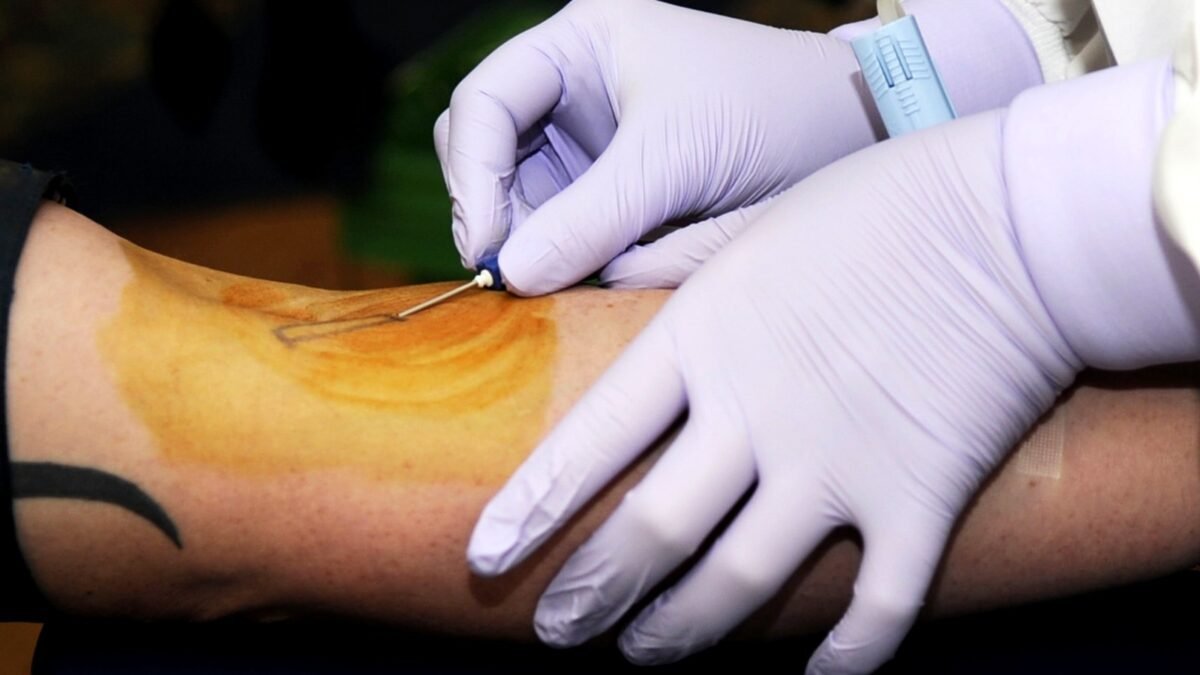
Let us be precise, because precision is a form of honesty. The trial will evaluate three different blood tests, each looking for signs of several cancers in one sample, and each able to suggest where in the body a tumour might be. Patients taking part will give one or two tubes of blood at their GP practice, alongside routine tests. Scientists will then analyse the samples — using artificial intelligence to read patterns a human eye could not — and the results will help doctors decide which patients should be sent for further investigation, and how quickly.
One of the tests, called Enlighten, was developed by the British biotechnology firm Proteotype Diagnostics. It looks for proteins in the blood that indicate the immune system is responding to the first signs of cancer. Another, Signatera, is already used on the NHS to help detect whether some cancers have returned after an initial diagnosis. The trial will test how well these tools work not in a laboratory, but in ordinary GP surgeries, alongside a doctor’s judgement, on real patients with real, ambiguous symptoms.
The cancers covered are thirteen in number: bowel, small bowel, stomach, oesophageal, pancreatic, liver, bile duct and gallbladder, ovarian, endometrial, kidney, bladder and prostate cancer. The breadth is the point. When a patient’s symptoms do not point to one organ, a test that points in several directions at once is worth more than a test that looks in only one.
And here I must insist on the caution that the trial’s own designers insist upon, because honesty about limits is what separates science from salesmanship. A positive result does not automatically mean a person has cancer. A negative result is not a guaranteed all-clear. These tests are not a diagnosis. They are a sorting tool — a way of deciding who needs urgent investigation and who can safely wait. A test that promises certainty would be a lie. A test that promises better decisions is something else entirely, and something worth having.
The Ghost of Galleri
There is a ghost at this feast, and I will not pretend it is not there. This is not the first time the NHS has trialled a blood test for multiple cancers. The NHS-Galleri trial, which tested a single blood test for cancers before symptoms appeared, involved more than 140,000 participants. Its results, published in September 2026, showed that the trial did not meet its primary objective of reducing the combined incidence of stage III and stage IV cancers across twelve cancer types. A secondary measure did show about 14% fewer stage IV diagnoses, a finding researchers are still examining. But the headline stands, and it stands as a warning.
Why should we care about a trial that fell short? Because it teaches the very lesson this new trial has been built to learn. A test can work beautifully in a laboratory and fail in the world. It can find a signal and still not change an outcome. It can detect disease earlier without making patients live longer. The distance between a clever test and a saved life is the distance this new trial must cross — and it is a distance measured not in molecules but in months of waiting, in referrals made or missed, in the judgement of a GP looking at a patient and deciding what happens next.
Professor Peter Johnson, NHS England’s national clinical director for cancer, has described detecting abdominal cancer early as notoriously difficult, precisely because the symptoms can so easily be mistaken for less serious conditions. Health Secretary Yvette Cooper has said she hopes simple blood tests like these will help identify patients needing urgent investigation much sooner. Michelle Mitchell of Cancer Research UK has said that GPs have long needed better tools to navigate uncertainty — to know which patients require further testing — and called the trial an important step towards meeting that need.
These are careful words from careful people. They do not promise a miracle. They promise a tool. And in medicine, as in war, tools are only as good as the hands that hold them and the judgement that guides them.
The Doctor’s Dilemma, and the Patient’s Wait
Now let me speak to you directly, reader, because this is where the story stops being about England and starts being about all of us. Imagine you are the GP. A patient sits before you — fifty-six years old, bloating for three weeks, a dull ache that comes and goes. You have seen forty patients today. Thirty-nine of them had something ordinary. This one might be the fortieth ordinary case. Or this one might be the patient you will think about for the rest of your career. Which is it? Your training tells you to watch and wait. Your instinct tells you something else. And the system tells you that a scan for every patient with bloating would collapse the hospital within a week.
That is the dilemma at the heart of this trial, and it is not an English dilemma. It is a human one. In Pakistan, in India, in Nigeria, in every country where a family doctor is the first and often the only line of defence, the same question is asked a thousand times a day: is this ordinary, or is this the beginning of the end? And in countries where diagnosis comes late as a matter of routine — where a patient reaches a specialist only when the pain can no longer be ignored — a simple blood test that could sort the urgent from the routine would not be a convenience. It would be a revolution. It would be the difference between a disease caught in a village clinic and a disease discovered in a hospital ward when nothing more can be done.
I do not claim this trial will deliver that revolution. I claim only that it is aimed at the right enemy, in the right place, at the right moment: the moment of first doubt, in the doctor’s surgery, when the future is still unwritten.
The Verdict of the Blood
So what should we make of this? Let me give you my verdict, plainly, as a man who has watched too many promises rise and fall. This trial is not a cure. It is not a breakthrough you can hold in your hand. It is something quieter and, in the long run, perhaps more important: a test of whether medicine can learn to listen earlier.
The blood has always been telling the truth. Every tumour that sheds its DNA into the bloodstream is confessing its presence. Every immune system that raises its proteins in alarm is sounding a warning. For two thousand years we could not hear it. For fifty years we have been trying to build the instruments to hear it. Now, in 200 GP surgeries in England, we are asking the simplest question of all: if we listen at the very first visit, at the first complaint of bloating or pain, can we hear the warning in time?
If the answer is yes, then the arithmetic of cancer changes. The 35,000 funerals become fewer. The words “we found it too late” are spoken less often. And a small tube of blood, drawn in an ordinary surgery on an ordinary day, becomes one of the most powerful instruments in medicine.
If the answer is no, then we will have learned something too — where the limits lie, and what must change. Science does not only advance by success. It advances by honest failure, and the Galleri trial proved that an honest failure can teach as much as a triumph.
But I tell you this: the question is worth asking. The trial is worth running. And the day when a doctor can look at a patient with a vague pain and a worried face, and say “let us check your blood, and let us know” — that day is worth waiting for, worth working for, and worth believing in. The blood has been speaking all along. At last, we are learning to listen.
Sources & References
- BBC News — “‘Multi-cancer’ blood tests coming to some GP surgeries”
- The Times — “GP patients to be offered new blood test for 13 types of cancer”
- BritBrief — “NHS launches trial of blood test for multiple abdominal cancers”
- Health and Me — “NHS Trial Offers New Blood Test To 20,000 Patients That Could Detect 13 Cancers”
- Newsy Today — “STRIDE-RCT Trial to Test Multi-Cancer Tests in GP Surgeries”
- New England Journal of Medicine — “Effect of Screening with Multicancer Early-Detection Test on Late-Stage Cancer Diagnosis” (NHS-Galleri results)

About the Author — Abdul Mannan
Related Articles
Would You Want to Know? The Blood Test That Can See Alzheimer’s Years Before It Arrives
A simple blood test can now detect Alzheimer's-linked brain changes years before symptoms — but it cannot tell…
The Epidemic We Chose: How America Lost Its Grip on Measles in 2026
Six Americans dead, 4,080 cases, and the worst measles year since 1991 — a disease America conquered in…
They Learned to Switch the Human Brain On and Off — With Light
On 5 October 2026, three scientists won the Nobel Prize in Medicine for learning to control the living…