
Nvidia Board Rules Out Huang Return as Shares Hit 52-Week Low Ahead of Earnings

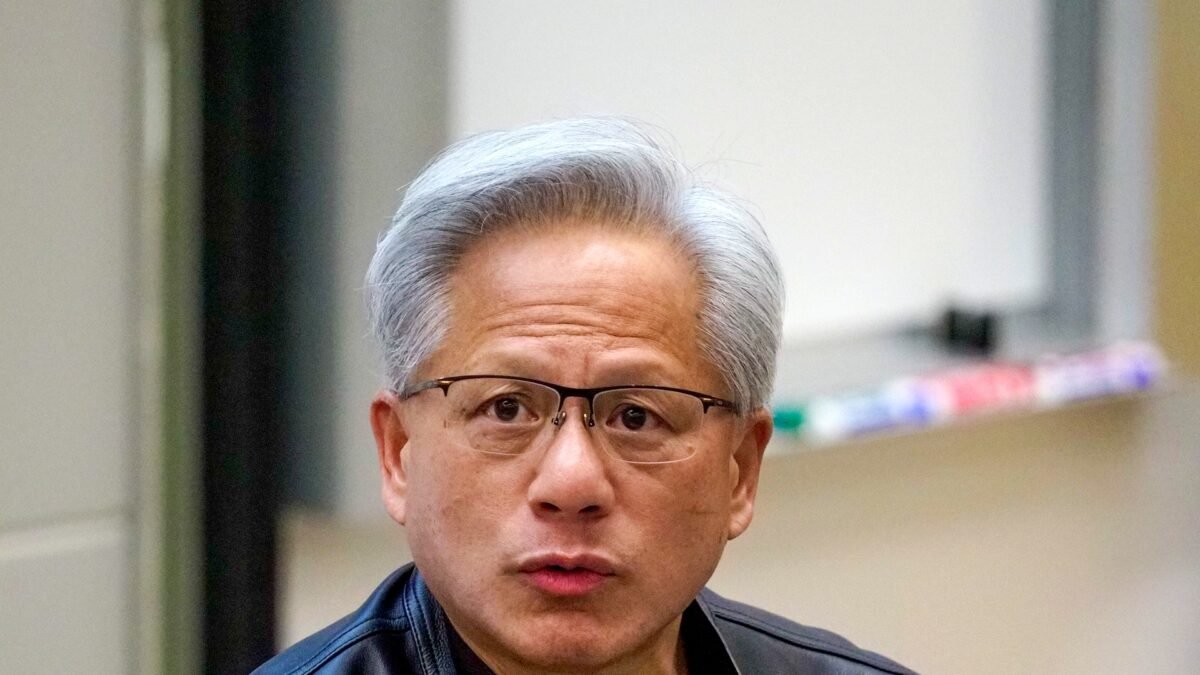
Nvidia’s board is not considering bringing Jensen Huang back as chief executive, three people told Reuters on Monday, closing the door — for now — on the most extraordinary comeback campaign in modern corporate history and sending the chipmaker’s shares to a new 52-week low on the eve of its first earnings report without its founder.
The shares fell 4.2 per cent to $155.98 on Monday, according to Barron’s, leaving Nvidia down 32 per cent from its October record high and down about 24 per cent this month alone. The decline came at the end of a day in which the world’s most important artificial intelligence company was fought over in public by its board, its most famous supporters, the president of the United States and his Treasury secretary — all before a single dollar of quarterly revenue had been reported.
The Financial Times reported on Sunday that Huang had discussed a possible return with confidants, and that allies in Silicon Valley were organising a coordinated campaign to press the board to reinstate him. By Monday morning, an open letter calling for his return had gathered more than 175,000 signatures, according to the BBC, including Tesla and SpaceX chief executive Elon Musk and Tim Sweeney, the chief executive of Fortnite-maker Epic Games. President Donald Trump added his voice on Monday, telling reporters as he left the White House that he “would certainly not mind” seeing Huang handed back his job.
“I think he learned a big lesson,” the president said, according to Reuters. “I would certainly not mind seeing that.”
The board’s answer, delivered through three people familiar with its thinking to Reuters and separately to the BBC and the New York Post, was unambiguous: it is not considering reinstating him. The Financial Times reported the same conclusion on Monday. The board has hired an executive search firm and will consider internal and external candidates for a permanent successor, while finance chief Colette Kress runs the company on an interim basis.
The collision between the campaign and the board’s refusal framed a day of heavy selling across the technology sector. The Dow Jones Industrial Average fell 739 points, or 1.4 per cent, the S&P 500 fell 1.92 per cent and the Nasdaq Composite fell about 2.5 per cent, according to Investor’s Business Daily. Taiwan Semiconductor Manufacturing’s American depositary receipts dropped nearly 5 per cent, the Philadelphia Semiconductor Index plunged more than 400 points in intraday trading, Advanced Micro Devices fell 3.8 per cent, Intel fell 5.9 per cent and Broadcom fell 3.1 per cent.
The selling had begun hours earlier in Asia. Taiwan’s Taiex index finished Monday down 6.03 per cent, South Korea’s Kospi lost about 4 per cent, and Japan’s Nikkei fell 2.42 per cent after third-quarter gross domestic product unexpectedly shrank. SK Hynix closed down 4.2 per cent and Samsung Electronics fell 5.8 per cent in Seoul. In London, the FTSE 100 closed down 0.2 per cent at 10,881.55, the CAC 40 in Paris fell 0.2 per cent and the DAX in Frankfurt fell 0.6 per cent.
All of it now turns on Tuesday. Nvidia is scheduled to report fiscal third-quarter results after the United States market closes on Tuesday, with an earnings call at 5 p.m. Eastern time, in what will be the first quarterly report since Huang resigned on 12 November and the first earnings call in the company’s history held without him present. Kress, who remains chief financial officer as well as interim chief executive, will lead it alone.
Analysts on average expect revenue of about $108.7 billion to $109.2 billion, up roughly 90 per cent from a year earlier, and adjusted earnings per share of about $2.47, according to FactSet and Yahoo Finance figures cited in Monday’s reporting. Options markets are pricing in a move of roughly 7.8 per cent in either direction after the results, the biggest implied swing in two years, according to ZeroHedge. Bank of America estimated a roughly 60 per cent probability that Nvidia beats expectations, driven by strong demand.
It is an extraordinary position for a company that, by every operational measure, is about to report one of the strongest quarters in corporate history — and whose shares are behaving as though the business itself is in doubt.
A resignation that became a referendum
Huang resigned as president, chief executive and a director on 12 November, ending a 33-year tenure as the only chief executive the company he co-founded has ever had. He admitted to an affair with Alice Huang, a businesswoman and former executive at Megaspeed, a Singapore-based company that builds data centres in south-east Asia and partners with Nvidia. A second affair, with one of his employees, was also reported, according to the BBC.
United States officials suspect Megaspeed of funnelling Nvidia chips to China, and the affair has been investigated by the FBI for at least a year, according to CNN, as reported by USA Today. Attorney General Todd Blanche said last week that the FBI had not reached any conclusions about whether Alice Huang was a spy, while the New York Times reported that Mr Trump had been notified in a classified memo in May that Huang was in a close relationship with a Chinese spy. Reuters has also reported that Huang misled Nvidia’s general counsel about the relationship.
The board has appointed the law firm Wachtell Lipton to investigate Huang, examining whether his conduct compromised national security or Nvidia’s trade secrets, according to the Wall Street Republic’s account of Monday’s reporting. Trump, speaking to reporters on Monday, played down the national security concerns in terms that put him at odds with parts of his own administration.
“I don’t know that she’s a Chinese spy,” the president said, according to the New York Post. “I don’t know that she was a spy at all. Nobody’s proven that. She may not be.”
He added that Huang “probably shouldn’t have been doing on a personal basis what he did”, but that “a lot of people are asking, they think Jensen should go back. That certainly isn’t a bad idea.”
Trump also said he may discuss the issue with Chinese President Xi Jinping during his trip this week to the Philippines and China, where he is due to meet Xi and Russian President Vladimir Putin in Shenzhen. He had floated Apple chairman Tim Cook as a possible replacement to lead Nvidia last week.
The Treasury secretary is pushing in the opposite direction. Scott Bessent said on Fox News on Sunday that Nvidia’s board should bring in an outside candidate as chief executive, saying the company needed “a dramatic shake-up”. Bessent also blamed the Commerce Department under Secretary Howard Lutnick for not cracking down on chip exports to Megaspeed, and Senate Republicans want Lutnick to testify over Nvidia chips reaching China, according to ZeroHedge.
On Monday, the Commerce Department’s Bureau of Industry and Security issued an interim final rule closing a loophole that has allowed Chinese companies to lease Nvidia’s computing power from locations in other countries, according to the Alliance News market wrap carried by AJ Bell. The move came, the wrap noted, in the wake of weekend reports that implicated Nvidia more deeply in the chip-smuggling saga.
The campaign for Huang’s return has drawn some of the most prominent names in technology. Musk said he would sign the open letter. Uber co-founder Travis Kalanick and Y Combinator president Garry Tan have also backed it, according to TechDefused. Brad Gerstner of Altimeter Capital and Gavin Baker of Atreides Management, who together held about $2.13 billion of Nvidia stock in June, urged the board to take its time and leave the door open to Huang’s return, the same report said.
Prediction markets, for what they are worth, are sceptical. Polymarket put the chances of Huang rejoining Nvidia by the end of the year at 8 per cent, and by the end of 2027 at 34 per cent, according to the New York Post.
Wall Street is losing its nerve
The market’s verdict on Monday was not only about the leadership question. It was about what the leadership question has exposed: that the company at the centre of the artificial intelligence boom is now, in the eyes of investors, a geopolitical asset as much as a commercial one, and that its value depends on judgements made in Washington and Beijing as well as in Santa Clara.
Analysts remain broadly positive on the shares, but their confidence has slipped sharply. HSBC downgraded the stock to Hold from Buy and cut its price target to $170 from $365. Baird downgraded the stock to neutral last week and cut its target from $500 to $200. Morgan Stanley and Bank of America have both dropped Nvidia from their top pick lists. Morgan Stanley said Huang’s leadership was “crucial to the company’s direction”. Dan Ives of Yorkville Ives has warned that Huang’s departure could cut Nvidia’s value by 25 to 30 per cent.
Even so, 25 of the 26 analysts who cover Nvidia still rate it a buy, according to TechDefused, and the shares trade at just 11.4 times expected earnings — a valuation that, for a company expected to report revenue growth of about 90 per cent, looks less like a growth stock than a value stock under a cloud.
The reason is not hard to find. Nvidia accounts for about 90 per cent of the market for the most advanced artificial intelligence chips, according to Nakoda News, citing the company’s market position. Its graphics processing units are the hardware on which the entire artificial intelligence build-out depends, and its chips have become a tool of American diplomacy, subject to export controls, licensing rules and now a criminal and national security investigation into their diversion.
Bank of America analysts said events at Nvidia had opened “a can of worms”, ranging from geopolitics to market dynamics, according to the Alliance News wrap. They suggested Huang’s departure would likely trigger heightened geopolitical tensions between the United States and China, and an eventual move towards tighter export controls on chips and rare earths.
That diagnosis was echoed by the European Central Bank, which warned on Monday of growing risks to financial stability if investor enthusiasm for artificial intelligence fades, potentially triggering sharp market losses. ECB Vice President Boris Vujcic said the rapid expansion of artificial intelligence was creating new challenges for financial stability across the eurozone, amid mounting concerns over whether the sector’s substantial investment spending will deliver sufficient returns.
Federal Reserve Chair Kevin Warsh also spoke on Monday at a forum in San Francisco, where his remarks on artificial intelligence’s impact were cited by market commentators as one of the factors weighing on technology shares.
The broader market backdrop did not help. China’s retail sales rose just 0.4 per cent year on year in October, slowing from 1.1 per cent in September and below the Bloomberg consensus forecast of 0.8 per cent, while industrial production expanded 4.8 per cent, slower than September’s 5.5 per cent and below the consensus expectation of 5.3 per cent, according to the Alliance News wrap. Gold was quoted at $3,857.91 an ounce on Monday, lower than $3,878.82 on Friday, silver fell 3.7 per cent, copper was down 0.9 per cent and Brent crude fell nearly 3 per cent to $93.44 a barrel. The yield on the United States 10-year Treasury was quoted at 5.14 per cent late on Monday afternoon, stretched from 5.13 per cent on Friday, after last week’s biggest weekly jump since April 2025.
The Anthropic test arrives on Thursday
If Tuesday belongs to Nvidia, Thursday belongs to Anthropic — and the two events are now bound together in a way neither company would have chosen.
Anthropic, the developer of the Claude chatbot, is expected to price its initial public offering on Wednesday evening and begin trading on the Nasdaq Global Select Market under the ticker ANT on Thursday, in what would be the largest public offering in history. The company is offering 825 million Class A shares at $70 to $78 apiece, which would raise up to $64.4 billion and value it at up to about $1.4 trillion on a fully diluted basis, according to CNBC’s calculations as reported by The Parameter. Orders have reached close to seven times the shares on offer, according to Bloomberg, as reported by Stocktwits, and the book is roughly six times oversubscribed on earlier reports.
The numbers in the filing are startling in both directions. Revenue surged more than tenfold year over year to $33.2 billion through the first nine months of 2026, against $4.6 billion for all of 2025, according to the amended S-1 as summarised by Yahoo Finance. The operating loss for the nine months was $1.3 billion, down from $5.2 billion a year earlier. Revenue earned per dollar of compute rose from $0.40 to $2.08 in six quarters, according to Techstrong.ai.
But the filing also discloses $895.4 billion in multi-year compute and infrastructure commitments, including contracts with Alphabet’s Google worth $114.5 billion, Amazon worth $110 billion, Microsoft worth $45 billion and SpaceX worth up to $120.5 billion, according to Techstrong.ai. Some $69.8 billion of that spending falls due over the next 12 months.
Goldman Sachs, the lead-left bank alongside Morgan Stanley, has published projections that read like a dare, according to Singularity Kiwi’s account of Financial Times figures: revenue of about $52 billion this year, $136 billion in 2027 and $442 billion in 2029, reaching more than $600 billion by 2030. Morningstar analyst Malik Ahmed Khan assigned a $92 per share fair value estimate, implying about $1.7 trillion, based on projected 47 per cent annual revenue growth over five years — but with a “Very High Uncertainty” rating spanning from a $188 bull case to a $25 bear case should open-weight models commoditise the sector.
Kathleen Brooks, research director at XTB, captured the stakes in the Alliance News wrap. “The tech stock rout does not look to be over, and could be broadening as we start a new week,” she said. She added that a successful Anthropic listing mattered far beyond Anthropic itself: “Nvidia has been a major financier for the likes of Anthropic and other AI labs. This financing is likely to come under greater scrutiny now that Jensen Huang has left Nvidia. While other sources of funding will be available, if Anthropic attracts strong investor interest this week then it suggests that the stock market is another option for some of the more mature AI lab businesses going forward.”
That is the hinge on which the week turns. Nvidia has been both the arms dealer and the banker of the artificial intelligence boom, supplying the chips and, through investments and partnerships, some of the money. If its leadership crisis now calls that financing into question, the public markets are being asked to take over the funding role at precisely the moment they are questioning the valuations.
Who runs Nvidia now?
The succession question is genuinely hard, and the difficulty is part of the story. Fortune has named Arm boss Rene Haas and AMD boss Lisa Su as possible outside candidates, according to TechDefused — a shortlist that underlines how few obvious successors Nvidia has inside the company. Huang was not merely the chief executive; he was the co-founder, the public face, the product strategist and, for three decades, the sole author of the company’s culture. There is no heir apparent, and the board’s search firm is starting from scratch.
Kress, the interim chief executive, is a known quantity to investors — she has led Nvidia’s earnings calls as chief financial officer for years — but she is also the person who must now answer, on Tuesday, questions she has never had to answer before: about the investigation, about the export-control exposure, about the financing of Anthropic and other AI labs, and about a board that has just publicly closed the door on the founder.
The board’s decision not to consider Huang’s return also creates a political problem it may not have anticipated. Trump has now said, on the record, that he would not mind Huang coming back, and that he does not believe the spying allegation has been proven. Bessent, his Treasury secretary, has said the opposite in substance — that the company needs an outsider and a dramatic shake-up. The board is caught between a president who wants the founder back and a Treasury secretary who wants him gone for good, with a Senate committee demanding testimony about chips reaching China.
It is worth stating plainly what is and is not established. Huang’s resignation followed his admission of an affair with a woman suspected of spying for China; the FBI has been investigating the affair for a year and has not reached conclusions; the board’s own investigation is continuing; and the question of whether Nvidia chips were diverted to China through Megaspeed is a matter of suspicion and investigation, not of established fact. None of that has been resolved, and none of it will be resolved by Tuesday’s earnings call.
What Tuesday will resolve is narrower but still decisive: whether the business underneath the scandal is still performing at the level the market has priced in for three years. The consensus expects revenue of about $109 billion, up about 90 per cent, and guidance for the fourth quarter of about $125 billion in revenue. A miss, or cautious guidance, would confirm the market’s fear that the leadership crisis is now a business crisis. A beat, delivered with confidence by Kress, would not end the succession question — but it would remind investors why 25 of 26 analysts still rate the stock a buy.
Analysis: Why It Matters
The board has chosen certainty over charisma — and the market is not sure it chose right
Boards do not lightly refuse a founder whom the president, the richest man in the world and 175,000 petitioners want back. Nvidia’s directors have done so because the alternative — reinstating a chief executive under an active national security investigation, after he misled the company’s own general counsel about the relationship at the centre of it — would have been a larger risk than the sell-off. That is a defensible judgement. It is also a judgement the market is punishing, because it removes the one outcome investors understood. The board has traded a known scandal for an unknown succession, and in the short term the market always prices the unknown more harshly than the known.
This is no longer a story about one man’s private life
The affair was the trigger, but the story has long since escaped it. It is now about whether the United States can keep its most advanced technology out of China’s hands, about whether the Commerce Department’s export controls actually work, about whether a company that controls 90 per cent of the advanced AI chip market can be allowed to have a leadership vacuum, and about whether the president and his Treasury secretary can disagree in public about the same company without the market concluding that nobody is in charge. Each of those questions is larger than Huang, and each of them will outlast him.
The earnings call is now a leadership audition, not a results presentation
Nobody seriously doubts that Nvidia will report spectacular numbers on Tuesday. The consensus expects revenue up about 90 per cent, and the company’s order book has been the envy of the corporate world. The numbers are not the test. The test is Colette Kress, alone on a call, answering questions about an investigation, an export-control probe, a succession search and a founder the board has just rejected — while the market listens for any hint of hesitation. Earnings calls are theatre at the best of times; this one will be a job interview conducted in front of the entire financial world.
Anthropic’s listing will be read as a verdict on the whole AI trade
The timing could hardly be worse for Anthropic, or more revealing. A $1.4 trillion valuation, $895 billion of compute commitments and a six-times oversubscribed book would, in any other month, be a triumph. This week, the listing will be read as a referendum on whether the artificial intelligence boom can fund itself without Nvidia’s money and without Nvidia’s chips as collateral. If ANT trades strongly on Thursday, it will suggest the market still believes in the AI build-out even without its central figure. If it stumbles, it will confirm the fear that the boom was, in part, a single company’s balance sheet dressed up as an industry.
The real risk is not the share price — it is the export-control regime
Strip away the drama and the most consequential development of Monday was the least theatrical: the Commerce Department’s interim final rule closing the loophole that let Chinese companies lease Nvidia computing power from abroad. That is a structural change, not a headline, and it signals that Washington intends to tighten the screws on AI chip access regardless of who runs Nvidia. For investors, the question is no longer whether the company can grow; it is whether the fastest-growing market in the world will be legally closed to it, and whether the political price of selling to China has now become too high for any chief executive to pay.
What to Watch Next
- Tuesday’s earnings (after the US close): Revenue against the roughly $109 billion consensus, fourth-quarter guidance against the roughly $125 billion expected, and — above all — Kress’s answers on the succession search, the investigation and export controls.
- The board’s search: Whether the search firm produces a named external candidate quickly, and whether the names in circulation — Arm’s Rene Haas, AMD’s Lisa Su — are confirmed, denied or joined by others.
- The Wachtell Lipton investigation: Any findings on whether Huang’s conduct compromised national security or Nvidia’s trade secrets, and whether the board’s refusal to consider his return hardens into a permanent position.
- Wednesday’s Anthropic pricing: Where the deal prices within the $70 to $78 range, and whether the reported six-to-seven-times oversubscription holds as the book closes on Tuesday.
- Thursday’s Anthropic debut as ANT: The first day’s trading will be read as a verdict on the AI trade itself, not just on one company.
- Trump’s trip to China: Whether the president raises Huang’s future with Xi Jinping in Shenzhen, and whether the Commerce Department’s new leasing rule draws a formal response from Beijing.
- The Senate and the export-control fight: Whether Commerce Secretary Lutnick testifies, as Senate Republicans have demanded, and whether Bessent’s call for a “dramatic shake-up” is followed by further administration action on chip exports.
Sources
- Reuters — Trump says he would not mind Huang being reinstated as Nvidia CEO
- Barron’s — Nvidia Stock Falls Again. It Doesn’t Need a Jensen Huang Comeback to Thrive.
- Investor’s Business Daily — Stock Market Today: Dow Dives As Nvidia Makes Huang Decision
- AJ Bell / Alliance News — Market news: market wrap, Monday 16 November 2026
- New York Post — Nvidia board not considering reinstating Jensen Huang as CEO: sources
- Techstrong.ai — Anthropic Readies Blockbuster Nasdaq Debut as Wall Street Weighs Explosive Growth vs. $900 Billion Compute Bet

About the Author — Abdul Mannan
Related Articles
ULA Vulcan Rocket Fails Ten Minutes Into Flight, Destroying 40 Amazon Leo Satellites
United Launch Alliance's Vulcan rocket suffered an anomaly ten minutes after liftoff from Cape Canaveral on Sunday, destroying…
Anthropic’s $1.4 Trillion IPO: The Day Wall Street Put a Price on Intelligence Itself
Anthropic's $1.4 trillion IPO asks Wall Street to price intelligence itself. The revenue is real, the loss is…
Gold Suffers Its Worst Week in Four Months as Fed Hike Bets and a Soaring Dollar Crush Bullion
Spot gold lost about 4.5 per cent in the week to 13 November 2026, its worst week since…