
Nvidia Brings Back Jensen Huang as Chief Executive After 11 Days as Shares Soar More Than 30%

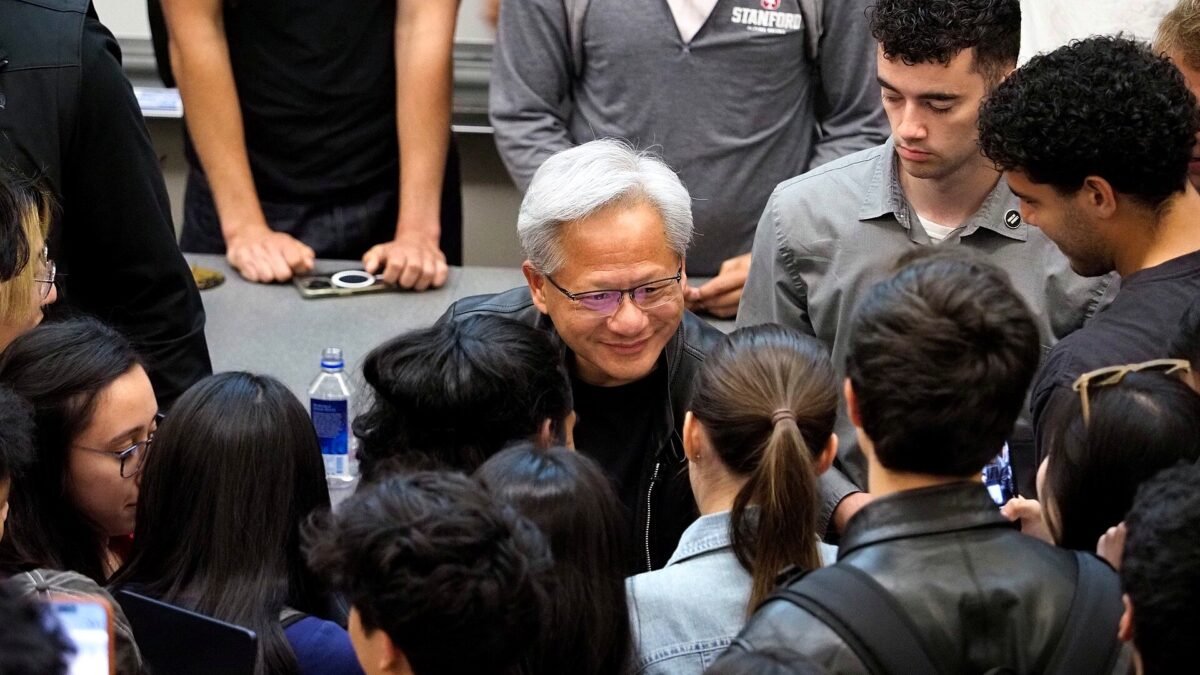
Nvidia has brought Jensen Huang back as its chief executive, president and board director, just 11 days after he resigned in the middle of a scandal involving extramarital affairs and an alleged Chinese intelligence operation, in one of the most extraordinary reversals in modern corporate history.
The chipmaker announced on Monday, 23 November 2026, that its board had voted unanimously to reinstate Huang with immediate effect. The decision, taken on Sunday according to a regulatory filing cited by market reports, ended an 11-day absence that had shaken the world’s most important artificial intelligence company and wiped hundreds of billions of dollars from its market value.
Investors reacted with delight. Nvidia shares surged by more than 30 per cent in early trading on Monday, according to Reuters, after rising by about 31 per cent in pre-market trading, and the rally spread across global markets. The Nasdaq Composite climbed by around 6 to 7 per cent, the S&P 500 rose by about 4 to 5 per cent, and the Dow Jones Industrial Average gained more than 3 per cent, or nearly 1,600 points, according to market reports. The Wall Street Journal reported that Nvidia was on pace to add close to one trillion dollars to its market value in a single session.
Huang, 63, co-founded Nvidia in 1993 and led it for 33 years, building it from a maker of graphics chips for video games into the dominant supplier of the processors that power the global artificial intelligence boom. His return restores the man investors, customers and even the President of the United States had come to regard as inseparable from the company itself.
“I am honored to return to NVIDIA and lead one of the most consequential technology companies in the world at the beginning of a new industrial revolution,” Huang said in the company’s announcement. “I take this responsibility with the greatest humility and renewed commitment.”
The board’s decision
Nvidia said its board had reached the decision after “a series of discussions and meetings” with Huang, and that directors were satisfied “with respect to Mr. Huang’s candor and ability to lead NVIDIA”. The statement, published on the company’s investor relations site, said the board had also received input from senior levels of the United States government and was confident that Huang’s reinstatement “poses no national security risk”.
“The Board believes Jensen is the right person to lead NVIDIA, and that his reinstatement is in the best interests of our stockholders, employees, partners and customers,” said Harvey C. Jones, the chair of the board. Jones, a director since 1993, was named as the company’s first-ever board chair when Huang stepped down. He will remain in that role.
Colette Kress, the chief financial officer who served as interim chief executive during Huang’s absence and delivered the company’s third-quarter results last week, will continue as chief financial officer, Nvidia said.
The reversal is striking because it came only days after the board had publicly ruled out exactly this outcome. On Nvidia’s earnings call last week, Jones said the board had unanimously accepted Huang’s voluntary resignation and “does not intend to reinstate Jensen as CEO”. The board’s change of mind within a week, after what it described as further discussions with Huang, has already raised questions about how the decision was reached and how quickly it was made.
President Donald Trump welcomed the decision in a post on Truth Social on Monday, writing that the board had made “the correct and proper decision to return Jensen Huang to the position of CEO”. He added: “The Country needs Jensen’s leadership at NVIDIA in order to ensure the Success and Prosperity of not only the Company, but the American Economy.”
According to CNN, Trump said in an interview with CNBC on Monday that he had convinced the board to bring Huang back, and that the US Attorney General “does not possess evidence that he has engaged in any unlawful conduct”. Reuters reported that Huang’s return followed mounting pressure from employees, shareholders and business partners, as well as from the president, who said last week that he wanted to see Huang back in the top job.
A remarkable market reaction
The scale of Monday’s market reaction showed how much Nvidia’s troubles had weighed on investors. The company’s shares had lost a third of their value in the past two weeks, according to Investopedia, and had fallen below four trillion dollars in market value for the first time since July 2025. Even after Monday’s surge, the shares remained in the red for 2026, Investopedia reported.
The rebound was not confined to Nvidia. Companies that depend on its chips were among the biggest gainers. Barron’s reported that Nebius Group, an Nvidia-backed artificial intelligence cloud provider, jumped 28 per cent, while CoreWeave, another cloud provider that counts Nvidia as a major investor, soared 27 per cent. Dell Technologies, which builds servers powered by Nvidia chips, rose 24 per cent, putting it on pace for its largest daily percentage gain since May, according to Dow Jones Market Data cited by Barron’s. Super Micro Computer climbed 19 per cent, Tesla rose 13 per cent, and chipmakers Marvell Technology and Micron each gained 19 per cent, while Intel added 12 per cent and Advanced Micro Devices rose 8 per cent, according to Investopedia.
Reuters reported that the Nasdaq rallied 6 per cent and the S&P 500 rose 4 per cent, making up for a plunge on Friday in which investors had sold artificial intelligence shares, driven in part by uncertainty at Nvidia itself. The rally also spread to Europe, where the STOXX 600 traded up 1.5 per cent, Reuters said, and investors moved out of safe-haven bonds, pushing short-dated Treasury yields up 10 basis points to 4.72 per cent.
Market analysts quoted by Reuters were blunt about what had changed. One strategist said the market was reacting positively because the decision was “a vote of confidence that Nvidia will continue to supply the chips and it’s business as usual”. Another described the episode as “a textbook example of poor governance”, arguing that the board could not possibly have completed all of its due diligence in such a short time, and questioning what kind of methodical process it had in place to evaluate a disruption of this kind.
How the scandal unfolded
The events that cost Huang his job unfolded with extraordinary speed over less than three weeks, and they mixed personal conduct with questions of national security in a way that few corporate scandals ever have.
According to a timeline published by the AFP news agency, the story broke on 29 October, when The New York Times reported that Huang had been the target of a Chinese spy plot. The newspaper said United States intelligence officials had concluded that Alice Huang, a Chinese executive linked to Megaspeed International, a Singapore-based data-centre company, had been funnelling information to Beijing. Alice Huang, who is of no relation to Jensen Huang, was a former senior executive at Megaspeed, which reports said had purchased 4.8 billion dollars’ worth of Nvidia chips over the previous two years. According to reports, American officials suspected her of acting as an asset for China’s Ministry of State Security. No charges have been filed against her, and Beijing denies the allegation.
Megaspeed had already been under investigation in the United States and Singapore over suspicions that it had illegally shared advanced chips with China, and The New York Times reported that the Justice Department had taken over the federal investigation into the company. Malaysian authorities said they were investigating Speedmatrix, a local subsidiary of Megaspeed, over the possible diversion of advanced artificial intelligence chips to other countries.
On 8 November, Huang issued a formal message to Nvidia staff admitting to an extramarital affair and apologising to his family and colleagues, according to reports. He did not publicly identify the individuals involved. The following day, Nvidia’s board announced that it had opened a probe into Huang. On 10 November, the independent directors retained the law firm Wachtell, Lipton, Rosen & Katz, led by former acting US Attorney Joon H. Kim, to conduct an independent inquiry into reports that Huang had been the target of a foreign intelligence effort.
The scandal escalated on 11 November, when The New York Times reported a second relationship, with Kimberly Powell, Nvidia’s vice president of healthcare, who reported directly to Huang. Nvidia, Huang and Powell have not confirmed that report. Reuters later reported that Huang had yet another extramarital affair with another unnamed Nvidia employee, a report that has likewise not been publicly confirmed.
On 12 November, Huang resigned as chief executive, president and board director, effective immediately, ending a 33-year tenure. The board appointed Colette Kress as interim chief executive and named Harvey Jones as its first chair, and began searching for a permanent successor.
The following day, US lawmakers summoned Huang to face questions. He was scheduled to give public testimony on 3 December before a Senate committee and to appear at a closed-door hearing on 1 December before members of the House of Representatives. On 15 November, Megaspeed confirmed that Alice Huang had left the company more than a year earlier and currently had no role there.
Public support for Huang’s return built quickly. A petition calling for his reinstatement drew more than 180,000 signatures, including one from Elon Musk, according to Reuters. On 17 November, Huang posted his first public statement since admitting the affair, saying he had seen an “outpouring” of calls for him to return and that he “would be honored” to return as chief executive.
The same day, Nvidia reported third-quarter results that beat Wall Street expectations, with revenue of 115.8 billion dollars, up 103 per cent year on year, and net profit of 65.3 billion dollars, according to AFP. Kress said full-year revenue was on track to exceed expectations, and the company said it would discontinue sales of its H200 chips in China. Yet on the earnings call, the board made clear it did not intend to bring Huang back.
Pressure continued to mount. On 19 November, California’s Attorney General, Rob Bonta, subpoenaed Nvidia over chips and confidential information sent to China and over its investor disclosures, and The Wall Street Journal reported a civil investigation by the Securities and Exchange Commission. The board, meanwhile, had established a standing National Security and Export Control Committee, made up solely of independent directors, to oversee trade compliance and national security risks.
What the board said, and what it did not say
Nvidia’s announcement on Monday was careful in what it claimed. It said the board was satisfied with Huang’s candor and leadership ability, and that it had received input from senior levels of the American government. It did not say what that input was, which officials provided it, or what evidence the board had reviewed.
Crucially, the company said the investigation into the reports that Huang had been the target of a foreign intelligence effort would continue to its conclusion, and that Huang fully supported it and was committed to cooperating. It also said the board had recently formed the National Security and Export Control Committee, that the committee was engaging counsel with experience in national security matters, and that Nvidia was commencing a search for a new chief compliance officer, who would oversee compliance across the company and report to the nominating and corporate governance committee. Nvidia said it would continue to cooperate with ongoing government investigations and inquiries.
In other words, the board cleared Huang to return while the inquiries into the affair at the heart of the scandal were still open. His congressional testimony, scheduled for 1 and 3 December, has not been cancelled, and the California Attorney General’s subpoena and the reported SEC investigation remain live. Those proceedings will now take place with Huang back in the chief executive’s chair rather than as a former executive.
Huang himself struck a humble note in the announcement. “I want to thank the NVIDIA Board for its confidence and deliberation through this process,” he said. “I am especially grateful to Harvey Jones for his leadership as Chair, and to Colette Kress and our executive staff for leading NVIDIA during this period. I am also deeply thankful to our employees, shareholders, leaders across the industry and partners around the world for their extraordinary support. Above all, I am grateful for the love and support of my family. I can’t wait to get back to work.”
Analysis: Why It Matters
The return of Jensen Huang is, on its face, a story about one man and one company. In reality, it touches almost every fault line in the modern technology industry: the dependence of the world’s most valuable companies on a single founder, the collision between personal conduct and national security, the power of a president to intervene in a boardroom, and the fragility of the artificial intelligence boom itself.
Start with the question of dependence. Nvidia is not merely a large company. Its processors are the foundation on which the world’s artificial intelligence systems are built, and Huang has been the central figure in its chip roadmap, its relationships with its biggest customers and its dealings with Washington for more than three decades. Reuters noted that his departure “reverberated from Silicon Valley to Taipei and Washington”, and the market’s reaction to his return, a gain of roughly a third in a single morning, is itself the measure of how much of Nvidia’s value investors attribute to one person. That is a remarkable position for a public company to be in, and a fragile one. A business whose value can fall by a third in two weeks because of its chief executive’s private life, and rise by a third because he returns, has a concentration of risk that no governance textbook would recommend.
The second question is governance. Nvidia’s board accepted Huang’s resignation within days of the first reports, then told investors a week later that it had no intention of bringing him back, then reversed itself within days. The speed of both decisions is the problem. A board that can dismiss a founder-chief executive in 24 hours and reinstate him 11 days later has, as one fund manager quoted by Reuters put it, a process that is hard to describe as methodical. The board says it held a series of discussions and meetings with Huang and is satisfied with his candour, but it has not explained what changed between last week’s earnings call and Sunday’s vote, beyond the intervention of the president and the pressure of shareholders, employees and business partners. Shareholders are entitled to ask whether the board was governing or reacting.
The third question is the role of the president. Trump said last week that he wanted Huang back, said on Monday that he had convinced the board, and publicly declared that the Attorney General “does not possess evidence that he has engaged in any unlawful conduct”. Whether or not the board would have reached the same conclusion on its own, the public record now shows a president taking credit for the return of a chief executive whose company sits at the centre of American technology policy and of the export-control regime that governs advanced chips. That is a precedent with consequences far beyond Nvidia. Every board in America will have noticed that presidential pressure, applied in public, can reverse a unanimous board decision within days. Every future chief executive in difficulty will wonder whether a call to the White House is now part of the playbook.
The fourth question is national security, and it is the one that has not been answered at all. The board says it is confident, on the basis of input from senior government officials, that Huang’s reinstatement poses no national security risk. But the allegations that forced him out, that a woman he was involved with was suspected of passing information to Beijing, have not been resolved. No charges have been filed, Beijing denies the allegation, and the board’s own independent investigation is still running. The congressional testimony scheduled for December will now take place with Huang restored to power, which changes its political character entirely. The California subpoena and the reported SEC investigation also continue. The market has treated the board’s statement as a clearing of the decks, but the decks have not been cleared. They have simply been rearranged.
There is also the question of the export-control system itself. The scandal has exposed how much of the global artificial intelligence trade flows through relationships that regulators struggle to see. Megaspeed, a Singapore company, reportedly bought 4.8 billion dollars’ worth of Nvidia chips in two years while under suspicion of diverting advanced chips to China. Reports have linked Alice Huang and her family to a Chinese company allegedly involved in purchases totalling about 7.5 billion dollars in Nvidia chips. The House Foreign Affairs Committee has said that about 900,000 advanced Nvidia and AMD chips were approved for Chinese firms between December 2025 and May 2026. These are not marginal numbers. They describe a system in which the most sensitive technology in the world moves through intermediaries, subsidiaries and family networks that export controls were designed to catch and, in this case, apparently did not catch in time. Nvidia’s new compliance officer and its new national security committee are admissions, in institutional form, that the old arrangements were not enough.
Finally, there is the artificial intelligence boom itself. The sell-off of the past two weeks, in which the Nasdaq fell 10 per cent in a week and Nvidia lost a third of its value, showed how much of the market’s confidence rests on a small number of companies and, within them, on a small number of people. Monday’s rally, in which the Nasdaq rose by 6 to 7 per cent on a single board announcement, showed the same thing from the other side. The artificial intelligence trade is not a broad, diversified bet on a technology. It is a concentrated bet on a handful of firms, and in Nvidia’s case, on one man. That concentration is what made Huang too important to lose, and it is also what makes the market so vulnerable to the next shock.
None of this diminishes what Huang has built. He took a company founded in 1993 to make graphics chips for games and turned it into the engine of the artificial intelligence age, and he did it with a vision that his rivals repeatedly failed to match. The petition signed by more than 180,000 people, the support of Elon Musk, the backing of employees and customers, and the enthusiasm of the market all testify to a leader whose return was genuinely wanted. But the manner of his return, fast, political and incomplete, leaves Nvidia with questions that a share price cannot answer. A company that depends this heavily on one person needs a plan for the day he is not there. A board that reverses itself in a week needs to explain how it decides. And a country that treats the chief executive of its most important technology company as a matter of national security needs to decide, in public, what the rules are, before the next scandal forces it to improvise again.
What to Watch Next
Several dates and decisions will show whether Monday’s announcement settles the affair or merely pauses it. The first is Huang’s congressional testimony, scheduled for 1 December behind closed doors before the House of Representatives and on 3 December in public before a Senate committee. Lawmakers summoned him when he was a former chief executive; they will now question a sitting one, and the tone of those hearings will matter.
The second is the conclusion of the board’s independent investigation, led by Wachtell, Lipton, Rosen & Katz. The board has said the inquiry will proceed to its conclusion, but it has not said when that will be, or whether its findings will be published. The credibility of the reinstatement depends, in part, on what that investigation eventually says.
The third is the appointment of the new chief compliance officer and the work of the National Security and Export Control Committee. These are the institutional answers to the questions raised by the Megaspeed affair, and their effectiveness will be tested by regulators, by Congress and by the company’s own customers.
The fourth is the market. Monday’s surge repaired much of the damage of the past two weeks, but Nvidia’s shares remained in the red for 2026 even after the rally, and the broader artificial intelligence trade remains volatile. The company’s next results, and its guidance for the year ahead, will show whether the business itself, as opposed to the leadership drama around it, is as strong as the board claims.
And the fifth is the export-control regime. The investigations into Megaspeed and the diversion of advanced chips, the California subpoena, the reported SEC inquiry and the congressional hearings all point in the same direction: the rules governing who can buy the world’s most advanced chips, and through whom, are being rewritten in real time. How Huang, newly restored, navigates that process, and how the Trump administration treats a company whose chief executive it has just helped to reinstate, will shape not only Nvidia’s future but the future of the global artificial intelligence industry.
Sources
- NVIDIA — “NVIDIA Board Reinstates Jensen Huang as President, CEO and Board Director” (company press release, 23 November 2026)
- Reuters — “Nvidia reinstates Jensen Huang as CEO” (23 November 2026)
- CNN — “Nvidia board reinstates Jensen Huang as CEO” (23 November 2026)
- The Wall Street Journal — “Nvidia Board Reinstates Jensen Huang as CEO” (23 November 2026)
- Investopedia — “Jensen Huang Is Back and Nvidia’s Stock Is Soaring” (23 November 2026)

About the Author — Abdul Mannan
Related Articles
Compass Group Plans to Move Primary Listing from London to New York in Fresh Blow to the City
The world's largest caterer is expected to announce on Tuesday that it will consult shareholders on shifting its…
Asian Regulators Rush to Calm Markets as AI Sell-Off Deepens: Taiwan Bans Short Sales, South Korea Readies Rescue Fund
Regulators in China, South Korea and Taiwan have rolled out emergency measures after the AI stock rout wiped…
Tata Steel to Sell Tubes Business and Colors Stake to APL Apollo in ₹28,000 Crore Deal
Tata Steel will sell its tubes business and its entire stake in Tata Steel Colors to APL Apollo…