
London’s Oxford Street Goes Traffic-Free as Buses and Taxis Are Banished From Its Busiest Stretch

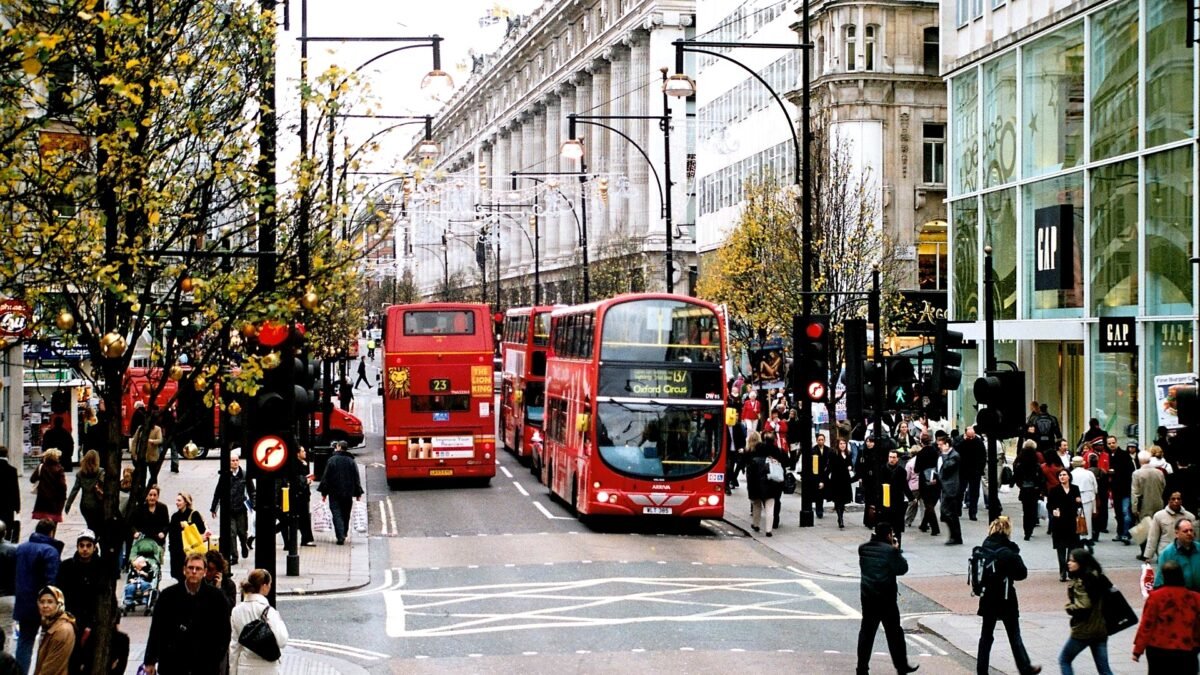
Almost a kilometre of London’s Oxford Street went permanently traffic-free on Monday, closing one of the most famous shopping streets in the world to the buses, taxis and cycles that have choked it for decades. The change, which took effect on 26 October 2026, bans vehicles from the stretch between Selfridges and the IKEA store at Oxford Circus, turning the heart of Britain’s busiest shopping thoroughfare over to pedestrians for the first time in its modern history.
According to Reuters, the closed section runs for almost one kilometre (0.6 miles) and is now shut to buses, cars, taxis, cycles, scooters and pedicabs. The office of London Mayor Sadiq Khan said the move was the first stage of a wider regeneration project designed to restore Oxford Street to the ranks of the world’s great shopping destinations, alongside New York’s Times Square, Paris’s Champs-Élysées and Barcelona’s La Rambla.
“After so many false dawns, and now working with a government who share the scale of my ambition, I’m proud that we’re finally unlocking a new era for the street,” Khan said, according to Reuters. “Revitalising Oxford Street will boost jobs and economic growth in the capital.”
The timing is deliberate. Minimal construction will take place during the run-up to Christmas, one of the busiest shopping periods of the year, so that the new pedestrian space can be tested immediately by the festive crowds. Plans for 2027 include more than 50 new trees, 100 new seats, two public squares, rest areas and better signage and lighting, according to Reuters.
Oxford Street attracts around half a million visitors every day, according to the mayor’s office, but it has struggled since the COVID-19 pandemic. Flagship stores including House of Fraser and Topshop have shut in recent years, and the arrival of American-style candy stores has, in the mayor’s office’s words, put shoppers off. Khan has said the area had been neglected.
“This marks an exciting new chapter for Oxford Street, creating a greener, more vibrant place that will attract visitors and investment, support businesses and jobs, and drive growth in the heart of our capital,” Angela Rayner, the secretary of state for housing, communities and local government, said, according to Reuters.
What exactly has changed
Under the published scheme, the pedestrianised section runs from Orchard Street, beside Selfridges near Marble Arch, to Great Portland Street, just east of the Oxford Circus IKEA store, according to Property Week. The stretch contains some of the street’s most famous department stores, including Selfridges and John Lewis, and sits at the western end of Oxford Street, where the most exclusive shops cluster near Mayfair.
The closure applies between 7am and midnight, seven days a week, with businesses able to receive deliveries outside those hours via certain access routes. Private cars have in practice been barred from much of Oxford Street for years, but the new rules go much further: for the first time, all motorised traffic, including buses and black cabs, as well as bicycles, is kept away from the closed stretch.
The change covers about half of the street’s total 1.2-mile length, which runs from Marble Arch in the west to Tottenham Court Road in the east. The mayoral development corporation set up to lead the project covers the whole of Oxford Street, according to Property Week, so the entire road could eventually become traffic-free if the first phase is judged a success.
Transport for London consulted on the transport and highways changes needed to make the closure work, with its consultation closing on 16 January 2026. The corporation itself was established by the mayor on 1 January 2026, and works towards pedestrianisation began at the start of September 2026, when Transport for London and Khan announced that the street would close to vehicles from 26 October.
A debate that ran for more than twenty years
The idea of pedestrianising Oxford Street is older than most of the shoppers who will walk it this Christmas. From 2005 to 2012 the street was closed to motor traffic on VIP Day, a Saturday before Christmas, and the experiment was popular: it boosted sales by more than £17 million in 2012 alone. But in 2013 the New West End Company, which represents local businesses, said the scheme would not continue because it wanted to do “something new”.
In 2006, the New West End Company and the then mayor, Ken Livingstone, proposed pedestrianising the street with a tram service running end to end. Boris Johnson, who succeeded Livingstone in 2008, rejected the plan as not cost-effective and too disruptive. Transport for London instead cut bus flows by 10 per cent in both 2009 and 2010, while the New West End Company called for a 33 per cent reduction in bus movements.
Khan made pedestrianisation a campaign promise when he first ran for mayor in 2015, pledging that the street would be completely pedestrianised by 2020. In 2017 the project was brought forward, with completion planned by the end of the following year. But the plan ran into opposition from local stakeholders, residents and the Fitzrovia Business Association, and in 2018 Westminster City Council blocked it.
The deadlock broke only after Khan’s re-election in 2024, when he announced a new scheme for the stretch between Oxford Circus and Marble Arch, backed by central government support that allowed the mayor’s office to override local council objections. In June 2025 Khan said the plans would move forward “as quickly as possible”, and at the Labour Party conference that autumn he confirmed the October launch, saying the changes would arrive “just in time for the busy Christmas shopping period”.
Not everyone is convinced. Westminster City Council, which is now controlled by the Conservatives after they retook it in the May 2026 local elections, has said residents and businesses still face a “long list of unanswered questions” about how the scheme will work. Tim Barnes, the council’s deputy leader and cabinet member for growth and planning, warned that access, air pollution, street cleaning and public safety all needed urgent answers, and that diverting vehicles could push traffic onto smaller neighbouring roads, causing economic and environmental harm. The council had promised to roll the pedestrianisation back, but rowed back on that commitment in June after legal advice suggested a judicial review “would be unlikely to succeed”, according to Property Week.
Retailers, by contrast, have largely welcomed the change. A consultation on the wider regeneration plans found that around seven in ten respondents supported the proposals, according to Retail Gazette, and businesses including Selfridges, John Lewis and IKEA have publicly backed the project.
Why the street needed something to change
Oxford Street’s problems have been visible to anyone who has tried to walk it. Around 175,000 people get on or off a bus on the street every day, along with 43,000 further through passengers, and the roadway has been regularly blocked by buses competing with crowds on pavements that were never designed for the volume. A 2016 report found that buses on Oxford Street generally travelled no faster than 4.6 miles per hour, barely quicker than a pedestrian walking at 3.1 miles per hour. Between 2009 and 2012 there were 71 accidents involving traffic and pedestrians.
Pollution has been just as severe. A 2014 report by a scientist at King’s College London found that Oxford Street had the world’s highest concentration of nitrogen dioxide pollution, at an average of 135 micrograms per cubic metre, with peaks of up to 463 micrograms per cubic metre during the day, more than eleven times the permitted European Union maximum of 40. The main culprit was diesel-powered traffic, above all buses and taxis.
The retail picture has darkened in parallel. Oxford Street has been ranked as the most important retail location in Britain and the busiest shopping street in Europe, with around 300 shops as of 2012, but it faces competition from out-of-town shopping centres such as Westfield London and Westfield Stratford City, from the Brent Cross centre, and from online retail. The eastern end of the street, towards Tottenham Court Road, has a higher proportion of downmarket retailers, fast-food restaurants and souvenir shops, while the western end near Mayfair holds the exclusive stores.
The candy-shop controversy of recent years became a symbol of the decline. In 2023 the street received heavy media attention over import candy shops alleged to be fronts for organised crime, particularly money laundering, and Westminster City Council raided several businesses, with at least 24 under active investigation for fraud and money laundering. The episode fed a sense, shared by the mayor’s office and many retailers, that the street had been allowed to drift.
There are also reasons for optimism that go beyond the new pavements. The Elizabeth line, which opened in the 2020s, serves Oxford Street at Bond Street and Tottenham Court Road, bringing millions of additional visitors within easy reach. The street’s Christmas lights, a tradition since 1959, remain one of London’s great seasonal draws, and the 2026 display is themed around Harry Potter, to coincide with a new flagship Harry Potter store on the street. The pedestrianisation is, in effect, an attempt to make the street itself worthy of the crowds it already attracts.
Analysis: Why It Matters
1. A twenty-year argument has finally been settled by changing who decides
The most important thing about Monday’s closure may not be the closure itself but how it became possible. For two decades, pedestrianisation was defeated by the same veto: the mayor could propose it, but Westminster City Council could block it, and local objectors could threaten legal action. The 2024 scheme broke the logjam by moving the project into a mayoral development corporation, a body whose remit covers the whole street and which can override borough-level objections. That institutional fix matters far beyond Oxford Street. London has other grand projects that have stalled for years in the gap between City Hall and the boroughs; the Oxford Street precedent shows that a determined mayor with central government backing can close that gap. It also raises a democratic question that will not go away: when a mayor overrides an elected council, the result had better work, because the council’s warnings are now on the record and will be quoted back if it does not.
2. This is a retail gamble, and Christmas is the first exam
Pedestrianisation is often presented as an obvious good, but for retailers it is a bet. The evidence from the VIP Day experiments is encouraging: closing the street to traffic before Christmas boosted sales by more than £17 million in 2012, which suggests that shoppers spend more when they are not dodging buses. But a one-day festival is not the same as a permanent closure, and the risks are real. If the surrounding streets become clogged with diverted buses and taxis, the area can feel harder to reach rather than easier. If delivery arrangements prove awkward, shops suffer in quieter ways. And the competition has not stood still: Westfield, Brent Cross and online retail are all competing for the same spending. Launching just before Christmas is therefore both clever and brave. The festive crowds will give the scheme its biggest possible showcase, but they will also expose any flaw immediately, in front of the largest audience of the year. The January trading figures, when they arrive, will be read as a verdict.
3. The bus question is the scheme’s hidden test
It is easy to forget, amid the celebration of a traffic-free street, that Oxford Street was not just a shopping street but London’s main east-west bus corridor. Some 175,000 people boarded or alighted from buses there every day, and 43,000 more passed through. Those passengers have not disappeared; they have been displaced onto surrounding streets, and the success of the scheme depends heavily on whether the surrounding network absorbs them without creating new congestion and new complaints. The 2016 finding that buses crawled at 4.6 miles per hour shows why the old arrangement was indefensible, but it does not prove that the new one will be smooth. Transport for London’s consultation on the highways changes was the unglamorous heart of this project, and its quality will determine whether residents of the side streets become the scheme’s next opponents. Watch the side streets, not just the main street, in the coming months.
4. Clean air is the quiet victory
The retail argument dominates the headlines, but the public-health argument may prove the most durable. Oxford Street once recorded the world’s highest nitrogen dioxide concentrations, with daytime peaks more than eleven times the permitted maximum, driven overwhelmingly by diesel buses and taxis. Removing those vehicles from the busiest stretch will not clean London’s air on its own, but it removes a concentrated source of pollution from precisely the place where half a million people walk every day. If air-quality monitors on and around the street show a sharp improvement, the scheme gains a justification that survives any argument about shop takings. It also strengthens the hand of those who want similar treatment for other polluted shopping streets. The first pollution readings from the pedestrianised stretch will be worth watching as closely as the first sales figures.
5. If it works here, it changes the argument everywhere
City planners around the world will be watching Oxford Street, and for good reason. London has studied the pedestrianisation of central Sydney and discussed the scheme with Barcelona, whose La Rambla has suffered some of the same problems of shabbiness and overcrowding. The comparison cuts both ways. If a street as busy, as contested and as commercially important as Oxford Street can be pedestrianised successfully, it becomes much harder for opponents of similar schemes elsewhere to argue that pedestrianisation cannot work at scale. If it fails, whether through displaced traffic, retailer complaints or a sense that the street has lost its energy, opponents everywhere will gain a ready-made cautionary tale. The £150 million price tag attached to the wider scheme means the stakes are financial as well as reputational. Oxford Street has, in effect, volunteered to be the test case for the world’s great shopping streets.
What to Watch Next
- Christmas trading: the first test of the scheme comes within weeks. Retailers’ festive sales and footfall figures will be read as an early verdict on whether pedestrianisation helps or hinders the street’s recovery.
- The 2027 phase: the mayor’s office has promised more than 50 new trees, 100 seats, two public squares, rest areas and better lighting next year. Whether that work arrives on schedule, and how much disruption it causes, will shape opinion through the quieter months.
- The side streets: Westminster City Council’s warning about traffic displaced onto smaller neighbouring roads is the most specific objection on the record. Congestion, pollution and complaint levels on those streets will show whether the warning was prescient or overblown.
- Air quality: monitors on and around Oxford Street should show whether removing buses and taxis from the closed stretch delivers the sharp pollution improvement the scheme’s supporters expect.
- The rest of the street: the mayoral development corporation covers the whole of Oxford Street, so the obvious next question is whether the traffic-free zone extends east towards Tottenham Court Road. The answer will depend on how the first phase performs.
Sources

About the Author — Abdul Mannan
Related Articles
Storm Boelo Leaves 82,000 Homes Without Power as 84mph Gusts Flood Largs and Halt Travel Across Britain
More than 82,000 homes were left without power as Storm Boelo battered Britain with gusts of up to…

Online Safety Laws Have Yet to Cut Children’s Exposure to Harmful Content, Ofcom Finds
Ofcom's first statutory review finds no significant fall in the share of children encountering harmful content in the…
Storm Austen Leaves Tens of Thousands Without Power as Storm Boelo Bears Down on the North
Storm Austen has left more than 31,000 homes in south-west England without power and torn part of Brighton's…