
Paraguay President Santiago Peña Resigns as Ueno Bank Collapse Freezes Millions of Accounts

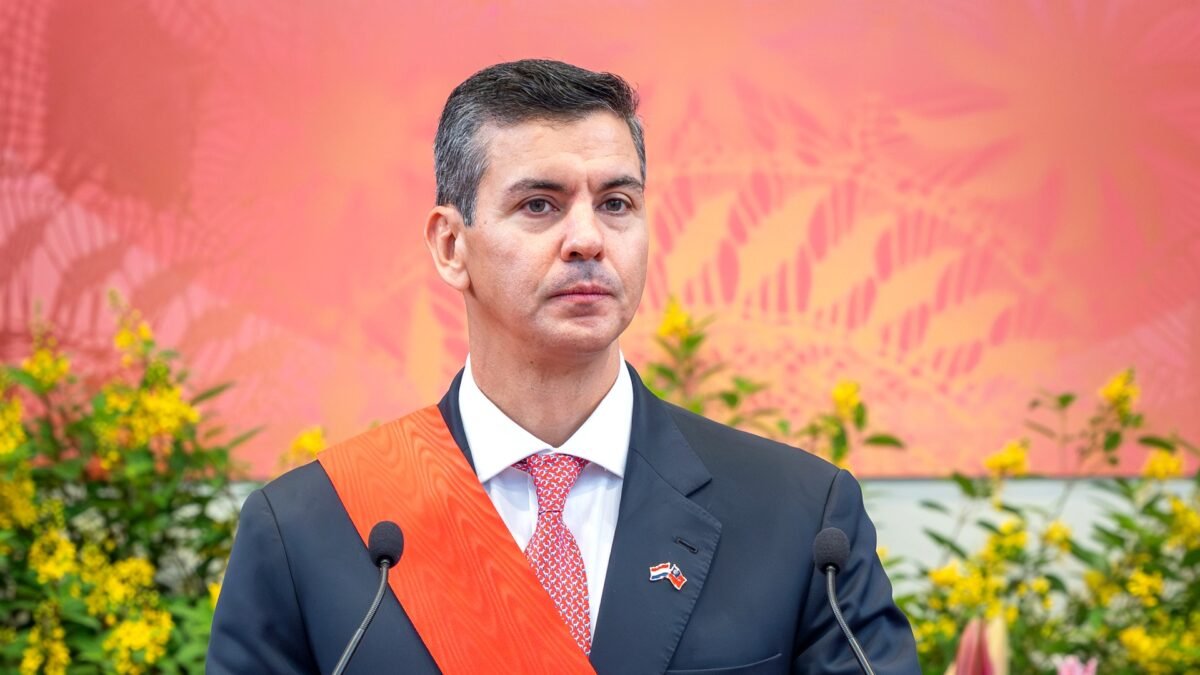
Paraguay’s President Santiago Peña resigned on Thursday after the sudden collapse of Ueno Bank, a fast-growing digital lender with close ties to his government, froze the accounts of around three million people and set off the gravest political crisis in the South American country in years.
Peña announced his decision in a video posted on social media as lawmakers in Asunción were debating charges against him, according to Reuters. “I have made the decision to submit my resignation from the Presidency of the Republic,” he said. “I do so with the stability of our country, social peace, and the need to preserve our public institutions in mind.”
Minutes after the announcement, Paraguay’s Chamber of Deputies voted unanimously, 78-0, to impeach him, according to the Associated Press. The vote sent the charges to the Senate, which must decide whether the proceedings move forward. Congressional leaders were expected to accept his resignation later on Thursday, clearing the way for Vice President Pedro Alliana to be sworn in as president and serve out Peña’s term through August 2028.
The resignation brought a stunning end to the presidency of a 47-year-old economist who had been regarded as one of Washington’s closest allies in South America, and it left a country of around seven million people facing a banking crisis that has touched more than 60 percent of its adults.
Peña, who took office in August 2023, had spent three days watching his political support collapse as protesters filled the streets of the capital, Asunción, demanding their money back, and as members of his own long-ruling Colorado Party joined the opposition in calling for his removal.
The resignation and the impeachment vote
Peña submitted his resignation while lawmakers were debating charges brought against him by 35 opposition lawmakers and ruling-party dissidents, according to CNN. The charges accused him of “serious and systematic dereliction of duty” in connection with his dealings with Ueno Bank and proposed removing him from office.
In his video message, Peña expressed contrition but stopped short of accepting responsibility for the banking crisis, according to the Associated Press. “Today my priority is only one thing: the peace of mind of the Paraguayans who entrusted their savings to our financial system,” he said, according to CNN. “History will judge and give due consideration to the events we are experiencing today,” he added. “I apologize to the people if I have failed them at any point.”
He also addressed the fate of the frozen money directly. “My greatest wish is that the return of those funds be guaranteed, that the deposit guarantee fund fulfill its purpose, and that public funds — as well as the resources that belong to all Paraguayans — be protected,” he said, according to Reuters.
The lower house’s unanimous vote to impeach him minutes later was a remarkable repudiation from a party that has dominated Paraguayan politics for most of the past 70 years. Even Horacio Cartes, the former president who leads the Colorado Party and had been Peña’s most powerful political backer, publicly supported his removal, saying the party would not side with “the plundering of public and private funds and pensioners’ money,” according to the Associated Press.
The two chambers of Congress were due to meet in a joint session on Thursday afternoon to consider the resignation, according to CNN. The choice before them carried real consequences for Peña himself: if lawmakers accept his resignation, he would take a seat in the Senate for life, with the immunity and special protections that come with it; if they instead remove him from power through impeachment, he would lose that protection and could face prosecution.
Some opposition lawmakers were already insisting on the second course. Senator Yolanda Paredes said lawmakers would not accept the resignation, according to CNN. “This guy, Santiago Peña, needs to be jailed. An arrest warrant must be issued … pretrial detention, straight to jail,” she told reporters.
On Thursday afternoon, Paraguay’s Chief Prosecutor’s Office said it had opened a criminal investigation into Peña, according to The Wall Street Journal. The Associated Press reported separately that the lower house had approved Peña’s impeachment while rejecting an impeachment motion against Vice President Alliana, who is next in line for the presidency.
How a star lender collapsed in days
Ueno Bank’s fall was as fast as its rise. The digital lender, a rebranded version of a decades-old finance company, had exploded from an obscure firm into a household name in less than five years, according to the Associated Press. It claimed more than 60 percent of Paraguay’s adults as customers, grew to more than 70 locations, sponsored Paraguay’s national soccer team, and put its name on the country’s main stadium.
It lured customers with generous cash-back offers on groceries and marketed itself as “the bank for everyone” after receiving its banking licence in 2023, according to The Times. By the time it failed, it held the accounts of roughly three million people in a country of around seven million — and close to $850 million in public funds, according to Reuters, including money from the state pension and health fund and the operators of Paraguay’s giant hydroelectric dams.
The trouble had been building for months. In June, inspectors at the central bank found a pattern of risky lending to insiders, the leading Paraguayan newspaper ABC Color reported, according to the Associated Press. Ueno had extended large sums to companies tied to its owners, beyond what the law allows and without enough collateral to cover the debts if they went bad.
As recently as last month, Peña defended Ueno and the central bank’s oversight, dismissing the concerns as a smear campaign that was spooking the public, according to the Associated Press. But on Monday, regulators investigating the bank’s loans to companies linked to its owners found poorly documented lending, the central bank said, as well as expenses the bank had wrongly counted as assets. Once the books were corrected, Ueno’s capital — the cushion banks must keep to absorb losses — had fallen to less than half the legal minimum.
The central bank announced the lender’s seizure on Tuesday, beginning a process to transfer deposits and recoverable assets to other banks before liquidating what remained, according to the Associated Press. Ueno’s app, cards and transfers went dark and its branches locked their doors. On Wednesday, a rush to open new accounts elsewhere crashed other banks’ mobile apps, fuelling public panic.
The Central Bank of Paraguay found that Ueno’s solvency ratio had fallen below 50 percent of the required minimum, “as a result of adjustments made to its financial statements during the regularization process,” according to CNN. The bank has made no public statement on the crisis, according to Reuters.
The fallout spread quickly beyond the bank itself. Paraguay’s central bank chief resigned, and eight Ueno executives were detained, according to Reuters. On Thursday, a judge ordered six Ueno executives, including founder Miguel Vázquez and bank president Juan Manuel Gustale, jailed pending trial, and placed two others under house arrest, according to the Associated Press. Prosecutors have charged 27 bank officials and associates with breach of trust and attempted fraud, alleging that Ueno made large loans to related companies without adequate guarantees and diverted some of the money to other group businesses.
Gustale’s lawyer pushed back on the charges, arguing that senior executives had relied on staff for lending decisions. “The president or board is not responsible for deciding who receives a particular loan,” José Fernández Zacur told local media, according to the Associated Press.
Peña’s links to the bank
At the centre of the political storm is Peña’s own history with the bank and the group behind it. Peña was a shareholder in Grupo Vázquez, the group that owned Ueno, until March 2025, according to Reuters. The Wall Street Journal reported that he indirectly held a large stake in Ueno during its rapid expansion in recent years, an expansion that included new business with government entities such as managing pension money.
Government money poured into Ueno’s coffers under Peña, according to the Associated Press. The bank received millions in funds from public entities, including the Social Security Institute, known as IPS, which manages the pensions of most of the country’s workers, according to CNN. As of last month, Ueno reported holding roughly $800 million in public deposits, about a quarter of its total, according to the Associated Press.
Peña also appointed Carlos Carvallo, the president of Financiera Ueno, the predecessor to Ueno Bank, to run the central bank — the very agency charged with supervising the digital lender, according to the Associated Press.
Lawmakers accused Peña of conflicts of interest, misuse of pension funds and institutional cover-ups linked to the collapse, according to Reuters. Opposition politicians and some members of his own party accused him of conflict of interest, diversion of pension funds and an institutional cover-up, according to The Times.
Peña has said he cut ties with the bank and the conglomerate that controls it, Grupo Vázquez, according to The Wall Street Journal. He expressed contrition in his resignation message but stopped short of accepting responsibility for the turmoil, according to the Associated Press.
Protests in the streets
The crisis spilled onto the streets within hours of the bank’s seizure. For three days, thousands of protesters marched on Congress in Asunción, many carrying banners reading “give us our money back” and shouting “We want your head, Peña!”, according to the Associated Press. Their signs branded him “the enemy of savers” and pleaded for the return of their savings. Riot police fired pepper spray and rubber bullets to push them back.
“Santiago Peña and the Colorado Party have stolen all our savings,” said Luis Pineda, one of the protesters marching to Congress on Wednesday, according to the Associated Press. “We are fed up with 70 years of plunder.”
“This is yet another assault on honest, hard-working citizens, people whose small savings are the fruit of years of labor,” said Belarmino Balbuena, one of thousands who marched on Congress on Wednesday, according to the Associated Press.
Even Ueno’s own employees joined the anger. Still in their Ueno uniforms, young employees burned their credit cards and cursed Peña outside the Labor Ministry on Thursday, demanding severance and unpaid wages, according to the Associated Press. The Labor Ministry estimates the collapse has affected about 7,000 direct and indirect jobs at the bank and its related businesses.
Peña’s resignation did little to calm the crowds. Many vowed to keep protesting until lawmakers finished impeaching him, saying his departure alone would neither bring accountability nor return their money. “Let the impeachment process take place and let him lose his immunity,” said Adolfo Villalba, one of the protesters on Thursday, according to the Associated Press.
At the national stadium that once bore Ueno’s name, the bank’s logo had already been scrubbed away, according to the Associated Press. Across the capital, fresh graffiti called politicians thieves.
What happens to depositors’ money
Officials have appealed for calm and moved quickly to promise repayment. Under a law rushed through Congress on Wednesday, a state guarantee fund must repay stranded depositors within five business days, starting on Thursday with small accounts of up to about $1,600 held by customers with no debts to Ueno, according to the Associated Press. The fund insures up to about $36,000 per customer, which the central bank says will cover the full balances of an estimated 97 percent of clients.
Whether that timetable holds will be the first real test of the new government’s handling of the crisis. The central bank has said it will move customers’ accounts, along with whatever assets still hold value, to other banks before liquidating what is left of Ueno, according to the Associated Press.
The economic damage is already visible. The guaraní, Paraguay’s currency, fell nearly 4 percent against the US dollar on Thursday, bringing its losses this week to nearly 7 percent, according to central bank exchange-rate data cited by the Associated Press.
The crisis has also struck at the heart of Paraguay’s recent economic story. The country has been trying to position itself as a regional financial hub, capitalising on the investment-grade status it attained in recent years after receiving approval from two of the world’s leading rating agencies, according to CNN. That reputation now faces its sharpest test.
Who is Santiago Peña
Peña, 47, was one of the youngest presidents in Paraguayan history when he took office on 15 August 2023, at the age of 44, according to CNN. Born in Asunción on 16 November 1978, he trained as an economist, studied at Columbia University in New York, worked at Paraguay’s central bank and then with the International Monetary Fund in Washington, before returning to Asunción to join the central bank’s board.
Horacio Cartes picked Peña to replace Germán Rojas as finance minister in 2015, and he served in the role until June 2017, according to his biography. He taught economics at the Catholic University of Asunción and later sat on the board of Banco Amambay, a bank that was part of the Cartes Group.
Peña began his political life in the Authentic Radical Liberal Party in 1996, then joined the conservative Colorado Party in 2016. He ran for the party’s presidential nomination in 2018 but lost to Mario Abdo Benítez, who went on to win the presidency. Five years later, backed once more by Cartes, he won the nomination and then the general election of 30 April 2023 with around 43 percent of the vote, defeating centre-left challenger Efraín Alegre, who took about 27.5 percent, according to preliminary results reported by Reuters.
His victory continued the Colorado Party’s hold on the presidency and gave the party a majority in both houses of Congress. Critics at the time called him a protégé of Cartes, whom the US Treasury had designated as “significantly corrupt” and sanctioned in January 2023 over bribery allegations. The Trump administration lifted those sanctions last year, according to the Associated Press.
In office, Peña became one of the staunchest allies of US President Donald Trump’s administration, aligning with Trump’s political priorities, particularly on immigration and security, according to CNN. He was welcomed in Washington just weeks ago as a key ally of the Trump administration, according to the Associated Press, and he nominated Trump for the Nobel Peace Prize last year, according to The Times.
That alliance made his fall all the more striking: a president who had enjoyed the backing of the country’s most powerful politicians and the open support of Washington lost both within days, as his own party concluded that defending him had become more costly than abandoning him.
Cartes and the Colorado Party machine
Understanding Peña’s fall means understanding the Colorado Party, one of Latin America’s longest-ruling political movements, which has governed Paraguay for most of the past 70 years. The party’s dominance has long rested on a dense network of patronage, and its leaders have repeatedly been accused of blurring the line between public office and private business.
Cartes, a wealthy businessman who served as president from 2013 to 2018, remains the party’s leader and its most powerful figure. He promoted Peña’s candidacy, stood beside him on election night, and was widely seen as the power behind the throne. The US Treasury sanctioned Cartes in 2023 over bribery allegations; the Trump administration lifted the sanctions last year, according to the Associated Press.
On Thursday, Cartes publicly joined the calls for Peña’s removal — the moment, more than any other, that sealed the president’s fate. When the man who had made Peña’s career decided the party could no longer defend him, the rest of the Colorado bloc followed within hours, delivering the unanimous 78-0 impeachment vote.
The speed of that reversal is the clearest measure of how damaging the Ueno scandal had become. A party that had closed ranks around its leaders for decades calculated that the sight of millions of Paraguayans locked out of their savings — pensioners, workers, small savers — was a political liability it could not survive by standing behind the president.
Only Venezuela ranks worse in South America on Transparency International’s latest index of perceived corruption, according to the Associated Press, and the protesters’ chant of “70 years of plunder” was aimed at the whole system, not only at Peña. The question now facing the Colorado Party is whether sacrificing its president will be enough to contain the anger, or whether the scandal will stain the party itself.
Analysis: Why It Matters
A president resigning over a bank failure is rare anywhere in the world. That it happened in Paraguay, in the space of three days, says something important about how the crisis unfolded — and about the structural weaknesses it exposed. The facts reported by Reuters, CNN, the Associated Press, The Wall Street Journal and The Times point to five lessons that reach well beyond Asunción.
A bank that became too big to fail in a small country
The most striking number in this story is not the size of Ueno’s losses but the scale of its reach. Around three million customers in a country of roughly seven million people — more than 60 percent of all adults — had accounts at a single digital lender that had held a banking licence for barely three years. When a bank serves that share of a population, its failure is not a private commercial event; it is a national emergency that touches pensioners, wage-earners and small businesses at once.
That concentration is what turned a regulatory failure into a political one. A bank with a few thousand wealthy clients can be wound down quietly. A bank that holds the savings of half a country cannot. The long lines outside branches, the crashed apps of rival banks as customers rushed to open new accounts, and the protests outside Congress were all consequences of the same fact: Ueno had become part of the country’s basic infrastructure, and nobody had planned for the day it stopped working.
The lesson for other small countries is uncomfortable. Digital banks can grow far faster than the supervisory systems built for an era of branch banking. Ueno went from an obscure finance company to a household name in under five years, and its growth was celebrated — sponsored football teams, a stadium name, cash-back offers — while the warnings about its lending accumulated inside the central bank. Growth that fast should itself have been treated as a risk signal.
The regulator was captured by the people it was meant to supervise
The second lesson is about the proximity between Peña’s government and the bank. The president had held a stake in the group that owned Ueno until March 2025. He appointed the head of Ueno’s predecessor company to run the central bank. Public money — including pension funds — flowed into the bank while it was lending large sums to companies tied to its own owners.
None of that, on its own, proves criminal wrongdoing, and the charges now facing Ueno’s executives will be tested in court. But the pattern is exactly the one that banking supervisors are supposed to prevent: related-party lending, weak collateral, expenses booked as assets, and a regulator led by a man drawn from the institution it supervised. The central bank’s own inspectors flagged the risky lending in June, according to ABC Color. The bank was not seized until November, after its capital had fallen below half the legal minimum.
The question of why it took so long will now be asked in Congress, in court and in the press. The criminal investigation opened into Peña on Thursday, and the charges against 27 bank officials and associates, suggest that prosecutors believe the answers will not be flattering. For Paraguay, the deeper issue is whether its regulators can ever be genuinely independent while the same small circle of politicians and businessmen moves between government, the central bank and the banks themselves.
The Colorado Party chose survival over loyalty
The third lesson is political. The Colorado Party has ruled Paraguay for most of 70 years by protecting its own. On Thursday it did the opposite, voting unanimously to impeach a sitting president from its own ranks, with its leader Horacio Cartes publicly endorsing the move.
That was not an act of principle so much as an act of self-preservation. The party’s leaders could see what the protesters were chanting — “70 years of plunder” — and understood that defending Peña would tie the entire party to the frozen savings of three million people. Sacrificing the president was the price of distancing the party from the scandal.
Whether it works is an open question. The anger in the streets was aimed at a system, not only a man, and the protesters who vowed to keep marching until Peña loses his immunity are unlikely to be satisfied by a resignation that preserves his Senate seat for life. The party’s gamble is that a new president from its own ranks, Pedro Alliana, can restore calm and get the deposit guarantee fund paying out on time. If the repayments slip, the anger will return — and next time it may not stop at the president.
Paraguay’s investment-grade ambitions are now on the line
The fourth lesson is economic. Paraguay had spent recent years building a reputation as a stable, fast-growing economy — the kind of place foreign investors could trust. It had won investment-grade credit ratings from two of the world’s leading agencies and was marketing itself as a regional financial hub. That reputation rested on a simple claim: that Paraguay’s institutions were sound.
The Ueno collapse damages that claim in two ways. First, it shows that a bank holding the savings of half the country could grow unchecked, lend to its own owners, and fail before regulators acted. Second, it shows that the political system around the bank was entangled with it at the highest level. Investors and rating agencies will now ask whether the supervision that failed at Ueno is an exception or a symptom.
The guaraní’s fall — nearly 4 percent on Thursday and almost 7 percent for the week — is the market’s first verdict. The longer-term verdict will depend on what the Alliana government does next: whether depositors are repaid within the promised five business days, whether the criminal cases are pursued to their conclusion, and whether the central bank is given real independence. A clean, fast resolution could limit the damage. A slow or politicised one could cost Paraguay the investment-grade standing it worked so hard to win.
A warning for digital banking across Latin America
The final lesson reaches beyond Paraguay’s borders. Across Latin America, digital lenders have grown at extraordinary speed, winning millions of customers with cash-back offers, slick apps and promises of inclusion for people the traditional banks ignored. Ueno’s story — a rebranded finance company, a banking licence in 2023, 70 branches, a stadium sponsorship and three million customers within a few years — could be told about lenders in several countries in the region.
The promise of that model is real: it brought banking to people who had never had it. But the risk is equally real. When a lender grows that fast, its loan book, its governance and its supervision all struggle to keep up, and when the lender is closely connected to the government of the day, the supervision may not be allowed to keep up at all. Paraguay’s experience is a case study in what happens when those risks materialise at once — and a warning that regulators elsewhere in the region should be reading closely.
What to Watch Next
- The joint session of Congress: whether lawmakers accept Peña’s resignation — giving him a Senate seat for life and immunity — or press ahead with impeachment and removal, which would leave him open to prosecution. The Senate’s decision will shape everything that follows.
- The criminal investigation: what the Chief Prosecutor’s Office finds in its investigation of Peña, and how the cases against the 27 charged Ueno officials and associates proceed, including the six executives ordered jailed pending trial.
- The deposit guarantee timetable: whether the state guarantee fund begins repaying small accounts within the promised five business days, and whether it covers the full balances of the estimated 97 percent of clients the central bank says are protected.
- Pedro Alliana’s first moves: who the incoming president appoints to the central bank and the finance ministry, and whether he orders a genuinely independent review of banking supervision.
- The guaraní and the ratings: whether the currency stabilises once depositors are repaid, and whether the credit rating agencies that gave Paraguay investment-grade status move to review it.
Sources
- Reuters — Paraguay President Peña resigns under mounting pressure from bank collapse
- CNN — President of Paraguay resigns amid crisis over bank collapse that left millions unable to access their money
- Associated Press (via WAMC) — Paraguay’s president is impeached minutes after resigning following a bank collapse
- The Wall Street Journal — Paraguay’s President Resigns as Collapse of Bank With Close Ties to Him Sparks Crisis
- The Times — Paraguay president resigns as digital bank collapse blocks accounts
- Wikipedia — Santiago Peña (biographical background)

About the Author — Abdul Mannan
Related Articles
Hundreds of Thousands March Across France in Nationwide Strike as Macron Faces Biggest Test Before 2027 Election
Hundreds of thousands of people marched across France on Thursday as trade unions staged a nationwide strike over…

Bomb Threats Divert Flights Across Europe as Fighter Jets Scramble in Second Wave in a Week
At least a dozen passenger flights across Europe were diverted or searched on Thursday after a fresh wave…
Israel Certifies Election Results and Rejects Netanyahu’s Fraud Claims as Herzog Weighs Giving Eisenkot First Shot at Government
Israel's election commission has certified the 27 October results and rejected Benjamin Netanyahu's fraud claims, leaving President Isaac…