
SpaceX Catches Starship From Orbit for the First Time as Mechazilla Grabs Ship 42 After 22 Hours in Space

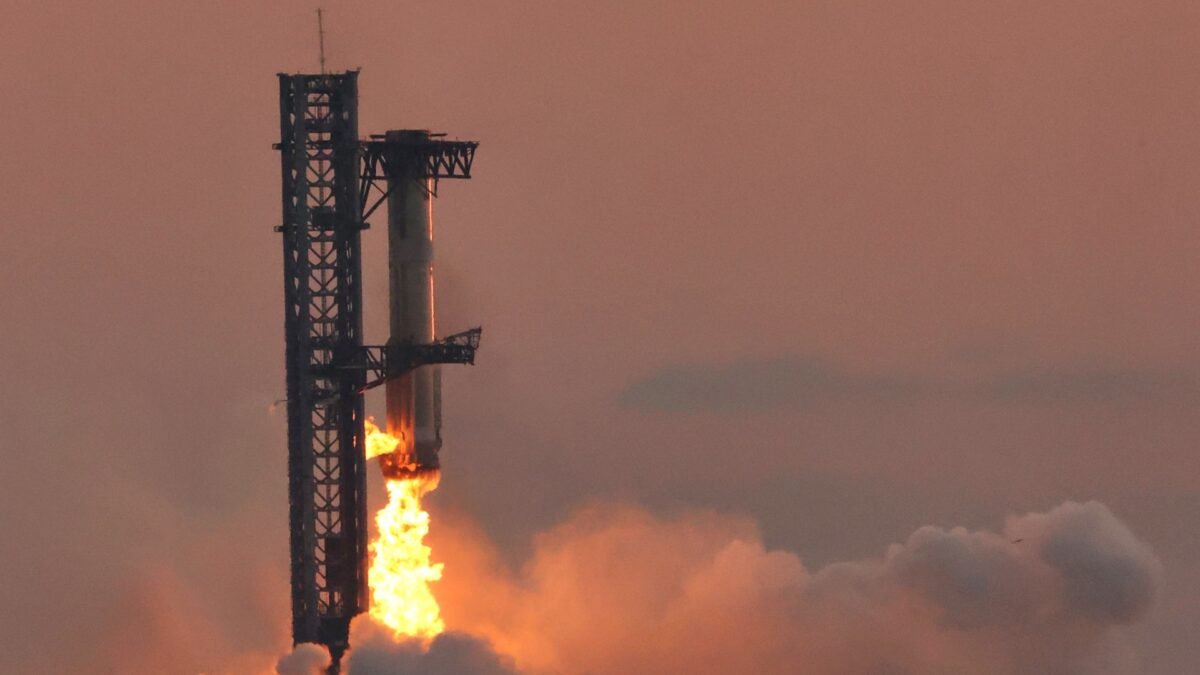
SpaceX has caught a Starship returning from orbit for the first time, snatching the giant spacecraft out of the sky with the mechanical arms of its launch tower in Texas after a flight of about 22 and a half hours. Ship 42, the upper stage of the world’s largest rocket, settled into the tower’s two arms, known as chopsticks, on Saturday afternoon, completing a manoeuvre no one had ever attempted before — and one that SpaceX needs to work if its dream of a fully reusable rocket is ever to become real.
The catch came at about 4:20 p.m. Eastern time on Saturday, 14 November, roughly 22 and a half hours after Flight 15 had lifted off from the same tower at SpaceX’s Starbase complex in South Texas, according to the Associated Press and Reuters. The stainless steel spacecraft had circled the Earth 14 times, deployed 26 Starlink internet satellites, and travelled some 350,000 miles (563,000 kilometres) before it came home. Cameras showed it dropping through the clouds, flipping upright, reigniting its engines and lowering itself gently between the arms of the tower the company calls Mechazilla, where it hung suspended above the ground as its engines shut down.
“Can you believe it?” SpaceX commentator Dan Huot shouted on the company’s webcast, dragging out each word, according to the Associated Press. “Look at her! Baby, she’s back!” Soon afterwards, Elon Musk congratulated his “incredible team”, and SpaceX posted on X: “Mechazilla catches Starship! Congratulations to the entire SpaceX team on this incredible achievement!” Huot added, in remarks reported by Agence France-Presse via the BBC: “We caught a Starship and now everything changes.”
It was the grand finale the company had hoped for — and only half of the plan. The first-stage Super Heavy booster, which was meant to be caught by the same tower minutes after Friday’s launch, was lost instead, exploding over the Gulf of Mexico after its engines shut down too early on the way back. SpaceX fell short of the “double catch” it had set out to achieve, the recovery of both stages of an orbital rocket in a single mission. But the ship’s return, after more than two years of trying, was the milestone that mattered most.
The catch, minute by minute
The 407-foot (124-metre) rocket — the largest and most powerful ever built — blasted off late on Friday afternoon from Starbase, near the United States-Mexico border, at 5:47 p.m. Eastern time, according to SpaceX and reporting by the Associated Press and Reuters. It was the 15th full-scale Starship flight since 2023, the first from Starbase’s second launch pad, and the first attempt to catch both stages of the rocket back at the pad. The Federal Aviation Administration had issued the necessary launch licence only on Friday afternoon, hours before the flight, according to Scientific American.
Its 33 Raptor engines pushed the combined stack — the 236-foot (72-metre) Super Heavy booster below and the 171-foot (52-metre) Starship spacecraft above — clear of the tower. The two stages separated cleanly, and the spacecraft soared on into orbit, only the second time a Starship has done so. About 35 minutes after launch it released its payload: 26 advanced Starlink V3 satellites, the latest generation of SpaceX’s internet constellation.
Then Ship 42 settled into a long, lonely vigil. It continued circling the world about 165 miles (265 kilometres) up, with live views of itself and the Earth streaming down via Starlink, according to the Associated Press. It completed 14 laps of the planet — far more than the one or two laps managed on the previous mission — in what became the longest Starship flight so far. A few of the satellites it had released photographed its heat shield for inspection as it flew, according to reporting by Space.com.
The return began early on Saturday afternoon, when the ship fired an engine to start its descent into the atmosphere. Travelling at an orbital speed of around 17,000 miles per hour, it faced intense heat as it slowed during re-entry, its black hexagonal heat-shield tiles glowing against the sky, before reaching the launch site. The Times reported that it was still travelling at about 17,500 miles per hour as it plunged through the clouds and decelerated with a sonic boom, then lowered itself into the two chopstick-style mechanical arms that caught it in mid-air.
SpaceX said everything on the spacecraft, including its vital heat shield, appeared to have worked well, according to the Associated Press. Its engines shut down after the catch, leaving the charred spacecraft suspended above the ground, and cameras panned up and down its scorched steel hull as it hung high above the pad. NASA welcomed the news. The space agency is paying SpaceX billions of dollars for Starship to land its Artemis astronauts on the Moon later this decade and to help build a permanent lunar base. “It was almost magic,” NASA Administrator Jared Isaacman said in a post on X, according to the Associated Press, adding that the achievement was making “more believers by the day” and was “one step closer” to the Moon.
The half that got away
The celebration was tempered by what had happened the day before. About six and a half minutes after liftoff, the Super Heavy booster was due to fly back to Starbase and be plucked from the sky by the same tower arms — a manoeuvre SpaceX has already pulled off three times, on Flights 5, 7 and 8. Instead, controllers diverted it to an offshore splashdown point in the Gulf of Mexico, and the booster exploded a short distance above the sea.
“Well, that certainly isn’t the news that we had hoped to hear for today,” SpaceX launch commentator Kate Tice said on the company’s webcast, according to the Associated Press, adding that the decision was in line with the many rigorous safety checks designed to protect the pad. Tice said the booster’s engines had stopped firing too soon on the way back down. Its guidance system sensed it was not in the right position and automatically initiated the watery detour and self-destruction. Engineers are still investigating the cause, and SpaceX said early indications pointed to a low fuel mass alarm, according to CNBC.
Wreckage remained in the Gulf of Mexico, cordoned off by buoys, as the spacecraft lowered itself upright at the launch pad a day later. The miss lands on the newest hardware: Booster 22 was the first Version 3 Super Heavy, the production model intended for Moon and Mars expeditions, and a Version 3 booster still has not made a successful return. The three earlier booster catches were all of earlier versions of the vehicle.
The loss of the booster meant the end of the double catch — the first time any rocket operator has tried to recover every piece of an orbital launch vehicle for reuse in a single flight. It was the goal SpaceX had set for Flight 15, and it remains the goal. Recovering both stages at the launch site is meant to speed inspection, refurbishment and reflight, which the company’s Starlink build-out and NASA’s Artemis Moon landings both depend on, according to SpaceX.
Fourteen laps, 26 satellites and a heat shield that held
For all the drama of the ending, the flight itself was the most complete Starship mission yet. Flight 14, in September, was the first Starship to reach orbit and to deploy operational Starlink satellites, but an engine failure cut its mission short. Flight 15 went further in almost every respect: orbit reached, a full payload of 26 Starlink V3 satellites deployed, 14 orbits completed, a deorbit burn performed, and the spacecraft brought home to the tower it had left.
The satellites matter as much as the catch. Starlink is the commercial engine of the whole Starship programme. SpaceX’s constellation already numbers more than 11,000 satellites, according to CNBC, and Starship is designed to carry up to 60 of the larger V3 satellites on a single flight — far more than the Falcon 9 can lift. The 26 deployed on Flight 15, added to the 26 deployed on Flight 14, bring the V3 total to 52 across the two orbital flights. Each Starship that flies and returns makes the business case for the giant rocket a little stronger, and each one that is lost makes it weaker.
The heat shield is the other half of the story. The black hexagonal tiles that cover the ship are designed to withstand the extreme temperatures of atmospheric re-entry, and they are not yet fully reusable, Reuters reported. SpaceX is developing new tile designs that would require little or no refurbishment between flights. Saturday’s flight was the first time a ship had survived re-entry from a full orbital mission and been recovered intact at the pad, giving engineers their first chance to inspect a heat shield that has actually been through the fire and come home.
That is the point of the whole exercise. SpaceX’s existing Falcon 9 rocket has a reusable first stage and has completed more than 700 launches since 2010, according to Reuters, but its second stage, which carries payloads into orbit, is discarded into the ocean after each flight. Musk wants Starship to operate more like a commercial aircraft, travelling to space and returning for repeated flights with minimal refurbishment. A ship that can be caught, inspected and flown again is the difference between a rocket you throw away and an aeroplane you keep.
A short, violent history
Starship’s road to Saturday’s catch has been long, public and often explosive. SpaceX began full-scale flight testing in April 2023, and the programme has blown up, broken apart or fallen short on many of the flights since. The company tests in public, breaks things, learns from the wreckage and flies again — a method that has produced both spectacular failures and, now, a spectacular first.
Flight 1, on 20 April 2023, ended with the rocket exploding about four minutes after launch, roughly 24 miles over the Gulf of Mexico. Flight 2, on 18 November 2023, demonstrated hot-stage separation — lighting the upper stage’s engines while it was still attached to the booster — but both stages were eventually lost. Flight 3, on 14 March 2024, saw the ship complete a full-duration burn and reach its intended velocity for the first time, then break up during re-entry. Flight 4, on 6 June 2024, brought both stages down in a controlled way for the first time, with the ship splashing down in the Indian Ocean.
Flight 5, on 13 October 2024, made headlines around the world. The Super Heavy booster flew back to its launch tower at Starbase and was caught in mid-air by the chopsticks on the first attempt — the first time any rocket stage had ever been caught that way. It was the moment the tower, Mechazilla, stopped being a curiosity and became a landing pad.
The next year was harder. On Flight 7, on 16 January 2025, SpaceX caught the booster a second time but lost the ship about eight and a half minutes into the flight, with debris falling over the Turks and Caicos. On Flight 8, on 6 March 2025, the tower caught the booster a third time, but the ship again suffered an energetic event in its rear section, lost several engines and then attitude control, and contact was lost about nine and a half minutes after liftoff. Flight 9, on 27 May 2025, flew a reused Super Heavy booster for the first time, but the booster broke apart about six minutes after launch.
Flight 10, on 26 August 2025, was a success: the ship deployed mock Starlink satellites and relit a Raptor engine in space. Flight 11, on 13 October 2025, was the last flight of the V2 ship. It hit its main goals, deploying eight Starlink simulators, flying a new banking manoeuvre, and splashing down in the Indian Ocean.
Then came Version 3. Flight 12, on 22 May 2026, debuted the taller V3 design with Raptor 3 engines and the first launch from Starbase’s second pad. Flight 13, on 24 July 2026, deployed the first real Starlink V3 satellites and splashed down intact. Flight 14, on 28 September 2026, became the first Starship mission to reach orbit, deploy operational Starlink V3 satellites, conduct a deorbit burn and splash down — though an engine failure cut the mission short of its planned 10 hours and six orbits. Flight 15 has now gone one better: orbit, payload, 14 orbits, and a catch.
Why NASA is watching
The stakes go well beyond SpaceX. NASA is relying on Starship for its lunar exploration plans, paying the company billions of dollars for the spacecraft to serve as a lunar lander for Artemis astronauts later this decade and to support the development of a permanent base on the Moon. The agency’s timetable is tight, and Starship is on its critical path.
Under NASA’s reshaped Artemis plan, announced in February 2026, the next mission, Artemis III, will not go to the Moon at all. Instead, in mid-2027, four astronauts will fly into low Earth orbit aboard NASA’s Orion capsule to practise docking with both Starship and Blue Origin’s Blue Moon lunar lander. The two companies will then take turns delivering crews to the lunar surface. NASA is targeting 2028 for Artemis IV, which aims to achieve humanity’s first Moon landing since the Apollo era more than half a century ago — and NASA expects to decide a year before that landing whether Starship or Blue Origin’s Blue Moon will carry the moonwalkers to the surface, according to the Associated Press.
The schedule has already slipped. NASA said earlier this year that the Starship-based lunar lander programme was delayed by at least two years from the plan made when SpaceX was selected as the contractor in 2021, according to the NASA Office of Inspector General, and NASA has removed a specific Moon landing assignment for either commercial lander. Every successful flight is therefore a small repayment of a large debt of time, and every failure is a reminder of how much remains to be proved — above all, orbital refuelling, which Starship must master before it can carry astronauts to the Moon at all.
SpaceX expects to begin launching Starships from Florida’s Kennedy Space Center within the next few months, according to the Associated Press. That site, alongside Starbase, would give the company a second launch complex and a faster flight rate — and it is the starting point for NASA’s next Artemis mission. A higher tempo matters because the Artemis plan needs not one Starship flight but many: tanker flights to refuel the lander in orbit, test flights of the lander itself, and then the crewed landing. None of that is possible while each ship is thrown away.
Musk’s ambitions are even grander than NASA’s. He wants to launch a fleet of Starships to build a city on Mars, and the system is also expected to support the company’s Starlink satellite business and its ambitions involving orbital data centres. Saturday’s catch was a step towards all of it, because a fully reusable Starship is the only way the arithmetic of those plans works: rockets that fly once are too expensive to build a city on another planet with.
Analysis: Why It Matters
The catch is the programme
Starship has now done almost everything it was designed to do, at least once: reach orbit, deploy a real payload, survive re-entry, and come home to the tower. Only the double catch is missing, and it is missing because of a booster, not the ship. That matters because the ship is the hard part. The booster flies a short, suborbital arc and comes back in minutes; the ship flies at 17,000 miles per hour, spends a day in orbit, and must survive the furnace of re-entry before it can even attempt a landing. Catching the booster was the proof of concept. Catching the ship is the proof of the vehicle.
Half a success is still a success — and still a failure
SpaceX will celebrate Saturday, and it should. But the company set out to catch both stages, and it caught one. The booster failure is not a footnote: it was the first Version 3 Super Heavy, the production model, and it failed on its first return attempt. A programme that needs dozens of flights a year cannot afford to lose a booster on every other flight, and it cannot afford a root cause it has not yet found. The honest reading of Flight 15 is that it proved the ship and indicted the booster, in the same mission, on the same day.
The heat shield is the quiet victory
The catch will dominate the headlines, but the heat shield may matter more in the long run. Every Starship that has returned from space until now has splashed down in an ocean, and a heat shield fished out of the sea tells engineers far less than one they can walk up to on dry land. For the first time, SpaceX has a ship that has been through orbital re-entry sitting on its own launch mount, intact, ready to be inspected tile by tile. If the tiles held, the path to rapid reuse shortens dramatically. If they did not, the company will know exactly where, and why, before the next flight.
NASA’s clock is the real deadline
SpaceX can afford to lose boosters. NASA cannot afford to lose years. The Artemis timetable — a docking test in Earth orbit in mid-2027, a landing in 2028 — assumes a Starship that flies often, refuels in orbit, and lands astronauts on the Moon. None of those things has been demonstrated yet, and the lander programme is already at least two years behind the plan drawn up in 2021. Saturday’s catch buys NASA confidence, but confidence is not a schedule. The agency will be watching the next flight, and the one after that, for the same thing: not whether Starship can do something once, but whether it can do it again, and again, and again.
The tower is now the landing pad
There is a larger shift hidden inside Saturday’s pictures. For seventy years, spacecraft have come home by parachute into the sea or onto a runway, and rockets have been thrown away. Mechazilla proposes a third way: a rocket that flies back to the building it launched from and is caught by it, like a plane returning to its own hangar. If it works at scale, the launch pad stops being a place rockets leave from and becomes a place they live. That is the bet SpaceX has made, and on Saturday, for the first time, the ship came home to prove it.
What to Watch Next
- The booster investigation: SpaceX engineers are still investigating why Booster 22’s engines shut down early. The root cause — and whether it points to the new Version 3 hardware — will decide how quickly the next flight can go.
- The double catch: Flight 16 will be the next attempt to catch both stages in a single mission. Until SpaceX does it, full reusability remains a goal rather than a demonstrated fact.
- The heat shield inspection: Engineers will now examine Ship 42’s tiles after a full orbital re-entry. The condition of the shield will show whether rapid reuse is close or still distant.
- Flight 16’s date: No date has been announced. The pace of the next flight — and whether it flies from Starbase or Florida — will signal how much confidence SpaceX took from Saturday.
- Florida launches: SpaceX expects to begin launching Starships from Kennedy Space Center within the next few months. The first Florida flight will be a test of a second launch complex and a faster tempo.
- Orbital refuelling: The unproven technology NASA needs most. Watch for any announcement of a propellant-transfer test, which Starship must master before it can carry astronauts to the Moon.
- Artemis III in mid-2027: Four astronauts are due to practise docking with Starship and Blue Origin’s Blue Moon in Earth orbit. Any slip in Starship’s flight rate now will show up in that mission first.
Sources
- Associated Press, via The Hindu BusinessLine — “SpaceX’s Starship makes historic return, caught by giant mechanical arms”
- Reuters, via The Times of India / 7Globe — “SpaceX’s Starship completes first-ever midair catch on return from orbit”
- BBC News — “SpaceX catches Starship rocket upper stage from space”
- The Times — “SpaceX ‘chopsticks’ catch rocket in world first”
- SpaceX — Starship Flight 15 (official launch page)
- Space.com — Starship Flight 15 live updates

About the Author — Abdul Mannan
Related Articles

UN Climate Chief Tells COP31 to ‘Move Swiftly’ as Fossil Fuel Divide Threatens a Deal in Antalya
UN climate chief Simon Stiell warned negotiators in Antalya to move swiftly to the hardest issues and avoid…
SpaceX Starship Reaches Orbit on Its Boldest Test Yet as Booster Explodes Over the Gulf
SpaceX's Starship reached orbit on its boldest test yet on Friday, but the Super Heavy booster exploded over…

Google Puts Gemini 4 Hydrogen Into Search for Every User in Its Biggest Upgrade Yet
Google has rolled out Gemini 4 Hydrogen, its fast new AI model, to every Search user worldwide, calling…