
Spain Votes in Snap Election as Far Right Eyes First Place in Government Since Franco

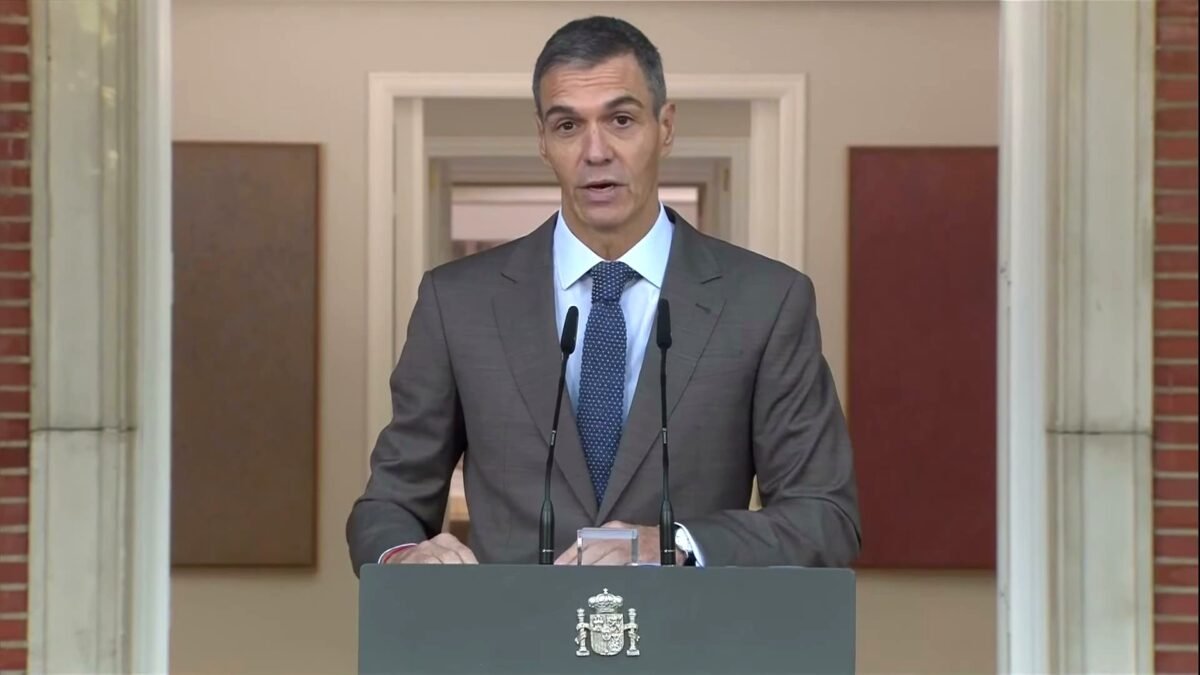
Spain votes on Sunday in a snap general election that could end eight years of Socialist-led government and bring a far-right party into national power for the first time since the country returned to democracy after the death of Francisco Franco. Polling stations open at 9 a.m. local time and close at 8 p.m., with the first results expected about an hour later, according to Reuters.
More than 38.6 million Spaniards are registered to vote for all 350 seats in the Congress of Deputies, the lower house of parliament, according to Spain’s Interior Ministry. A party or coalition needs 176 seats for an absolute majority. Voters will also elect most of the seats in the Senate.
The election is a straight choice, as Prime Minister Pedro Sánchez has framed it, between his Socialist government and a conservative-led alternative that would almost certainly depend on the far-right Vox party. Sánchez, 54, has led Spain since 2018 and is one of Europe’s last remaining left-wing leaders. His challenger is Alberto Núñez Feijóo, 65, leader of the conservative People’s Party, known as the PP. Behind Feijóo stands Santiago Abascal, 50, whose Vox party could hold the balance of power and demand cabinet posts in return for its support.
Almost every opinion poll published before Spain’s five-day polling blackout pointed the same way: the PP narrowly ahead, the Socialists close behind, and the two right-wing parties together above the 176-seat threshold. According to Reuters, the PP is polling at around 31 per cent, Sánchez’s Spanish Socialist Workers’ Party, the PSOE, at around 29 per cent, and Vox at roughly 18 per cent. The five final polls published before the blackout projected between 190 and 203 seats for the PP and Vox combined.
Yet Sánchez has refused to accept that the contest is lost. On Friday, the final day of campaigning, he insisted that his own party’s internal data showed he could still secure a majority with smaller left-wing parties, even though most published polls point to a centre-right victory. It is a familiar position for a leader who has defied the polls before: in 2023, Sánchez called a snap election after heavy losses in regional and local elections, most polls predicted he would lose power, and the PSOE instead recorded its best result as a share of the vote since 2008.
What the Polls Say
The final surveys, published before the legal blackout on new polls in the five days before voting, tell a consistent story with one striking exception. A 40dB survey for El País put the PP on 31.8 per cent and between 127 and 136 seats, the PSOE on 30.9 per cent and between 116 and 127 seats, and Vox on 17.3 per cent and between 51 and 61 seats, giving the right-wing bloc a majority. A GAD3 poll for ABC projected 194 seats for the PP and Vox together, while Ipsos for La Vanguardia projected 190, Data10 for OKDiario projected 196, and NC Report for La Razón projected at least 194. One pollster, Hamalgama Métrica for Vozpópuli, went further, projecting 210 seats for the two parties and 80 seats for Vox alone.
The single outlier is the state-run CIS institute, whose survey put the Socialists ahead on 34.4 per cent against 24.9 per cent for the PP and 15.6 per cent for Vox. Most polling averages exclude the CIS, and other pollsters have also produced different results: two firms, SW Demoscopia and Cluster17, put the Socialists first. The disagreement matters because it leaves open a second possibility, however unlikely the averages make it look: that the PSOE could finish first in votes and still struggle to govern, because the left is divided and its potential partners are weaker than they were in 2023.
The gap between the two main parties has narrowed during the campaign. According to Reuters, some polls showed the PSOE catching the PP but at the expense of a disillusioned far left, whose support Sánchez would need once more to form a government. That is the trap the Socialists are in: every vote they win back from the centre seems to cost them support on their own flank, and they need both to survive.
Why Sánchez Called the Vote
Sánchez called the snap election on 5 October, saying he needed a majority after parliament rejected emergency decrees he had proposed to tackle Spain’s mounting housing crisis. The vote in Congress on 2 October was lost when Junts, the Catalan party whose seven deputies had kept his minority government alive, withdrew its support. Without a budget of his own since 2023, Sánchez dissolved parliament and set the election for 29 November, months before it was due.
Housing is the issue that has defined this campaign, and one eviction in particular became its symbol. On 23 September, María del Carmen Abascal, an 87-year-old pensioner in a wheelchair, was forcibly removed from the Madrid flat where she had lived for seventy years. Her case, reported by the Council on Foreign Relations, turned a national argument about rents and evictions into a human story that every voter could understand, and it helped to push Sánchez towards the election he then called. The German Marshall Fund notes that her eviction and later death, together with the Ceuta migration crisis two months earlier, corruption allegations and deadly rail accidents, led Sánchez to call the snap vote.
In response to the housing protests, Sánchez introduced emergency measures including restrictions on rent increases, but parliament defeated them. The left and the right now offer sharply different answers to the same problem. The Socialists and their allies have promised rent controls and stronger protection against eviction, while the PP has focused on building more homes, tax breaks for homebuyers and loosening planning rules. Vox, meanwhile, wants to give Spaniards priority over foreign residents in the queue for public housing.
A Campaign Shaped by Housing, Trains and Corruption
If housing set the election in motion, three other crises shaped the campaign that followed. The first was the rail disaster near Urda, close to Toledo, where a high-speed train collision killed 69 people in October. It was the second major train incident in Spain this year, and the two crashes together claimed 115 lives. Transport Minister Óscar Puente resigned in the aftermath, and the disaster fed a wider argument about the competence of the government. Sánchez announced the election before the second crash, but the accidents became part of the case against him all the same.
The second was a migration crisis in Ceuta, the Spanish enclave on the North African coast, where a surge of arrivals tested the government’s border policy and gave Vox one of its strongest campaign themes. The third was a nationwide power outage, which joined the list of incidents that Sánchez’s critics cite as evidence of poor management. Around them sits a long-running series of corruption allegations involving the prime minister’s inner circle and his family, including his wife, Begoña Gómez, whose role has been a recurring feature of the campaign.
Feijóo, who has governed Galicia for thirteen years and presents himself as a technocrat with an eye for detail, has tried to make the election a verdict on management rather than ideology. Sánchez, by contrast, has tried to make it a verdict on values, describing the prospect of a PP-Vox coalition as a regression and warning voters of a far-right wave that brings regression wherever it governs. He has called on Spaniards to deliver a larger left-leaning majority capable of taking on the elites, achieving new social advances, and continuing to transform Spain.
Sánchez also carries a political wound from 2023 that his opponents have not let him forget. After that election, in which the PP won the most votes but fell short of a majority, he stayed in power by granting an amnesty to the leaders of Catalonia’s attempt to separate from Spain in exchange for their support in parliament. His critics present that deal as proof that he will pay any price to stay in office; his supporters present it as the price of keeping Spain governable.
What a PP-Vox Government Would Mean
The most likely outcome, according to the polls and the analysts who follow them, is a coalition or confidence-and-supply arrangement between the PP and Vox. The two parties already govern together in four of Spain’s regions, so the partnership is not untested, but taking it to national government would be a step of a different order. It would put a far-right party in cabinet for the first time since Franco’s death in 1975, and it would make Spain the latest large European country to swing to the right.
Vox’s programme is clear about what it wants. According to Reuters, the party advocates tougher immigration controls, the recentralisation of state powers, lower taxes and the reversal of many progressive social policies. It wants to deport convicted foreign nationals and to give Spaniards priority in access to public services and housing. The PP’s own immigration plans are less sweeping but still a sharp break with the current government: it says it would prohibit mass amnesties for undocumented migrants, allow returns to third countries and introduce a points-based system for legal immigration.
On the economy and the climate, the PP has promised to cut taxes, relax climate rules and extend the operating licences of Spain’s five nuclear power plants. That would reverse the direction of Sánchez’s government, which has presented Spain as a champion of green policy in Europe. Vox would push further, seeking to unwind progressive social legislation that Sánchez regards as part of his legacy.
Whether Vox actually takes ministries is not settled. Analysts say that, depending on how many seats Vox wins, it could choose to support a PP minority government from outside rather than entering the cabinet. Feijóo has said that forming a coalition with Vox does not depend on him, and he has ruled out asking the Socialists to abstain so that he can govern without the far right. The bargaining over ministries, if the right wins, is likely to be long and difficult. Under Spain’s rules there is no formal deadline before the first investiture vote, but if no candidate wins the confidence of parliament within two months of that attempt, fresh elections are automatically triggered.
The new lower house will meet on 23 December and elect a speaker. King Felipe will then nominate a candidate for prime minister, usually the leader of the most-voted party, according to Reuters. Whoever is nominated will need to assemble a majority in a parliament where neither bloc, on most projections, commands it comfortably.
The European Stakes
The result will be watched far beyond Spain, because it could redraw the balance of power inside the European Union. According to Reuters, a defeat for Sánchez would leave only three countries in the EU — Denmark, Lithuania and Malta — with centre-left leaders. Sánchez has also positioned himself as a counterweight to President Donald Trump on the world stage, and as a defender of immigration at a time when most of Europe is tightening its borders. A PP-led government would, in the words of the German Marshall Fund, end that approach and return Spain to a more measured style, broadly aligned with Europe’s centrist mainstream on most transatlantic questions.
Vox’s arrival in national government would also matter for Europe’s far right as a movement. Abascal presides over Patriots for Europe, the Eurosceptic far-right alliance that includes Marine Le Pen’s National Rally in France and Matteo Salvini’s League in Italy. According to the German Marshall Fund, Vox would become the Patriots’ third foothold inside an EU government, alongside the League in Italy and ANO in the Czech Republic. That would strengthen the far right’s ability to block or delay decisions in the European Council and the Council of Ministers on issues such as migration, climate, trade and Ukraine.
For decades Spain was seen as relatively resistant to the far-right populism that has spread across Europe, in part because of the country’s own experience of dictatorship under Franco. CBS News notes that this resistance is now being tested as never before. Vox was founded in 2013 and won only 33 seats in 2023, but the polls suggest it could nearly double that total, winning between 55 and 69 seats, according to the University of St. Gallen’s HSG Focus. In some projections it reaches 80. For a party that was a minor force a decade ago, that would be a transformation.
Spain’s economy is part of the argument on both sides. Sánchez points to one of the fastest-growing economies in the EU, according to Reuters, bolstered by a rise in the minimum wage and a labour reform that has pushed unemployment to its lowest level in almost two decades. But many Spaniards say they are not feeling the effects of those headline gains, because of rising prices for housing, energy and consumer goods. Economists also warn that the boom has been fuelled by migrants, and that the anti-immigration policies of a potential right-wing government could stifle growth. Sánchez has rowed against the tide by promoting immigration as an economic benefit, even as most of Europe moves in the opposite direction.
Analysis: Why It Matters
This election is about more than who governs Spain for the next four years. It is a test of three propositions that will shape European politics well beyond this weekend, and the result will be read in Paris, Berlin, Warsaw and Rome as much as in Madrid.
The first proposition is that a government can survive on values alone when voters feel poorer. Sánchez’s record, on the numbers, is strong: fast growth, falling unemployment, a rising minimum wage, and a labour reform that gave millions of workers more security. Yet the campaign has been fought on the ground where those numbers do not reach — the rent that rises faster than the wage, the flat that a family can no longer afford, the electricity bill that eats the pay rise. The 87-year-old woman evicted from the home she had lived in for seventy years did more damage to Sánchez than any opposition speech, because she turned an abstract housing crisis into a moral fact. Governments that deliver growth but not security discover, sooner or later, that voters judge them on the second, not the first. If Sánchez loses, it will be because the economy he built did not feel like prosperity to enough of the people who live in it.
The second proposition is that Spain’s immunity to the far right was permanent. It was never a law of nature; it was a memory. The generation that lived under Franco is passing, and the voters who will decide this election have no personal memory of dictatorship. What they have instead is a housing market that shuts them out, a border crisis that frightens them, and a political class that seems unable to fix either. Vox has understood that the far right does not need to win an argument about the past when it can win one about the present. Its rise from 33 seats to a projected 60 or more is not a sudden conversion of Spain to extremism; it is the steady accumulation of grievances that the mainstream parties left unanswered. The PP’s willingness to govern with Vox, after years of treating it as untouchable, is the moment when that accumulation becomes institutional. Once a far-right party holds ministries in a major European state, the question for every other centre-right party in Europe changes from whether it can be done to why it should not be done at home.
The third proposition is that the centre can still hold when the left is divided against itself. Sánchez’s problem is not only that the right is united in its arithmetic; it is that the left is not. In 2023, the hard-left parties fought together under the Sumar banner and won 31 seats. This time, Frente Amplio and Podemos are competing separately, and the polls put the Broad Front on course for only 10 to 15 seats, with Podemos at risk of losing its parliamentary representation altogether. Every seat the left loses to its own divisions is a seat the right does not need to win. Sánchez’s gamble in calling this election was that a clear choice would concentrate the left behind him. The polls suggest the opposite has happened: the left has fragmented while the right has consolidated, and the voters who are most disillusioned with Sánchez are drifting not to another party of the left but out of politics altogether, or across to the right.
There is, however, a real chance that the polls are wrong again, and it would be a mistake to treat the PP-Vox majority as a settled fact. Spanish pollsters have missed before, and Sánchez has a record of outperforming expectations when the campaign reaches its final days. His argument — that this is a choice between social justice and regression — is aimed squarely at the voters who stayed home in 2023 or voted for smaller parties, and he has set a turnout target of 75 per cent. If turnout surges, and if the late movement towards the PSOE that some polls detected continues, the arithmetic could shift by enough seats to deny the right its majority and leave Spain with another hung parliament. The CIS poll, dismissed by most averages, may be an outlier, but it is a reminder that the electorate is not a spreadsheet, and that the voters who answer pollsters are not always the voters who turn up.
Whatever the result, the aftermath will be long. If the right wins, the negotiation over ministries will test whether Feijóo can contain a partner that wants to move faster and further than he does, and whether Vox prefers power inside the government or leverage from outside it. If Sánchez survives, he will govern with a left that is weaker and more divided than the one that carried him into office, and with a right that will regard his survival as an accident to be corrected. And if no bloc wins a majority, Spain faces weeks of bargaining under a two-month clock that ends, if it runs out, in yet another election. None of those paths is stable, and none of them resolves the housing crisis, the railways or the corruption cases that brought Spain to this vote. The election will settle who governs. It will not settle what is wrong.
What to Watch Next
The first numbers will come at 8 p.m. local time, when polling stations close on the mainland and broadcasters release their exit polls. Provisional results from the Interior Ministry will begin to appear about an hour later, and the overall picture should be clear before midnight. Three things will matter most. First, the size of the PP-Vox combined total: above 176 seats, a right-wing government becomes a matter of negotiation rather than arithmetic. Second, the gap between the PP and the PSOE: if the Socialists finish first in votes, Sánchez will claim a mandate to try to govern even without a majority, and the battle will move to the smaller parties. Third, turnout: a high turnout has historically favoured the left, and Sánchez’s team will be watching the participation figures as closely as the seat counts.
Beyond election night, the calendar is fixed. The new Congress meets on 23 December to elect its speaker, and King Felipe will then nominate a candidate for prime minister. From the first investiture vote, the two-month clock starts. Spain has been here before, in 2015 and 2016 and again in 2019, when months of deadlock ended in repeat elections. The country will hope this time is different. The polls say it may not be.
Sources
- Reuters — Spain heads to polls with far right in sight of power, 29 November 2026
- BBC News — Spanish election: What you need to know and what is at stake
- Council on Foreign Relations — Spain’s Election Could Spark Europe’s Next Right-Wing Wave, 24 November 2026
- German Marshall Fund of the United States — Spain’s Snap Election and the Stakes for Europe
- Wikimedia Commons — La Moncloa video of Pedro Sánchez announcing the 29 November election, 5 October 2026 (source of the featured image still)

About the Author — Abdul Mannan
Related Articles
Myanmar Military Strikes Kill Dozens at Wedding Venue and School in Three Days of Bombing
At least 21 people, including five children, were killed when a military airstrike hit a wedding in Moe…
Sea Tribunal Rejects Argentina’s Bid to Halt Falkland Islands Oil Drilling in 18–3 Ruling
The Hamburg tribunal ruled 18–3 that Argentina's bid to halt the Sea Lion oil project could not be…
Taiwan’s Ruling Party Posts Best Local Election Result in a Decade as Voters Back Nuclear Power Revival
Taiwan's ruling DPP nearly doubled its local governments in Saturday's elections, its best result in a decade, while…