
Trump Calls Ukraine’s Refinery Strikes ‘a Disgrace’ as EU Leaders Rally Around Zelenskyy at Brussels Summit

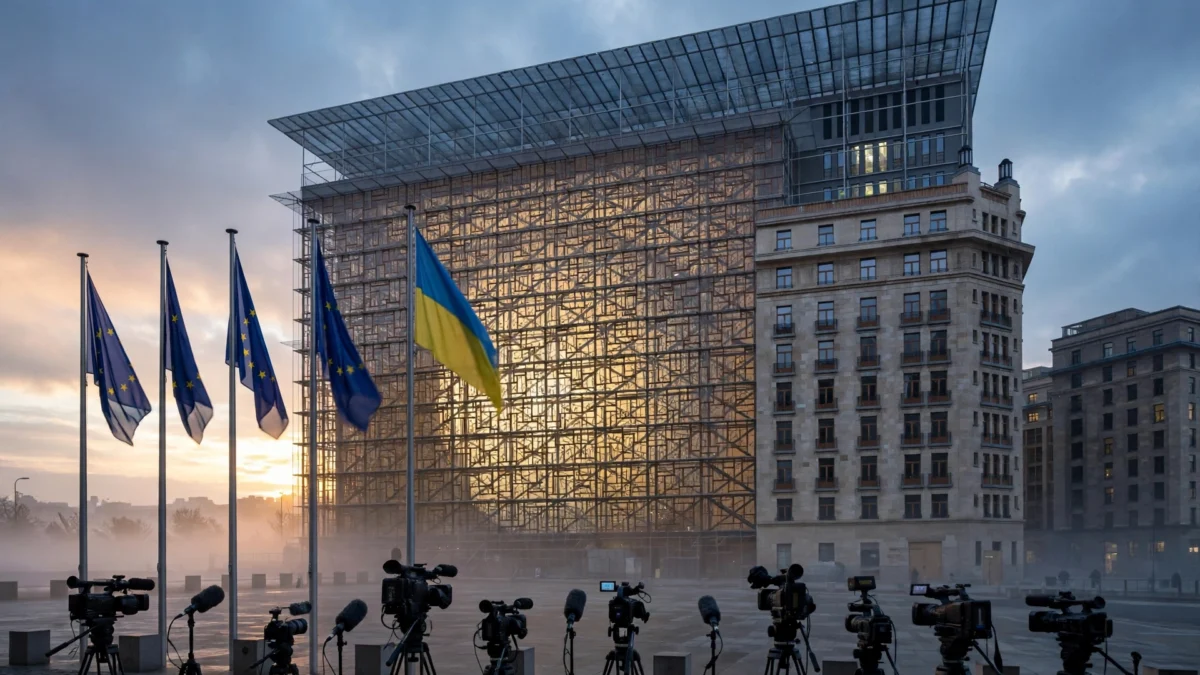
The Summit — Europe Closes Ranks
European Union leaders closed ranks around Ukrainian President Volodymyr Zelenskyy at a summit in Brussels on Friday, pledging continued support for Kyiv at one of the most difficult moments in the country’s war with Russia, as United States President Donald Trump publicly branded Ukraine’s renewed strikes on Russian oil refineries “a disgrace.”
Zelenskyy arrived at the summit with two principal requests, according to EU Observer: more money for Kyiv’s defence and more sanctions against Russia. The main topic of the talks was energy and how Ukraine should prepare for the difficult months ahead, with the Ukrainian president telling reporters that the “winter package” under discussion would cover far more than fuel.
“We want to end this war as quick as possible. We don’t see now signals from the Russian side that they are ready for this, to end this war, that’s why we have to prepare for the winter,” Zelenskyy said as he arrived at the summit, according to Reuters. “The winter package is not only energy, it’s also air defence and funding,” he added, noting that he would discuss Ukraine’s needs for the rest of this year and for 2027.
“I am happy to be here. I am grateful that we have such enormous support from the EU, the Council, the Commission and the leaders — real leaders,” Zelenskyy said on his way into the summit, according to the Sweden Herald.
The displays of solidarity were emphatic. European Commission President Ursula von der Leyen said the bloc would not lift any sanctions on Russia, and discussions were underway on a 22nd sanctions package. European Council President António Costa said the EU’s support remained firm. “The EU’s support for Ukraine remains as strong as ever. This is not the time to withdraw support for Ukraine or reduce pressure on Russia,” Costa said, according to the Sweden Herald.
French President Emmanuel Macron, who met Zelenskyy alongside NATO Secretary General Mark Rutte in Brussels on Thursday, said it was crucial that Ukraine receive “all the means necessary to protect itself.” Polish Prime Minister Donald Tusk posted a message of solidarity online: “I can reassure you, dear Ukrainian friends and President Zelenskyy: YOU ARE NOT ALONE,” according to reports. The EU has set up a support loan for Kyiv worth €90 billion (about $100.8 billion) covering 2026 and 2027, and has been urging Ukraine’s international allies to step up their funding.
Progress was also noted on Ukraine’s EU membership path: last week Kyiv was allowed to open two more negotiation clusters, and von der Leyen said the goal was now to open the last two clusters before the end of the year.
The Breaking Point — Trump’s “Disgrace” and the Collapsed Energy Truce
Hours before the summit’s main session, Trump launched a fresh verbal attack on Kyiv in an interview with the Newsmax news outlet. Asked about Ukraine’s renewed strikes on Russian refineries, the US president said: “All he’s doing is making the world oil price higher. Well, I think that’s a disgrace,” according to Reuters.
The strike in question was a Ukrainian drone attack on a refinery in Russia’s Ryazan region, roughly 300 kilometres southeast of Moscow, which triggered a fire at the facility. The strike came after Zelenskyy told the Financial Times in an interview published Thursday that Ukraine was abandoning the brief pause in energy-target attacks. “The block [on attacking refineries] is out. We’re done,” he was quoted as saying.
That pause dated back to Sunday, when Trump blindsided both Kyiv and Moscow by announcing that Ukraine and Russia had agreed not to target each other’s energy facilities. Moscow never confirmed the arrangement, and Kyiv says Russia kept striking Ukrainian energy infrastructure throughout the supposed truce, leaving hundreds of thousands of Ukrainian homes without power. As he met Macron in Brussels on Thursday, Zelenskyy said the Kremlin had “launched yet another vile drone strike on Ukrainian energy infrastructure” in the city of Lutsk, causing blackouts, according to reports.
Trump went further in the Newsmax interview, asserting that he found Zelenskyy “more difficult to deal with than Putin” when it comes to reaching a compromise to end the war, according to multiple reports citing the interview.
The Intelligence and Starlink Rift
Beneath the public dispute over refinery strikes lies a deeper rupture over the instruments of modern warfare. Zelenskyy has said Ukraine was denied the usual Western intelligence on Russian ballistic missile strikes in recent days and that limits were placed on its use of Starlink satellite communication terminals — both vital for the Ukrainian military’s drone operations and air defences.
During a visit to London this week, the Ukrainian president said the sudden restriction of Starlink had left him feeling personally betrayed by Trump and lamented losing a partner, according to reports. Ukraine’s Starshield satellite system was also degraded, with Zelenskyy quoted as saying: “It was not a technical problem; it was the will.” US officials told the Ukrainians that if they would not stop the refinery strikes, Washington would block intelligence sharing, according to Zelenskyy’s account given to the Financial Times.
Britain’s defence secretary Wes Streeting said on Thursday that his US counterpart, Pete Hegseth, had assured him in a face-to-face meeting that the satellite communications system had been restored, though he told the BBC it was unclear what had caused the disruption. “This is not the first time we’ve seen a falling out between Washington and Kyiv,” he said, according to reports.
The Midterms Calculus
Trump’s hostility to the refinery strikes is openly tied to American domestic politics. Facing US midterm elections in November, the president has blamed Ukrainian strikes on Russian refineries for pushing up energy prices that could cost Republicans at the ballot box, according to Reuters.
The economics of the dispute are entangled with an unusual American commercial move: the Trump administration recently announced plans to buy hundreds of thousands of tons of diesel from Russia, a deal that has drawn sharp criticism from Democratic lawmakers. A senior administration official said this week that Ukrainian refinery strikes were “not acceptable to President Trump,” and the administration is also considering easing sanctions on so-called shadow fleet vessels that have transported oil and petroleum products from Russia, a US official said on Wednesday, according to Reuters.
Russian Foreign Minister Sergey Lavrov labelled Ukraine’s refinery strikes a “direct and crude challenge to President Trump,” while Kremlin spokesman Dmitry Peskov claimed Ukraine never halted its attacks. It has not been possible to independently verify each side’s claims about the scope of the strikes during the pause.
Moscow’s Counter-Move — Seizing European Assets
As Zelenskyy arrived in Brussels, Russia moved to tighten the screws on Europe. On Thursday, President Vladimir Putin signed a decree placing the local assets of four more European companies under temporary management: French flooring maker Tarkett, German packaging maker Menshen, Swedish packaging firm Sverige International Holdings and Dutch packaging maker Sonoco, according to Reuters.
The move followed a similar action last month against food giant Nestlé and retailers Auchan and Metro. The Kremlin said the measure was a response to EU nations’ role in the war and stressed that it was “reversible” — language Moscow has used before as both a threat and a negotiating signal.
The decree came as reports emerged that the United States could seek control of some Russian assets frozen in Europe, adding another layer of tension to an already crowded summit agenda.
Analysis — Why It Matters
The Brussels summit may come to be remembered less for what Europe decided than for what it revealed: the United States and Europe are now operating on fundamentally different theories of how this war should end — and Washington’s theory increasingly casts Kyiv as the obstacle rather than Moscow.
Trump’s framing of Ukrainian refinery strikes as a “disgrace” that raises global oil prices inverts the logic that has guided Western policy since 2022. For three years, the argument was that degrading Russia’s war economy — and its energy revenues in particular — was a legitimate and necessary way to shorten the war. The administration’s position now treats those same strikes as a domestic political liability, with November’s midterms explicitly in view. That shift turns Ukraine’s military strategy into an American electoral variable, something no Ukrainian leader could have anticipated when planning a campaign season.
Europe, by contrast, is stepping into the space Washington is vacating. The €90 billion support loan, the talk of a 22nd sanctions package, the insistence that sanctions will not be lifted, and the EU accession timetable all send the same message: Brussels is preparing to carry Ukraine’s financing for 2026 and 2027 with or without Washington. Tusk’s “YOU ARE NOT ALONE” and Macron’s pledge of “all the means necessary” are not mere rhetoric; they are the public scaffolding of a strategic decision to Europeanise the war effort.
Yet Europe’s solidarity has limits that the summit did not fully conceal. EU leaders were reportedly not expected to make large-scale new commitments beyond words of encouragement, and the funding discussions ahead are brutally difficult — they involve the bloc’s long-term budget, energy prices at home, and competition from Chinese exports. Solidarity statements are free; air defence batteries and winter energy packages are not.
The intelligence and Starlink episode may prove the most consequential development of all. By demonstrating that the tap feeding Ukraine’s battlefield awareness can be turned off remotely and at political will, Washington has shown Kyiv — and every other American ally watching — that dependence on US-provided military technology carries a coercion premium. Europe has no near-term substitute for American intelligence feeds or satellite constellations, which means Ukraine’s military effectiveness now hangs partly on the mood of the US president. That structural vulnerability will shape Kyiv’s negotiating behaviour for years.
Finally, Russia’s asset seizures are a reminder that Moscow reads Western disunity in real time and moves to price it. The temporary-management decrees against European firms are calibrated pressure: painful enough to concentrate boardroom minds in Paris, Berlin, Stockholm and Amsterdam, yet “reversible” enough to leave room for a deal. Putin’s timing — hours before Zelenskyy’s summit appearance — was no accident. It was a message to the Europeans in the room: support for Ukraine has a balance-sheet cost, and Moscow will keep itemising it.
What to Watch Next
- The summit’s concrete outcomes: whether EU leaders agree on the structure of the 22nd Russia sanctions package, fresh funding mechanisms for 2027, and the winter energy package Zelenskyy requested — words of encouragement are not the same as committed money.
- The shadow-fleet decision: whether the Trump administration follows through on easing sanctions on vessels transporting Russian oil — a move that would directly undercut Europe’s sanctions architecture and reward Moscow’s energy trade.
- Winter as a battlefield: with both sides targeting energy infrastructure, the coming months will test whether Europe’s promised winter package can keep Ukrainian cities heated and lit — and whether Ukraine sustains its refinery campaign despite US pressure.
- The midterms factor: whether Trump’s criticism of Kyiv intensifies as the November US midterms approach, and whether energy prices become the lever that reshapes American Ukraine policy after the vote.
- Russia’s corporate squeeze: whether Moscow extends its temporary-management decrees to more European firms, and how the affected companies and their governments respond — the reversibility of the measures gives both sides room to bargain.
Sources
- Reuters — EU leaders rally around Zelenskiy as Trump calls Ukrainian strikes on Russia a ‘disgrace’
- Reuters — Russia moves on more European firms ahead of Zelenskiy’s appearance at EU summit
- Sweden Herald — Zelensky thanks ‘real leaders’ in Europe for support at Brussels EU summit
- EU Agenda — Zelensky urges unity, more money for Ukraine and sanctions on Russia ahead of key summit (via EU Observer)

About the Author — Abdul Mannan
Related Articles
Five Killed as Houthi Missiles Strike Yemen’s Presidential Palace in Aden
Houthi missiles struck Yemen's Al-Maashiq presidential palace in Aden on Thursday, killing five and wounding sixteen, in the…
Zelensky Ends Ukraine’s Energy-Strike Pause as Drones Set Fire to Russia’s Ryazan Refinery: “We’re Done”
Ukraine ended its three-day pause on striking Russian energy targets after Vladimir Zelenskyy told the Financial Times the…

Colombia Opens Embassy in Jerusalem, Restoring Israel Ties Broken Under Petro
Colombia inaugurated its embassy in Jerusalem on Wednesday, becoming the tenth country to locate its mission in the…