
Trump Signs Bill Ending Longest Government Shutdown in US History as House Passes Funding Deal 222-209

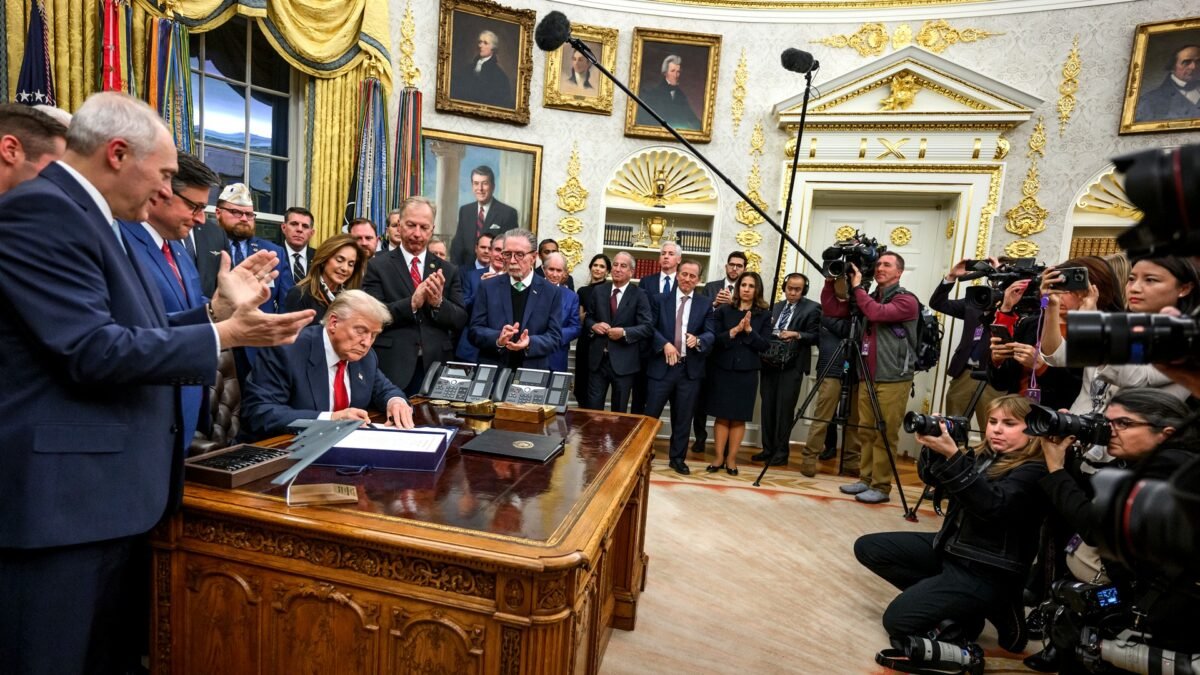
President Donald Trump signed a government funding bill into law in the Oval Office on Wednesday night, ending the longest government shutdown in American history after 42 days in which hundreds of thousands of federal workers went without pay, food assistance for millions of families was thrown into doubt, and air travel across the country was disrupted. The signing, at about 9:45 p.m. Eastern time, came less than two hours after the House of Representatives approved the measure by 222 votes to 209, according to the Associated Press.
The shutdown, which began on 1 October when Congress failed to pass funding for the new fiscal year, passed the previous record of 35 days set during the funding lapse of December 2018 to January 2019, in Mr Trump’s first term. Federal agencies were expected to begin reopening within hours, with furloughed workers returning to their jobs on Thursday and back pay to follow, according to the White House and congressional leaders.
Flanked by Republican lawmakers around the Resolute Desk, Mr Trump used the signing ceremony to blame Democrats for the standoff and to warn voters to remember it. “So I just want to tell the American people, you should not forget this,” he said, according to the Associated Press. “When we come up to midterms and other things, don’t forget what they’ve done to our country.” He also told those present that “the country has never been in better shape” and described the shutdown as a “short-term disaster” caused by Democrats who, in his words, thought it would help them politically.
The bill does not settle the argument that caused the shutdown. It contains no extension of the enhanced tax credits that lower the cost of health insurance bought through the Affordable Care Act marketplaces, the demand Democrats made the condition of their support for six weeks. Those credits expire at the end of December, and the promise Democrats extracted in return is a Senate vote on extending them, no later than the second week of December, rather than the extension itself.
The House vote
The House approved the spending package on Wednesday evening in a vote that was mostly along party lines, according to the Associated Press and States Newsroom. It was the first time the chamber had taken up legislation since mid-September, when Republican leaders sent members home after passing a stopgap measure they knew could not advance in the Senate. The recess, which lasted nearly two months, was itself part of the pressure strategy in the standoff.
Two Republicans voted against the bill: Thomas Massie of Kentucky and Greg Steube of Florida. Six Democrats voted for it: Henry Cuellar of Texas, Don Davis of North Carolina, Jared Golden of Maine, Adam Gray of California, Marie Gluesenkamp Perez of Washington state and Tom Suozzi of New York, according to States Newsroom. The result was announced on the House floor just before 7:30 p.m. Central time.
Tom Cole of Oklahoma, the Republican chairman of the Appropriations Committee, urged support for the legislation during the debate, telling colleagues that “history reminds us that shutdowns never change the outcome.” He added, according to States Newsroom: “Over the last 43 days the facts did not shift, the votes required did not shift, the path forward did not change. The only thing that did move was the level of pain Democrats inflicted on the nation.” Mr Cole’s figure of 43 days reflects the count used by several news wires; by the calendar, the funding lapse ran from 1 October to 11 November.
Rosa DeLauro of Connecticut, the senior Democrat on the spending panel, rejected the bill and said it did nothing to address the rising cost of health care. “More than 20 million Americans will have to pay double, even triple, their monthly insurance premium in just a matter of weeks,” she said, according to States Newsroom. “And this bill leaves families without even a glimmer of hope that their costs might go down.”
One of the most striking moments of the debate came from Mikie Sherrill, the Democratic representative from New Jersey who was recently elected as the state’s next governor and was making what was likely her last appearance on the House floor before resigning next week. In an emotional farewell speech opposing the bill, she told her colleagues: “Do not let this body become a ceremonial red stamp for an administration that takes food away from children and rips away healthcare.” Addressing the country, she added: “As we say in the Navy, don’t give up the ship.”
What the bill contains
The legislation is a 394-page package that the Senate substantially reworked from the stopgap bill the House originally passed in mid-September, according to States Newsroom. Its core is a continuing resolution that funds most of the federal government at existing levels through 30 January 2027, giving Congress about eleven more weeks to complete the full-year spending bills for the fiscal year that began on 1 October.
Attached to the stopgap are three full-year spending bills that fund their areas through 30 September: the Agriculture Department, including the Food and Drug Administration; the Department of Veterans Affairs and military construction; and the legislative branch, which is Congress itself. The Agriculture and military construction bills also contain tens of billions of dollars in earmarks requested by lawmakers from both parties, according to States Newsroom.
One provision matters to millions of households immediately. The Supplemental Nutrition Assistance Program, the food assistance programme used by about 42 million lower-income Americans, is fully funded through the end of the fiscal year under the Agriculture bill, so benefits no longer depend on the next round of negotiations. That guarantee arrives in the same week that the Agriculture Department separately proposed a rule to tighten eligibility for the programme, a proposal that would remove about 6.3 million people from food stamps if finalised. The two developments are distinct: the funding bill secures the money, while the proposed rule would change who qualifies for it.
The package also reverses the Trump administration’s firing of furloughed federal workers during the shutdown and bars further layoffs through January. It requires back pay for all federal workers, including those furloughed during the shutdown. Mr Trump had at one point during the standoff threatened to withhold that back pay, although it is required by law. The White House issued a statement of administration policy a few hours before the House vote, strongly supporting the bill and describing it as “a fiscally responsible package that provides the full-year funding necessary to support the Nation’s veterans, farmers, and rural communities.” The statement added that the measure “ends disruptions to programs the American people rely on and ensures the thousands of Federal employees who have been forced to work without a paycheck, such as air traffic controllers, will be promptly paid.”
Security funding is also included. The package provides 30 million dollars for the United States Capitol Police to enhance protections for lawmakers, 30 million dollars for the United States Marshals Service to bolster security for members of the judicial and executive branches, and 28 million dollars for enhanced safety for Supreme Court justices, according to States Newsroom. The Associated Press reported a larger overall security figure of 203.5 million dollars for lawmakers’ security, a difference that appears to reflect additional items counted in the wider total.
How the deadlock broke
The shutdown ended the way it had been heading since Sunday night, when the Senate first cracked the deadlock. After nearly six weeks of failed procedural votes, seven centrist Senate Democrats and one independent broke with their party’s leaders on Sunday to advance a reworked spending package, and the same eight then voted to approve the legislation on Monday night by 60 votes to 40, the threshold needed to overcome a filibuster.
The eight were Dick Durbin of Illinois, John Fetterman of Pennsylvania, Maggie Hassan and Jeanne Shaheen of New Hampshire, Tim Kaine of Virginia, Catherine Cortez Masto and Jacky Rosen of Nevada, and Angus King of Maine, an independent who caucuses with the Democrats, according to Vellum Daily and the Associated Press. Most other Democrats voted no, including the Senate Democratic leader, Chuck Schumer, who argued the deal gave up too much. The negotiators said the country could not wait any longer, pointing to airport security lines, food assistance offices and unpaid workers in every state.
The Senate vote on Monday night did not reopen anything by itself. Until the House passed the same bill and the president signed it, federal workers remained unpaid, food aid stayed in limbo and the government stayed shut. What Monday night did was clear the hardest hurdle: the Senate, where a weeks-long standoff had blocked every earlier attempt. Fourteen earlier procedural votes on the House-passed funding bill had gone nowhere.
The shutdown began on 1 October, the first day of the federal fiscal year, when all twelve annual appropriations bills had lapsed and no continuing resolution was in force. The central dispute was whether a stopgap should extend the enhanced Affordable Care Act premium tax credits that were scheduled to expire at the end of December. Democrats refused to supply the votes to advance the Republican funding bill without that extension, and Republicans refused to tie the extension to a funding bill. Over 42 days, the effects spread from airport security lines to food assistance offices, with thousands of flights cancelled or delayed, federal workers missing pay cheques, and long lines at food banks.
The health-care fight is postponed, not settled
The one thing the deal does not do is the thing Democrats spent six weeks demanding. It does not extend the Affordable Care Act subsidies that help millions of people pay for health insurance, and those subsidies expire at the end of December. Without an extension, premiums for many plans are expected to jump sharply in the new year.
In exchange for dropping that demand for now, the Senate majority leader, John Thune of South Dakota, promised that the Senate will vote on extending the subsidies no later than the second week of December. It is a promise of a vote, not a promise of a result: the extension would still need 60 votes in the Senate and a path through the House, where the Speaker, Mike Johnson of Louisiana, has made no commitment to hold a similar vote. Mr Thune said throughout the shutdown that he was interested in a bipartisan path forward on health insurance costs after the shutdown ended, and he repeated the commitment after the Senate vote.
Mr Johnson said repeatedly during the funding lapse that Republican lawmakers have ideas to improve the health care system, but he did not detail any of those publicly and has not committed to a floor vote, according to States Newsroom. The White House press secretary, Karoline Leavitt, said at a briefing on Wednesday that Mr Trump will turn his attention to the rising cost of health care now that the government is reopening, though she put no firm timeline on when he will release any plans. “Once the government reopens, the president, as he’s always maintained, is absolutely open to having conversations about health care,” she said. “And I think you’ll see the president putting forth some really good policy proposals that Democrats should take very seriously to fix, again, the system that they broke.”
The House minority leader, Hakeem Jeffries of New York, told reporters after a closed-door meeting that Democrats will try to gather the signatures needed for a discharge petition to force a floor vote on legislation extending the tax credits for three years for people who buy their health insurance from the Affordable Care Act marketplace. The extension mirrors how long the enhanced tax credits were set to last initially under the Inflation Reduction Act of 2022. The temporary subsidies were originally passed as part of the Covid-era American Rescue Plan in 2021 for two years, then extended for three years by the Inflation Reduction Act, the Biden administration’s signature climate law, expiring at the end of December. Democrats will need the support of at least a handful of Republicans to reach the 218 signatures needed to force a vote. “The legislation that we will introduce in the context of a discharge petition will provide that level of certainty to working-class Americans who are on the verge of seeing their premiums, co-pays and deductibles skyrocket,” Mr Jeffries said.
The provision that angered both parties
Not every Republican on Capitol Hill is happy with how the full-year bills turned out. Tucked into the Legislative Branch spending bill is a provision that would allow senators to file suit against the federal government if their data is subpoenaed, retroactive to 1 January 2022, according to States Newsroom. The provision applies to the eight senators whose mobile phone records were subpoenaed during a 2023 investigation into Mr Trump’s efforts to overturn the 2020 election results: Josh Hawley of Missouri, Lindsey Graham of South Carolina, Bill Hagerty of Tennessee, Dan Sullivan of Alaska, Tommy Tuberville of Alabama, Ron Johnson of Wisconsin, Cynthia Lummis of Wyoming and Marsha Blackburn of Tennessee, as well as Representative Mike Kelly of Pennsylvania.
The measure retroactively makes it illegal, in most cases, to obtain a senator’s phone records without disclosure, and it allows lawmakers whose data was seized to sue the Justice Department for 500,000 dollars in damages, plus legal fees and related costs, according to the Associated Press. Mr Graham told reporters earlier on Wednesday that he will “definitely” be filing a lawsuit once the provision becomes law. “And if you think I’m going to settle this thing for a million dollars? No. I want to make it so painful no one ever does this again,” he said, later adding that he was not sure he would win such a case.
Jamie Raskin of Maryland, a Democratic member of the House, said during the floor debate that the bill “contains the single most corrupt provision for legislative self-dealing that anyone in this chamber today has ever voted on.” He called it “an affront to our taxpayers, to the rule of law, to everyone who believes that we in public office must be the servants of the people, not the masters of the people who get special legal rights and privileges and multi-million-dollar payoffs.”
Mr Johnson announced in mid-afternoon that the House would take a separate vote later this month to remove the language from the package. “We are putting this legislation on the fast track suspension calendar in the House for next week,” he wrote in a social media post. But dissatisfaction was on full display among his own members: Mr Steube, one of the two Republicans who voted against the whole package, responded to Mr Johnson’s post by writing that the “Senate will never take up your ‘standalone’ bill. This is precisely why you shouldn’t let the Senate jam the House.”
A crowded Wednesday on Capitol Hill
Wednesday was a crowded day in the House beyond the funding vote. Also on Wednesday, Mr Johnson swore in Democrat Adelita Grijalva, who won a special election in September to fill the Arizona seat once held by her late father, Representative Raul Grijalva. Her arrival provided the final signature needed to force a House vote on releasing all unclassified records related to the late financier and convicted sex offender Jeffrey Epstein, just hours after Democrats made public a new batch of documents from the case. The move means that, after completing its primary duty of passing a funding bill to reopen the government, the House could soon be drawn into renewed controversy over Mr Trump’s former associate.
The politics of the shutdown were already being measured. A Reuters/Ipsos poll released on Wednesday found that 50 per cent of Americans blamed Republicans for the record-long shutdown, while 47 per cent blamed Democrats, according to the Associated Press. The near-even split underlines a central fact of the standoff: neither party emerged with a decisive victory, and both spent the final days of the shutdown arguing that the other side would pay for it at the ballot box.
The week also brought a change at the top of the White House staff. Stephen Miller took over as Mr Trump’s chief of staff in the same week the funding deal was struck, according to Vellum Daily, adding a new face to the team that will now have to manage both the reopening of the government and the health-care fight that follows it.
Analysis: Why It Matters
A shutdown that changed nothing, except the damage
The most striking fact about this shutdown is how little the final deal differs from what was available on the first day. The funding package that passed on Wednesday is, in substance, the stopgap the House passed in mid-September with three full-year bills attached and a promise of a future vote on health care. Mr Cole said it plainly on the floor: over the course of the shutdown, the facts did not shift, the votes required did not shift, and the path forward did not change. What moved was the level of pain. That is the recurring lesson of American shutdowns, and it is why they keep happening: the mechanism punishes people who have no part in the negotiation, while the negotiators themselves lose nothing by waiting. Federal workers missed pay, families queued at food banks, flights were cancelled, and at the end of it the two parties agreed to the arrangement that had been on the table all along, plus a promise to argue about health care later.
The Democratic split is the real story
The shutdown did not end because the two parties reached agreement. It ended because eight members of the Democratic caucus decided their own leaders’ strategy had run its course. That split matters more than the funding bill itself, because it reveals a party still arguing with itself about how to oppose Mr Trump. The eight who broke ranks were not the party’s left flank; they were centrists and institutionalists, including the party’s former whip, Mr Durbin, and Mr King, an independent. Their argument was practical rather than ideological: the country could not wait any longer, and the health-care demand was not going to be met through a funding standoff. Mr Schumer, who voted against the deal, now faces the familiar problem of a leader whose caucus has shown it will move without him. The split also sits awkwardly against the Democrats’ recent electoral success. Just eight days before the House vote, Democrats scored several major election victories that many in the party thought strengthened their hand on health care. Instead, the shutdown ended on Republican terms, with the subsidy question deferred to a December vote that may never happen.
Health care is now a ticking clock
The deal trades an immediate crisis for a scheduled one. The enhanced tax credits expire on 31 December, and the promised Senate vote comes no later than the second week of that month, which leaves almost no time to pass an extension, reconcile it with the House, and get it signed before premiums rise. Mr Thune’s promise is a vote, not a result, and it would still need 60 votes in a Senate where the Republican majority has shown no appetite for the extension, plus a path through a House whose Speaker has not committed to a vote at all. Mr Jeffries’s discharge petition is a long shot that needs Republican signatures. The most likely outcome is that the subsidies lapse, premiums jump in January, and health care dominates the opening weeks of the new year, exactly as it dominated the shutdown. The difference is that the leverage will have changed: Democrats will no longer be able to threaten a shutdown to force the issue, because the next funding deadline is 30 January and the memory of this one is fresh.
The price was paid by people with no seat at the table
Shutdowns are often discussed as a contest between parties, but the costs fall on people who are not parties to it. Hundreds of thousands of federal employees worked or waited without pay for more than a month. About 42 million Americans depend on food assistance that was thrown into doubt. Travellers faced thousands of cancelled and delayed flights as air traffic controllers and security staff worked unpaid. Small businesses that depend on federal lending and permits waited. None of those people had a vote in the negotiation, and none of them will be compensated for the disruption beyond back pay for federal workers. The Reuters/Ipsos finding that blame split almost evenly between the parties, 50 per cent against Republicans and 47 per cent against Democrats, suggests the public understood this: the shutdown was not a policy dispute with a winner, but a failure of government for which both sides were held responsible.
The poison pill that survived
The phone-records provision is a reminder of how must-pass legislation works in Washington. A 394-page package that had to pass to reopen the government carried, deep inside the Legislative Branch bill, a retroactive legal privilege for eight named senators and one representative, worth hundreds of thousands of dollars each in potential damages. It had nothing to do with funding the government. It survived because the bill could not be amended without restarting the whole process, and because the senators who benefit from it were not the ones who had to vote on it in the House. Mr Johnson’s promise of a separate vote to strip it out next week may or may not happen, and Mr Steube’s warning that the Senate will never take up such a bill is probably correct. The episode will be remembered as an example of what gets smuggled through when a bill is too urgent to read carefully, and it hands Democrats a ready-made line about self-dealing that they will use for months.
What to Watch Next
- Federal workers return to their jobs on Thursday and agencies begin reopening; the timing of back pay, and whether it reaches all furloughed and excepted employees promptly, will be the first test of the recovery.
- Air travel: the Federal Aviation Administration’s flight reductions and the backlog of cancelled flights should ease over the coming days, but full schedules may take longer to restore.
- Food assistance: with the Agriculture bill funding the Supplemental Nutrition Assistance Program through the end of the fiscal year, the focus shifts to the Agriculture Department’s separate proposed rule that would remove about 6.3 million people from the programme, which is now open for public comment.
- The Senate vote on extending the Affordable Care Act subsidies, promised no later than the second week of December, and whether it can reach 60 votes.
- Mr Jeffries’s discharge petition for a three-year subsidy extension, and whether any Republicans sign it to reach the 218 signatures needed to force a House vote.
- The 30 January funding deadline: Congress must still pass the nine remaining annual appropriations bills, and failure would mean another shutdown fight within eleven weeks.
- Mr Johnson’s promised vote to strip the phone-records provision from the Legislative Branch bill, and whether Mr Graham follows through on his pledge to sue the Justice Department.
- The Epstein records vote: with Ms Grijalva sworn in, the discharge petition now has the signatures to force a House vote on releasing the files, and both Mr Johnson and Mr Trump have resisted releasing the complete set of documents.
Sources
- Associated Press, “President Trump signs government funding bill, ending shutdown after a record 43-day disruption”, via TaxTMI
- Associated Press, “US government’s 43-day shutdown ends after Trump signs bill”, via Manila Metro
- States Newsroom, “Government to reopen after 43 days: House sends bill to Trump ending record shutdown”, via North Platte Post
- Vellum Daily, “Senate Passes Government Shutdown Bill; House Is Next”
- LawStreet Journal, “Trump Signs Funding Bill Ending 43 Day Government Shutdown”
- Webull, “Trump Signs Deal to Reopen U.S. Government”

About the Author — Abdul Mannan
Related Articles

Democrat Scott Colom Wins Mississippi Senate Seat in Historic Upset, First Black Senator from the State Since Reconstruction
Democrat Scott Colom has defeated Republican Senator Cindy Hyde-Smith in Mississippi, becoming the state's first Black senator since…

Trump Administration Moves to Cut Food Stamps for 6.3 Million Americans in Biggest SNAP Crackdown in Years
The USDA's proposed rule would end broad-based categorical eligibility, stripping about 6.3 million people of food stamps and…

House Republicans Elect Jim Jordan as Minority Leader in 106–73 Vote Over Steve Scalise
House Republicans have elected Jim Jordan of Ohio as their minority leader, defeating Steve Scalise 106–73 in a…