
US, Russia and Ukraine Resume Peace Talks in Abu Dhabi as First Day Ends With No Breakthrough but a ‘Constructive’ Tone

Negotiators from the United States, Russia and Ukraine sat down together in Abu Dhabi on Tuesday for the first trilateral peace talks in nine months, reopening a diplomatic track that had been frozen since February and giving the Trump administration a fresh attempt to end a war now in its fifth year.
The first day of talks lasted more than four hours, according to CNN, and both Washington and Kyiv described the session in positive terms. The United States called the discussions “very productive”, while Ukrainian President Volodymyr Zelenskyy thanked Washington for organising the meeting and called the talks “constructive and quite substantive”. The negotiations were expected to resume in the United Arab Emirates capital on Wednesday morning.
No breakthrough was announced. No ceasefire was agreed, no political settlement was unveiled, and the central disagreements that have defeated every previous round of talks remain in place. Russia is still demanding territory and security concessions that Ukraine refuses to give, and Ukraine is still demanding an immediate ceasefire that Russia refuses to accept. But after nine months without a meeting of this kind, the fact that the three sides were in the same room at all was itself the news of the day.
“The negotiations lasted for more than four hours on Tuesday and were described by the US as very productive,” CNN reported. Zelenskyy said later on Tuesday that negotiators “spoke in detail about the substance of security guarantees for Ukraine and the foundations for ensuring these guarantees function over the long term.”
The talks opened on the same day that Russia launched a fresh overnight assault on Ukraine’s power grid, striking five major electrical substations across ten regions and killing two people, according to Reuters. The contrast between the negotiating table in Abu Dhabi and the war at home in Ukraine framed the day: diplomacy resumed, but the fighting did not pause for it.
A Four-Hour Session, and a Second Day to Come
The two-day session in Abu Dhabi is the first three-way meeting between the three countries since February, according to Reuters, and the fourth round of trilateral talks overall. The earlier rounds took place in January and February, and the diplomatic track then largely stalled after the start of United States military operations against Iran, according to Qazinform. A further round that had been expected in March was postponed because of the war in Iran, CNN reported.
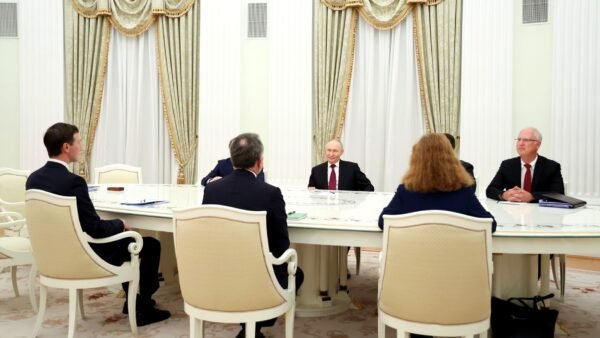
At the start of the talks on Tuesday morning, Jared Kushner, President Donald Trump’s son-in-law, told delegates that the president was committed to achieving “a new framework and a new understanding” to secure “decades, if not centuries, of peace”, according to The Times. Russian and Ukrainian negotiators sat facing each other, with Kushner and Steve Witkoff, the United States special envoy, at the head of the table.
Kushner said of Trump at the start of the meeting: “He really has asked us to put extra effort into trying to find a solution that hopefully ends the war but also leaves both sides in a much stronger position to start pursuing the full potential of what their two amazing countries have the ability to reach,” The Times reported.
According to the Associated Press, the two-day session would focus on security guarantees. Kushner said last week that the meeting in Abu Dhabi on Tuesday and Wednesday would focus on “security guarantees for Ukraine and a broader European security architecture”, The Times reported. The discussions also covered humanitarian issues and possible prisoner exchanges, according to Boldvoices, which reported that the session lasted close to four hours.
The United States described the day as productive and Ukraine described it as constructive, but neither side claimed that the hardest questions had been resolved. The talks were expected to resume on Wednesday morning local time, with the central disagreements still substantial: Russia demanding territorial and security concessions, and Ukraine refusing to surrender land or accept restrictions that could leave it vulnerable to another attack.
Who Sat at the Table
The United States was represented by Kushner, who acts as one of the country’s top diplomats despite holding no official role within the Trump administration, and by Witkoff, the president’s Middle East envoy, according to CNN. Ukraine’s delegation was led by Rustem Umerov, the head of the country’s Foreign Intelligence Service and its top negotiator, and also included President Zelenskyy’s chief of staff, Kyrylo Budanov, his deputy, Sergiy Kyslytsya, and Davyd Arakhamia, the parliamentary faction leader of Zelenskyy’s Servant of the People party, according to the Associated Press.
Russia’s delegation was again led by Kremlin aide Vladimir Medinsky, who has headed Moscow’s negotiating team since the first direct talks with Kyiv in Istanbul in March 2022, according to the Associated Press. It also included deputy foreign ministers Sergei Ryabkov and Mikhail Galuzin, military intelligence chief Igor Kostyukov, and Yuri Zhigarlovsky, a senior military officer from the General Staff’s operational department. Ryabkov is a significant addition: he led Moscow’s negotiations over its 2021 demands on NATO, according to The Times, and his presence signals that the broader European security questions are genuinely on the agenda rather than being treated as a side issue.
The Russian delegation’s composition matters because it tells the story of what Moscow wants these talks to be about. Medinsky is the man who has led every round of direct negotiation with Ukraine since 2022. Ryabkov is the diplomat who carried Russia’s demands on NATO in the months before the full-scale invasion. Kostyukov is a spy chief. Together, they represent a delegation built to discuss the war in Ukraine and the security order of Europe as a single package, which is precisely how the Kremlin has framed the talks.
Before the trilateral session began, the American envoys met separately with Ukrainian and European partners. Umerov said in a social media post that the day began with a meeting between the Ukrainian team, the United States envoys and representatives from the United Kingdom, France, Germany, Italy, NATO and the European Commission, according to the Associated Press. “Next, we will move to a trilateral format involving Ukraine, the United States and Russia,” he wrote.
Witkoff said he and Kushner had met with Ukrainian and European partners on Tuesday to continue the “close coordination on efforts to end the war in Ukraine and establish the conditions for a durable peace, including support for robust security guarantees as part of any settlement”, according to CNN. He added in a post on X that “the participants reaffirmed their shared commitment to a strong post-war European security architecture and arrangements, and were clear that a strong NATO will remain central to Euro-Atlantic collective defense.”
What Was on the Agenda
The formal agenda, as described by the Americans, was security guarantees for Ukraine and a broader European security architecture. That second phrase is the one that has alarmed Kyiv and its European allies, because it echoes Russia’s long-standing demand for a new settlement governing the security of the whole continent, rather than a settlement confined to the war in Ukraine.
Last week, Trump declared that some kind of grand deal about European security was in the works, describing it as “a big agreement” that is “going to involve more than Ukraine”, according to the Associated Press. “There’s going to be an agreement,” Trump said last week, according to The Times. “It’s going to involve more than Ukraine, and I could even say it might involve all of Europe. It’s going to be a big, beautiful agreement, and everyone’s going to be thrilled.”
Kushner said on Monday on X that a “comprehensive and lasting settlement will also require direct engagement between Russia and our European partners on the broader security arrangements that affect them”, according to the Associated Press. He added that the discussions in Abu Dhabi would set the stage for “that engagement to begin in the near future, as part of a broader multilateral process.”
Moscow has praised the broad approach. “We can only welcome the (U.S.) negotiators on President Donald Trump’s request proposing to put the issue of collective security on top of the agenda of the talks on a Ukrainian settlement,” Russian Foreign Minister Sergey Lavrov said, according to the Associated Press.
The humanitarian track was also on the table. The first day’s discussions covered humanitarian issues and possible prisoner exchanges, according to Boldvoices, and the United States Secretary of State, Marco Rubio, described the session as productive. Prisoner exchanges have been one of the few areas where Russia and Ukraine have managed to reach practical agreements even while the wider war has continued, and they are often treated by diplomats as a way of building confidence before the harder political questions are attempted.
The 28-point peace plan drafted last year by Kirill Dmitriev, the head of Russia’s sovereign wealth fund, and Witkoff hangs over the talks as background. According to The Times, the plan called for Ukraine to cede land to Moscow and renounce its ambitions to join NATO, and stipulated that the United States should mediate talks between NATO and Russia on global security. Trump spoke to Dmitriev, described by The Times as a Kremlin envoy known as “Putin’s Trump-whisperer”, at the White House last Thursday, but did not hold talks with Ukrainian officials who were also at the White House for a meeting with Melania Trump, the United States first lady.
Europe’s Fight for a Seat
European officials were not present at the trilateral table, but they were in Abu Dhabi all the same. Representatives from the E4 group, the United Kingdom, France, Germany and Italy, as well as NATO and the European Commission, were in the United Arab Emirates capital for separate meetings, and met with the Ukrainian and American delegations before Tuesday’s trilateral talks, according to CNN.
Russia has made clear that it wants the negotiations to be strictly trilateral, and Lavrov was dismissive of the European presence. “As for the Europeans’ involvement, well, they flew to Abu Dhabi. Let them sit in a hotel there,” Lavrov said on Tuesday as the negotiations were under way, according to CNN.
Many in Europe have cast doubt on Moscow’s intentions. The European Union’s foreign policy chief, Kaja Kallas, said on Monday that she saw little sign that Russia was willing to negotiate in good faith, according to CNN. The concern in European capitals is that a deal negotiated over their heads could trade away the security of the continent’s eastern flank in exchange for a settlement in Ukraine.
Zelenskyy put that fear in historical terms. “This is dangerous for all of us; we all live in Europe. We don’t want a second Yalta,” he told CNN, according to The Times, referring to the meeting of American, British and Soviet leaders in 1945 that led to the carving-up of Europe into spheres of influence. Umerov said on Monday that Ukraine was “doing everything we can to ensure that Europe is a participant in the diplomatic process”, according to CNN.
The Élysée Palace in Paris said on Tuesday before the talks started: “Our objective is to assert a fundamental principle: the pursuit of peace in Ukraine and security in Europe are inextricably linked,” according to CNN. The German foreign minister, Johann Wadephul, said on Monday: “It is very clear that Europe does not need a new security architecture, as Russia is trying to make us believe, but rather quite simply the restoration of the existing security architecture,” according to The Times.
Kallas made the same point by citing the 1994 Budapest Memorandum, when Moscow pledged to respect Ukraine’s sovereignty in return for Kyiv giving up its Soviet-era nuclear arsenal, according to The Times. “The problem is that we already have a European security architecture in place that Russia has agreed to,” she said.
Rubio, who is in Paris for a meeting of G7 foreign ministers, said on Tuesday that his administration’s goal was to expand the current talks so that Europeans are “represented at that table directly”, according to CNN. He also downplayed differences between the United States and Europe on the war, saying “our goals are the same”. Whether that expansion happens, and on what terms, is one of the questions the second day of talks may begin to answer.
One veteran European diplomat told The Times: “This seems like an opening for the Kremlin to try and get all the things it was looking for in 2021. It is very, very dangerous for us to have them negotiating our security architecture over our heads.”
The Gaps That Remain
The distance between the two sides has not narrowed in any measurable way, and the statements made around the talks on Tuesday made that plain. According to the Associated Press, Russian President Vladimir Putin wants Ukraine to pull its troops back from Donetsk, Luhansk, Zaporizhzhia and Kherson, the four regions that Moscow illegally annexed in September 2022 but never fully captured. He also demands that Ukraine abandon its bid to join NATO, accept strict limits on its military, and drop restrictions on the Russian language and the Moscow-affiliated Orthodox Church in Ukraine.
Putin wants a comprehensive peace deal on those conditions and will not agree to a general halt in hostilities, arguing that it would only allow Ukrainian troops to rest and replenish their weapons stockpiles, according to the Associated Press. He has warned that Russia will achieve its goals by force if Kyiv refuses to meet its conditions for peace. Lavrov said separately that Russia would not agree to an immediate ceasefire without knowing what would happen next, according to Reuters.
Zelenskyy, who was visiting Denmark on Tuesday, rejects Putin’s demands to voluntarily cede territory that Russia has not been able to take on the battlefield, according to the Associated Press. He also rejects any limits on Ukraine’s military or its arrangements with Western partners, which Kyiv sees as essential security guarantees to stop Moscow from invading again. Ukraine argues that an immediate ceasefire is the necessary first step toward negotiating a wider settlement, and says a direct meeting between Putin and Zelenskyy is the only way territorial issues can be settled.
Trump has added to Kyiv’s unease. In an interview screened on Monday by CBS’s 60 Minutes programme, he said Ukraine would “end up with a little bit different shape” after the war, according to The Times, and accused Zelenskyy of showing “disrespect” towards Putin. CNN reported that Trump refused in the same interview to say whether he trusted Zelenskyy or Putin more, and suggested Ukraine may have to cede some of its territory, a scenario Zelenskyy has repeatedly rejected.
Putin’s demands are, in substance, the same maximalist demands he has made since the start of the war: control over Ukraine’s eastern Donbas region, a reduction in the size of Ukraine’s military, and the abandonment of Kyiv’s ambitions to join NATO, according to CNN. None of them has been accepted by Kyiv, and none of them was conceded in Abu Dhabi on Tuesday.
John Herbst, senior director of the Atlantic Council’s Eurasia Center and a former United States ambassador to Ukraine, said any expectations for the Abu Dhabi talks should be “very modest”, according to CNN. “They are only taking place because Putin wants to give Trump a reason to continue to distance himself from Ukraine,” Herbst wrote last week. The Times reported that, despite Trump’s overtures to Putin, there is almost no chance of a deal in Abu Dhabi to end the war, and that Putin has rejected several Ukrainian ceasefire proposals. The Kremlin has said he will only meet Zelenskyy in Moscow to conclude a peace agreement, a proposal Kyiv has rejected.
The War Went On While They Talked
As the negotiators met in Abu Dhabi, Russia struck ten Ukrainian regions overnight in air attacks that targeted five major electrical substations, sparked widespread power outages and killed two people, according to Reuters. Ukrainian Prime Minister Sergiy Koretskyi said on Telegram that Russia had hit substations in the Poltava, Dnipropetrovsk, Vinnytsia and Kirovohrad regions, and that the two fatalities occurred in the Vinnytsia region.
Earlier, the state grid operator Ukrenergo said Russia had struck energy infrastructure in eight regions overnight and into the morning, leaving homes without power in six, including Kyiv, Kharkiv and Dnipropetrovsk, according to Reuters. Civilian infrastructure in the central Kirovohrad region, including a major home improvement store, also came under attack, the regional governor, Andriy Raikovych, said. In the south-eastern Dnipropetrovsk region, Russia attacked four districts with drones more than twenty times overnight, regional officials said.
Moscow has expanded its attacks in recent months to strike Ukrainian businesses, consumer logistics and other economic-related targets in a bid to weaken Kyiv’s war effort, according to Reuters. Ukraine has struggled to intercept Russia’s mounting attacks amid a shortage of weapons to down fast-moving ballistic missiles and jet-powered drones.
Ukraine struck back. Its General Staff said its forces struck the Morozov plant east of St Petersburg overnight into Monday, damaging three workshops, according to the Silk Paradox newsletter, which cited Ukrainian and Russian reporting. Ukraine has also escalated its drone strikes on Russian oil refineries, according to the Associated Press, and restarted its attacks on Russian oil refineries on 1 November, after agreeing to pause them following pressure from the White House, according to The Times.
The human cost of the war continues to rise. Civilian deaths in Ukraine are at their highest point since the start of the war, with more than 2,700 killed in Russian strikes so far this year, according to ACLED, a global conflict monitor, cited by CNN. At least 55 people were killed last Monday when Russia dropped several bombs on a school building used as a shelter and aid centre in Zaporizhzhia, marking one of the deadliest single incidents of the war to date, according to CNN.
The Times reported that more than 450,000 Russians have been killed in the war, according to data from Moscow’s official state statistics service that was published at the weekend by the pro-Ukrainian Silent Crow cybergroup, with the true number thought to be higher. That figure, if accurate, would be roughly equivalent to the population of Belfast.
The energy war is now entering its fourth winter. Russian attacks on the power grid left more than 600,000 people in the Dnipropetrovsk region without electricity overnight into Sunday, Zelenskyy said, according to CNN, as temperatures plummet and winter draws in. Russian drones and missiles are already hitting Ukraine’s energy infrastructure, but harder and earlier than in other winters, analysts say, according to CNN. Ukraine’s foreign minister, Andrii Sybiha, told The Times that Ukraine had run out of interceptors for United States-made Patriot air defence systems, its only effective defence against Russian ballistic missiles, and appealed for international assistance to help Ukraine through the winter months, when temperatures can fall to minus 20 degrees Celsius.
“No country can be self-sufficient when facing an enemy like this and dealing with challenges of this scale,” Sybiha said. He also said, however, that Russia would not achieve its military objectives, and that Kyiv was in a stronger position on the battlefield than last year. Ukraine’s long-range strikes against Russia remained the “most effective sanctions” against Moscow, he said, and Ukraine produces 50 per cent of its own military equipment and is seeking to scale up to 90 per cent.
A Diplomatic Track That Has Stalled Before
This is the fourth round of trilateral talks, and all of them have ended without significant breakthrough, according to CNN. Earlier this year, Zelenskyy said that trilateral talks in Geneva, Switzerland, in February fell short of Ukraine’s goals. The three countries held three rounds of trilateral talks in January and February, but the diplomatic track largely stalled after the start of United States military operations against Iran, according to Qazinform.
The pattern of the earlier rounds is worth remembering. Each round produced statements of goodwill and, on occasion, agreement on prisoner exchanges or humanitarian measures. None of them produced a ceasefire, and none of them narrowed the gap on the central questions of territory, NATO membership, or the size of Ukraine’s armed forces. The war continued through every round, and in some cases intensified while the negotiators were meeting.
The ground battles have morphed into a war of attrition along a 1,200-kilometre front line, according to the Associated Press, while Russia and Ukraine have ramped up their long-range strikes with drones and missiles. With Russia’s full-scale invasion of Ukraine now in its fifth year and gains on the battlefield remaining difficult to come by, Moscow has escalated its aerial attacks, with deadly results for Ukrainians, according to CNN.
Over the past few months, Russia has deployed faster, jet-powered Shahed drones, which are harder to shoot down, according to CNN. At the same time, more missiles are slipping through Ukraine’s air defences as Kyiv grapples with a chronic shortage of United States-made Patriot interceptors, one of the few defensive weapons capable of shooting down ballistic missiles.
The history matters because it sets the standard against which Abu Dhabi should be judged. A productive first day is not a breakthrough. A constructive tone is not a ceasefire. The test of these talks will not be the adjectives used to describe them on Tuesday, but whether the second day produces anything concrete, and whether anything agreed in Abu Dhabi survives contact with the battlefield.
The Midterm Factor
The talks come amid a renewed push by European nations for a more active role in negotiations over Ukraine’s future, and the security of the bloc at large, after Trump touted a new security deal for Ukraine that “might involve all of Europe”, according to CNN. Many in Washington believe that Trump’s heavy defeat in the midterm elections has injected a sense of urgency into the process to end the war, according to The Times.
The Republicans suffered a landslide defeat in last week’s midterms, according to CNN, and Democrats are preparing to take control of Congress in January. With two months before Democrats take control after the drubbing for the Republican Party at the United States midterms, the Kremlin is hoping to capitalise on Trump’s desire for a foreign policy success, analysts say, according to The Times.
Trump’s sensitivity to rising gas prices, which skyrocketed due to the Iran war and contributed to the Republicans’ landslide defeat in last week’s midterms, has underpinned much of the recent tension, according to CNN. He has shown a willingness to strike business deals with Moscow, including one to supply markets with Russia’s diesel, in a sharp break from the sanctions aimed at punishing and isolating the Russian economy, and pressured Zelenskyy to accept a short-lived “energy ceasefire”, according to CNN.
The relationship between the Trump administration and Kyiv has been decidedly more complicated than the relationship under the Biden administration, which positioned the United States as Ukraine’s biggest single donor and most powerful ally, according to CNN. The Trump administration halted financial aid to Ukraine at the beginning of 2025, while the intelligence and technology support it still provides has come under strain in recent weeks. Last month, Zelenskyy accused his Western allies of not providing intelligence warnings before multiple ballistic missile attacks, a claim the Trump administration denied, according to CNN.
In October, Ukraine’s ability to use Starshield, a military-grade version of Elon Musk’s Starlink service that is critical to its military operations, was hampered when speed limits were imposed on the satellite terminals, according to CNN. Trump denied approving that decision, while Musk said the Trump administration was behind the ban in a social media post.
Zelenskyy has publicly said he hopes the “blue wave” can bolster United States support for Ukraine since the Democratic Party “speaks very clearly about supporting Ukraine and providing assistance to Ukraine”, according to CNN. It remains unclear whether the midterms will substantively change United States policy toward Kyiv, however. Kyiv’s defiance is only likely to increase after the results of the United States midterms, said Mykola Bielieskov, a research fellow at Ukraine’s National Institute for Strategic Studies and a senior analyst at Come Back Alive, a Ukrainian non-governmental organisation, according to The Times. “The blue tsunami means that Ukraine is more confident than before,” he said.
Analysis: Why It Matters
The talks themselves are the news
Nine months is a long time for a diplomatic track to lie dormant while a war kills thousands of people. The resumption of trilateral talks in Abu Dhabi matters first and foremost because it breaks that silence. Diplomacy is not a substitute for a settlement, and a meeting is not a deal, but wars that end do so because the parties eventually talk, and the absence of talks for nine months was itself a statement about how far apart the sides had drifted. The fact that Kushner and Witkoff, Umerov, and Medinsky and Ryabkov were in the same room on Tuesday is a precondition for any settlement, even if it guarantees nothing. The danger is in mistaking the precondition for the achievement. The earlier rounds in January and February also began with optimism, and they ended with nothing. Abu Dhabi deserves to be reported as a resumption, not as progress.
Europe’s fight for a seat is the real negotiation
The most revealing argument in Abu Dhabi may not be between Russia and Ukraine at all, but between Europe and the two powers negotiating over its head. The “second Yalta” warning from Zelenskyy is not rhetorical decoration. Yalta in 1945 was the moment when the great powers redrew the map of Europe without consulting the countries whose futures they were deciding, and the memory of it runs deep in every capital east of Berlin. When European officials warn that a new security architecture must not be imposed on them, they are saying that the structure of the settlement matters as much as its content. A deal that ends the fighting in Ukraine but leaves Poland, the Baltic states and the rest of eastern Europe feeling exposed would not be a settlement at all. It would be a postponement. Rubio’s promise to expand the talks so that Europeans are “represented at that table directly” is the most important sentence uttered around these talks so far, and whether it is honoured will tell us more about the outcome than anything said in the trilateral room on Tuesday.
The gap between the table and the battlefield
The most striking feature of Tuesday was the simultaneity of the two stories: negotiators describing a productive session in Abu Dhabi while Russian missiles hit five Ukrainian substations and killed two people in Vinnytsia. This is not a contradiction to be resolved. It is the strategy. Russia has used the winter energy campaign as leverage in every year of the war, and the timing of the strikes on the day the talks opened is a message in itself: Moscow negotiates from a position it believes is strengthened by the blackouts it can impose. Ukraine’s answer is the refinery campaign, the strikes on the Morozov plant, and the long-range drone war against Russia’s energy infrastructure. Both sides are trying to improve their bargaining position while the talking goes on, which means the talks will not stop the war, and the war will not stop the talks. Any assessment of Abu Dhabi that ignores the battlefield is incomplete, and any assessment that treats the battlefield as proof that the talks are futile misses the point. The two tracks are running in parallel, and each is shaping the other.
Trump’s clock is running
The timing of these talks is not accidental. Trump lost the midterms, and the Democrats take control of Congress in January. The Kremlin knows it, and the analysts quoted by The Times are right that Moscow hopes to capitalise on Trump’s desire for a foreign policy success before that window closes. But the clock cuts both ways. A president who needs a win is a president who may be tempted to accept a bad deal, and the Europeans know it. That is why the “second Yalta” warning and the insistence on a European seat are not just about principle. They are about the calendar. The danger is not that Trump wants peace. It is that the pressure to produce a result before January could lead to a settlement that trades Ukrainian territory and European security for a headline. The counterweight is that Zelenskyy, emboldened by the midterm result, is more willing to defy Washington than he was a month ago. The balance of that tension will decide whether Abu Dhabi produces a genuine negotiation or a performance.
What “constructive” actually buys
If the first day achieved anything concrete, it is most likely to be found in the humanitarian track. Prisoner exchanges and humanitarian measures are the one area where Russia and Ukraine have repeatedly managed to agree even while the war has raged, and they are the natural early deliverable of a resumed negotiation. A prisoner exchange would be real, it would matter to the families involved, and it would give both sides something to point to as evidence that talking works. It would not be a step towards ending the war, and it should not be reported as one. But it would be a reason to keep talking, and in a process that has stalled for nine months, a reason to keep talking is not nothing. The test comes on Wednesday: whether the second day produces anything beyond the adjectives used to describe the first.
What to Watch Next
- The second day in Abu Dhabi: whether the talks resume on Wednesday morning as planned, and whether any joint statement, prisoner-exchange agreement or humanitarian measure is announced. Silence after the second day would be as telling as any statement.
- Europe’s seat at the table: whether Rubio’s promise to bring European representatives into the talks directly is acted on, and whether the E4 group, NATO and the European Commission are given a formal role in the next round.
- What Moscow says next: whether Lavrov or the Kremlin softens the demand for Ukrainian withdrawal from the four annexed regions, or repeats the refusal of an immediate ceasefire. Any movement on either point would be the first real signal of flexibility.
- Whether Kyiv holds its line: whether Zelenskyy maintains his rejection of territorial concessions and limits on Ukraine’s military, and whether the confidence given by the midterm result translates into a firmer public position.
- The energy war through the winter: whether Russia’s strikes on substations continue at the current pace, whether Ukraine’s Patriot interceptor shortage worsens, and whether the blackouts in Dnipropetrovsk, Kyiv and Kharkiv deepen as temperatures fall towards minus 20 degrees Celsius.
- Washington’s next move: whether Trump comments on the talks publicly, and whether the administration’s approach to European security changes as the January handover of Congress approaches.
Sources
- Reuters — “Russia pounds Ukraine’s power grid as talks open in Abu Dhabi”
- Reuters — “Russia, Ukraine to meet for US-backed talks after Trump says broad deal possible”
- CNN — “Ukraine peace talks restart after 9 months. What makes them different this time?”
- The Times — “Ukraine warns of ‘second Yalta’ as US-brokered talks open in Abu Dhabi”
- Associated Press — “US-brokered talks are set to start in Abu Dhabi to discuss Ukraine-Russia peace deal” (via EuropeSays)
- Qazinform — “Abu Dhabi hosts first U.S.-Russia-Ukraine talks since February”

About the Author — Abdul Mannan
Related Articles

Senior US Soldier Arrested in UK on Suspicion of Spying for Russia
British counter-terrorism police have arrested a 41-year-old senior US soldier near Gloucester on suspicion of espionage offences relating…

Houthi Missiles Intercepted Over Riyadh for the Second Time in Three Days as Saudi Strikes Hit Sanaa
Saudi air defences intercepted a ballistic and a cruise missile aimed at Riyadh early on Tuesday, the second…
Russia and Ukraine Open First Trilateral Peace Talks in Nine Months in Abu Dhabi as US Pushes a Wider European Security Deal
Russian, Ukrainian and American negotiators opened two days of talks in Abu Dhabi on Tuesday, the first three-way…