
US Warns Madagascar Against Deepening Military Ties With Russia, Citing the Sahel’s Failed Security Model

The United States has publicly warned Madagascar against deepening its military ties with Russia, telling the island nation’s military-led government that the security model Moscow has sold to West Africa’s juntas has failed to make those countries safer and risks spreading instability across the Indian Ocean region.
Lieutenant General John Brennan, the deputy head of United States Africa Command, delivered the warning on Tuesday, 11 November, during an online briefing with reporters, according to the BBC. He said Madagascar’s location made it too important to global trade for Washington to stay silent about the direction of its security partnerships.
“We are concerned about Russia wanting to proliferate [the Sahel model] elsewhere across the continent,” General Brennan said, according to the BBC. “Madagascar sits in a location that is extremely important, as is Mozambique, and we don’t want to see those models be applied in those two locations.”
The “Sahel model” he referred to is the bargain struck by the military governments of Mali, Burkina Faso and Niger, which severed security ties with their Western partners and turned to Russia for military support in their fight against jihadist groups. General Brennan said those partnerships had failed to improve security, and he urged Madagascar to weigh the risks before following the same path.
Russia has expanded its military cooperation with Madagascar since the military seized power in the country in 2025, supplying weapons and military instructors, according to the BBC. Madagascar has not publicly responded to General Brennan’s comments.
General Brennan was careful to frame the warning as advice rather than an order. He said American partners were “free to partner with whom they wish” but urged them to understand the potential risks of the choice, according to the BBC. The distinction matters, because the United States has no treaty right to veto Madagascar’s security partnerships, and the warning only carries weight if Antananarivo believes the American reading of the Sahel’s record.
The warning was issued as Madagascar’s leader, President Michaël Randrianirina, has publicly reiterated his support for stronger ties between Russia and African countries. During the Russia-Africa summit last month, Madagascar and Russia signed several cooperation agreements covering defence, tourism and trade, according to the BBC.
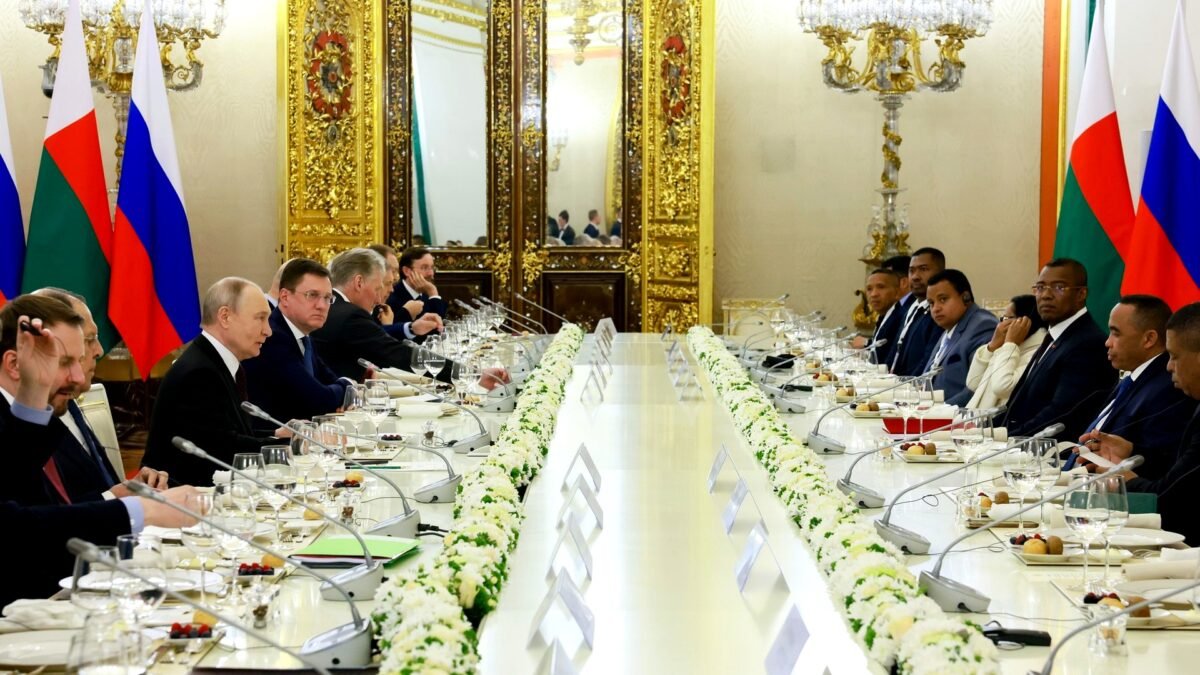
In February, a few months after taking power in a military takeover, Mr Randrianirina visited Moscow. It was the first official visit to Russia by a Malagasy leader in nearly 50 years, according to the BBC. The photograph that accompanies this article was taken during that visit, at the Kremlin on 19 February 2026.
The Sahel record Washington is pointing to
The three countries General Brennan named have become the central case study in the argument over Russian security partnerships in Africa. Mali, Burkina Faso and Niger are all ruled by military governments that came to power in coups between 2020 and 2023. Each blamed its former Western partners, principally France, for failing to contain jihadist violence, expelled French and other Western forces, and turned to Moscow.
Russia’s support arrived first through the Wagner Group, the private military company led by Yevgeny Prigozhin, and then through its successor, the state-controlled Africa Corps, which operates under Russia’s Defence Ministry. Estimates put the number of Africa Corps fighters across the three countries at roughly 1,700 to 2,000, most of them in Mali, according to the Associated Press.
The three juntas formalised their break with the West in September 2023, when they created the Alliance of Sahel States, a mutual defence pact. They have since left the Economic Community of West African States, the regional bloc, and built their security policy around the Russian partnership.
By the measure that matters most to the people living there, the bargain has not worked. Militant attacks have continued despite the closer military ties with Russia, according to the BBC, and the available data supports that assessment. The Armed Conflict Location and Event Data Project, known as ACLED, recorded more than 10,000 conflict-related deaths across the three countries in 2025, and the United Nations refugee agency said nearly four million people had been displaced from Burkina Faso, Mali and Niger by October 2026.
The violence has not only persisted but grown more ambitious. The Global Centre for the Responsibility to Protect, citing United Nations figures, recorded 2,640 civilian deaths in the central Sahel between January and March 2026 alone. In April 2026, the al-Qaeda-linked group Jama’at Nasr al-Islam wal Muslimin, known as JNIM, launched coordinated attacks across central and northern Mali alongside Tuareg separatists, and on 28 April it declared a full blockade of the capital, Bamako, cutting fuel supplies to the city. JNIM, with nearly 8,000 fighters, has become the most powerful al-Qaeda franchise on the African continent, according to analysts cited in reporting on the conflict.
In Niger, the Islamic State’s Sahel Province has carried out increasingly sophisticated attacks, including an unprecedented assault on the international airport in the capital, Niamey. ACLED counted 5,836 deaths in Niger in the three years after the July 2023 coup, against 3,199 in the three years before it.
The record is not one of unbroken failure for the juntas. Mali’s army, fighting alongside Russian Africa Corps personnel, re-entered the northern city of Kidal on 6 October 2026, months after Tuareg separatists and JNIM fighters had taken it in April. But Kidal has changed hands before, and a single city does not answer the broader question of whether the Russian model has made the Sahel safer. The juntas’ own critics note that the Malian armed forces and Africa Corps have themselves been accused of serious abuses against civilians, including summary executions, indiscriminate air strikes and sexual violence, according to the Global Centre for the Responsibility to Protect.
General Brennan’s argument, in short, is that Madagascar would be buying into a model whose results are already visible, and that the results are poor. The question is whether Antananarivo sees the same record and draws the same conclusion.
Why Madagascar, and why now
Madagascar is the world’s fourth-largest island, a country of about 30 million people off the south-eastern coast of Africa, and one of the poorest countries on earth. Its strategic value has little to do with its wealth and everything to do with its position. The island sits at the western edge of the Indian Ocean, beside the Mozambique Channel, the strait that separates Madagascar from mainland Africa and carries a large share of the shipping that moves between Asia, the Middle East and the Atlantic.
General Brennan raised concerns about security in the Mozambique Channel specifically, according to the BBC, calling it an important route for international shipping and trade. He said it was vital to prevent Islamic State-linked militants in northern Mozambique and other hostile actors from threatening maritime activity, and he cited recent piracy-related incidents along the coast. He said militant groups in northern Mozambique were adapting their tactics, including developing greater maritime capabilities.
The concern is grounded in a real and long-running conflict across the channel. An Islamic State-linked insurgency has fought in Mozambique’s northern Cabo Delgado province since 2017, displacing hundreds of thousands of people and disrupting one of Africa’s largest natural gas developments. The prospect of that insurgency acquiring the ability to operate at sea, in a strait through which oil tankers and container ships pass daily, is the kind of development that brings American generals to the microphone.
The timing of the warning also reflects how quickly Madagascar’s relationship with Moscow has deepened. The military government is barely a year old. Its leader, Colonel Michaël Randrianirina, took power after a youth-led uprising that began on 25 September 2025, when protests erupted across the country over chronic water and electricity cuts in the capital, Antananarivo, and beyond.
The protests, led by young Malagasy people who called themselves Gen Z Madagascar, gathered force for more than two weeks. On 11 October, Mr Randrianirina’s elite CAPSAT unit sided with the demonstrators, and its commander recorded a video calling on the security forces to refuse orders to open fire on protesters. The following day, President Andry Rajoelina fled the country aboard a French military aircraft. The National Assembly impeached him on 14 October, and on 17 October Mr Randrianirina was sworn in as President of the Refoundation of the Republic of Madagascar.
The African Union suspended Madagascar after the takeover, and the Southern African Development Community called in August for a return to constitutional normality. The military government has promised elections within two years, with a constitutional referendum planned for June 2027 and a presidential election in October 2027. One year after the uprising, however, the young activists who led the protests say little of the promised “refoundation” has materialised. “The basic demands still haven’t been met,” Mihary Rakotondravelo, a prominent Gen Z activist, told the Agence France-Presse news agency in October 2026.
It is against that background that the turn to Moscow has accelerated. Mr Randrianirina’s February 2026 visit to the Kremlin was the first by a Malagasy head of state in almost half a century, and the agreements signed at last month’s Russia-Africa summit extended the relationship into defence, tourism and trade. For a government that took power promising renewal and now faces questions about what it has delivered, a powerful foreign patron offers both practical help and political validation.
Washington’s warning is, in that sense, a response to a trend that is already well advanced, not a pre-emptive shot. The question it raises is whether Madagascar’s government, having invested political capital in the Russian relationship, is willing to reconsider it, or whether the warning will simply harden a choice that has already been made.
The wider contest for Africa
The exchange over Madagascar is the latest episode in a much larger contest for influence in Africa, in which Russia has systematically expanded its security footprint while the United States and its European allies have lost ground.
The pattern is by now familiar. A military government comes to power, often after a coup justified by the failure of the previous civilian government to contain an insurgency. It expels Western forces, denounces the former colonial power, and invites Russian military support. Moscow provides fighters, instructors, weapons and, crucially, political cover at the United Nations. In return, it gains access to minerals, military bases and a reliable vote in international forums.
The Sahel is the most advanced example of that pattern, but it is not the only one. Russia has built security relationships across the Central African Republic, Sudan and Libya, and its Africa Corps now operates in several countries where Western forces have withdrawn. The United States, for its part, has been forced to close bases and rethink its approach to a continent where its traditional partners keep falling to coups.
Madagascar would be a significant prize in that contest. Unlike the Sahel states, it is not fighting a jihadist insurgency on its own soil. Its value is maritime and geographic: control of, or influence over, the Mozambique Channel would give any outside power a lever over one of the world’s busiest shipping lanes, and a friendly port on the Indian Ocean would extend Russia’s naval reach far beyond its existing positions.
That is why General Brennan named Mozambique in the same breath as Madagascar. The two countries flank the channel, and a Russian security presence in one would change the strategic calculation for the other. The warning was addressed to Antananarivo, but it was also a message to Maputo, and to every other African capital weighing a similar offer from Moscow.
It is also worth noting what the warning did not contain. There was no threat of sanctions, no suggestion that American aid would be cut, and no ultimatum. General Brennan explicitly acknowledged Madagascar’s right to choose its own partners. The American approach, at least in public, is to make the case on the evidence and let the government in Antananarivo decide. Whether that restraint reflects confidence in the argument, or an awareness that threats would backfire with a government that came to power by defying outside pressure, is an open question.
Analysis: Why It Matters
A public warning is a policy signal, not small talk
Senior American generals do not casually name individual countries in public briefings and tell them they are making a mistake. The fact that the deputy commander of Africa Command chose to single out Madagascar, by name, in an online briefing with reporters, indicates that Washington regards the deepening of Madagascar’s military relationship with Russia as a development worth spending political capital on.
The choice of messenger matters too. General Brennan is not a diplomat, and his words carry a different weight from a State Department statement. Africa Command is the part of the American military that plans and conducts operations on the continent, and its deputy commander speaking publicly about a specific country’s security choices is a signal to the Pentagon, to allies and to Moscow that the issue has reached the level of military concern, not merely diplomatic discomfort.
It is also a signal that the United States is watching the Indian Ocean with the same attention it has long given to the Atlantic approaches to Africa. For decades, American strategy in Africa has been organised around the Sahel and the Horn. A public warning about the Mozambique Channel suggests that the centre of gravity is shifting, and that Washington now sees the western Indian Ocean as a front line in the competition with Russia.
The Sahel record is the argument, and it is a strong one
The most powerful element of General Brennan’s case is that it does not rest on ideology or on loyalty to the West. It rests on results. Mali, Burkina Faso and Niger were promised that Russian support would succeed where French and American support had failed. Five years into that experiment, the jihadist groups those countries set out to defeat are stronger, better organised and more ambitious than they were when the Western forces left.
JNIM now fields nearly 8,000 fighters, besieges the Malian capital’s fuel supplies and holds large rural areas across the three countries. The Islamic State’s Sahel branch fights on a second front. More than 10,000 people were killed in the three countries in 2025, and nearly four million have been displaced. Those are not the figures of a security model that works.
The defenders of the Russian partnership will argue, with some justice, that the Western model also failed, and that the violence was already rising before the Russians arrived. That is true. But it does not answer the question General Brennan is posing, which is whether switching patrons has made things better. On the available evidence, it has not. A government considering the same switch is entitled to ask why its outcome would be different, and Madagascar’s government has so far offered no public answer to that question.
Geography is why Madagascar matters more than its size suggests
Madagascar is rarely at the centre of global news, and it is easy to treat a warning about the island as a minor story. That would be a mistake. The Mozambique Channel is one of the world’s great maritime chokepoints, and the country that sits beside it holds a position out of all proportion to its economic weight.
Ships passing through the channel carry oil, gas, containers and bulk cargo between Asia and the Atlantic, and any disruption there would ripple through global supply chains in the same way that the Houthi attacks in the Red Sea did. The prospect of an Islamic State-linked group developing maritime capabilities in northern Mozambique, which General Brennan raised, is precisely the kind of threat that turns a local insurgency into a global problem.
Madagascar’s own waters matter too. The island’s exclusive economic zone is vast, its fisheries are rich, and its offshore energy potential is largely unexplored. A security partnership with Russia would give Moscow a foothold in a maritime space it has never had, and a platform from which to observe, and potentially to complicate, the shipping that passes through the channel. That is the strategic logic behind the American warning, and it explains why a country of 30 million people on an island most Americans could not find on a map has become the subject of a public intervention by a three-star general.
The choice is not really about Russia alone
It would be a mistake to read the warning as a simple contest between Washington and Moscow for Madagascar’s favour. The deeper question is what kind of government Madagascar is becoming, and whether its military rulers intend to keep the promises they made when they took power.
The Gen Z protesters who brought down Andry Rajoelina did not take to the streets to demand a closer relationship with Russia. They demanded water, electricity and a government that worked. One year on, the activists who led those protests say the basic demands have still not been met, and the timetable for a return to civilian rule stretches to late 2027.
In that context, a deepening military partnership with Moscow serves a purpose that has little to do with national security. It gives a transitional government an external source of legitimacy, a supplier of weapons and instructors who ask no questions about human rights or democratic transition, and a powerful friend at the United Nations. The risk is that it also entrenches the military’s hold on power, and makes the promised return to civilian rule harder to achieve.
That is the subtext of General Brennan’s reference to sovereignty. When he said the Russian model compromised sovereignty and institutional stability, he was speaking about the Sahel, but the warning applies with equal force to Madagascar. A government that depends on a foreign military patron for its survival is less free, not more, and the history of the Sahel suggests that the dependence deepens over time rather than fading away.
A military government with a deadline has the most to lose
The final point is about timing. Madagascar’s military government has promised a constitutional referendum in June 2027 and a presidential election in October 2027. Those dates are now less than two years away, and the government’s credibility depends on meeting them.
A public dispute with the United States complicates that timetable. Washington is not threatening to block the transition, and the African Union’s suspension of Madagascar already reflects the continent’s own unease with the takeover. But a government that is trying to win international recognition for its transition does not benefit from being publicly identified as the next candidate for a security model that the United States has just described as a failure.
Conversely, the warning gives Mr Randrianirina’s government an opportunity it did not have before. If it can show that its relationship with Moscow is limited, transparent and consistent with the promised return to civilian rule, it can defuse the American concern without abandoning the relationship. If it responds with defiance, or by deepening the partnership in public, it will confirm Washington’s reading of the situation and invite closer scrutiny of everything that follows.
The choice, as General Brennan himself acknowledged, belongs to Madagascar. But the warning has made the choice visible, and the consequences of getting it wrong are now a matter of public record.
What to Watch Next
- Antananarivo’s response: whether President Randrianirina or his government answers General Brennan publicly, and whether the response defends the Russian partnership, plays it down or ignores the warning altogether.
- The next Russia-Africa engagement: whether Madagascar signs further defence agreements with Moscow in the coming months, and whether Russian instructors or equipment deliveries become visible.
- The Mozambique Channel: whether Islamic State-linked militants in northern Mozambique demonstrate the greater maritime capabilities General Brennan warned about, and whether shipping or naval patrols in the channel change in response.
- The Sahel’s trajectory: whether JNIM’s blockade of Bamako and the fighting in Mali and Niger continue to worsen, which would strengthen Washington’s argument, or whether the juntas and Africa Corps score successes they can point to.
- The transition timetable: whether the constitutional referendum planned for June 2027 and the presidential election planned for October 2027 stay on schedule, and whether Gen Z activists continue to press the government on its unmet promises.
- The American follow-up: whether the warning is followed by a diplomatic approach, an offer of renewed security cooperation with Madagascar, or a visit by a senior American official to Antananarivo.
Sources
- AAN TV: US Warns Madagascar Over Growing Military Ties With Russia
- Channel Africa: US AFRICOM warns Madagascar against expanding Russian security ties
- PiQ Markets: US general warns Madagascar over Russian military ties
- Breaking Africa News (RFI): A Year After Madagascar’s Gen Z Protests and Rajoelina’s Ouster, Little Promised Change
- Global Centre for the Responsibility to Protect: Central Sahel, Niger
- Orbis: Sahel Conflict 2026 — Who Is Fighting in Mali, Burkina Faso and Niger

About the Author — Abdul Mannan
Related Articles
Abu Dhabi Peace Talks End With Prisoner Swap Deal but No Breakthrough as US Envoys Head to Moscow to See Putin
Two days of US-mediated talks in Abu Dhabi ended with a deal on the largest prisoner exchange of…
US Treasury Secretary Scott Bessent Moved to a Military Base After Iranian Threats to His Life
US Treasury Secretary Scott Bessent has moved from his Washington home to a military base after Iranian threats…
US Charges Three Iran-Backed Operatives Over RAF Fairford Terror Plot and Nearly 20 Attacks Across Europe and America
An eight-count US indictment unsealed on Tuesday accuses three Iran-backed operatives of plotting a fuel-van attack on RAF…