
Voyager 1 Is Now One Light-Day From Earth — And Humanity’s Voice Is Still Travelling

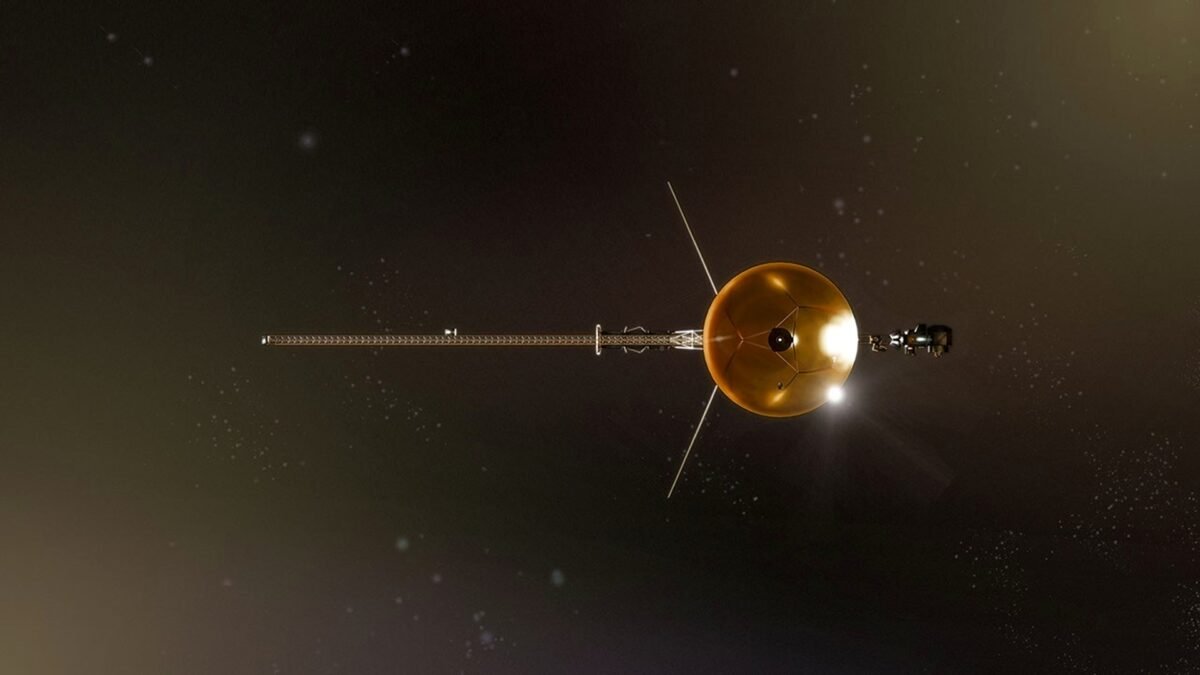
A Day’s Journey for Light
What do you say to a friend who is a whole day away by the fastest thing in the universe? On Wednesday, 18 November 2026, at 5:16 in the morning, Eastern time, humanity quietly crossed a line no one had ever crossed before. Voyager 1 — a machine older than most of the people reading this — became the first human-made object in history to stand one light-day from Earth. Sixteen billion miles. Twenty-six billion kilometres. A distance so great that light itself, the swiftest messenger creation knows, needs a full twenty-four hours to make the journey. Speak to Voyager today, and your words arrive tomorrow. Its answer reaches you the day after that.
NASA waited a day to tell us. Not out of ceremony, but out of physics: the signal confirming the crossing itself took a day to arrive. Think about that for a moment. The news of the milestone was itself a day old when it reached us — the universe insisting, one last time, that we understand the scale of what we have done.
I have been thinking about this small, stubborn spacecraft all week, and I keep returning to a single question: what kind of civilisation sends a message it will never hear answered?
The Little Engine That Would Not Die
Voyager 1 was launched on 5 September 1977 from Cape Canaveral, Florida — sixteen days after its twin, Voyager 2. It was built to last five years. Five. Its mission was a grand tour of Jupiter and Saturn, and then, if fortune allowed, silence. It is now forty-nine years old, and it is still talking. It swept past Jupiter in 1979 and Saturn in 1980, sending back images that rewrote the textbooks. In 1998 it passed Pioneer 10 and became the most distant human-made object in existence — a title it has held ever since. In August 2012 it crossed the heliopause and entered interstellar space, the first craft of ours ever to swim beyond the Sun’s protective bubble. And still it flies, at nearly 38,000 miles per hour, seventeen kilometres every second, toward a star called Gliese 445, more than seventeen light-years away, which it will pass — at a distance of some 1.6 light-years — in roughly forty thousand years.
Consider the arithmetic of that journey. It took Voyager nearly half a century to travel a single light-day. To travel a single light-year — the distance light covers in a year — would take it some 18,000 years. The nearest star is, in practical terms, forever away. And yet the little craft flies on, its plutonium heart growing colder year by year, its engineers on Earth switching off one instrument after another to save power, coaxing a few more watts out of a machine built when Jimmy Carter was president and the word “internet” did not exist in any living room on Earth.
Even this week, Voyager reminded us of its frailty. On 14 November, the spacecraft stopped sending science and engineering data; a Deep Space Network antenna in Canberra, Australia, locked on and heard only the carrier signal — the hum of a voice with no words in it. Engineers worked the problem, and NASA confirmed the milestone anyway, from the carrier signal and the known trajectory. The spacecraft, they said, has no way to change its speed. Nothing could stop it reaching one light-day on time. There is something quietly magnificent in that: a machine so old it is falling apart, and yet so faithful to its course that not even its own failing can deflect it.
A Golden Letter in a Bottle
But the distance is not the story. The story is what Voyager carries. Bolted to its side is a twelve-inch disc of gold-plated copper — the Golden Record. A committee chaired by the astronomer Carl Sagan filled it with 115 images, the sounds of Earth, music from Bach to Chuck Berry, and spoken greetings in fifty-five languages. There are messages from President Jimmy Carter and from the Secretary-General of the United Nations. And there is the voice of a six-year-old boy — Sagan’s own son, Nick — saying, in the plainest English a child can manage: “Hello from the children of Planet Earth.”
Reader, stop and sit with that for a moment. In 1977, the world was divided by a Cold War, armed to the teeth, rehearsing its own destruction. And the best of us — the best of us — chose to send into the dark not a weapon, not a flag, not a claim of territory, but a greeting. A record of whalesong and thunder, of a mother’s first words to her newborn, of a kiss. We sent our music before our missiles. We introduced ourselves to the universe as children, not conquerors.
That is why Voyager matters more than any rocket that has flown since. Every empire in history has built monuments to outlast itself — the pyramids of Giza, the Great Wall of China, the cathedrals of Europe — stone raised against the certainty of decay, each one saying, in its own way: we were here. The Golden Record is the same impulse, refined to its purest form. It is a pyramid that flies. It will outlast every monument we have ever built, because it will outlast the Earth itself; long after our cities are dust, that golden disc will still be sailing through the dark, carrying the sound of rain on a tin roof and a child’s hello.
The Pale Blue Dot
There is a photograph I want you to remember alongside this milestone. In 1990, at Sagan’s urging, Voyager 1 turned its camera back toward home from beyond Neptune and took a picture of Earth. In it, our entire world — every war and wedding, every empire and every grave — is a single pixel of pale blue light, suspended in a sunbeam. Sagan’s words about that image are among the most honest ever written about the human condition: he called it a reminder of our responsibility to deal more kindly with one another, and to preserve and cherish the pale blue dot, the only home we have ever known.
Now place the two facts together. The same spacecraft that showed us how small we are has also shown us how far we can reach. That is the paradox at the heart of this story, and it is the paradox at the heart of being human. We are a mote of dust — and we built a thing that has flown a light-day from home. We are quarrelsome and small — and we sent a golden greeting into the void in fifty-five languages. The dot is tiny. The reach is not.
What the Silence Teaches Us
Voyager will not fly forever. NASA expects it to keep a single instrument alive into the 2030s; by around 2036, its power will fade past the point of communication, and the voice will go quiet. Its twin, Voyager 2, travelling a different road, will not reach one light-day until November 2035 — and no one can promise it will still be speaking when it gets there. The engineers who tend these craft — men and women who have given their working lives to machines older than their own children — know this. They switch off heaters, they ration watts, they write software patches for computers with less memory than a greeting card. They are, in the truest sense, keeping a dying friend alive a little longer, because the friend still has something to say.
And what does it still have to say? Not data, in the end. Data is the excuse. What it says is: we were here, we wondered, we reached. On the evening of 17 November, NASA asked people around the world to step outside after sunset and flash the letters V-G-R — Voyager’s call sign — into the night sky in Morse code, a wave of golden light rising from the planet toward its farthest child. Thousands did. I find that unbearably moving, and I cannot quite say why, except this: we were waving goodbye to something that cannot wave back, and we did it anyway, because love does not require an answer.
The Mirror
History, as I have always argued in these columns, is a mirror, and Voyager is the clearest mirror we have held up in fifty years. Consider what it reflects. In 1977, two superpowers pointed their finest engineering at the heavens and chose to send music instead of menace. Today, the same heavens are filling with weapons and war-talk, with satellites that watch and missiles that wait, and the great powers speak of the Moon and Mars as the next ground to be claimed. The contrast should shame us. The generation that had the least — the generation of slide rules and punch cards, of a world split in two — dreamed the biggest. We, who have everything, dream mostly of ourselves.
And yet. And yet the record still flies. The greeting still travels. Every second, Voyager carries our better selves a further seventeen kilometres from the worst of us, and nothing we do down here can call it back. There is a verdict in that, if we are brave enough to hear it: what we send into the future is not decided by our weapons or our wealth, but by what we choose to put on the record. The empires that built their pyramids are dust; the record they left behind is what we remember them by. So it will be with us. A thousand years from now, no one will remember our arguments. They will remember — if anything remembers us at all — that once, a quarrelsome species on a pale blue dot pressed its songs onto gold and threw them at the stars.
So here is my closing thought, and I offer it to you directly, reader, because it belongs to you as much as to me. Voyager 1 is one light-day away tonight, and tomorrow it will be further still. It will never come home. It was never meant to. Its mission was not to return, but to remain — to keep going, long after we have forgotten how to listen, carrying the proof that we once believed the universe was worth greeting. That is the measure of a civilisation: not how loudly it shouts at its enemies, but how gently it speaks to strangers it will never meet.
Goodbye, Voyager. Fly well. And thank you — for showing a small, loud, quarrelsome world that its voice could travel a day at the speed of light, and still be worth hearing.
Sources & References
- NASA Science — Voyager 1: What Is a Light-Day?
- NASA Science — Voyager 1 Engineers Analyze Data Issue, Ready to Confirm Light-Day
- Reuters — NASA Confirms Voyager 1 Probe’s ‘Light-Day’ Distance Milestone
- CNN — Voyager 1, the Farthest Human-Made Object, Is Now One Light-Day From Earth
- Smithsonian Magazine — NASA’s Voyager 1 Has Reached One Light-Day From Earth
- NASA Science — Voyager One Light-Day Downloads
- German Aerospace Center (DLR) — Voyager 1 Is Now One Light-Day Away
Featured image: NASA/JPL-Caltech — artist’s concept of Voyager 1 in deep space, released for the one light-day milestone. Image credit: NASA/JPL-Caltech.

About the Author — Abdul Mannan
Related Articles
PROMISE on the Moon: Humanity Is Going Back — This Time, to Stay
NASA has promised a permanent base on the Moon, and its new nuclear-powered rover PROMISE is the scout…
Older Than the Sun: The Interstellar Comet Carrying a Message From Before Our World Existed
A lump of ice older than the Sun itself has crossed our Solar System — and the James…
The Comet Nobody Was Looking For: What Euclid’s Accidental Discovery Says About Us
A Telescope Built to Ignore Exactly This Have you ever found something precious that you were never looking…