
Pope Leo XIV Diagnosed With Lung Cancer After Successful Surgery to Remove Part of Right Lung

Pope Leo XIV has been diagnosed with lung cancer after surgeons removed the lower lobe of his right lung during a 90-minute operation that the Vatican says was successful, marking the first major health crisis of his 17-month pontificate.
The Vatican announced on Tuesday evening that tissue examined during the surgery confirmed pulmonary adenocarcinoma, a common form of lung cancer — the same diagnosis doctors had suspected from the pope’s pre-operative tests.
In a medical bulletin issued by the Holy See Press Office, the pope’s personal physician, Dr. Luigi Carbone, and Professor Stefano Margaritora, the hospital’s chief thoracic surgeon, said the procedure had gone according to plan. The bulletin said the lower lobe of the right lung was taken out using video-assisted surgery — a minimally invasive technique — and that examination of the removed tissue confirmed the adenocarcinoma diagnosis.
The Vatican said the pope spent about three hours in the operating theatre, while the operation itself lasted around 90 minutes. “The surgery was successful, and there were no complications,” the Vatican said in its statement. The 71-year-old pontiff woke up normally after the procedure and, following a brief observation period, returned to his room on the hospital’s tenth floor, where he was resting on Tuesday evening.
Vatican spokesman Matteo Bruni told reporters that the pope had asked to have some dinner that evening, describing his condition after the operation as normal.
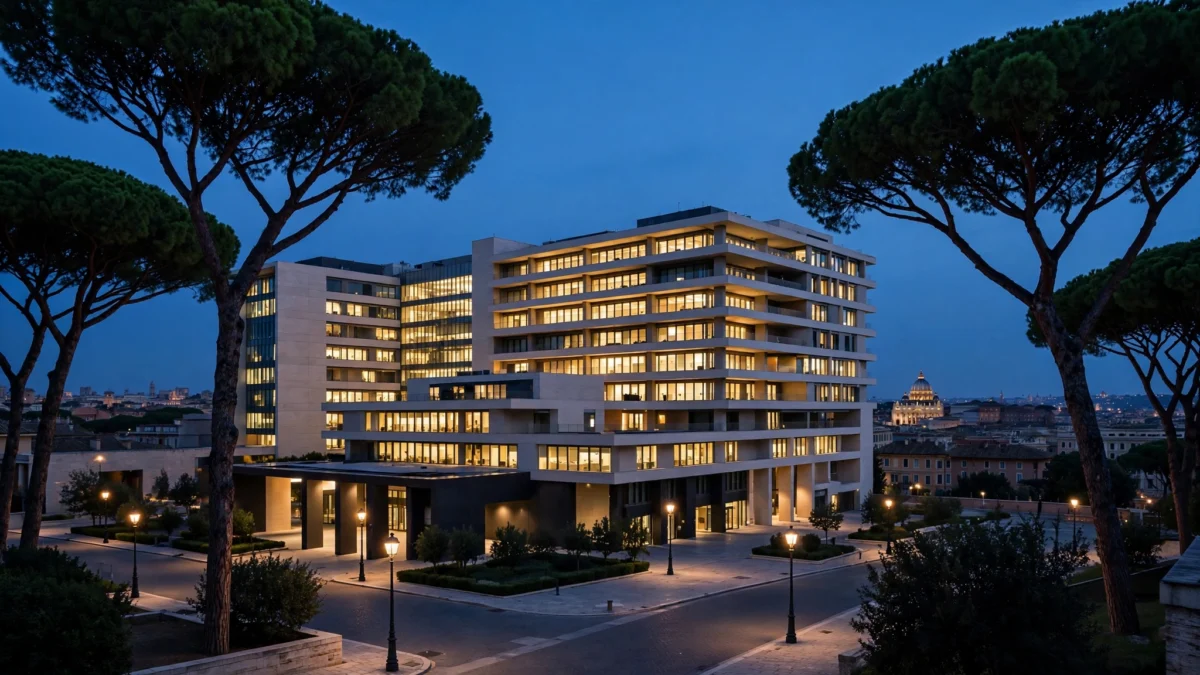
The surgery took place on Tuesday afternoon at the Agostino Gemelli University Policlinic hospital in northwest Rome, the private medical facility that has served as the hospital of the popes for decades. The pope was admitted earlier in the day and was seen walking through the hospital’s main entrance and waving to well-wishers who had gathered to greet him, according to the Associated Press.
The growth had been discovered during a recent routine medical checkup. The pope disclosed the finding himself on Sunday, telling pilgrims gathered in St. Peter’s Square that doctors had found a “nodule” on his lung and had advised him to have it removed. He said the growth had been detected “at a very early stage” and was “well-contained.”
The Vatican said the pope is expected to spend about a week recovering in the hospital, and all of his public events have been cancelled through October 20.
More tests to determine whether the cancer has spread
Vatican sources said on Tuesday night that the cancerous tissue had been “completely removed” and that further tests were being carried out to determine whether the cancer had spread beyond the lung, according to The Times. Asked whether chemotherapy or other follow-up treatment was being planned, the sources said doctors had not yet discussed it.
The staging of the cancer — the one critical fact the Vatican has not yet provided — will determine the pope’s prognosis, outside experts said. Dr. Stephen Liu, a lung cancer specialist at Georgetown University in Washington and division chief of hematology and oncology at MedStar Georgetown University Hospital, told Reuters that the stage was decisive: if the tumour was small and no lymph nodes were involved, surgery alone was likely to have cured the disease, but a greater extent of cancer would point to a poorer outlook.
A first for this pontificate
The hospital stay is the first of Leo’s pontificate. Until Tuesday, the 71-year-old pope had no publicly known health problems and was widely regarded as physically active. According to the Associated Press, he plays tennis weekly and swims regularly at the papal summer retreat in Castel Gandolfo.
The episode also marks a striking break with the Vatican’s historical instinct for secrecy about papal health. When Leo’s predecessor Pope Francis was seriously ill, official updates were often sparse and carefully worded. Leo, by contrast, announced the discovery of the nodule himself, in person, on a Sunday afternoon — and the Tuesday bulletin named the surgeons, the technique, and the diagnosis in the same evening the operation concluded.
A hospital with papal history
Gemelli hospital occupies a singular place in the modern story of the papacy. Pope John Paul II was admitted there repeatedly — most memorably in July 1992, when he told pilgrims at the Angelus that he was going in for tests and, three days later, surgeons removed a benign colon tumour. Pope Francis was hospitalised at Gemelli multiple times, including during the long respiratory crisis in early 2025 that developed into double pneumonia and preceded his death on April 21, 2025, at the age of 88. Francis had suffered from chronic lung disease since youth — part of one lung had been removed when he was a young man — a history that gives any papal lung diagnosis a particular gravity for those who remember his final months.
The hospital maintains a dedicated suite of rooms for the pope on its tenth floor, which John Paul II famously dubbed “Vatican three” — St. Peter’s being Vatican one and the papal residence at Castel Gandolfo, Vatican two.
The first American pope
The global attention on Leo’s health is inseparable from the unprecedented figure he cuts in the history of the Catholic Church. Born Robert Francis Prevost on September 14, 1955, in Chicago, he was elected on May 8, 2025, becoming the 267th pope and the first ever born in the United States.
His biography blends American roots with a deeply Latin American formation. After entering the Order of Saint Augustine and being ordained in 1982, he spent roughly two decades in Peru, first as a missionary and later as bishop of Chiclayo, taking Peruvian citizenship along the way. In 2023, Pope Francis brought him to Rome to lead the powerful Dicastery for Bishops, the office that vets candidates for bishoprics worldwide — a role that made him known to, and respected by, a large share of the cardinals who would later elect him. He leads a Church of roughly 1.4 billion people.
In his first year and a half, Leo has positioned himself as an outspoken moral voice on international affairs, renewing weekly appeals for peace in Ukraine and using his X account to call for the worldwide abolition of the death penalty. He has also publicly criticised the United States’ prosecution of the Iran war, drawing rebukes from President Donald Trump and Vice President JD Vance.
Analysis: Why It Matters
The transparency shift is being tested in real time. For most of the modern papacy, a pope’s health was treated as a state secret: officials declined for years to name John Paul II’s Parkinson’s disease, and the circumstances of John Paul I’s death in 1978 fed decades of conspiracy theories. Against that history, Leo’s handling of this episode has been striking — he announced the nodule himself on Sunday, and the Vatican’s Tuesday bulletin carried the diagnosis, the surgeons’ names, and the surgical technique within hours of the operation. That openness buys trust. But the test of the new candour is still ahead: when the staging results arrive and treatment decisions are made, the Vatican will have to decide how much of that it shares. Any retreat into vagueness would revive the suspicion that shadowed his predecessors.
A diagnosis is not a scare. On Sunday, the pope’s emphasis was on reassurance — a small nodule, found early, well contained. Tuesday’s bulletin confirms the most feared outcome of that nodule, even as the Vatican stresses the complete removal of the cancerous tissue. The Church of 1.4 billion now lives with a diagnosis, not a precaution. That distinction changes the weight of every future bulletin, and it raises the stakes of the Vatican’s communication: over-reassurance now risks a credibility wound if the staging brings harder news.
A pope’s body is an institutional event. The Catholic Church’s centralised governance means that a pope’s calendar is the calendar of 1.4 billion people’s shepherd. A week in hospital means a week of cancelled audiences, postponed decisions, and a frozen diplomatic calendar. The November trip to Uruguay, Argentina, and Peru — still on the books, and the longest journey of the pontificate — now hangs in the balance. Governments and diplomats calibrate their own timetables around the pope’s, and the Vatican’s handling of the coming days will be watched far beyond the faithful.
The active-pope model, confronted with mortality. Leo’s physical vigour — the weekly tennis, the swims at Castel Gandolfo — had become part of how the faithful understood his papacy, a quiet contrast with the frailty of his predecessor’s final years. A cancer diagnosis, whatever its stage, scrambles that image. How he returns to public life, and how quickly, will define the next phase of his leadership — and the Vatican’s evident awareness of that is visible in the careful, calm tone of every update so far.
What to Watch Next
- The staging results. The pathology assessment of whether the cancer has spread to lymph nodes or beyond is the single most important unanswered question, and it will determine both prognosis and treatment.
- Whether treatment is discussed. Vatican sources say doctors have not discussed chemotherapy. The first indication of any follow-up treatment plan will signal how advanced the disease is judged to be.
- The week of recovery. The Vatican expects the pope to remain in hospital about a week. Each update from Gemelli — and each day without one — will be parsed for meaning.
- The October 20 milestone. All public events are cancelled through that date. Whether the pope resumes his schedule on time will be the first public measure of his recovery.
- The November trip. The November 6–17 journey to Uruguay, Argentina, and Peru is still planned. Any adjustment to the itinerary would be the clearest sign of the longer-term impact of the diagnosis.
Sources

About the Author — Abdul Mannan
Related Articles
Russia Launches Overnight Barrage on Ukraine’s Energy Grid, Leaving More Than 600,000 Without Power
Russia fired 39 ballistic missiles and more than 120 drones at Ukrainian energy sites overnight, leaving more than…
Nord Stream Trial Opens in Hamburg as Ukrainian Ex-Officer Denies Pipeline Sabotage Charges
A former Ukrainian officer has gone on trial in Hamburg over the 2022 explosions that ruptured the Nord…
The Ceasefire That Exists Only in a Post
Trump announced a Russia–Ukraine "energy ceasefire" on social media — while missiles fell on Kyiv. A column on…