
Missiles Strike Aden Airport as Saudi-Led Coalition Intercepts Ballistic Missile Aimed at Yanbu Oil Hub

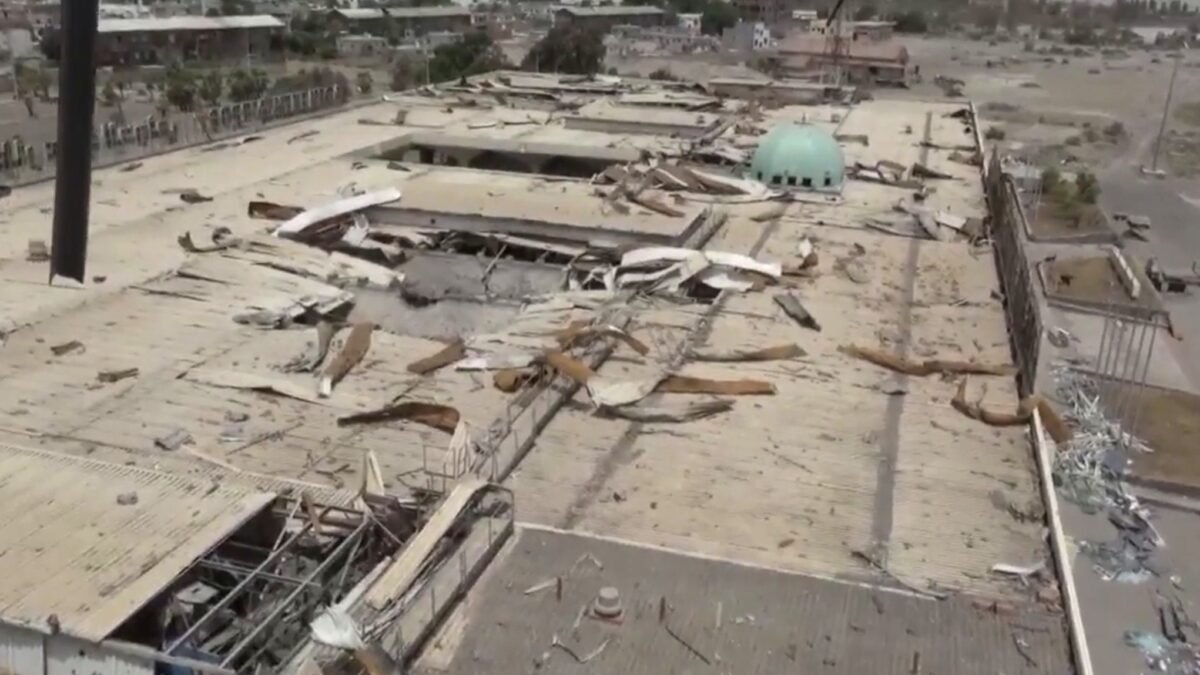
Missiles struck the grounds of Aden International Airport in southern Yemen on Friday, while a Saudi-led military coalition said it had intercepted a ballistic missile headed for the Red Sea port city of Yanbu — a one-two punch of attacks that briefly pushed Brent crude to 110 dollars a barrel for the first time since May and sharpened fears that Yemen’s war is widening into a direct contest over the region’s energy lifelines.
According to Reuters, two missiles landed on the airport grounds in Aden on Friday evening. The Aden Security Department blamed the Iran-aligned Houthi movement for the strike, which it described as the second attack on the facility in less than a week. The Houthis did not immediately claim responsibility. No casualties were reported, but the timing underlined the risk to civilian aviation: a Yemenia Airways flight bound for Cairo was preparing for takeoff when the missiles came down, the security department said.
Hours earlier, the Saudi-led coalition fighting the Houthis announced a string of interceptions across the kingdom. Coalition spokesman Turki al-Malki said on X on Friday afternoon that a ballistic missile had been intercepted and destroyed near Yanbu on Saudi Arabia’s western Red Sea coast, and that coalition air defences had also destroyed two cruise missiles over the Red Sea and three drones in the country’s Southern and Riyadh regions, Sweden Herald reported. The coalition did not identify who was behind the attacks.
Why Yanbu matters
Yanbu is not just another Saudi city. It is one of the kingdom’s most important oil export outlets, home to refineries and shipping terminals that allow Saudi Arabia to load crude onto tankers in the Red Sea without sending them through the Strait of Hormuz. That strait — the narrow waterway between Iran and Oman — has been the focus of months of heightened tension, with regional security threats raising persistent concerns about the safety of shipping through it.
The fact that a ballistic missile was aimed at, or at least in the direction of, the city that serves as Saudi Arabia’s Hormuz bypass is therefore significant beyond the immediate military detail. It suggests the confrontation is moving toward the very infrastructure Riyadh built to insulate its oil exports from a Gulf crisis. For energy markets, the message was unmistakable: Brent crude briefly touched 110 dollars a barrel on Friday, its first visit to that level since May, as traders priced in the risk of tighter global supplies, Reuters reported.
Saudi Civil Defense authorities had already issued alerts earlier in the day in the Jazan region and the southwestern city of Khamis Mushait — warnings that have become a grim routine since fighting resumed last month. Aid agencies, meanwhile, have warned that the humanitarian crisis in Yemen is deteriorating rapidly as the fighting intensifies.
A week of escalating strikes
Friday’s attacks did not come out of nowhere. They are the latest in a rapid-fire sequence that has made October one of the most violent months in the Yemen conflict in years.
A day earlier, on Thursday, Houthi missiles and drones struck the Al-Maashiq Palace in Aden — the hilltop complex that serves as the headquarters of Yemen’s internationally recognised government. Five people were killed, including two members of Prime Minister Shaya Al-Zindani’s security detail, and sixteen were wounded, according to Yemen’s Health Ministry. The Houthis claimed they were targeting what they described as a Saudi military operations centre inside the compound, part of what their military spokesman Yahya Saree has called a declared policy of striking Saudi military deployments “wherever they may be.”
The palace strike was itself one of the highest-profile attacks on the Yemeni government since it launched “Yemen’s Dawn,” its latest campaign in the long-running war against the rebels, earlier this month. That campaign followed months of Houthi attacks on Saudi targets, including repeated strikes on airports. In a briefing on Thursday, the coalition said Houthi attacks on Riyadh’s King Khalid International Airport this month had killed seventeen people and wounded more than three hundred, while a separate attack on Abha airport killed three and wounded twenty-eight. The coalition said it had destroyed 127 Houthi weapons storage facilities in response. Saudi Arabia’s civil aviation authority extended the suspension of operations at Riyadh’s main airport through October 17.
Earlier in the month, on October 7, missiles and drones were fired at Aden International Airport itself, with one missile landing near the runway minutes before a passenger flight from Cairo was due to land. Airport officials diverted the incoming Yemenia flight to Jeddah and moved two aircraft away from the terminal. The Houthis said at the time that they had hit a “military camp” storing Saudi military equipment near the airport, and insisted they were not targeting civilians.
The pattern is clear: airports — civilian and dual-use — have become the favoured pressure points of this phase of the war. The governing council of the International Civil Aviation Organization has condemned the attacks on civilian airports, but the condemnation has not slowed the tempo.
Analysis: Why It Matters
The energy war goes to the bypass. For months, the strategic logic of the Red Sea crisis has been straightforward: threaten shipping through one chokepoint and watch the world reroute. Saudi Arabia’s answer to the Strait of Hormuz has long been its Red Sea coast — Yanbu’s terminals, the East-West pipeline, the refineries. A ballistic missile aimed in Yanbu’s direction changes the calculus. It tells Riyadh, and the oil market, that the bypass itself is now within reach. That is why Brent’s jump to 110 dollars matters more than the usual Friday volatility: markets are not pricing in a single intercepted missile, but the possibility that the war’s next phase targets the infrastructure built to survive it.
Civilian aviation is becoming a battlefield. Aden airport is Yemen’s second-busiest gateway and a lifeline for aid workers, journalists and ordinary Yemenis. It has now been hit twice in just over a week, and a Cairo-bound passenger jet was on the tarmac during Friday’s strike. The Houthis argue these are legitimate targets because of the Saudi military presence around them; the coalition and civil aviation bodies call them attacks on civilian infrastructure. Whatever the legal arguments, the practical effect is the same: airlines, insurers and passengers are being taught that Yemeni and Saudi airspace carries a war premium. Riyadh’s airport suspension and the repeated diversions at Aden are the market’s verdict on that lesson.
The information war is fought in real time. Notice how Friday’s events reached the world: not through a government press conference, but through the coalition spokesman’s posts on X, matched within hours by wire reporting. The Houthis, for their part, stayed silent on the Aden airport strike while loudly claiming the palace attack a day earlier. This asymmetry is deliberate. Claiming an attack on a government compound projects strength; silence about missiles landing near a civilian airliner avoids the awkward questions. In a conflict where both sides are fighting for international legitimacy as much as territory, the choice of what to claim is as strategic as the choice of what to hit.
110-dollar oil has political consequences far beyond the Gulf. The United States heads into midterm elections on November 3, and American voters experience foreign crises most directly at the petrol pump. A sustained move above 110 dollars would feed straight into inflation data and campaign rhetoric. That gives every actor in this crisis — Riyadh, the Houthis, Tehran, Washington — an incentive to calibrate, but it also raises the stakes of miscalculation. Energy markets have a long memory for wars that started as “limited” exchanges and ended as supply shocks.
The off-ramps are narrowing. This escalation is unfolding against the backdrop of an eight-month-old US-Iran war, a collapsed 2022 truce in Yemen, and a humanitarian catastrophe that aid agencies say is worsening by the week. Each round of strikes — palace, airport, refinery town — makes the next round easier to justify and harder to stop. The question is no longer whether the Yemen war and the wider regional confrontation have merged; they have. The question is whether anyone still has both the leverage and the interest to pull them apart before the next missile finds something the interceptors miss.
What to Watch Next
- A Houthi claim — or continued silence. Whether Yahya Saree or Houthi media claim Friday’s Aden airport and Yanbu attacks will signal how the group wants this round framed: as part of its declared campaign against Saudi military targets, or as deniable pressure.
- The coalition’s response. After the palace strike, the coalition pointed to 127 destroyed weapons facilities. Watch for fresh strikes under the “Yemen’s Dawn” campaign and any announcement of expanded targeting inside Houthi-held territory.
- Aviation disruptions. Riyadh’s airport suspension runs through October 17; any extension, plus the operational status of Aden airport and Yemenia’s schedule, will show how quickly civilian aviation can absorb this tempo of attacks.
- Oil price direction. Whether Brent holds above 110 dollars into next week — and whether Saudi Arabia or its OPEC+ partners signal any supply response — will reveal how seriously producers take the threat to export infrastructure.
- The humanitarian fallout. Aid agencies warn conditions are deteriorating rapidly. Watch for updated displacement figures and any UN Security Council session on the escalation, as well as the fate of commercial and aid flows into Yemen.
Sources
- Reuters — Missiles hit Aden airport as Saudi-led coalition intercepts missile headed for Yanbu
- Sweden Herald — Saudi Arabia says it intercepted missiles and drones bound for Riyadh and other targets
- CNN — Iran-aligned Houthis launch deadly attack on Yemeni presidential palace
- Wikipedia — Aden International Airport (background)

About the Author — Abdul Mannan
Related Articles
UNICEF Warns Gaza’s Malnutrition Gains Are “Fragile” as Commercial Supply Halt Bites
UNICEF's Ricardo Pires urges that all Gaza crossings remain open as a new report finds only one in…

Hezbollah Lawmaker Admits Seized Explosives Belonged to Group, Says They Were Meant for Israel
Hezbollah MP Hassan Fadlallah publicly claimed ownership of a 500kg explosives shipment seized in the Bekaa, demanding its…

Two Cargo Ships Sink Near the Strait of Hormuz as Iran Escalates Attacks on Shipping
The Singapore-flagged GFS Pride and the Antigua and Barbuda-flagged Cape Dao went down within 24 hours of projectile…