
UNICEF Warns Gaza’s Malnutrition Gains Are “Fragile” as Commercial Supply Halt Bites

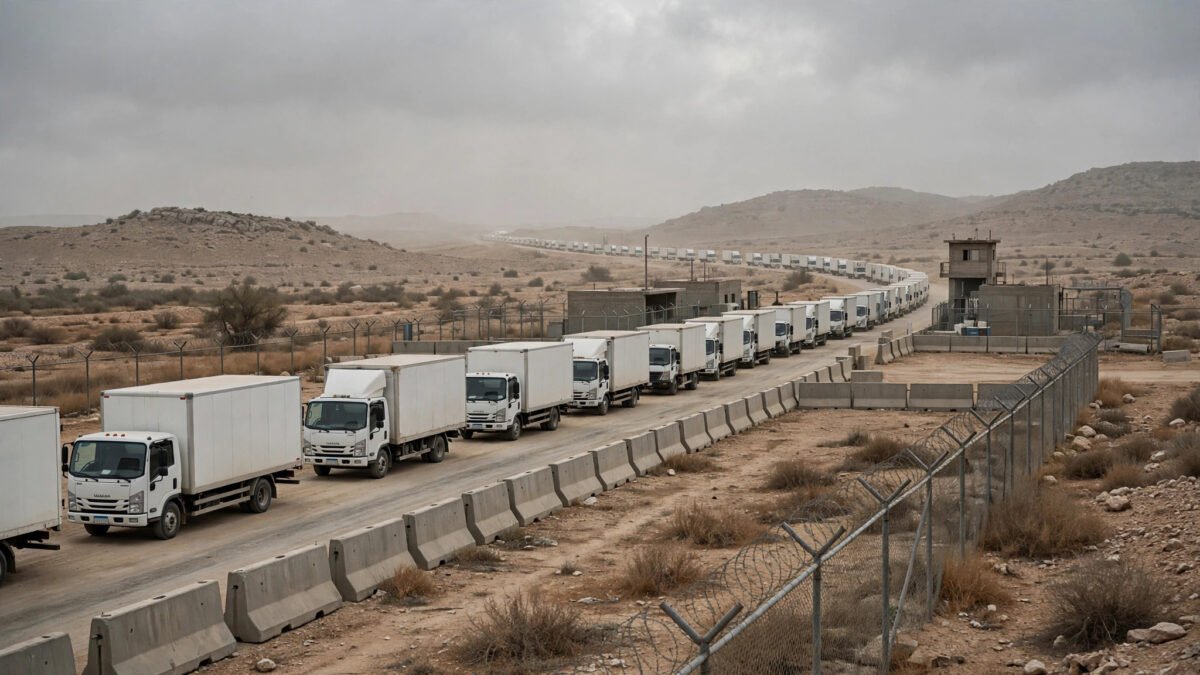
Gaza’s fragile recovery from the threat of famine is at risk of reversing after a halt in commercial goods entering the territory, the UN children’s agency UNICEF warned on Friday, calling for all crossings into the Palestinian enclave to remain open and for the flow of both humanitarian and commercial supplies to stay “predictable and continuous.”
Speaking to reporters in Geneva, UNICEF spokesperson Ricardo Pires said the gains made against malnutrition in Gaza since the ceasefire could be undone by disruptions to supply routes, adding that “the impact on children obviously will be felt if this situation is not resolved.”
“We can’t go back to a situation where children and families are not getting all the supplies, goods, and services that they require,” Pires said, according to Reuters.
The warning came alongside a new UNICEF report published on Friday which found that while the ceasefire has allowed more humanitarian aid and commercial supplies into Gaza, acute malnutrition remains a risk and the progress achieved so far rests on uncertain ground.
A Friday warning from Geneva
UNICEF’s briefing in Geneva landed at a moment of renewed strain on Gaza’s supply lines. According to the agency, the flow of goods into the enclave — home to around 2 million people, most of them living in makeshift shelters after three years of war — must not be interrupted if the slow progress on nutrition is to hold.
The agency’s new report says the easing of the threat of famine — a threat confirmed by a global food security monitor in August last year — was achieved through a scaled-up food and nutrition response, the easing of restrictions on the entry of food and nutrition supplies, and the ceasefire itself. “However, those gains remain fragile,” the report stated.
UNICEF also urged improvements in living conditions across the devastated territory, where the agency says some 800,000 children remain displaced and most are living in tents or unsafe buildings as winter approaches. Better shelter and basic services, it said, are essential to support any lasting recovery.
The numbers behind the warning
The UNICEF report contains a mixture of encouragement and caution. Acute malnutrition rates have fallen, it says, but only one in three children under the age of two is currently achieving minimum dietary diversity — meaning the great majority of Gaza’s toddlers are still not receiving the variety of foods needed for healthy development.
A survey conducted by UNICEF in June also found a significant prevalence of chronic malnutrition, affecting one in eight children under five, according to the report.
The figures underline a central point that humanitarian workers have repeated throughout the year: large-scale famine and chronic undernutrition are different problems, and progress on one does not guarantee the other. A child who is no longer at immediate risk of starvation may still be growing up malnourished — a condition with consequences that can last a lifetime.
The concern is that even modest interruptions to the supply of food and essential goods can quickly push these already-vulnerable figures in the wrong direction, especially for children in the earliest years of life, when malnutrition does its deepest damage.
How Gaza’s commercial lifeline stopped
The disruption behind UNICEF’s warning began on Wednesday, when Israel said commercial goods were no longer entering Gaza, citing what it described as a dispute over taxes between local merchants and Hamas.
COGAT, the Israeli military body that oversees humanitarian affairs in Gaza, said in a statement that Gazan merchants had decided to stop coordinating with it on the entry of commercial goods. According to COGAT, the merchants told the agency they had made the decision in response to a 10,000-shekel fee — roughly $3,220 — imposed by Hamas on each truck entering Gaza, and a demand that 30 percent of all their sales inside Gaza be carried out in cash.
The halt cuts off a vital source of food and other goods in a territory where a majority of the population is dependent on aid supplies, following three years of war, repeated displacement and severe restrictions imposed by Israel on aid deliveries.
Nahed Shhaibar, the head of the private transport union in Gaza, said that not a single truck carrying commercial products from Israel entered Gaza on Thursday. He said trucks carrying humanitarian aid had entered, as had trucks carrying commercial goods from Egypt via an Israeli-controlled crossing.
COGAT said the merchants’ decision would cut the total number of trucks — which carry both humanitarian and commercial goods — entering Gaza each day to around 300, or roughly half the previous flow. Diplomats say that far fewer than 600 trucks normally enter Gaza each day; Shhaibar said the real figure was closer to 300, with about two-thirds of those carrying commercial goods.
A tax dispute with two versions
What exactly drove the merchants to stop coordinating remains contested. Hamas later said the 10,000-shekel fee was a voluntary payment by wealthy Gazans to a national fund intended to provide for those in need, such as widows and orphans. It also said that cash payments were being encouraged because of what it described as an acute cash shortage in the war-torn territory.
COGAT’s deputy spokesperson, Lieutenant Daniel Kantorovich, said the agency was acting on a decision made by Palestinian merchants a day earlier and could reverse the halt at their request. “The merchants don’t want to bring goods into Gaza,” he said, adding that the vendors had informed the agency they were cancelling coordination “due to Hamas’s taxation mechanism and threats against them.”
Palestinian importers have disputed Hamas’s account of the dispute, according to AP reporting. The conflicting narratives — a voluntary solidarity contribution versus coercive taxation — reflect the murky economics of a territory where the line between governance, survival and profiteering has been blurred by years of siege and war.
Merchants in Gaza coordinate directly with vendors outside the territory, and their shipments are examined by Israel’s military before entering Gaza. The suspension has immediately cut the variety of goods available: aid groups generally bring in staples such as flour, while merchants import more perishable foods like fruit and meat, according to data released earlier this year by COGAT. Items such as fresh fruit and winter clothing — the latter critical with winter approaching — were among the commercial shipments halted.
A year into a fragile ceasefire
The supply halt arrives almost exactly one year after the Gaza ceasefire agreement brokered by the United States took effect in October 2025. The ceasefire improved aid access and reduced large-scale fighting, but humanitarian agencies say ongoing strikes, continued displacement and widespread destruction have left civilians highly vulnerable.
A global hunger monitor warned in July that more than two-thirds of Gazans could face acute hunger by the year’s end. According to AP reporting, around 2 million Gazans live in the territory, most in makeshift shelters, and the war that began with the Hamas-led attacks of October 7, 2023 — in which about 1,200 people were killed and 251 taken hostage — has killed more than 74,000 Palestinians, according to the Gaza Health Ministry.
The ministry says more than 1,400 Palestinians have been killed since the ceasefire took effect. Israel, meanwhile, has continued periodic strikes, which it says target Hamas and Islamic Jihad fighters and violate no terms when aimed at militants preparing attacks.
Against this backdrop, the commercial-goods halt is being watched closely by aid agencies. “The humanitarian sector on its own cannot meet the needs of all the people,” said Shaina Low, a spokesperson for the Norwegian Refugee Council, adding: “The markets need to be functioning.”
The suspension is also raising fears about affordability, humanitarian workers say, because a combination of aid and a robust commercial market is needed to keep prices under control. When commercial supply shrinks, prices rise — and in a territory where most families have no income, higher prices are a second famine by another name.
Analysis: Why It Matters
UNICEF’s warning matters not because it says something new, but because it says something old at precisely the moment it threatens to be forgotten. A year into the ceasefire, the narrative of “progress” has settled into place: famine pushed back, aid flowing, large-scale fighting reduced. The agency is reminding the world that progress in Gaza is not a staircase — it is a rope stretched tight, and cutting even a few strands changes everything.
The dispute at the heart of the halt exposes a quieter struggle that rarely makes headlines: who taxes whom in a territory where the formal economy has been destroyed. Whether the 10,000-shekel fee was voluntary or coercive, its existence shows that Gaza’s recovery is being built on economic foundations that are improvisational at best. Merchants, militants, and military bureaucracies are negotiating the price of a loaf of fruit over the heads of two million people who cannot leave.
There is also a structural lesson here that goes beyond Gaza. Aid and markets are often treated as separate systems — the charitable and the commercial — but in reality they are load-bearing walls of the same house. Aid brings flour; merchants bring fruit, meat, clothing, the perishable and varied goods that turn survival into something resembling a diet. When the commercial wall is removed, the aid wall cannot carry the whole structure. The Norwegian Refugee Council’s observation — that the humanitarian sector alone cannot meet everyone’s needs — is not rhetoric; it is logistics.
The timing adds a further edge. With winter approaching, and some 800,000 children displaced and living in tents or unsafe buildings, the loss of winter clothing shipments and the prospect of rising food prices arrive together. Malnutrition is not only a function of what crosses the border today; it is a function of what children will eat, and where they will sleep, in the coldest months of the year. UNICEF’s emphasis on shelter and basic services is a signal that the crisis is seasonal as well as structural.
Finally, the competing accounts of the tax dispute — voluntary contribution versus coercion — illustrate how information itself has become a battlefield in post-ceasefire Gaza. In a territory closed to independent foreign journalists for three years, the public must rely on the claims of interested parties. That fog makes every supply disruption harder to resolve, because the first casualty of the dispute is a shared understanding of what the dispute even is.
What to Watch Next
- Whether Gazan merchants resume coordination with COGAT — and on what terms — will determine whether the commercial halt is a days-long interruption or a lasting new restriction.
- Price movements in Gaza’s markets in the coming weeks will show whether the loss of commercial trucks is feeding through to the cost of food for ordinary families.
- UN agencies’ next nutrition surveys will test whether the “fragile gains” UNICEF describes hold steady or begin to slip, particularly among children under two.
- The winter shelter response — tents, repairs, and services for the 800,000 displaced children — will shape whether malnutrition figures stay contained or deteriorate as temperatures drop.
- How the ceasefire’s guarantors, including the United States, respond to a supply squeeze that was triggered not by war but by a tax dispute will signal how much diplomatic capital still guards Gaza’s humanitarian lifeline.
Sources
- Reuters — “UN says Gaza malnutrition gains fragile as commercial supplies halt” (Oct 16, 2026)
- Reuters — “Israel says commercial goods no longer entering Gaza after merchants suspend coordination” (Oct 15, 2026)
- Associated Press (via The Reflector) — “Commercial goods are no longer entering Gaza, raising fears of worsening shortages” (Oct 16, 2026)
- Tomorrow’s Affairs — “Do taxes imposed by Hamas prevent the entry of commercial goods in Gaza?” (Oct 15, 2026)

About the Author — Abdul Mannan
Related Articles
Hezbollah Lawmaker Admits Seized Explosives Belonged to Group, Says They Were Meant for Israel
Hezbollah MP Hassan Fadlallah publicly claimed ownership of a 500kg explosives shipment seized in the Bekaa, demanding its…
Two Cargo Ships Sink Near the Strait of Hormuz as Iran Escalates Attacks on Shipping
The Singapore-flagged GFS Pride and the Antigua and Barbuda-flagged Cape Dao went down within 24 hours of projectile…

Houthis Encircled Taiz, Yemen’s Third-Largest City, as UN Warns of Looming “Humanitarian Catastrophe”
Houthi rebels have encircled Taiz, Yemen's third-largest city, trapping more than a million residents as the UN World…