
Four Soldiers Killed, 39 Hurt in Wainwright Base Fire; Carney Declares National Mourning

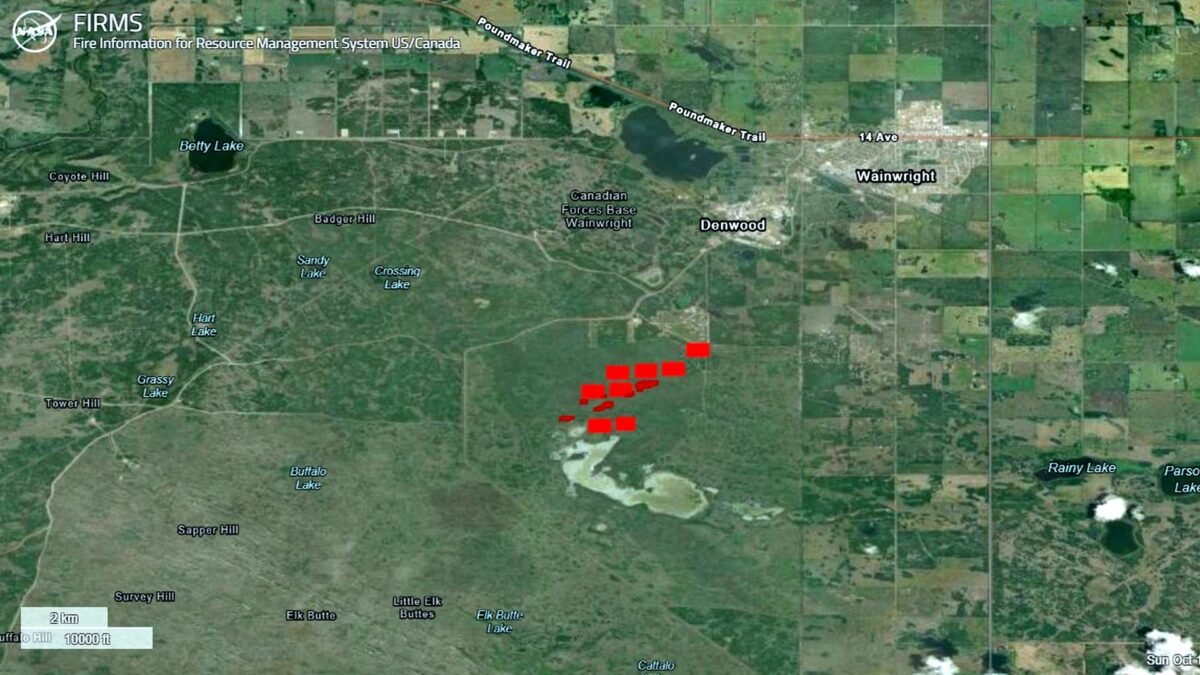
Four Dead, Dozens Hurt as Fire Sweeps Canadian Base During Live-Fire Training
Four Canadian service members were killed and dozens more injured on Saturday when a fast-moving fire tore through a training area at Canadian Forces Base Wainwright in Alberta while troops were conducting live-fire combat exercises, in what Prime Minister Mark Carney has called one of the worst peacetime tragedies ever to strike Canada’s military on home soil.
Thirty-nine people were being treated in hospital as of Sunday afternoon, and at least 19 of them were in critical condition, Alberta Premier Danielle Smith said at a press conference on Sunday, according to CNN. A provincial health official said eight of the injured were stable and 12 others were described as “ambulatory,” with lesser injuries.
Speaking in a televised national address on Sunday, Carney confirmed that the families of the four dead had been notified. “The nation is in mourning for those brave members of our armed forces whom we have lost,” he said, describing the incident as “one of the worst tragedies for the forces on Canadian soil in peacetime.” He ordered flags on all federal buildings flown at half-staff, and praised the crews who battled the blaze, saying: “Military and civilian crews fought this fire throughout the night in some of the worst conditions imaginable, risking their lives to protect their fellow Canadians.”
Victims Named: Sergeant and Three Privates
On Sunday evening, Canada’s military released the names of the four service members killed in the fire, according to CNN. They were Sergeant Morgan Wong of the Loyal Edmonton Regiment, and Privates Shaun Farrell, Aidan Goulding and Hayden Lykkemark of the 3rd Battalion, Princess Patricia’s Canadian Light Infantry.
Carney said those killed and injured had come from bases across the country to train at Wainwright, and included reservists alongside regular-force soldiers from Princess Patricia’s Canadian Light Infantry, which he noted is one of Canada’s most storied regiments. The wounded were being treated in hospitals in Wainwright, Edmonton, Red Deer and Calgary, according to the Associated Press.
Among the critically injured is the eldest son of Cathy Keane, a mayoral candidate in Ontario, who wrote on social media that she was travelling to Alberta to be with him. “As a mother, right now I need to be with my son and family,” she wrote, according to AP.
A Fire a Kilometre Away That Moved in Seconds
The fire broke out at about 4 p.m. local time on Saturday in the base’s training area and spread rapidly, the Canadian Armed Forces said in a news release. The Municipal District of Wainwright said the blaze “spread rapidly due to high winds” and crossed the base fence into the surrounding rural district on Saturday evening. Late on Saturday night, municipal officials said the fire was “being held,” though firefighting crews continued to monitor the area.
Maj.-Gen. Wade Rutland, commander of the 1st Canadian Division, told reporters on Sunday that a grass fire had ignited during a training activity involving the 3rd Battalion, Princess Patricia’s Canadian Light Infantry. He said a fire had already been burning “for several hours” about a kilometre away, but the base’s range control decided the training could continue because that fire was judged “contained” and was not expected to move “anywhere near” the soldiers.
Then, Rutland said, “uncommonly strong winds caused the fire to shift rapidly.” He added: “The fire was a kilometer away when the wind shifted; it is not normal for a fire to move a kilometer in 30, 60 seconds,” and said he had never “seen anything like it.”
The troops had been conducting what Rutland described as “high-intensity combat training with live munitions,” including throwing hand grenades on a grenade range and carrying out simulated attacks. According to reporting compiled on the incident, the unit involved was Charlie Company of the 3rd Battalion, taking part in section-level attack and grenade exercises. The battalion had been preparing to become a rapid-reaction force and was also slated to deploy to Latvia in the spring as part of NATO’s mission bolstering allies near Russia, Rutland said.
Investigation to Ask Whether Tragedy Was “Preventable”
Rutland said an investigation would determine whether the tragedy was “preventable,” and that the cause of the fire remained under “active investigation.” He said the military did not believe the fire involved “any outside interference” or oil and gas infrastructure. A National Defence official told CBC News there were no indications of “any terrorist activity,” and the Alberta Energy Regulator said it had received no reports of incidents involving oil and gas infrastructure on the base.
“There was a multitude of ordnance moving through the Wainwright training area yesterday. Grenade launcher, grenades, small arms, ammunition. Quite frankly, it could have been any of that, or none of it,” Rutland said, adding that it could not yet be confirmed whether munitions were related to the ignition at all. He also stated there were no explosions, a detail that cuts against early media reports citing unnamed military sources that had suggested an explosion tied to a live-fire exercise.
Early reporting on casualty figures also varied: Global News and CBC News initially reported, citing sources, that at least seven people had been killed. Carney’s Sunday announcement confirmed the official toll of four dead. This article uses only the officially confirmed figures.
Defence Minister David McGuinty, who confirmed fatalities on Saturday evening before any numbers were released, described the situation as “very, very active and delicate” and said he “cannot recall an incident like this in recent memory.” McGuinty said he had ordered national defence and emergency preparedness officials to deliver a detailed report on what happened. The Royal Canadian Mounted Police are involved in the investigation.
Hospitals Overwhelmed; Mass-Casualty Response
The scale of the casualties triggered a province-wide mass-casualty response. A “code orange” — the disaster protocol used when hospitals must prepare for a high number of patients — was declared at hospitals in Edmonton, about 200 kilometres northwest of the base. Dr. Warren Thirsk, an emergency department physician at Edmonton’s Royal Alexandra Hospital, told CBC News that Wainwright’s own health-care facilities had been “completely overwhelmed” by the number of patients.
“This number of patients would overwhelm the city of Edmonton,” Thirsk said. “It is more patients than any of us want to count right now. It’s a disaster. It’s a one in every 15- to 25-year disaster.”
Emergency Health Services Alberta deployed 30 units to Wainwright — 22 ground ambulances, six fixed-wing air ambulances and two helicopters — with assistance from Saskatchewan, whose premier, Scott Moe, said his province was sending help. More than a dozen search-and-rescue technicians were parachuted into the Wainwright area from CFB Winnipeg to provide additional medical care. The code orange activations were stood down on Sunday afternoon after more than 10 hours.
Eyewitnesses described chaotic scenes as the injured arrived at local hospitals. Brandon Simmons, who lives in the long-term care unit of the Wainwright Health Centre, told the Reuters news agency that the facility was quickly inundated with patients transported in military vehicles. “I heard people screaming inside of those vehicles that will never end up being out of my mind,” he said. “It was just a scene from a war movie.”
Family members of personnel at the base said online that it was placed under a communications lockdown after the incident, which a former senior military officer told CBC News was normal protocol following a major incident.
A Base at the Heart of Canada’s Army — and a Town That Shares Its Life
Canadian Forces Base Wainwright, about 210 kilometres southeast of Edmonton, is one of the country’s largest and busiest military bases. It houses the Canadian Manoeuvre Training Centre and the 3rd Canadian Division Training Centre, and is described by the Canadian Broadcasting Corporation as the principal base for live-fire training exercises in Canada. Around 1,300 military personnel are stationed there, and the transient training population averages more than 1,000 at any given time, swelling in summer when reservists arrive for annual training. The base covers roughly 600 square kilometres, including 25 weapons ranges.
Bruce Pugh, the mayor of the neighbouring community of Wainwright, said the fire would have a profound impact on his town, noting how deeply intertwined it is with the base. “We share our lives” with the service members, he told CBC, adding: “We have neighbors who are either serving or former members of the Canadian Armed Forces. We’re integrated, our kids playing the same hockey teams, attend the same schools.” He said residents were also worried about community members and friends who work at the Wainwright hospital.
The Globe and Mail reported that the fire ranks among the deadliest training incidents on Canadian soil since 1988, when six military engineering students were killed in an explosives accident in British Columbia.
Condolences Across Party Lines — and Beyond Borders
Political reaction cut across party lines. Conservative opposition leader Pierre Poilievre, who represents the area in Parliament, wrote on social media that he had spoken with Carney about the fire, thanked emergency responders, and added: “Pray for Wainwright, everyone.”
Former prime minister Justin Trudeau wrote: “My thoughts are with the Canadian Forces community, the victims, and all those impacted by yesterday’s horrible tragedy at CFB Wainwright. We mourn with you.”
Governor General Louise Arbour, the commander-in-chief of the Canadian Armed Forces, extended support to military members, families and affected communities in an official statement from Rideau Hall, also recognising the dedication of first responders. The United States ambassador to Canada, Pete Hoekstra, said his “heart is heavy” and that he was praying for the families of the dead and the recovery of the injured, while NATO’s Military Committee also sent condolences, according to the Texas Gazette.
On Sunday evening, the National Hockey League’s Calgary Flames held a moment of silence for the victims before a home game against the Carolina Hurricanes.
Analysis: Why It Matters
The Wainwright fire is, first and foremost, a human catastrophe — four young lives ended and dozens of families thrust into hospital corridors in a single afternoon. But beyond the grief, the emerging facts point to questions that will not be answered by condolences alone, and that Canada’s military establishment will have to confront in public.
The most consequential of those questions concerns the decision to keep training. By the military’s own account, a grass fire had been burning for hours roughly a kilometre from where soldiers were throwing live grenades, and range control judged it contained. That judgment — reasonable on its face in normal conditions — met what Rutland himself called abnormal ones: winds strong enough to carry a fire a kilometre in under a minute, a phenomenon he said he had never witnessed. The investigation’s central task will be to reconstruct exactly what information range control had, what thresholds govern a training halt, and whether those thresholds are fit for an era of hotter, drier, windier fire seasons on the Prairies. “Preventable” is a heavy word for a general to introduce unprompted; its presence in Rutland’s briefing suggests the military knows the scrutiny is coming.
There is also a readiness dimension that reaches beyond Alberta. The battalion at the centre of this tragedy was preparing for two demanding roles: standing up as a rapid-reaction force and deploying to Latvia in the spring as part of NATO’s eastern deterrent posture. Losing four soldiers and hospitalising 39 — many of them critically — does not just wound a unit; it degrades a formation earmarked for alliance commitments made at the highest political level. How quickly 3rd Battalion, Princess Patricia’s Canadian Light Infantry can reconstitute, and whether the Latvia rotation stays on schedule, will become a live question in Ottawa and at NATO headquarters in the weeks ahead.
The political handling, by contrast, has so far been a study in national unity. Carney’s decision to address the country directly, the half-mast order, the cross-party condolences, even a hockey moment of silence — all of it signals a leadership class that understands this moment belongs to the families, not to politics. That consensus is genuine now, but it is also fragile: if the investigation finds that warnings were missed or protocols were thin, the same leaders offering condolences today will face demands for accountability tomorrow, and the line between a tragedy and a scandal is drawn by findings, not intentions.
Finally, there is the quiet, structural story this fire illuminates: how much of modern military risk sits not on battlefields but on home ranges. Live-fire training is inherently dangerous — it must be, to be realistic — and Western militaries lose more personnel to training accidents in most years than to combat. Canada had been fortunate; the Globe and Mail’s comparison to the 1988 British Columbia explosives accident shows how rare a mass-casualty training event is in this country. Rarity, however, can breed complacency about the systems that produce it. The honest measure of this tragedy will not be the tributes paid this week, but whether the investigation’s recommendations — on range safety, weather thresholds, and the authority to stop training — are still being enforced five years from now, when the headlines have faded.
What to Watch Next
- The investigation’s findings: Maj.-Gen. Rutland has promised an inquiry into whether the tragedy was “preventable,” including the range-control decision to continue training near a burning grass fire. Its conclusions — and whether they are made public in full — will shape everything that follows.
- The casualty count: With 19 people in critical condition as of Sunday afternoon, the death toll of four may yet rise. Hospital updates in the coming days will determine the final scale of the disaster.
- Funerals and national memorial: With the names of the four dead now released and flags at half-staff, expect announcements of funerals, regimental memorials and possibly a national commemoration in the days ahead.
- The Latvia deployment question: The affected battalion was due to deploy to Latvia in the spring for NATO’s eastern-flank mission. Watch for statements from National Defence on whether that rotation holds, is delayed, or is reassigned.
- A safety review of training ranges: Opposition parties and veterans’ advocates are likely to demand a wider review of live-fire training safety protocols, weather-related halt criteria and range-control authority across all Canadian bases.
Sources
- CNN — “4 dead and dozens injured after major fire breaks out at one of Canada’s largest military bases”
- Associated Press (via Military.com) — “Carney Says 4 Service Members Killed and Dozens Injured in Fire at Alberta Military Base”
- USA Today — “At least 4 dead after ‘violent’ fire at Canadian military base”
- The Times — “Canada military base fire: four killed and dozens injured”
- National Defence / Canadian Armed Forces — “Incident at Canadian Forces Base Wainwright” (press release)

About the Author — Abdul Mannan
Related Articles
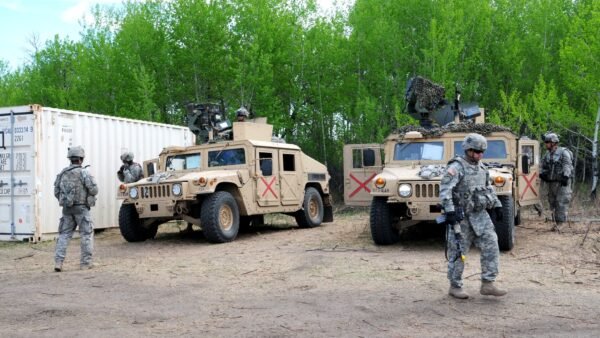
Deaths Confirmed After Major Fire at Canadian Forces Base Wainwright in Alberta
Canada's military has confirmed deaths and injuries after a fire broke out in the training area of Canadian…

Zelensky Asks EU for €70bn More as Brussels Summit Ends Without New Ukraine Funding Deal
Zelensky asked 27 EU leaders in Brussels for an additional €70bn to cover Ukraine's 2027 war costs; the…

Fourteen Killed as Paddy-Laden Truck Rams Devotees Near Gwalior’s Sheetla Mata Temple During Navratri
At least 14 people were killed and dozens injured when an out-of-control paddy-laden truck broke through a police…