
US Strike on Iran ‘Absolutely’ Possible This Weekend, Says Trump Envoy Tom Barrack

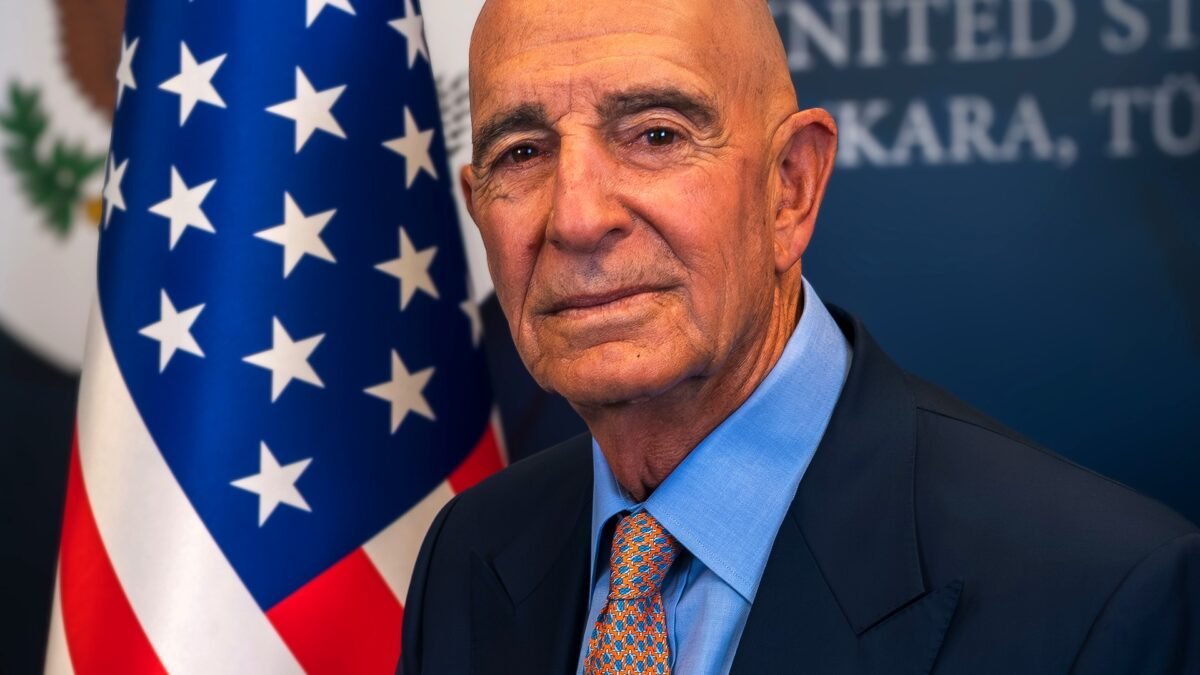
The United States could launch fresh military strikes against Iran as early as this weekend, the American ambassador to Turkey, Tom Barrack, has said — a warning delivered on Friday that was immediately contradicted by his own president. Asked directly whether a strike was possible before the weekend was out, Barrack answered without hesitation: “Could there be a strike this weekend? Absolutely.”
Barrack, who also serves as Washington’s special envoy for Syria, made the remarks during an interview with podcast host Mario Nawfal while visiting the Gulf, according to AFP. He stressed that President Donald Trump remained open to a negotiated settlement after months of diplomatic engagement, saying Trump was “very clear” that he was “open and available and accessible to a deal” and that both sides had “been at the table for months and months and months.”
The warning landed with force because of who delivered it and where. Barrack is one of the president’s longest-standing confidants — a billionaire investor who chaired Trump’s 2017 inaugural committee and has acted as his personal emissary in the Middle East since taking up the Ankara post. He holds no formal role on the Iran portfolio, a caveat every newsroom carrying his words repeated, but his proximity to the president gave the remark immediate weight across Gulf capitals and energy markets.
Hours later, the president himself appeared to undercut the warning. Asked about Barrack’s comments as he arrived in Florida, Trump told reporters: “If that’s the case, I don’t know anything about it.” The dissonance — an envoy declaring a strike “absolutely” possible while the commander-in-chief pleads ignorance — has become the defining feature of this latest flare-up in the US-Iran confrontation.
A strike without regime change
What made Barrack’s remarks particularly significant was what he ruled out. The envoy insisted that any renewed American action would not aim to overthrow Iran’s government, directly contradicting Israeli Prime Minister Benjamin Netanyahu, who has repeatedly called for the removal of Iran’s clerical regime following previous bombing campaigns.
“If you keep threatening the world, our allies, the Gulf, there will be a consequence. The consequence won’t be regime change,” Barrack said. “The United States — the president of the United States — has said he’s not interested in regime change.” He added, in a line that recalled America’s costly experiments in the region: “The problem with regime change always is, what’s the day-two scenario?”
The distinction matters. Washington and Jerusalem are openly split on the purpose of any further military action. Netanyahu, who faces Israeli elections on Tuesday, has vowed to topple the Iranian leadership. Barrack’s framing — punishment for threats against American allies and Gulf states, but no attempt to dismantle the Islamic Republic — is a public signal to Tehran, to the Gulf monarchies and arguably to Netanyahu himself about where the Trump administration draws the line.
Timing, elections and a White House that said otherwise
Barrack’s weekend timetable sits uneasily with the White House’s own stated position. Trump has previously signalled that he could resume military action against Iran amid stalled diplomacy, but had indicated that major action would not take place before the US congressional elections on 3 November. A day before the podcast aired, White House spokesperson Anna Kelly ruled out US strikes before the midterms, according to reports.
The president himself has sent mixed signals. The same day Barrack’s interview circulated, Trump told reporters the United States could end the war with Iran “very quickly” but questioned whether Washington should seek a swift conclusion or allow the conflict to wind down gradually — and floated “another little Epic Fury,” an explicit reference to the joint Israeli-American bombing campaign of February 2026 that opened the current conflict, followed by a second round of strikes later in the year.
The electoral calendar is doing heavy lifting on both sides. Netanyahu, trailing in a volatile Israeli campaign, has an incentive to sound maximalist about Iran before Tuesday’s vote. Trump, facing midterm elections on 3 November that will shape the remainder of his presidency, has reasons to threaten force — and reasons to hold it in reserve.
The region braces
The reaction across the Middle East was swift. On Friday, foreign ministers from Türkiye, Saudi Arabia, Pakistan and Egypt met their counterparts from Britain, France and Germany plus Italy in Istanbul — the first meeting in that format — and left with a single message for Washington: no new attack on Iran. According to Al Jazeera, the ministers condemned Houthi attacks on Saudi Arabia and on Red Sea shipping, and called the Israeli occupation “the fundamental source of instability in the region and beyond.”
Iran’s own answer was diplomatic and defiant in equal measure. Foreign Minister Abbas Araghchi announced that President Masoud Pezeshkian would travel to Moscow next week to meet Vladimir Putin, framing it as a follow-up to Russian Foreign Minister Sergey Lavrov’s visit to Tehran earlier in the week. It was a deliberate signal: if Washington is weighing strikes, Tehran is consolidating its great-power backers.
Iran has also hardened its deterrent posture. Al Jazeera reported that Iranian officials have drawn up plans to strike undersea communications cables in the Gulf if war resumes — a threat to the region’s financial data flows. The IRGC political deputy warned this week that internet cables running through the Strait of Hormuz could be targeted if Iranian infrastructure came under attack.
The Strait itself remains the pressure point. Earlier this week, Iran’s official IRNA news agency reported several explosions heard near Sirik in Hormozgan province, overlooking the waterway, with no casualties reported and no cause given — the first such blasts in the area this month after a relative lull in fighting. Separate IRGC claims of naval-mine strikes on tankers using unauthorised routes have added to the fog. Through it all, the world’s most important oil artery stays hostage to the next escalation.
How the confrontation reached this point
The current war began in late February 2026 with “Epic Fury,” the joint Israeli-American bombing campaign against Iranian nuclear and military targets — the first direct, sustained American bombing of Iran in history. A second major campaign followed months later. Since then, the conflict has settled into a grinding pattern: American naval pressure and strikes, Iranian proxies hitting back across the region, Gulf states caught in between, and diplomacy running in parallel through Qatari, Pakistani and Turkish channels.
Barrack’s insistence that “we’ve been at the table for months and months” is the least-reported part of his interview, but it may be the most important. Despite two bombing campaigns, channels between Washington and Tehran have never fully closed. The unresolved core — Iran’s uranium enrichment and the disposal of its highly enriched nuclear material, plus a “meaningful agreement on domestic enrichment,” as the administration frames it — remains stuck, and each round of fighting hardens the terms.
That is the context in which a single word on a podcast — “Absolutely” — can move markets and ministries. In this confrontation, signalling is half the war.
Analysis: Why It Matters
The gap between the envoy and the president is the real story
The substantive news is not that an envoy thinks a strike is possible; it is that the envoy and the president are describing different realities within hours of each other. Three readings are available, and Washington-watchers will be weighing them through the weekend.
The first is that Barrack was freelancing — a confidant speaking loosely on a friendly podcast, overreaching beyond his portfolio, and being quietly corrected by a president who genuinely did not authorise the remark. The second is that this was deliberate strategic ambiguity: Barrack says “absolutely,” Trump says “I don’t know anything about it,” and Tehran must prepare for both possibilities — the classic good-cop, bad-cop coercion play, with the podcast as the deniable delivery mechanism. The third is that the administration itself is divided, with Barrack voicing a camp that believes escalation is imminent while Trump keeps his options open.
Which reading is correct will only be known in hindsight. But the second reading has a long pedigree in Trump’s foreign policy: maximum pressure is most effective when the adversary cannot tell bluff from intent. The problem, as the Gulf capitals know, is that in a region wired with tripwires — Houthi missiles, IRGC naval units, Israeli jets, American carriers — ambiguity can detonate as easily as it coerces.
The no-regime-change line is aimed at Netanyahu as much as Tehran
Barrack’s most carefully constructed sentence was not the “Absolutely” but the disavowal of regime change. By saying the quiet part plainly — and invoking the “day-two scenario” — the envoy was doing two things at once. To Tehran, it was an assurance: comply on the nuclear and regional-threat files and your system survives. To Jerusalem, it was a leash: do not use American firepower to pursue the maximalist war aims Netanyahu has been campaigning on.
This is the deepest fault line in the confrontation. Netanyahu, days from an election, has every incentive to fuse American and Israeli war aims into a single crusade against the clerical state. Barrack was publicly unfusing them. Whether that leash holds if shooting starts is a question no statement can answer.
The Gulf is the tripwire, not the nuclear sites
Notice what triggers the strike in Barrack’s telling: not enrichment levels, not inspectors’ reports, but threats to “our allies, the Gulf.” The casus belli has quietly migrated from the nuclear dossier to regional behaviour — Houthi attacks on Saudi Arabia, harassment of shipping, threats to undersea cables. This gives Washington enormous flexibility in timing, because the Gulf produces provocations weekly. It also means the decision to strike may hinge on an event neither Washington nor Tehran fully controls: a missile that lands wrong, a tanker that hits a mine, a proxy that overreaches.
Two elections are setting the tempo
Strip away the communiqués and this is a confrontation being paced by two ballots. Netanyahu’s maximalism peaks before Tuesday’s Israeli vote; Trump’s timeline is fenced by the 3 November midterms. The danger zone is the gap between them — a window in which an Israeli leader with nothing to lose and an American president who wants to look strong but not reckless are both improvising. Barrack’s “this weekend” falls squarely in that gap.
Diplomacy is not dead — it is just wearing a disguise
It would be easy to read this week as the collapse of talks. The evidence points the other way. The Istanbul ministers’ meeting, the Pezeshkian-Putin trip, Barrack’s own emphasis on months at the table, the administration’s parallel insistence on a negotiated enrichment deal — all of it describes a diplomatic process running at full speed alongside the war plans. In the modern Middle East, negotiations and bombing campaigns are not opposites; they are instruments in the same orchestra. The “Absolutely” and the “open to a deal” were delivered in the same interview, and that is the point. Coercion is the continuation of diplomacy by other means — and vice versa.
What to Watch Next
- The weekend itself. Barrack named a window: this weekend. Watch US naval and air movements, any Israeli cabinet statements after Tuesday’s election, and whether Gulf air defences go to heightened alert.
- Trump’s next words. The president has contradicted his envoy once; whether he repeats the “I don’t know anything about it” line or shifts to endorsing the warning will signal which camp is winning in Washington.
- The Istanbul format’s follow-up. The R4-plus-E3-plus-Italy grouping is new. If it convenes again quickly, it means the Europeans and the Gulf states are coordinating a restraint campaign — and someone in Washington is listening.
- Moscow next week. The Pezeshkian-Putin meeting will be read in Washington as Tehran shopping for a veto-holder’s cover. Any joint statement on the US-Iran confrontation will set the tone for the next escalation round.
- The Strait of Hormuz. Sirik’s unexplained blasts, the mine claims, the cable threats — the waterway is where this war is most likely to start by accident. Shipping insurers and oil traders will be watching it before anyone else.
Sources
- AFP via TBI Africa — “US could strike Iran weekend – Envoy” (23 October 2026)
- The Business Standard (TBS News) — “US could strike Iran as soon as this weekend: Envoy” (24 October 2026)
- The War Zone (TWZ) — “On The Brink Of Epic Fury Round Two?” (23 October 2026)
- Wikimedia Commons — Official portrait of Ambassador Thomas J. Barrack Jr. (U.S. Department of State, public domain)

About the Author — Abdul Mannan
Related Articles
Israel Strikes Iran’s Nuclear Sites, Iran Hits US Base in Saudi Arabia as Rubio Promises War Will End ‘in Weeks’
Israel strikes Iran's nuclear sites including Bushehr and Arak while Iran hits a US airbase in Saudi Arabia,…
At Least Six Killed as Gunmen Open Fire at Church Funeral in Jordan’s Karak
Gunmen killed at least six people and wounded 28 at a Greek Orthodox church funeral in Jordan's Karak…
Turkey Brings Seven Foreign Ministers to Istanbul for First R4+E3 Talks on Hormuz, Gaza and Ukraine
Turkey hosts the first-ever R4+E3 foreign ministers meeting in Istanbul — seven countries talking Hormuz, Gaza, Yemen and…