
Kennedy Family Joins Lawsuit to Block Trump’s 250-Foot Triumphal Arch Near JFK’s Grave at Arlington

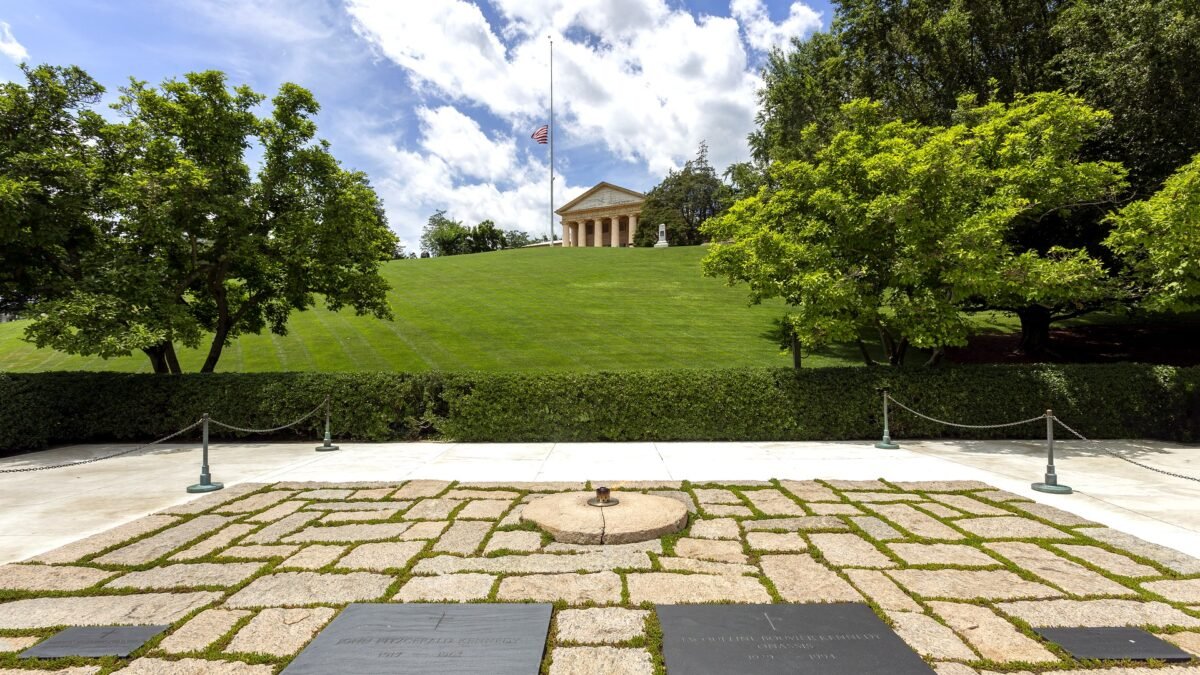
Nine members of the Kennedy family have moved to join the legal fight against President Donald Trump’s proposed 250-foot triumphal arch at Memorial Circle, arguing that the monument would cast shadows over the graves of President John F. Kennedy and his relatives at Arlington National Cemetery and permanently damage one of the most carefully designed sight lines in the United States.
The nine relatives filed a motion on Tuesday, 10 November, asking a federal judge in Washington to let them join an existing lawsuit challenging the project, according to Reuters, which first reported the filing. The move adds the most famous name in American politics to a court battle that already includes three Vietnam War veterans, an architectural historian, and the governments of the District of Columbia and Virginia.
The Kennedys argue that the arch, which would stand at least 250 feet tall on a highway roundabout between the Lincoln Memorial and Arlington National Cemetery, would obstruct views of the Kennedy gravesites and the Eternal Flame honouring President Kennedy from Arlington Memorial Bridge, and would cast shadows over the graves, particularly in the early morning hours when family members typically visit. According to court documents reviewed by PEOPLE, a forensic study cited in the complaint found that the arch would put a shadow on President Kennedy’s grave on 50 days of the year.
“This action is about protecting sacred spaces that belong to the American people,” Rory Kennedy and Maxwell Kennedy, children of the late Senator Robert F. Kennedy and Ethel Kennedy, said in a joint statement issued through the Democracy Defenders Fund, the legal advocacy organisation representing the family. “Our parents, Robert and Ethel Kennedy, and our uncles, President John F. Kennedy and Senator Edward M. Kennedy, are laid to rest at Arlington National Cemetery. Our uncle Joseph P. Kennedy Jr., who lost his life serving our country in World War II, is also memorialized there. They are among the more than 400,000 veterans and family members buried or honored on this hallowed ground. We believe Donald Trump has violated the laws and procedures established by Congress to protect this most sacred national memorial. In bringing this lawsuit, we stand for those who can not stand for themselves.”
The White House did not immediately respond to a request for comment from Reuters. PEOPLE said it had also reached out to the White House for comment. The Trump administration has previously said the arch would honour veterans, and it contends that Congress approved the project more than a century ago, when it authorised construction of a bridge across the Potomac River.
Who filed, and what they are asking the court to do
The nine family members who filed on Tuesday are Rory Kennedy, Maxwell Kennedy, Christopher G. Kennedy, Kerry Kennedy, Courtney Kennedy, Kathleen Kennedy Townsend, Joseph P. Kennedy II, Joseph P. Kennedy III and Edward M. Kennedy Jr., according to court documents reviewed by PEOPLE. The Wall Street Journal, which also reported the filing, said the nine are the latest parties to challenge the development in the U.S. District Court for the District of Columbia.
Their complaint alleges that the National Park Service and the Department of the Interior violated federal laws governing commemorative monuments when they authorised construction on 5 November, according to PEOPLE. The relatives are asking the court to overturn that approval and to prevent construction from moving forward until the administration obtains congressional authorisation and meets other legal requirements.
The court has not yet ruled on the Kennedys’ request to join the case, according to PEOPLE. Their filing does not start a new lawsuit; it asks to intervene in litigation that was already under way, and that litigation is itself the subject of a temporary court order that has halted construction for now.
The family’s lawyers framed the case as a question of constitutional authority as much as of landscape. “The gigantic proposed arch is an illegal interference with Arlington National Cemetery and the heroes remembered there, including at the gravesites and memorials of the Kennedy brothers and Ethel Kennedy,” Norman Eisen and Steve Jonas of the Democracy Defenders Fund said in a statement. “Only Congress has the constitutional power to authorize an intrusion of this magnitude. Today, members of the Kennedy family are joining with the other litigants in this case to protect this historic site – and to defend the rule of law and separation of powers.”
The Kennedys say their interest is not only personal. Family members say they regularly return to the gravesites, often arriving before the cemetery officially opens so they can pay their respects privately, according to the complaint summarised by PEOPLE. They argue that the arch would not only obstruct the views they have long associated with the memorials, but would also cast shadows over the graves at the hour they typically visit.
“Americans from every corner of the country visit Arlington to honor those who served and sacrificed for our nation,” the family’s statement continued. “A towering arch casting shadows across the graves of our father, mother, and uncles, as well as the graves of so many who have served our country, would also cast a shadow over our democratic principles, undermining the safeguards established by our elected representatives to protect this hallowed ground for generations to come. Our lawsuit asks the administration to respect the sanctity of Arlington National Cemetery, the laws established to protect it, and the rights of all Americans who come here to honor those who have served our country.”
The arch and where it would stand
The proposed monument would rise about 250 feet, or 76 metres, at Memorial Circle, the traffic circle at the Virginia end of Arlington Memorial Bridge, between the Lincoln Memorial in Washington and the entrance to Arlington National Cemetery. According to Reuters, a rendering shows the arch topped by a flame held by a 60-foot gold winged female figure and flanked by gold flying eagles. The Wall Street Journal reported that the arch would be twice as large as the Lincoln Memorial and would take about three years to complete. PEOPLE, citing the same figures, said it would stand more than twice the height of the Lincoln Memorial.
The White House has called the project the “Independence Arch” and has tied it to the nation’s 250th anniversary, which the United States marked in 2026. The National Park Service has said the arch is being constructed to honour the 250th anniversary, according to the Wall Street Journal. President Trump has said the arch would be 250 feet high in honour of the 250th anniversary of the signing of the Declaration of Independence, according to Bloomberg Law.
No final public cost for the project has been established, although estimates have run to approximately $100 million, according to reporting on the project. The design draws inspiration from monumental arches such as the Arc de Triomphe in Paris, a comparison that has acquired an unintended irony in this dispute: Jacqueline Kennedy took the idea for her husband’s eternal flame from the flame memorialising the Tomb of the Unknown Soldier beneath the Arc de Triomphe in Paris.
The president has also linked the arch to national security. In a post on Truth Social late last month, he said he had agreed to convert what he called the “magnificent Triumphal Arch, planned since the Civil War Era many years ago, at the Receptive Circle adjoining the Arlington Memorial Bridge, into a top grade Military Complex/Triumphal Arch”. Bloomberg Law reported that the Justice Department’s claim that the arch was needed for national security was described by the judge in the case as “belated and unsupported”.
Memorial Circle is not an empty plot. It is the ceremonial gateway to Arlington National Cemetery, the point at which the long axis running from the Lincoln Memorial across Arlington Memorial Bridge arrives at the cemetery’s entrance. According to the Kennedy family’s filing, as summarised in reporting on it, the structures at Memorial Circle were specifically constructed low to the ground in an effort to maintain the visibility and sight lines at the cemetery. The family argues that a 250-foot arch at that spot would destroy what the filing calls an “essential element” of the Kennedy gravesites: the clear sight line from Arlington Memorial Bridge to the graves and the Eternal Flame.
A legal fight that was already under way
The Kennedys are joining a case that has been moving quickly, and in the administration’s disfavour, for weeks. Three Vietnam War veterans and an architectural historian first sued the administration in February 2026, arguing that the project lacked the necessary congressional approval, according to PEOPLE. The District of Columbia and Virginia later filed a separate lawsuit, and the cases were consolidated, according to a federal court opinion cited by PEOPLE. Bloomberg Law identifies the cases as Lemmon v. Trump and District of Columbia v. National Park Service.
The District and Virginia filed their challenge on 31 October, claiming that the proposed project violates environmental and historical preservation laws, according to Bloomberg Law. The administration had notified the court on 21 October that the National Capital Planning Commission was set to take up the arch proposal on 5 November and that work could begin the same day.
On Thursday 5 November, the National Capital Planning Commission voted 8-4 to approve the arch’s proposed site and building plans, after approximately nine and a half hours of testimony and debate. The commission, which oversees major building and development decisions in Washington, is led by Trump appointees, according to the Wall Street Journal.
Less than two hours later, U.S. District Judge Tanya Chutkan issued a 14-day temporary restraining order preventing the Trump administration from beginning any construction-related activity on the project. The order bars the government from initiating or carrying out construction, excavation, demolition, land disturbance, utility installation or roadway closures connected with the arch, according to Bloomberg Law. Judge Chutkan concluded that Washington and Virginia had demonstrated a risk of immediate harm if the project proceeded before the legal disputes were resolved, and that the two jurisdictions would incur “significant unrecoverable costs” if the administration were allowed to begin construction.
The temporary order runs through 19 November, according to Reuters, while the judge considers whether to issue a preliminary injunction. A federal judge temporarily blocked construction for 14 days on 5 November while considering the challenge brought by the District and Virginia, and the judge has not yet decided whether construction should remain paused beyond that period, according to the court’s memorandum opinion cited by PEOPLE. The administration was also ordered to provide a compliance report on Monday 9 November.
At the heart of the legal dispute is a disagreement about what Congress authorised, and when. The administration’s lawyers maintain that legislation dating to 1925, which approved the construction of two columns at Memorial Circle, established sufficient authority for a monument at the site, and the administration contends more broadly that Congress approved the arch more than a century ago when it authorised the bridge across the Potomac. The challengers argue that a triumphal arch of this scale is a new commemorative work that requires fresh congressional authorisation under the federal laws governing monuments in the capital, and that no such authorisation exists. The temporary restraining order is not a final ruling on that question; it preserves the status quo while the court examines it.
Numerous Democrats in Congress have vowed to block construction once they take control in January, after winning November’s midterm elections, according to Reuters. That political clock is part of why the project has moved at such speed. CNN reported on 10 November that the Trump administration is signalling it will accelerate plans for its Washington construction projects, which the president regards as part of his legacy, to lay as much groundwork as possible before Democrats take over Congress in January. The arch, a project to put up fencing at Lafayette Square, the East Potomac Golf Links and a development plan for the Tidal Basin that includes the president’s Garden of American Heroes will all see action pushing them ahead over the next 60 days, according to CNN.
The same CNN report said House Democrats are demanding that the Interior Department preserve documents related to the president’s construction projects after whistleblowers warned that key paperwork has already been destroyed before Democrats take power. The Interior Department dismissed the allegations as “100 per cent false”, saying it complies with all federal records management requirements. White House spokesperson Davis Ingle defended the accelerated timetable, telling CNN: “President Trump is moving at lightning speed because we don’t have time to waste in our mission to make America greater than ever before.”
The shadow over the Eternal Flame
The most striking claim in the Kennedy filing is also the most concrete: that the arch would throw a shadow across the grave of a murdered president. The family’s complaint cites a forensic study, according to PEOPLE, which found that the arch would cast a shadow over President Kennedy’s grave on 50 days of the year, with the effect concentrated in the early morning, when the family most often visits.
That detail matters because the gravesite was designed, above all, around light and simplicity. President Kennedy was assassinated in Dallas, Texas, on 22 November 1963. On Sunday 24 November, Jacqueline Kennedy requested an eternal flame for her husband’s grave. With the state funeral set for Monday 25 November, there was almost no time to build one: overnight, Colonel Clayton B. Lyle and a United States Army Corps of Engineers team improvised a flame from a propane gas-fuelled tiki torch obtained from the Washington Gas and Light Company, tested it and modified it for the grave.
The permanent site was designed by the architect John Carl Warnecke, a longtime friend of the president whom Jacqueline Kennedy chose on 29 November 1963, the day after she, Warnecke and Robert F. Kennedy visited the grave to discuss a permanent memorial. Warnecke concluded immediately that the grave must be simple and must incorporate the eternal flame as its centrepiece. The government formally set aside a three-acre site around the grave on 5 December 1963, and the permanent site, an elliptical marble plaza with a five-foot circular fieldstone holding the flame, was consecrated and opened to the public on 15 March 1967. The flame has burned ever since.
The site was chosen because the president had admired it. On a visit to Arlington in March 1963, eight months before his assassination, President Kennedy stood on the hillside below Arlington House, the Robert E. Lee National Memorial, with Warnecke, and admired the peaceful atmosphere and the view across the Potomac to Washington. The initial suggestion to bury him at Arlington is said to have come from Secretary of Defense Robert McNamara. Jacqueline Kennedy’s inspiration for the flame came from Paris, where she had seen the flame at the Tomb of the Unknown Soldier beneath the Arc de Triomphe.
That history is why the family’s complaint treats the sight line as part of the memorial itself, not as a view that happens to exist beside it. The gravesite occupies a grassy hillside just east of and below Arlington House, with views to the Potomac River and Washington. From the bridge, the visitor looks up the slope to the graves and the flame. A 250-foot structure at Memorial Circle, at the foot of that slope, would stand between the bridge and the hill, and, on the family’s evidence, would throw its shadow up the hill on 50 mornings a year.
President Kennedy is buried at Arlington with his wife, Jacqueline Kennedy Onassis, and two of their children. Robert F. Kennedy, his wife Ethel Kennedy and his brother Edward M. Kennedy are buried nearby, and a memorial honours their brother Joseph P. Kennedy Jr., who died while serving in the Second World War, according to the filing summarised by PEOPLE. The cemetery as a whole holds more than 400,000 veterans and family members, and the family’s statement deliberately widened the argument beyond its own dead: a shadow across those graves, it said, would fall across the graves of “so many who have served our country”.
A family divided, and a dynasty’s name
The filing also exposes a fault line inside the Kennedy family itself. The most prominent Kennedy in the Trump administration is Robert F. Kennedy Jr., the nephew of President Kennedy, who serves as the president’s health secretary. He is not among the nine relatives who filed on Tuesday, and his name does not appear in the family’s statement. Reuters noted his position in its report of the filing, and the contrast needs no elaboration: one Kennedy is a cabinet secretary in the administration building the arch, while nine of his relatives are asking a federal court to stop it.
The family’s statement was issued in the names of Rory Kennedy and Maxwell Kennedy, the children of Robert and Ethel Kennedy, and it was provided by the Democracy Defenders Fund, the legal advocacy organisation representing the family in the case. The organisation is led by Norman Eisen, a former White House ethics lawyer, and it is currently fighting several other legal battles against the Trump administration, including the president’s push to redesign a public golf course in East Potomac Park, according to reporting on the filing.
It is also worth noting what the Kennedys are not arguing. They are not asking the court to decide whether the arch is beautiful, or whether a triumphal arch is an appropriate way to mark the 250th anniversary of the Declaration of Independence. Their case, as filed, is that the administration broke the law by approving it without Congress, and that the approval must be overturned until the administration obtains congressional authorisation and meets the other legal requirements. That is a narrower claim than a judgement on the monument, and it is a deliberately chosen one: it asks the court to enforce procedure, not taste.
The distinction matters because the administration’s defence rests on the same ground. Its lawyers do not argue that the president may build whatever he wishes wherever he wishes; they argue that Congress already gave permission, in 1925, for a monument at Memorial Circle, and that the arch falls within it. If the court accepts that reading, the arch proceeds. If it does not, the project needs a vote in Congress, and the Democrats who take control of Congress in January have already said they will not give it one. The case is therefore, in substance, a fight about whether a century-old authorisation for two columns can carry a 250-foot arch, a gold winged figure and a military complex.
The wider battle over Washington’s landscape
The arch is not an isolated project. It is the most prominent element of a broader effort by President Trump to remake the capital’s historic landscape in his second term, and almost every element of that effort is now in court, in Congress, or both.
The same week the arch was approved and then frozen, preservation groups sued to block the overhaul of the Kennedy Center, the performing arts complex that opened in 1971 as a living memorial to President Kennedy. The National Trust for Historic Preservation, the American Institute of Architects and six other groups alleged in federal court in Washington that the administration launched the project without required congressional approval and bypassed mandatory federal reviews, according to Reuters. The White House and the Kennedy Center did not immediately respond to requests for comment on that lawsuit. A federal judge in Washington is expected to rule this month whether to freeze work on the White House ballroom project, in a separate lawsuit brought by the National Trust, after the administration demolished the East Wing to make room for a ballroom the president said would fit 999 people.
The pattern in each case is the same: the administration moves quickly, citing old authorisations or executive authority; preservationists, local governments and now the Kennedy family argue that the law requires Congress, or a fuller review, first; and a federal judge is asked to freeze the work while the question is decided. In the arch case, the judge has frozen it. In the ballroom case, a ruling is expected this month. In the Kennedy Center case, the lawsuit was filed in March 2026 and is proceeding.
Congress is the other front. Representative Jared Huffman, the California Democrat who is expected to become chairman of the House Natural Resources Committee when Democrats take control in January, has told CNN that the committee could use subpoenas and legal action to block some of the projects, and that it is coordinating with the House Oversight and Judiciary committees on investigations into the administration. Committee aides expect a high-profile hearing on one or several projects early in the new Congress, with the golf course and the triumphal arch chief among the areas of focus, according to CNN. The arch’s fate may therefore be decided as much by the calendar as by the court: the temporary restraining order runs to 19 November, the preliminary injunction decision will follow, and a new Congress arrives in January with the power to refuse funding altogether.
Analysis: Why It Matters
A shadow is a fact, not a metaphor, and that is why it works
The Kennedy family’s most effective argument is also its simplest, and it is the one the family put in its headline claim: the arch would cast a shadow over the grave of John F. Kennedy on 50 days a year. That is a measurable, physical consequence, supported by a forensic study cited in the complaint, and it does not depend on anyone’s opinion about the arch’s design. It also turns the administration’s own symbolism against it. The arch is topped by a flame held by a golden figure; the grave it would overshadow is marked by a flame that has burned since 1963. One flame was lit by a grieving widow in the hours after an assassination; the other would be cast in gold as the crowning element of a monument to a living president’s legacy. The contrast is not an argument the family needed to make in words, because the facts make it for them.
There is a second reason the shadow matters. The Kennedy gravesite was designed by Warnecke to be simple, and its power comes from what is not there: no towering structure, no ornament, no competition with the landscape. The filing’s point about the low structures at Memorial Circle is the same point in architectural terms: the whole approach to Arlington was designed so that nothing would stand between the visitor and the hill. A 250-foot arch at the foot of that hill would not merely add a new object to the view; it would reverse the design logic of the place. That is why the family’s language is about “permanent” damage to sight lines, not about temporary inconvenience. A shadow that falls on a grave 50 mornings a year is, for the people who visit on those mornings, a permanent change to what the place is.
The law, not the monument, is the battlefield both sides chose
It is striking how little of this dispute is about whether the arch is a good idea. The Kennedys’ complaint is framed as a violation of the laws governing commemorative monuments, and the administration’s defence is framed as a century-old congressional authorisation. Both sides have chosen to fight on procedure, and that choice reveals something about the state of American monument-building: no one any longer expects a president to ask Congress first and build second, and no one any longer expects a court to defer to the executive on the question.
The 1925 argument deserves scrutiny on its own terms. A law that authorised two columns at Memorial Circle a century ago is being asked to carry a 250-foot arch, a 60-foot gold figure, golden eagles and, in the president’s own description, a “top grade Military Complex”. That is a very long way from two columns, and the distance between the two is the whole case. If the court accepts the administration’s reading, then almost any monument at Memorial Circle could be justified by the same 1925 law, and the requirement of congressional authorisation for commemorative works would become a formality. If the court rejects it, the arch needs a vote it is unlikely to get from a Democratic Congress. The judge’s description of the administration’s national-security justification as “belated and unsupported” suggests she is not inclined to accept novel justifications offered after the fact, and that is a bad sign for a defence that depends on stretching a century-old law.
The Kennedy name still carries weight, and the family knows it
Nine Kennedys filing together is a political act as well as a legal one. The family’s name is attached to the cemetery in a way no other family’s is: the grave, the flame, the hillside and the view are, for millions of visitors, the Kennedy memorial at Arlington, even though the cemetery holds 400,000 others. When the family says the arch would damage “the gravesites and memorials of the Kennedy brothers”, it is speaking as the custodian of a national shrine, and it knows that the court, the press and the public will hear it that way.
The family also knows the cost of the gesture. The filing puts the Kennedys publicly at odds with a president whose cabinet includes Robert F. Kennedy Jr., and it does so in the week when the administration is accelerating its building programme before Democrats take Congress. The statement’s language about standing “for those who can not stand for themselves” is aimed, quite deliberately, at the 400,000 other dead at Arlington, and at the argument that this is a family protecting its own plot. Whether the court accepts the family’s standing to intervene is a separate question from whether the public accepts its motives, and the family has plainly decided that both are worth the risk.
The calendar is the administration’s enemy
Every element of this story is governed by a date. The temporary restraining order runs to 19 November. The preliminary injunction decision will follow. A new Congress takes control in January, with Democrats vowing to block the project and to investigate the administration’s building programme. The arch is supposed to take about three years to build, which means it would not be finished until well into a presidency that may or may not still be Trump’s, and it would be built, if at all, under a Congress that has said it will not fund it.
That is why the administration is, in the White House’s own words, “moving at lightning speed”. The speed is not a sign of confidence; it is a sign that the administration knows its window is closing. The National Capital Planning Commission approved the arch on 5 November, the same day Democrats’ midterm victory was being digested, and the administration was ready to begin work the same day. The judge’s order, issued less than two hours later, stopped it. The whistleblower allegations about destroyed documents, whether true or not, fit the same pattern: an administration trying to finish, or at least to make irreversible, a building programme before the people who oppose it acquire the power to stop it. The Kennedys’ intervention, filed on 10 November, is the latest attempt to make sure the window closes before the concrete is poured.
Washington’s landscape is now a partisan battlefield
The arch, the ballroom, the Kennedy Center, the golf course, the fencing at Lafayette Square and the Garden of American Heroes at the Tidal Basin are, taken together, a single project: the remaking of the capital’s symbolic landscape by one president, quickly, and largely without Congress. Each project has its own lawsuit, its own judge and its own legal theory, but the pattern is the same, and the opposition has now learned to meet it with the same tools: temporary restraining orders, preservation statutes, congressional oversight and, in this case, a family with a grave at stake.
That pattern is unlikely to end with this case. If the arch is blocked, the administration will point to the ballroom and the Kennedy Center as the next fronts. If it is built, the precedent will be that a president can raise a 250-foot monument at the entrance to the nation’s most sacred cemetery on the strength of a 1925 law about two columns, and every future president will know it. Either way, the question the Kennedys have put to the court is the question the country will have to answer about all of these projects: who gets to decide what the capital looks like, a president in a hurry, or Congress, acting slowly and in public, as the law requires.
What to Watch Next
- The intervention ruling: whether Judge Chutkan allows the nine Kennedy family members to join the consolidated lawsuit, and whether their standing as relatives of those buried at Arlington strengthens the case against the arch.
- 19 November: whether the temporary restraining order is extended or replaced by a preliminary injunction, which would keep construction frozen for months while the case is decided.
- The 1925 question: how the court rules on the administration’s claim that a century-old authorisation for two columns at Memorial Circle covers a 250-foot arch, and whether the judge’s scepticism about the national-security justification extends to the rest of the defence.
- The compliance report: what the administration told the court in the report it was ordered to file on 9 November, and whether the judge finds that the government has obeyed the restraining order.
- Congress in January: whether the incoming Democratic majority moves to block funding for the arch, and whether the House Natural Resources Committee holds the early hearing its aides have promised on the arch and the golf course.
- The other monuments: the expected ruling this month on whether to freeze work on the White House ballroom, and the progress of the Kennedy Center lawsuit, which will show whether the arch case is an outlier or part of a wider judicial check on the president’s building programme.
Sources
- Reuters – Kennedy family tries to stop Trump’s Washington arch
- The Wall Street Journal – Kennedy Family Joins Effort to Block Construction of Trump’s Arch
- PEOPLE – Kennedy Family Sues to Block Trump Arch, Which Would Put Shadow on JFK’s Grave 50 Days a Year
- Bloomberg Law – US Judge Blocks Trump’s Plan to Construct Triumphal Arch
- CNN – Whistleblowers tell Democrats documents linked to Trump’s construction projects are being destroyed
- Wikipedia – John F. Kennedy Eternal Flame (background on the gravesite’s history)

About the Author — Abdul Mannan
Related Articles
Supreme Court Clears Trump to Resume Border Wall Construction in Big Bend National Park
The US Supreme Court has cleared the Trump administration to resume border wall construction in Texas's remote Big…
House Oversight Report Finds Federal Failures Let Jeffrey Epstein Keep Abusing Victims After 2005
A 15-month House investigation concludes the crimes Jeffrey Epstein committed after 2005 could have been prevented — and…
Senate Passes Bill to End Longest US Government Shutdown as House Prepares Wednesday Vote
The Senate has voted 60-40 to pass a funding package that would end the longest government shutdown in…