
Pakistan Takes the ECO Chair as Dar Hosts Regional Foreign Ministers in Islamabad

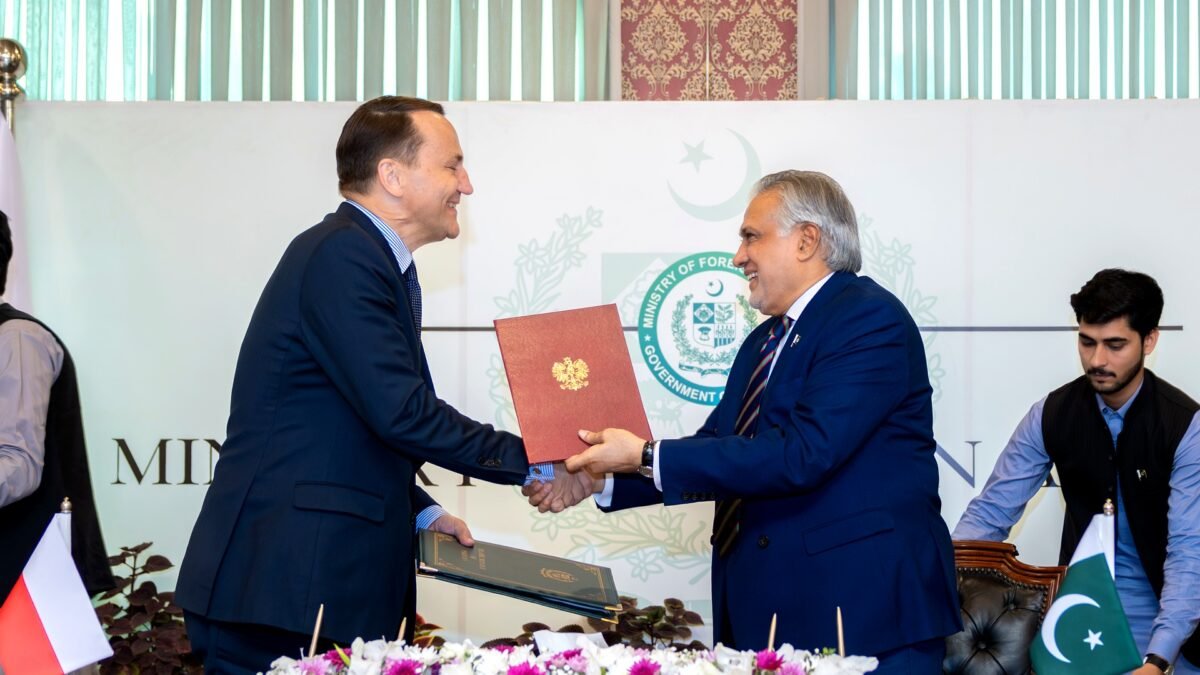
Pakistan has taken the chair of the Economic Cooperation Organization for 2026–27, opening the 30th meeting of the organisation’s Council of Ministers in Islamabad on Sunday with Deputy Prime Minister and Foreign Minister Ishaq Dar in the chair, according to Radio Pakistan and the Foreign Office.
The two-day ministerial meeting, which runs on 15 and 16 November, brings together the foreign ministers and heads of delegation of the ECO’s ten member states at a moment when the region the organisation was built to connect is instead defined by a war, a closed border and a blockaded strait. Pakistan has set its chairmanship theme as “Reviving Regionalism for a Resilient ECO”, and the Foreign Office says the chairmanship will focus on strengthening regional connectivity, deepening integration and promoting joint efforts for economic prosperity and sustainable development.
The meeting opened on the morning of Sunday 15 November, Radio Pakistan reported, with the state broadcaster describing the session as a chance to reinvigorate the organisation “as an effective platform for regional cooperation, dialogue and economic collaboration”. The Foreign Office said the chairmanship offers Pakistan “an opportunity to position the country as a regional connectivity hub, a facilitator of logistics and supply chains, and an agenda setter for regional trade”.
Two documents are expected to come out of the meeting, according to the most specific account published so far, from the government of Turkmenistan: an Islamabad Declaration and a programme document titled “Strategic Goals of Economic Cooperation – 2035”. The programme is meant to guide economic cooperation among the members over the coming decade. The senior officials’ meeting that prepared the file for the ministers has already met, and the texts that were drafts in early November are now the texts the council will vote on.
The gathering is being held against a backdrop no ECO ministerial has faced before. Iran, one of the organisation’s three founding members, is at war. The United States and Israel launched surprise attacks on Iran on 28 February 2026, and the conflict has since spread across the Gulf: Iran has attacked shipping in the Strait of Hormuz, launched drones at a United States base in Bahrain, and seen its allies fire missiles towards Riyadh. The foreign minister of a country at war travelling to Islamabad to sit in a room with nine other governments is itself one of the most striking facts of this meeting.
Who is in the room
The Foreign Office said the meeting would be attended by foreign ministers and heads of delegations of the member states, together with the secretariat and its subsidiary bodies, Geo News reported on 14 November. Delegations continued to arrive in the capital through Sunday, and the Foreign Office shared the arrivals in posts on X, noting that each visiting official was received at the airport by ministry officials.
According to Feature Pakistan, Turkish Deputy Foreign Minister Musa Kulaklikaya arrived in Islamabad to lead his country’s delegation, as did Azerbaijan’s Deputy Foreign Minister Elnur Mammadov and Kazakhstan’s Deputy Foreign Minister Arman Issagaliyev. Shanghai Cooperation Organisation Deputy Secretary General Ahmad Saidmurodzoda also arrived, along with Organisation of Islamic Cooperation Secretary General Ismail Ould Cheikh Ahmed. The foreign minister of the Turkish Republic of Northern Cyprus, Tahsin Ertugruloglu, arrived on Saturday to take part.
Iranian Foreign Minister Abbas Araghchi travelled to Islamabad to attend the meeting, according to reporting on Sunday, and Dar held separate meetings on the sidelines with the ECO Secretary General and the OIC Secretary General to reaffirm Pakistan’s priorities and its pledge to host the ECO Summit in 2027, Particle reported.
One delegation was conspicuous by its absence. Afghanistan’s tricolour flag was displayed at the meeting, but the Taliban were not invited, according to Taneen. The Express Tribune had reported before the meeting, citing people familiar with the preparations, that there was no clarity on whether Afghanistan would be invited, and noted that an ECO interior ministers’ meeting due in Islamabad in late October had been postponed amid the prevailing regional situation.
The senior officials’ file that went to the ministers was assembled in Tehran. The 312th meeting of the ECO Council of Permanent Representatives was held at the secretariat in the Iranian capital on 8 November, under the chairmanship of Pakistan’s ambassador Imran Ahmed Siddiqui, with the permanent representatives of member states and the ECO Secretary General, Asad M. Khan, taking part, the organisation announced. The council considered the Strategic Goals of Economic Cooperation 2035 “for submission to the 30th ECO Council of Ministers Meeting”, and also reviewed preparations for the ministerial and for the 18th ECO summit.
What Pakistan wants from the chair
Islamabad’s pitch is straightforward: Pakistan should be the route that connects landlocked Central Asia to the Arabian Sea. The chairmanship’s public statements have led with connectivity, and the argument runs through the projects already on the table, from a connectivity memorandum with Kazakhstan to a proposed Gwadar–Sohar port link, as KhabarWire reported.
Dar has already set out the ambition in public. When he addressed ECO ministers in New York in September, he called for a digitally enabled ECO free trade area and for the corridors that would make such an area usable. The Foreign Office’s account of the chairmanship repeats the same language: strengthening regional connectivity, deepening regional integration, strengthening regional partnerships and promoting collective efforts towards greater prosperity, sustainable development and a more integrated and resilient ECO region.
The numbers give the argument its scale. Trade among ECO member states reached approximately 95.8 billion dollars in 2024, around 1.7 times its 2020 level, according to a 2025 research report by the Centre for Economic Diplomacy at Uzbekistan’s Institute for International Relations, cited in coverage of the meeting. The figure is large in absolute terms and small relative to what the members trade with the rest of the world — which is precisely the gap Pakistan says the chairmanship should close.
The meeting is also a piece of stagecraft. Radio Pakistan reported on 15 November that Information Secretary Ashfaq Ahmad Khalil opened a Media Facilitation Centre at the Pak-China Friendship Centre, with high-speed internet, workstations, a digital studio and briefing rooms, so that domestic and international journalists can cover the meeting. A government that builds a media centre for a ministerial wants the meeting seen.
The two documents to watch
The Islamabad Declaration and the Strategic Goals 2035 document carry the weight of Pakistan’s chairmanship year. The programme sets the direction for the coming decade; the declaration is the political statement that goes with it. Turkmenistan’s government published the most specific account of what is expected: after a cabinet meeting chaired by President Serdar Berdimuhamedov, the state portal recorded that the agenda “covers a wide range of issues of multilateral interaction within the framework of the ECO, including trade, transport, energy and other sectors”, and that “following the results of the meeting, it is planned to adopt the Islamabad Declaration and the program document ‘Strategic Goals of Economic Cooperation – 2035′”.
What neither document yet sets out in public is the timetable Pakistan has been asking for. Three questions will decide whether the meeting matters beyond its photographs. The first is whether the Strategic Goals 2035 attach a timetable to the free trade area Pakistan promotes. The second is whether the declaration names the transit corridors, and the ports, that would carry Central Asian trade. The third is whether the connectivity promise survives the fact that the landlocked route to it runs through a border that is closed.
None of that was settled when the meeting opened on Sunday. The outcome documents were not public when the first day’s reporting was written, and the name of the main outcome document itself differs between accounts: Turkmenistan’s government calls it an Islamabad Declaration, while the draft agenda circulated to members referred to a communiqué. The declaration and the programme document are the two texts to watch, and the ambition Radio Pakistan described for the chairmanship — a country positioned as a connectivity hub and an agenda setter for regional trade — is the standard the delegation has set for itself.
A region at war, in one room
The ECO was founded in 1985 by Pakistan, Iran and Türkiye, and expanded in 1992 to include Afghanistan, Azerbaijan, Kazakhstan, Kyrgyzstan, Tajikistan, Turkmenistan and Uzbekistan. It now has ten members. Its stated aim is to promote economic development through cooperation in trade, transport, energy and investment.
That founding story is part of why this meeting is unusual. The organisation’s three founders are Pakistan, Iran and Türkiye. One of them is at war with the United States and Israel. Another, Türkiye, has just published the law ratifying the Makkah defence pact, which President Recep Tayyip Erdogan says strengthened ties with Pakistan. The third is chairing the meeting and positioning itself as the region’s connectivity hub. The ECO has always been an economic body that sits on top of deep political fractures; this week those fractures are in the room.
The war shapes the agenda in practical ways as well. Iran insists it should control the Strait of Hormuz, and has attacked what it calls unauthorised traffic through it, while the United States protects tankers. The strait is the route through which much of the region’s energy moves, and the ECO’s members include both the producers and the consumers of that energy. A connectivity agenda that does not account for a blockaded strait is an agenda written for a different region.
Pakistan has also been urging de-escalation in the Gulf at the United Nations, even as it hosts the Iranian foreign minister. That balancing act — hosting a wartime ally’s foreign minister while calling publicly for calm — is the diplomatic posture the chairmanship requires, and it is also the posture most exposed to events. A further escalation in the Gulf during the two days of the meeting would change what the declaration can say, and what it means.
The Afghanistan question
The hardest test of the connectivity agenda is not in the declaration but at the border. The Express Tribune’s account of the preparations listed the closure of the Pakistan-Afghan border, inadequate infrastructure and the absence of effective cross-border trade arrangements as the reasons regional economic integration has remained limited, alongside the security pressure of attacks launched from Afghan soil.
Pakistan has repeatedly asked Kabul to stop the banned Tehreek-e-Taliban Pakistan using Afghan territory to stage attacks inside Pakistan, and that argument sits directly underneath the corridor argument. A commitment to a corridor has to be written into the declaration to count, and a corridor that runs through a closed border is a line on a map, not a trade route.
The decision not to invite the Taliban government, while displaying the Afghan tricolour, is a statement in itself. It preserves the ECO’s formal position on Afghanistan’s representation while keeping the country symbolically in the room. It also means the government that controls the territory through which the central corridor must pass is not at the table. That is the contradiction the chairmanship inherits, and it will not be resolved by a declaration.
Pakistan’s wider diplomatic week
The ECO meeting is not the only diplomacy on Pakistan’s calendar. Dar announced on Saturday that the government has decided to nominate Dr Musadik Masood Malik, the Federal Minister for Climate Change and Environmental Coordination, to represent Pakistan at the SCO Civilisational Dialogue to be held in New Delhi from 20 to 22 November 2026, The News reported. The nomination means a Pakistani minister will travel to India days after Islamabad hosts the ECO ministers — a reminder that Pakistan’s regional diplomacy runs on more than one track at once.
The ECO chairmanship also sits alongside Pakistan’s role at the United Nations, where it has urged Gulf de-escalation, and its deepening defence relationship with Türkiye. None of these tracks is separate from the others. The same week that Pakistan chairs a regional economic body, it is managing a war on its western doorstep, a closed border to its north-west, and a diplomatic opening to its east. The ECO meeting is where those threads are supposed to come together; whether they do is the question the next two years of the chairmanship will answer.
Analysis: Why It Matters
A chairmanship is a test, not a trophy
Chairing a regional organisation is often treated as a ceremonial honour, a line in a foreign minister’s biography. That reading misses what the chairmanship actually is: a two-year window in which one government sets the agenda, drafts the documents and decides what counts as progress. Pakistan has used that window to put a single idea at the centre of the ECO — that the organisation’s future is connectivity, and that Pakistan is the route. The idea is sound. The question is whether the chairmanship can produce anything more than the idea. Declarations are cheap; corridors are not. The measure of this chairmanship will not be the Islamabad Declaration but whether, by 2027, a truck can move from Tashkent to Gwadar faster and cheaper than it can today. Nothing in the first day’s reporting answers that question, and that is the honest place to start.
The war is the agenda, whether or not it is on it
No ECO ministerial has ever met while one of its founding members was at war. The formal agenda is trade, transport, energy and investment. The real agenda is whether ten countries that disagree about almost everything can agree about anything while a war is being fought in their neighbourhood. Iran’s foreign minister sitting in Islamabad is the most important fact of this meeting, and it is also the most fragile one. If the war escalates, the declaration’s language on connectivity will read as an artefact from a calmer time. If the war pauses, the meeting will be remembered as the moment the region’s governments kept talking. Either way, the war, not the trade agenda, will decide how this meeting is remembered. That is not a criticism of the ECO; it is a description of what it means to hold a regional economic meeting in a region at war.
Connectivity is the right idea, and the hardest one
Pakistan’s connectivity pitch is the strongest argument it has, because it is the argument that makes Pakistan indispensable rather than merely important. Landlocked Central Asia needs a route to the sea, and Pakistan has the ports. But the pitch has a weakness that no declaration can fix: the route to the sea runs through Afghanistan, and the border with Afghanistan is closed. A chairmanship that promises corridors while the corridor’s gate is shut is promising a future it cannot deliver on its own. The honest version of the connectivity agenda is that it depends on a political settlement with Kabul that Pakistan does not currently have. The ECO meeting can name the corridors; it cannot open the border. That gap between what the chairmanship can promise and what it can deliver is the central tension of the next two years, and it was visible in the room from the first day.
The Afghanistan empty chair says more than the declaration
The decision to display the Afghan tricolour while not inviting the Taliban is the kind of diplomatic compromise that looks tidy in a photograph and untidy in practice. It keeps Afghanistan formally inside the ECO while keeping its actual government outside the room. The logic is understandable: recognising the Taliban government would be a political step no member is prepared to take collectively. But the consequence is that the government controlling the territory the corridors must cross has no stake in the corridors’ success. A regional organisation that excludes the government of the country at its centre is not a regional organisation in the full sense. It is a club of nine governments and a flag. Pakistan, as chair, owns that contradiction now. How it handles it — whether it finds a way to bring Kabul into the room without recognising it, or leaves the chair empty for two years — will be one of the chairmanship’s defining choices.
Declarations are the ECO’s habit, and its problem
The ECO has a long history of declarations. The Islamabad Declaration, if adopted, will join a shelf of them. The organisation’s critics have a fair point: its members share borders, trade routes and energy links, but regional trade remains far below its potential, and the gap between what ministers agree and what customs officers do at the border is the organisation’s oldest problem. The Strategic Goals 2035 document is an attempt to answer that criticism with a longer horizon — a ten-year programme rather than a two-day statement. But a ten-year programme without a timetable is a ten-year excuse. The test of this meeting is therefore narrow and specific: does the programme attach dates to the free trade area, and does the declaration name the corridors and the ports? If the answer to both is yes, the meeting will have done something real. If the answer is no, the chairmanship will have begun the way too many ECO meetings have ended — with a photograph and a promise.
What to Watch Next
- Whether the Islamabad Declaration and the Strategic Goals 2035 document are formally adopted on the meeting’s second day, and whether the texts are published in full.
- Whether the Strategic Goals 2035 programme attaches a timetable to the digitally enabled ECO free trade area that Dar proposed in New York in September.
- Whether the declaration names specific transit corridors and ports, including Gwadar, or stays at the level of general commitments to connectivity.
- What Iran’s Foreign Minister Abbas Araghchi says publicly in Islamabad, and whether he holds bilateral meetings with Prime Minister Shehbaz Sharif or Dar.
- Whether the meeting produces any movement on the Pakistan-Afghanistan border, or any mechanism for bringing Kabul into the ECO’s work.
- What the ECO Summit that Pakistan has pledged to host in 2027 is asked to deliver, and whether the chairmanship’s agenda survives the war in the Gulf.
- Whether Dr Musadik Malik’s trip to New Delhi for the SCO Civilisational Dialogue on 20–22 November produces any follow-up in Pakistan-India engagement.
Sources
- KhabarWire — “ECO ministers meet in Islamabad on connectivity” (15 November 2026)
- Feature Pakistan — “Islamabad Hosts 30th ECO Ministerial Meeting” (15 November 2026)
- Particle — “Pakistan Assumes ECO Chairship and Hosts Ministers’ Meeting in Islamabad” (16 November 2026)
- The News — “Dr Musadik to represent Pakistan at SCO dialogue in New Delhi” (15 November 2026)
- Treasure Magazine — “Iran’s FM Abbas Araghchi Arrives in Islamabad for ECO Meeting” (15 November 2026)
- Taneen — “Afghanistan’s Tricolor Flag Displayed at ECO Meeting in Islamabad; Taliban Not Invited” (15 November 2026)

About the Author — Abdul Mannan
Related Articles
No Relief for Imran Khan and No Change in KP, Sources Say, as PTI Backchannel Talks Narrow to Bushra Bibi
Sources say backchannel contacts between the PTI and the authorities will stay within narrow limits: no relief for…
Major Among Four Soldiers Killed as 24 Militants Die in North Waziristan and Balochistan Operations
Four soldiers, including a major, were killed and 24 militants died in separate operations in North Waziristan and…
Zardari Meets Shehbaz in Lahore as Pakistan’s 12-Province Plan and Referendum Idea Divide the Coalition
President Asif Ali Zardari met Prime Minister Shehbaz Sharif in Lahore on Saturday as a proposal to redraw…