
Major Among Four Soldiers Killed as 24 Militants Die in North Waziristan and Balochistan Operations

Four Pakistani soldiers, including an army major, were killed and 24 militants died in separate security operations in North Waziristan and Balochistan on Saturday, Pakistan’s military said, in a single day of fighting across the country’s two most violent provinces. The deadliest single incident was not a gun battle but a drone strike: militants used armed quadcopters to attack a military patrol in Balochistan, killing two soldiers and underlining how quickly the insurgency’s tactics are changing.
According to the Inter-Services Public Relations (ISPR), the military’s media wing, the operations were carried out in two separate announcements on Saturday 14 November. In North Waziristan, in Khyber Pakhtunkhwa, security forces killed 16 militants in a series of intelligence-based operations, while two soldiers were killed in exchanges of fire. In Balochistan, eight militants, including a suspected suicide bomber, were killed in an overnight operation in the Kolpur area, and two more soldiers were killed hours later when militants attacked patrol vehicles with weaponised quadcopters in the nearby Kardagap area.
The military identified all four dead soldiers by name. In North Waziristan, Havildar Asmat Ali, 43, from Swabi district, and Naik Aftab Ali, 32, from Mardan district, were killed during intense exchanges of fire. In Balochistan, Major Omer Minhas Nasir, from Chakwal district, and Havildar Muhammad Adnan Khan, from Kotli Sattian, were killed in the quadcopter attack. The ISPR said clearance and sanitisation operations were continuing in the affected areas, and that the counterterrorism campaign under the government’s Azm-e-Istehkam initiative would continue at full pace.
The figures, like all casualty numbers in this conflict, come from the military itself and have not been independently verified. No independent organisation, journalist or monitor was present at the operations, and the identities of the militants killed have not been independently confirmed. That caveat matters, and this report attributes the numbers to the ISPR throughout rather than presenting them as established fact. What is independently established is the pattern around them: the operations, the places, the dead soldiers named by the military, the reactions of the government, and the data from independent think tanks that show violence in both provinces running at levels not seen in years.
What happened in North Waziristan
The North Waziristan operations were described by the ISPR in a statement issued earlier on Saturday. According to the military, security forces carried out a series of intelligence-based operations across the district, engaging militants at their locations over a period of about 12 hours. Twelve militants were killed in Ali Khel, including two Afghan nationals, while two more were killed in Mir Ali and two in Datta Khel.
Ali Khel, Mir Ali and Datta Khel are three of the most fought-over places in the district. Mir Ali, the district’s second town, has been the focus of repeated operations all year: on Friday the military said 35 militants had been killed there in the previous 48 hours, and only days earlier, on 8 or 9 November, security forces cleared two militant hideouts set up inside mosques in Mozak village on the southern outskirts of Mir Ali, recovering improvised explosive devices, bomb-making material, arms and ammunition. Datta Khel, a town on the road from Miranshah towards the Afghan border, has been a crossing point and a hideout for years. Ali Khel, a village in the same belt, was where the heaviest fighting of the day took place.
The ISPR said the militants killed in North Waziristan belonged to what the state calls Fitna al-Khawarij, the official designation used by Pakistani authorities for the banned Tehreek-e-Taliban Pakistan (TTP). The military said the two Afghan nationals killed in Ali Khel were affiliated with the same group, and alleged that the militants had been involved in multiple attacks, including attacks that killed civilians. Weapons and ammunition were recovered from their possession, according to the statement.
The two soldiers killed in North Waziristan died in what the ISPR described as intense exchanges of fire. Havildar Asmat Ali, 43, a resident of Swabi district, and Naik Aftab Ali, 32, a resident of Mardan district, were named in the military’s statement. Both were from districts in Khyber Pakhtunkhwa that have supplied soldiers to the army for generations, and both were killed in the province where they served.
The military said sanitisation operations were continuing in the area to locate and eliminate any remaining militants. That phrase, used after almost every operation in the district, is a reminder that these raids are not presented as one-off events. They are part of a rolling campaign in which forces move from one village to the next, and in which the same names — Mir Ali, Datta Khel, Ali Khel — recur week after week.
The Balochistan operation and the drone attack
The Balochistan operation began on 13 November, according to the ISPR, with clearance and patrolling operations around Kolpur, Kardagap and Nushki, alongside area domination and patrolling of the Quetta-Taftan National Highway, the N-40, to keep it safe for local traffic. The N-40 is the road that runs from Quetta west to the Taftan border crossing with Iran, and it is one of the most important and most attacked roads in the province.
During the night of 13-14 November, security forces carried out an intelligence-based operation in Kolpur, in Kachhi district, and killed eight militants, including a suspected suicide bomber, according to the military. A large cache of weapons and ammunition was recovered. The ISPR identified the dead as members of what the state calls Fitna al-Hindustan, the official designation for Balochistan-based militant groups that Islamabad alleges are backed by India. That allegation of Indian sponsorship has not been independently verified, and India has historically denied any involvement in the Baloch insurgency. This report repeats the designation because it is the military’s own term, not because the sponsorship claim has been established.
Hours later, on Saturday 14 November, militants attacked military vehicles on patrol in the Kardagap area using armed quadcopters. Major Omer Minhas Nasir, from Chakwal district in Punjab, and Havildar Muhammad Adnan Khan, from Kotli Sattian, were killed in the attack. The ISPR said the attack had not shaken the resolve of the security forces and that intelligence-based operations would continue until the threat was completely eliminated.
The outlawed Baloch Liberation Army (BLA) claimed responsibility for the armed quadcopter attack in Kardagap, according to reports. That claim has not been independently verified, and it should be treated with the same caution as the military’s own unverified claims. What is not in doubt is that the attack happened and that two soldiers were killed by a weaponised drone, because the military itself reported both facts and named the dead.
Interior Minister Mohsin Naqvi condemned the attack and named the two soldiers killed in the drone strike. Balochistan Chief Minister Sarfraz Bugti also condemned it, saying there would be no safe havens for those involved in activities against peace and stability in the province. Bugti said the use of advanced drone technology and other destructive methods would not weaken the state’s resolve, and added that state institutions were strengthening their capabilities and adapting their strategies to counter evolving militant tactics.
The ISPR, in its statement, accused hostile intelligence agencies of supplying militant groups with financing, improvised explosive devices and drone technology to disrupt peace and target both civilians and security personnel. That accusation, like the sponsorship claim, is the military’s allegation and has not been independently verified.
A week of heavy fighting
Saturday’s operations followed a major announcement on Friday, when the ISPR said security forces had killed 74 militants in operations across the two provinces. According to that announcement, 43 militants were killed during operations conducted over 48 hours in Khyber Pakhtunkhwa, including 35 in Mir Ali and eight in Orakzai district, while 31 were killed during a separate operation in Balochistan that began on 3 November. Taken together with Saturday’s figures, the military says it has killed 98 militants in the two provinces in the space of about three days, while losing four soldiers. Eleven policemen were killed in a separate ambush earlier in the week.
That earlier ambush underlines how the violence is not confined to military operations. On Thursday, 11 policemen were killed and 12 wounded when militants ambushed their convoy in Kohat district, Khyber Pakhtunkhwa, as the officers returned from an operation against illegal gold mining, according to reports. The police, not the army, are increasingly the target in the province, and the attack on a convoy returning from a mining operation showed that the militants are striking at the state’s everyday presence, not only at its military campaigns.
The week’s operations also included the clearing of the two mosque hideouts near Mir Ali, where the military said it recovered explosives and bomb-making material. The use of mosques as hideouts, and the military’s decision to publicise the recovery, is part of the information war that runs alongside the shooting war: each side uses the week’s events to argue that the other has crossed a line.
The operations are being carried out under Azm-e-Istehkam, the counterterrorism campaign approved by the Apex Committee on the National Action Plan on 22 June 2024 and endorsed by the federal cabinet three days later. The campaign was presented as a multi-domain, multi-agency effort, and the ISPR invokes it in almost every statement. It is the third major campaign in a decade, after Zarb-e-Azb and Radd-ul-Fasaad, and like its predecessors it is being fought overwhelmingly in the same two provinces.
The numbers behind the violence
The reason Saturday’s figures matter is not the numbers themselves, which are unverified, but the independent data that surrounds them. According to the Pakistan Institute for Conflict and Security Studies (PICSS), an Islamabad-based independent think tank, Pakistan recorded 225 militant attacks in September 2026, the highest monthly total in 12 years, up 13 per cent from 199 in August. Those attacks killed 259 people and injured 242. Counting both militant attacks and security-force operations, at least 545 people were killed in September, the second-highest monthly toll of the past year. Kidnappings linked to militant incidents reached 72, the highest monthly figure in a decade.
Balochistan remained the principal theatre, accounting for 131 of September’s 225 attacks, or 58 per cent of the national total. In the first nine months of 2026, PICSS counted 1,232 militant attacks across Pakistan and 3,629 people killed in attacks and security operations combined, up 52 and 51 per cent respectively on the same months of 2025. The institute’s weekly data for the week of 30 October to 5 November showed militant attacks in the former tribal districts jumping from eight to 20 compared with the previous week, while in Balochistan weekly attacks dipped from 15 to 11, though fatalities rose from five to seven.
The Centre for Research and Security Studies (CRSS), another independent monitor, reported that in the second quarter of 2026, Khyber Pakhtunkhwa and Balochistan together accounted for about 96 per cent of violence-related fatalities in the country, with 475 deaths in Khyber Pakhtunkhwa and 265 in Balochistan. The South Asia Terrorism Portal’s partial data counted 1,702 terrorism-related fatalities in Khyber Pakhtunkhwa in the first nine months of 2026, including 1,132 militants, 319 security personnel and 251 civilians. And according to a policy review based on annual data from the Pak Institute for Peace Studies (PIPS), terrorist attacks in Khyber Pakhtunkhwa nearly quadrupled between 2021 and 2025, rising from 111 to 413, an increase of 272 per cent.
The trend did not begin this year. Militant violence has risen sharply since the TTP ended its ceasefire with the government in November 2022, and since the Afghan Taliban returned to power in Kabul in 2021. A December 2025 report by the United Nations Security Council’s sanctions monitors said the Taliban’s harbouring of TTP leadership and facilitation of TTP operations continued. Pakistan has repeatedly accused the Afghan Taliban of sheltering the group, an allegation the Taliban have publicly denied. The result, on the ground, is a war that has now run for four years without a political settlement in sight, and in which the monthly attack count in September reached its highest level in 12 years.
For the security forces themselves, 2024 was the deadliest year in a decade, with at least 685 personnel killed in 444 attacks, according to the Centre for Research and Security Studies. The four soldiers killed on Saturday are part of that continuing toll, and the military’s practice of naming the dead, with their ages and home districts, is the one part of its statements that is verifiable and human: a 43-year-old havildar from Swabi, a 32-year-old naik from Mardan, a major from Chakwal, a havildar from Kotli Sattian.
Two insurgencies, one label problem
Pakistan’s military now fights two distinct insurgencies and gives each a name of its own. In Khyber Pakhtunkhwa, the enemy is Fitna al-Khawarij, the state’s term for the banned Tehreek-e-Taliban Pakistan, a Pakistani Islamist insurgency that draws fighters from the tribal districts and, according to the military, from across the Afghan border. In Balochistan, the enemy is Fitna al-Hindustan, the state’s term for Baloch separatist groups, above all the Baloch Liberation Army, which is fighting for an independent Balochistan and which targets the state, its security forces and, increasingly, Chinese-linked projects and workers.
The two insurgencies have different aims, different histories and different bases of support. The TTP wants to overthrow the Pakistani state and impose its own rule; the BLA wants to break Balochistan away from it. They operate in different provinces, speak different languages, and recruit from different communities. The only thing they share, from the state’s point of view, is that both are described as foreign-sponsored: the TTP as sheltered by the Afghan Taliban and backed by hostile intelligence agencies, the Baloch groups as sponsored by India.
Those sponsorship claims are central to the government’s account of the war, and they are also the least verified part of it. The claim that the Afghan Taliban shelter the TTP has support in the UN monitors’ reporting. The claim that India sponsors the Baloch insurgency has not been independently verified, and India has denied it. The distinction matters, because the sponsorship claim is used to frame a domestic insurgency as a foreign conspiracy, which in turn shapes the response: military operations rather than political negotiation, and a refusal to treat the Baloch insurgency as a political problem with political roots.
There is also a practical question about the labels. When the military reports that it has killed 16 members of Fitna al-Khawarij in North Waziristan and eight members of Fitna al-Hindustan in Balochistan, the reader is being asked to accept, on the military’s word alone, not only the numbers but the identities and affiliations of the dead. No names of the militants are published, no evidence is presented, and no independent observer is present. The state’s terms are useful as a guide to how the military sees the war, but they are not evidence about who was actually killed.
Analysis: Why It Matters
The drone is the story, not the death toll
The most important fact in Saturday’s announcements is not that 24 militants were reported killed, a figure that cannot be verified, but that two soldiers were killed by an armed quadcopter. A weaponised commercial drone, flown by militants against a moving patrol, killed a major and a havildar in broad daylight on a road the military was supposed to be dominating. That is a tactical change with strategic consequences, and it is the third time in a month that it has happened in Balochistan.
At the end of October, the BLA announced the formation of its drone unit, which it calls QAHR, the Qazi Aero Hive Rangers, and claimed nine drone strikes on a military camp at Tarki Dam in Surab on 26 October, followed by further strikes in Surab, Kharan and Kalat between 26 and 30 October. A separate armed group, the Baloch Republican Guards, announced its own drone unit, the Aamir Aero Guardians, and claimed to have struck a military installation in Kachhi district. Those claims, like the military’s, have not been independently verified, and the casualty figures the groups claim should be treated with caution. But the pattern is now confirmed by the military’s own reporting: militants in Balochistan have moved from roadside bombs and hit-and-run ambushes to commercially modified quadcopters rigged with explosives, used against moving convoys and forward posts.
That changes the arithmetic of the war. A roadside bomb requires the attacker to be on the ground, to plant a device, and to be near enough to trigger it. A drone can be flown from a distance, by an operator who never comes within range of the patrol’s weapons. It is cheap, it is commercially available, and it is hard to defend against without equipment the average patrol does not carry. The Balochistan chief minister’s remark that state institutions are adapting their strategies is an admission that the adaptation is still under way, and that the militants got there first.
Two fronts, one overstretched state
Saturday’s fighting happened on two fronts, 600 kilometres apart, on the same day, and that is the second thing that matters. The military is fighting a religious insurgency in the north-west and a separatist insurgency in the south-west at the same time, with the same army, the same intelligence agencies and the same overstretched police. The independent data shows both fronts getting worse at once: September was the worst month in 12 years nationally, Balochistan accounted for 58 per cent of attacks, and the former tribal districts saw attacks more than double in a single week at the end of October.
A state can fight one insurgency for a long time. Fighting two, in two provinces that together account for 96 per cent of the country’s violence-related deaths, is a different proposition. It means the army cannot concentrate, the police cannot hold ground, and the political leadership cannot settle one conflict without the other flaring. It also means the military’s announcements, which report 74 killed one day and 24 the next, are describing a campaign that is consuming enormous resources without producing a visible end.
The strain shows in the details. The N-40 highway, which the military says it is securing for local traffic, is a road that has to be patrolled because it cannot be held. The sanitisation operations that follow every raid are, by definition, operations to clear ground that has already been cleared before. And the fact that Mir Ali appears in the military’s announcements week after week, with the same villages named and the same numbers reported, suggests a war of attrition in which the same ground is fought over again and again.
The numbers are the message, and the gap
There is a reason the ISPR reports its figures the way it does, and it is worth understanding. The military announces militant deaths in large round numbers, names its own dead with ages and home districts, and says almost nothing about the evidence. That is not an accident. The numbers are the message: they are meant to show that the campaign is working, that the enemy is being degraded, and that the sacrifices are producing results.
The problem is the gap between the numbers and the independent data. If the military has killed 74 militants on Friday and 24 more on Saturday, and has been killing militants at this rate all year, the violence should be falling. It is not. September was the worst month in 12 years. The first nine months of 2026 saw 1,232 attacks, up 52 per cent on the same period of 2025. Either the numbers are inflated, or the militants are replacing their losses faster than the military can inflict them, or both. None of those possibilities is reassuring, and the military’s refusal to publish names or evidence for the dead makes it impossible to tell which is true.
This is not an argument that the figures are false. It is an argument that they are unverifiable, and that unverifiable figures should be treated as claims, not as facts. A serious account of this war has to say, plainly and repeatedly, that the casualty numbers come from one side only. That is what this report does, and it is what the reader should demand of every report, including this one.
A province under emergency rule, fighting a war
The North Waziristan operations are being fought in a province whose elected government has been suspended since 11 October, when emergency rule was imposed in Khyber Pakhtunkhwa under Articles 232 and 234 of the Constitution. The suspended chief minister, Sohail Afridi, is in preventive custody, his detention is being challenged before the Federal Constitutional Court, and an anti-terrorism court in Peshawar reissued warrants against him on 11 November and began proclamation proceedings on 14 November, with the next hearing due on 17 November.
That matters because counterinsurgency is not only a military task. It requires police, courts, local government, and a political authority that the population recognises. In Khyber Pakhtunkhwa, the police have just lost 11 officers in a single ambush, the elected government is suspended, and the province is being run by a governor-led administration that is setting up faceless anti-terrorism courts and spending a reported Rs70 billion a year on the police and the Counter-Terrorism Department. A province that is being governed by emergency powers is a province in which the state’s authority is asserted by force rather than by consent, and force alone has not ended this insurgency in four years.
The political context also explains why the military’s operations are announced the way they are. With the provincial government suspended and the national political debate consumed by the argument over new provinces and a possible 28th Amendment, the war in the north-west is being fought and reported almost entirely by the military itself. There is no civilian political voice explaining the campaign, questioning its conduct, or offering a political alternative. That silence is itself part of the story.
The highway is the target
The final thing Saturday’s announcements reveal is the importance of the road. The Balochistan operation was explicitly framed as securing the Quetta-Taftan National Highway, the N-40, for local traffic. The quadcopter attack that killed the major happened while patrol vehicles were on patrol duties along that corridor. The militants are not attacking the highway by accident. They are attacking it because it is the artery that connects Quetta to the Iranian border at Taftan, because it carries trade and traffic that the state needs to keep moving, and because a road that cannot be used safely is a visible sign that the state does not control its own territory.
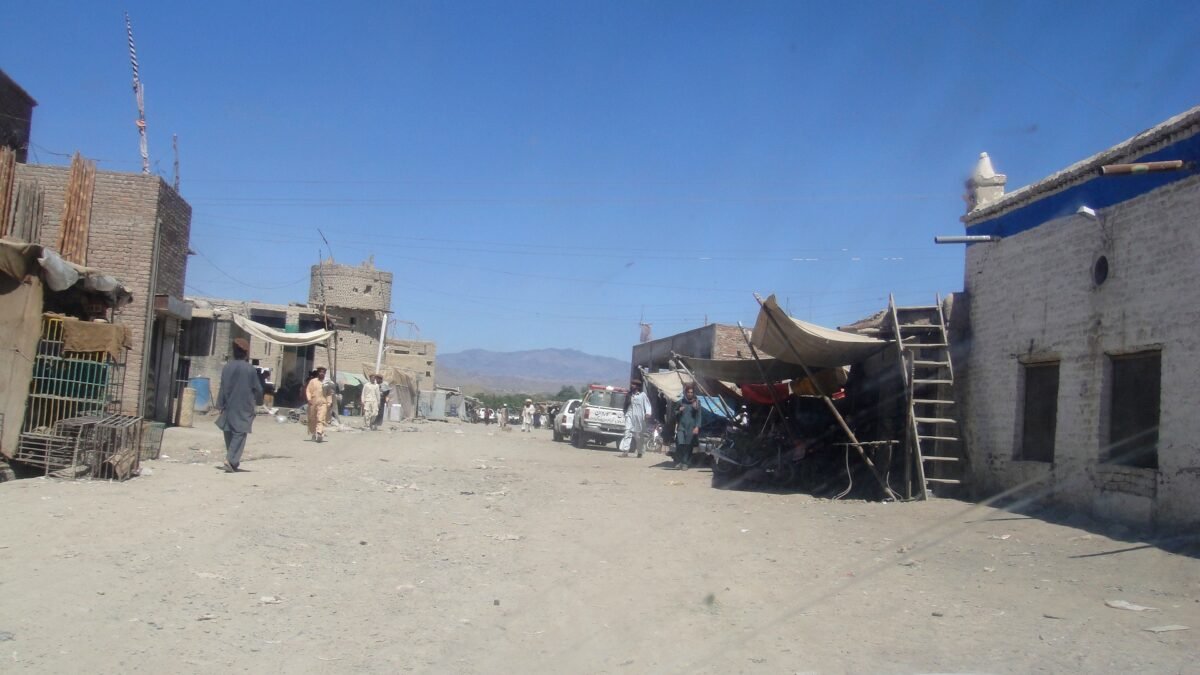
The same logic applies in the north. The road from Miranshah to Datta Khel, where two militants were reported killed on Saturday, is the road along which the military’s operations move, and along which its patrols are most exposed. The photograph that accompanies this report shows that road as it was in 2010: a dusty street in Digan village, with shops, a watchtower and mountains behind it. Sixteen years later, the same road is still being fought over, and the same villages are still appearing in the military’s announcements.
That is the bleakest fact in this story. The places do not change. The numbers do not change. The names of the operations change, the designations change, the technology changes — and now the militants have drones — but the war itself goes on, in the same districts, on the same roads, with the same toll measured in soldiers named by their home districts and militants counted but never named.
What to Watch Next
- Whether the military publishes any evidence for Saturday’s casualty figures, including names or photographs of the militants killed, or whether the numbers remain single-source claims.
- Whether the BLA or another group releases footage of the Kardagap quadcopter attack, and whether the military confirms the drone unit’s capabilities in any public statement.
- What counter-drone measures the military deploys along the N-40 highway and in the Kolpur, Kardagap and Nushki areas, and whether patrols are restricted or re-equipped.
- The outcome of the 17 November hearing in the challenge to the Khyber Pakhtunkhwa emergency, and whether the suspended provincial government’s status changes.
- The PICSS figures for October, which will show whether September’s 12-year high of 225 attacks was a peak or a floor.
- Whether the military’s high reported kill counts continue in the coming days, and whether the independent attack data moves in the same direction or continues to rise.
- Any statement from the Afghan Taliban on the two Afghan nationals reported killed in Ali Khel, and any response from India to the renewed allegation of sponsorship of Baloch groups.
Sources
- Terror Monitor — 16 TTP Terrorists Killed, Two Pakistani Soldiers Die in North Waziristan Operations: ISPR
- Terror Monitor — Pakistan Army Major Among Two Soldiers Killed in Armed Quadcopter Attack in Balochistan
- YeJahan — Major among 4 soldiers martyred, 24 militants killed
- The AZB — Eight Militants Killed in Balochistan Operations; Two Security Personnel Martyred
- The News — Militant attacks surge to 12-year high in September (PICSS data)
- Nation Press — BLA claims drone strikes kill 7+ Pakistani personnel across Balochistan

About the Author — Abdul Mannan
Related Articles
Zardari Meets Shehbaz in Lahore as Pakistan’s 12-Province Plan and Referendum Idea Divide the Coalition
President Asif Ali Zardari met Prime Minister Shehbaz Sharif in Lahore on Saturday as a proposal to redraw…
Pakistan Says 74 Militants Killed in Raids Across Balochistan and Khyber Pakhtunkhwa
Pakistan's military says security forces killed 74 militants in intelligence-based operations in Balochistan and Khyber Pakhtunkhwa, including 43…
PTI Takes the Khyber Pakhtunkhwa Fight to the Constitutional Court as Its Missing Chief Minister Stays Out of Sight
Two petitions filed in Islamabad on Thursday ask the Federal Constitutional Court to order the release of Khyber…