
Trump Gives Posthumous Pardon to Baseball Legend Pete Rose, Clearing His Tax Convictions Two Years After His Death

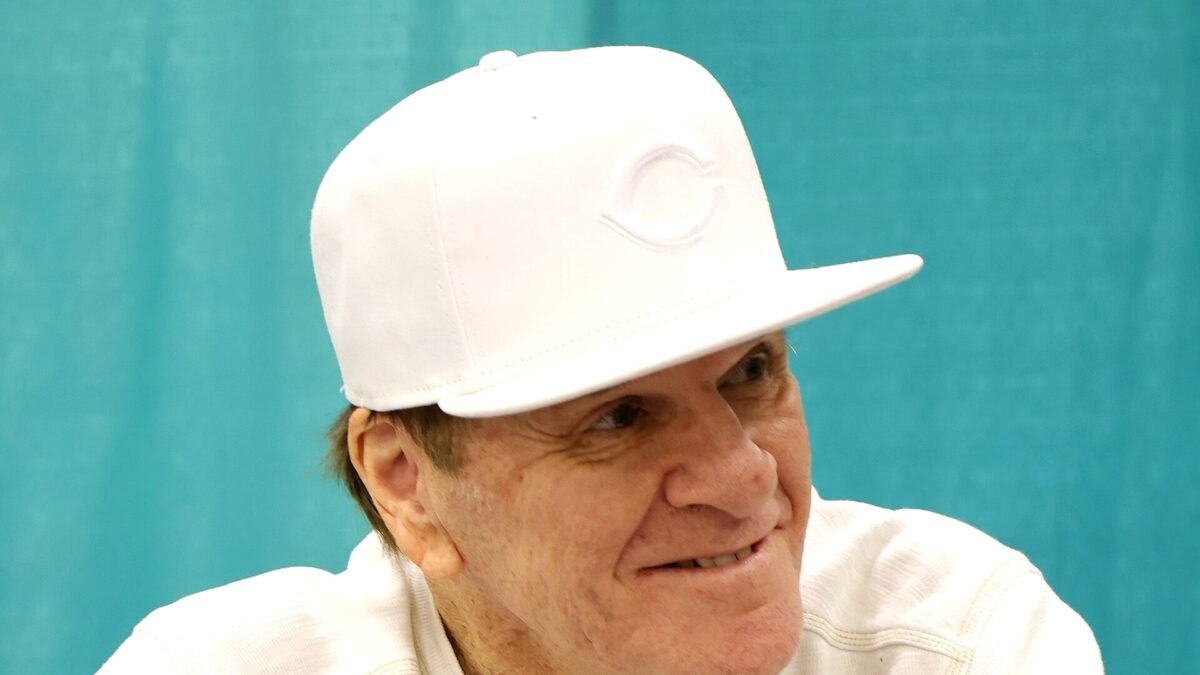
President Donald Trump has posthumously pardoned Pete Rose, baseball’s all-time hits leader, wiping away the federal tax convictions that followed the gambling scandal which ended the career of one of the greatest players the sport has ever seen. The pardon, announced on Thursday, comes more than two years after Rose’s death and nearly 37 years after he agreed to a lifetime ban from baseball.
Trump announced the pardon in a social media post written aboard Air Force One as he flew home from his trip to Asia, where he had taken part in the first-ever three-way summit with the leaders of Russia and China. “I have just given a Complete and Total Pardon to the Late, Great Pete Rose, a true Baseball SUPERSTAR & LEGEND,” the president wrote on Truth Social, according to Reuters.
The pardon covers the two felony counts of filing false tax returns to which Rose pleaded guilty in 1990. It does not, by itself, change anything about Rose’s standing with baseball. That question was already settled in May 2025, when Major League Baseball Commissioner Rob Manfred removed Rose from the permanently ineligible list, ruling that a lifetime ban ends with a person’s death. What the pardon does is close the criminal case that has shadowed Rose’s name since the year after his ban, and it adds the full weight of the presidency to the long campaign to restore the reputation of a player whose achievements on the field were never in doubt, even when almost everything else about him was.
Trump’s announcement also carried a swipe at baseball’s establishment and at the Hall of Fame, which has kept Rose out for more than three decades. Writing that Rose had been “treated terribly by Major League Baseball in not allowing him to go into the Baseball Hall of Fame,” Trump drew a parallel with the former pitcher Roger Clemens, “who won 354 games,” and added: “Politics, I guess!”
The post also contained an error that quickly became part of the story. Trump wrote that Rose’s record of 4,256 hits “in a Season will never be broken.” The figure is in fact Rose’s career total, collected across 24 seasons from 1963 to 1986. The single-season record belongs to Ichiro Suzuki, who collected 262 hits in 2004. The mistake was noted by CNN in its reporting of the announcement, but it did not distract from the substance of what Trump had done: the first presidential pardon of a figure whose disgrace was as famous as his greatness.
A Career Without Equal, A Fall Without Precedent
To understand why a pardon for a man who died in September 2024 still commands national attention, it is necessary to understand what Pete Rose was. He was, by the numbers, the most productive hitter in the history of Major League Baseball. His 4,256 hits passed Ty Cobb’s long-standing record of 4,191 in September 1985, in front of a home crowd in Cincinnati. He played in 3,562 games, more than any player before or since. He finished with a career batting average of .303, was selected to 17 All-Star Games, won the National League’s Most Valuable Player award in 1973, was the Most Valuable Player of the 1975 World Series, and won three World Series championships: two with the Cincinnati Reds, in 1975 and 1976, and one with the Philadelphia Phillies in 1980.
He was known as “Charlie Hustle,” a nickname that captured the headfirst slides, the sprints to first base on walks, and the relentless style of play that made him a hero in Cincinnati and one of the most recognisable figures in American sport. He was the engine of the “Big Red Machine,” the Reds team of the mid-1970s that is still discussed as one of the finest ever assembled. He won the National League Rookie of the Year award in 1963, collected two Gold Glove awards for his fielding, and remained a productive player into his mid-forties, still chasing hits when most players of his generation had been retired for a decade.
None of that is disputed. What destroyed him was not his performance but what he did away from the batter’s box. In 1989, Major League Baseball’s investigator, the former federal prosecutor John M. Dowd, concluded after a months-long inquiry that Rose had bet on baseball games, including games involving the Cincinnati Reds, while he was both playing for and managing his hometown team between 1985 and 1987. In August 1989, Rose agreed to a permanent ban from the game. He did not admit to the gambling at the time, and he maintained his denial for 15 years, before finally admitting in his 2004 autobiography, “My Prison Without Bars,” that he had bet on baseball.
The ban carried consequences that went far beyond the loss of a job. Under a rule adopted by the Hall of Fame’s board of directors in 1991, anyone on baseball’s permanently ineligible list could not be considered for election to the Hall. Rose, the holder of the sport’s most famous hitting record, was barred from the building that exists to honour players like him. He was barred from working in the game in any capacity, from coaching to managing to holding any official role. For the remaining 35 years of his life, he lived largely outside the sport he had dominated, supporting himself, as Reuters reported, through memorabilia signings and public appearances, the income from which would become the basis of his criminal case.
The Tax Case That Followed the Ban
The pardon announced on Thursday relates not to the gambling itself, which was never a federal crime, but to what came after it. On 20 April 1990, Rose pleaded guilty to two counts of filing false tax returns, admitting that he had failed to report $354,968 of income over a four-year period, according to the Associated Press. The unreported income included money earned from baseball memorabilia sales, autograph appearances and personal appearances, as well as winnings from wagers on horse racing, according to Reuters.
On 19 July 1990, the United States District Judge S. Arthur Spiegel in Cincinnati sentenced Rose to five months in prison. He reported to the federal prison camp in Marion, Illinois, on 10 August 1990 and was released on 7 January 1991. He also paid a $50,000 fine, was ordered to complete 1,000 hours of community service working as a gym teacher’s assistant in Cincinnati, and repaid the Internal Revenue Service $366,042, according to the Associated Press.
The sentence was short, and Rose served it, paid what he owed, and completed his community service. But a federal conviction is not a sentence that ends when the prison term does. For the rest of his life, Rose was a convicted felon as well as a banned ballplayer, and the two labels reinforced each other in the public mind. The tax case gave his critics a second reason to say he should never be forgiven, and it gave his supporters a second injustice to point to: a man punished twice, once by baseball and once by the courts, for conduct that grew out of the same exile from the game.
That is the conviction the pardon now erases. A presidential pardon does not declare that the offence never happened, and it does not refund the months Rose spent in prison or the money he paid. What it does is remove the legal stain of the conviction itself, restoring Rose, in the eyes of the law, to the standing of a man who was never convicted at all. For a man who is no longer alive to enjoy it, the gesture is symbolic. But symbols are precisely what the fight over Pete Rose has always been about.
A Pardon More Than a Year in the Making
Thursday’s announcement was not a surprise to anyone who had followed Trump’s public statements about Rose. In early 2025, shortly after returning to the White House, Trump said he intended to sign a pardon for Rose “over the next few weeks,” arguing at the time that baseball lacked “the courage or decency” to put him in the Hall of Fame, according to CNN. The pardon did not come then, but the president returned to the subject repeatedly through the year.
Earlier in November, Trump said he would consider a pardon for Rose. When he held an impromptu press conference at the White House with the mixed martial arts promoter Dana White, a reporter asked about the possibility directly. Trump asked whether Rose had ever been criminally charged, and when the reporter replied that he had been convicted of tax evasion, the president said: “I’d give Pete Rose a pardon. I think Pete Rose was very mistreated. But he was gambling on his own team, Dana. He wasn’t gambling against. That’s different.”
The conservative radio host Hugh Hewitt also raised the idea with Trump during an interview last week, according to CNN, and Trump had floated the pardon at a campaign rally in Texas in October, appearing alongside Clemens and telling the crowd: “Today you’re allowed to gamble on games. How about that? He always bet on his own team.”
The president has invoked Rose’s name in other contexts as well. This spring, asked in the Oval Office about an American special forces soldier charged with using classified information to win about $400,000 by betting on the military operation to capture the Venezuelan leader Nicolás Maduro, Trump said dismissively: “That’s like Pete Rose betting on his own team. Now, if he bet against his team, that would be no good.”
The through-line in all of these remarks is consistent, and it is the argument Trump has made about Rose for years: that betting on your own team to win is a different moral matter from betting against it, and that the punishment Rose received was out of proportion to the offence. It is an argument that many baseball fans have made as well, and it is an argument that baseball’s authorities have consistently rejected, on the ground that any betting by a participant on the game corrupts it, whatever side of the wager he takes.
The Road Back Began Before the Pardon
Whatever the pardon means, the more consequential step for Rose’s legacy had already been taken, and Trump played a part in that too. In May 2025, Commissioner Manfred issued a sweeping decision removing Rose from baseball’s permanently ineligible list, ruling that a lifetime ban ends at death. The decision affected 17 people, most notably Rose and Shoeless Joe Jackson, the star of the 1919 Chicago White Sox who was banned for his role in the Black Sox scandal. Manfred later acknowledged, in June 2025, that the president had been influential in the decision, after Trump raised the matter with him in a meeting at the White House in April, according to CNN and the Associated Press.
The effect of Manfred’s ruling was to make Rose eligible for consideration by the Hall of Fame for the first time since 1991. The body that will decide his case is the Hall’s Classic Baseball Era Committee, which next meets in December 2027. If the committee votes to elect him, he could be inducted in July 2028, nearly 40 years after his ban and almost four years after his death. The Associated Press reported that the earliest Rose or Jackson could now be inducted would be in 2028.
That timetable is important, because it explains the limits of Thursday’s pardon. As USA Today noted in its analysis of the announcement, the pardon “means nothing for Hall of Fame” eligibility, because that eligibility had already been restored by Manfred’s decision, and because the Hall of Fame is a private institution whose elections no president can control. A pardon clears a federal conviction. It cannot compel 12 voters on a committee in Cooperstown to put a man in the Hall, and it cannot erase the reason he was kept out for so long.
The reactions to the pardon reflected that division. The Hall of Fame did not respond to a request for comment, according to Reuters, and a spokesman for Major League Baseball declined to comment. The most substantive response came from Jeffrey Lenkov, the attorney who has represented the Rose family in its campaign for reinstatement. He called the pardon a “benevolent gesture” by Trump, but added, “it would have been better to have occurred when he was alive.”
Lenkov told Reuters that his appeal to Hall of Fame voters would rest principally on Rose’s achievements on the field and on the argument that he had “paid back any debt” for both his baseball and his legal transgressions. “The impact on the Hall is difficult to surmise,” he said. “Pete is very polarizing.”
That last sentence may be the most accurate summary of the position Rose still occupies. There are few figures in American sport about whom opinion is so evenly and so passionately divided, and the pardon does not resolve the division. It simply adds a presidential seal to one side of it.
Analysis: Why It Matters
A pardon that changes the record, not the outcome
The first thing to understand about Thursday’s announcement is what it does not do. Pete Rose’s path to the Hall of Fame was already open, and it remains exactly as open, or as closed, as it was on Wednesday. The committee that will judge him meets in December 2027, and no pardon can influence its vote except as a piece of atmosphere. The pardon clears a tax conviction, not a gambling ban, and the gambling ban was already lifted by the commissioner. In strictly practical terms, the pardon changes almost nothing about Rose’s status in baseball.
And yet it would be a mistake to call it meaningless. A presidential pardon is the most formal act of forgiveness available in American public life, and this one is aimed at a man who spent the last 35 years of his life asking to be forgiven and being refused. It does not put Rose in the Hall of Fame, but it removes one of the two formal judgments against him, and it does so with the authority of the presidency. For the family that has carried his case since his death, and for the millions of fans who never accepted his exclusion, that is a real victory, even if it is not the victory they ultimately want. The pardon is best understood as the closing of a legal chapter, not the opening of a baseball one.
The president as baseball’s most powerful fan
The second thing the pardon reveals is the extent to which Donald Trump has made himself a direct participant in baseball’s oldest argument. Presidents have opinions about sport, and they have often expressed them, but it is unusual for a president to intervene so persistently and so effectively in the internal discipline of a private league. Trump pressed Manfred to lift the ban, and Manfred has acknowledged that the pressure mattered. Trump promised a pardon in early 2025, repeated the promise through the year, and has now delivered it. Whatever one thinks of the outcome, the process is a demonstration of how much influence a determined president can exercise over an institution that is, in law, entirely beyond his authority.
There is a political dimension to this that should not be ignored. Rose is a folk hero in Ohio, a state that matters in every presidential election, and his cause has long been popular with the kind of working-class sports fans who form a central part of Trump’s political coalition. The pardon costs Trump nothing, pleases a large and vocal constituency, and allows him to present himself as a champion of fairness against an unfeeling establishment, a role he has played throughout his political career. The comparison with Clemens in the same social media post extends the gesture to another beloved player kept out of the Hall, and to another constituency of fans who believe their hero was wronged. None of this makes the pardon cynical, but it does make it characteristic: a decision in which principle, sentiment and political advantage all point in the same direction.
Gambling’s great reversal
The third reason the pardon matters is that it arrives at a moment when the moral world that condemned Pete Rose has been turned upside down. When Rose was banned in 1989, gambling on sport was a crime in almost every American state, and a player who bet on his own team was regarded as a threat to the integrity of the game itself. The rule that banned him was written in the shadow of the 1919 Black Sox scandal, and it was treated as absolute: bet on baseball, and you are out, for life.
That world no longer exists. In 2018, the Supreme Court struck down the federal ban on sports betting, and legal wagering is now available in most American states. Major League Baseball itself has commercial partnerships with sports betting companies, and its broadcasts are filled with advertisements for the very activity that ended Rose’s career. Trump’s remark at the Texas rally, “Today you’re allowed to gamble on games,” is not a joke but a statement of fact, and it captures the contradiction at the heart of the Rose case: the game now profits from the conduct for which it exiled its hits leader.
This does not settle the question of whether Rose should have been banned. Betting by a participant is different from betting by a spectator, and a manager who bets on his own team still has an interest in the outcome that no other manager shares. But it does change the moral temperature of the debate. A punishment that looked proportionate in 1989 looks increasingly severe in a country where gambling is advertised during the games themselves, and the pardon can be read as an official recognition that the world has moved on from the certainties that condemned him.
The Hall of Fame still holds the only vote that counts
The fourth point is the one that will decide whether the pardon is remembered as a footnote or as a turning point. The Hall of Fame’s Classic Baseball Era Committee meets in December 2027, and its members will have to answer a question that has divided baseball for 35 years: whether what a player did on the field can be separated from what he did off it.
The committee’s decision will not be a simple one. Rose’s numbers are beyond dispute: no one has more hits, no one has played more games, and his record has stood for four decades. But the Hall has always claimed to judge character as well as performance, and its voters have kept out players whose achievements were tainted by gambling, by performance-enhancing drugs, or by other misconduct. Clemens, whose 354 wins Trump cited in his post, remains outside for reasons connected to drug allegations he has always denied. Barry Bonds, the holder of the home run record, is outside as well. The Hall has shown, repeatedly, that it is willing to leave the record books incomplete rather than honour players it considers to have broken the game’s trust.
Rose’s case is arguably stronger than either of those, because his offence did not affect his performance: he did not cheat to get his hits, and no one has ever suggested that he tried to lose a game. His supporters will argue that the debt has been paid in full: a lifetime ban, a prison sentence, 35 years of exile, and now a death that came before any forgiveness. His opponents will argue that the ban was the price of the game’s integrity, and that lifting it after death does not undo the damage. The pardon will be part of the atmosphere in which that debate takes place, but it will not decide it. Only the committee can do that, and its members have 13 months to make up their minds.
Posthumous pardons and the politics of redemption
Finally, the pardon belongs to a small and distinctive category of presidential acts: forgiveness granted to the dead. Posthumous pardons are rare, precisely because they benefit no one who can enjoy them, and they are granted, when they are granted, for the sake of history rather than of the person. Trump has issued them before: in 2018, he pardoned the boxer Jack Johnson, the first black heavyweight champion, who had been convicted in 1913 under a law used to punish interracial relationships; in 2020, he pardoned the suffragist Susan B. Anthony, convicted in 1873 for voting while a woman.
Those pardons were widely seen as corrections of historic injustice, and they were largely uncontroversial. Rose’s is different, because his guilt was never in doubt: he admitted the gambling, he pleaded guilty to the tax charges, and he served his sentence. The pardon does not correct a wrongful conviction. It declares, instead, that the punishment was enough, and that the ledger is now closed. That is a different kind of judgment, and a more contestable one. It says that a man who broke the rules, admitted it, and paid for it should not carry the conviction to his grave, or beyond it.
Whether history agrees will depend on what happens in December 2027. If the committee elects Rose, the pardon will be remembered as the final step in a long rehabilitation, the moment when the state joined the sport in letting him back in. If it does not, the pardon will stand as a gesture that changed the legal record but not the verdict that mattered most to him. Either way, it is a reminder that in American public life, forgiveness is itself a political act, and that the question of who deserves it is never settled by the law alone.
What to Watch Next
- The formal pardon paperwork: whether the White House publishes the full text of the pardon and confirms precisely which convictions it covers, and whether the Justice Department’s Office of the Pardon Attorney records it in the usual way.
- The Rose family’s response: whether Pete Rose Jr. or other family members issue a public statement, and whether they use the pardon to renew their campaign for Hall of Fame election.
- The Hall of Fame’s position: whether the Hall, which declined to comment on Thursday, says anything about the pardon, and whether it clarifies the timetable and the rules for the Classic Baseball Era Committee’s December 2027 meeting.
- The Clemens question: whether Trump’s mention of Roger Clemens in the same post leads to any further action on the former pitcher’s case, or to renewed debate about players kept out of the Hall over performance-enhancing drug allegations.
- Reaction inside baseball: whether current or former players, managers or executives speak publicly about the pardon, and whether opinion divides along the same lines as it has for 35 years.
- The betting industry’s response: whether baseball’s gambling partners or the leagues comment on a pardon that implicitly endorses the view that betting on your own team is a lesser offence.
- December 2027: the meeting of the Classic Baseball Era Committee, the first real test of whether Rose’s rehabilitation is complete, with induction in July 2028 the prize if the committee votes in his favour.
Sources
- Reuters — “Trump pardons late baseball legend Pete Rose for tax crimes” (Jacob Bogage, 19 November 2026)
- CNN — “Trump pardons controversial baseball legend Pete Rose” (19 November 2026)
- NBC Sports (Associated Press) — “Pete Rose posthumously pardoned by Trump after baseball’s career hits leader was reinstated by MLB” (19 November 2026)
- USA Today — “Trump says he pardoned Pete Rose. That means nothing for Hall of Fame” (19 November 2026)
- USA Today — “Trump gives a posthumous pardon to baseball hit leader Pete Rose” (19 November 2026)
- theScore (Associated Press) — “Pete Rose posthumously pardoned by Trump” (19 November 2026)

About the Author — Abdul Mannan
Related Articles
House Democrats Put Trump Family and Top Officials on Notice as Garcia Orders Records Preserved for January Investigations
Incoming Oversight chairman Robert Garcia has sent a dozen document-preservation letters to the president's sons, his son-in-law, the…
Elon Musk Calls Record $446 Million Midterm Spending ‘Pretty Foolish’ and Says He Is ‘Not MAGA’
The world's richest man says he would spend less if he could rewind the clock — and distances…
Hakeem Jeffries Wins Speaker Nomination 251-11 as Democrats Prepare to Make Him the First Black Speaker in US History
House Democrats have nominated Hakeem Jeffries to be the next Speaker by 251 votes to 11, putting the…