
Elon Musk Calls Record $446 Million Midterm Spending ‘Pretty Foolish’ and Says He Is ‘Not MAGA’

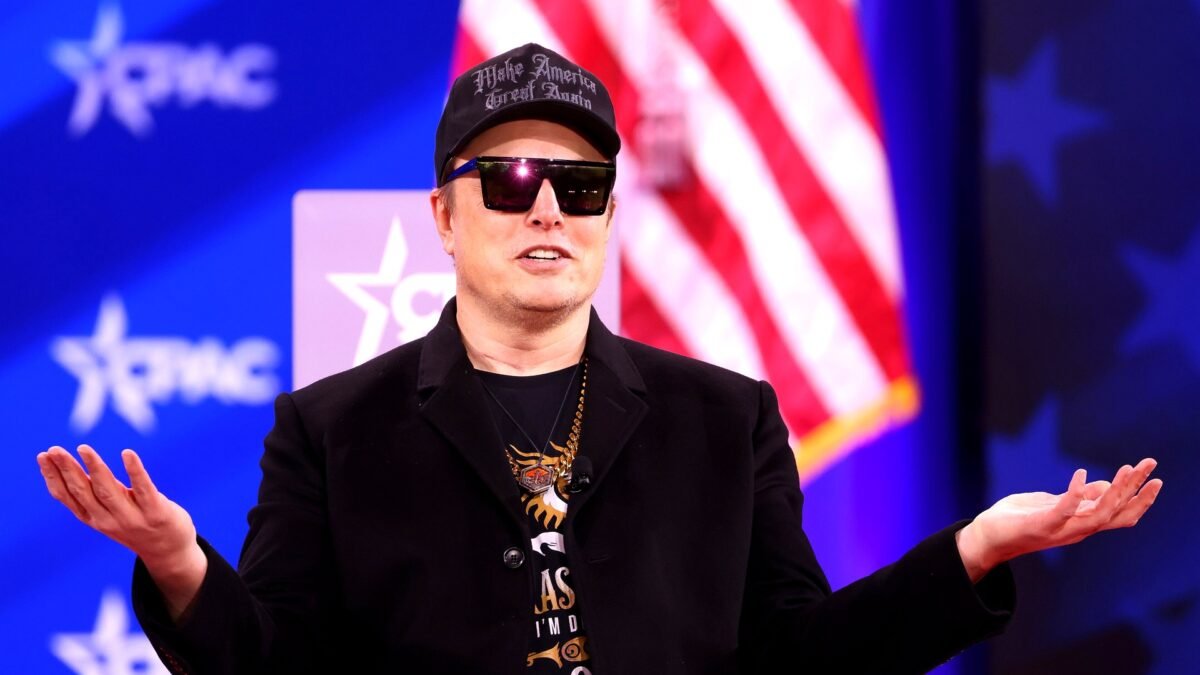
Elon Musk has said he feels “pretty foolish” about the record $446 million he spent backing Republicans in this month’s midterm elections, and has publicly distanced himself from the political movement he once embraced, telling an audience in New York that he is “not MAGA”.
The Tesla and SpaceX chief executive, the world’s richest man, made the remarks on Wednesday 18 November in a virtual appearance at the New York Times DealBook Summit, interviewed by the newspaper’s columnist Andrew Ross Sorkin. Musk joined the conversation by video link from China, where he was travelling with President Donald Trump for the Asia-Pacific Economic Cooperation summit.
“I feel pretty foolish about having spent so much money and not seeing much for it,” Musk said, according to Reuters. “Probably, if I could rewind the clock, I would have spent less money.”
The admission landed as one of the most striking moments of a 45-minute interview, and it was reported within hours by the BBC, Reuters, the Washington Post and TechCrunch, all carrying the same two blunt phrases: “pretty foolish” and “not MAGA”. Together they amount to the clearest public break yet between the world’s richest man and the political movement he helped to fund and personify.
Musk was the election’s top individual donor by a wide margin. The BBC reported that he gave $446 million, about £339 million, to support President Trump’s party, much of it aimed at races in Texas, where Tesla and SpaceX are based. The Washington Post put the figure at the same $446 million and reported that it made Musk the largest individual political donor in American history, contributing nearly $300 million more to Republican candidates than the next largest Republican donors, Richard and Elizabeth Uihlein.
Not every tally agrees to the dollar. The Hill put the total at $442 million, while PBS, cited by TechCrunch, reported about $445 million. The differences reflect timing and how particular donations are classified, and this article uses the $446 million figure reported by the BBC and the Washington Post. Whatever the precise final count, the scale is not in dispute: no individual donor in American history has spent anything like it on a single election cycle.
The money did not buy what Musk wanted. Democrats won control of both chambers of Congress, flipping competitive seats and making historic gains in places that have been controlled by Republicans for decades, according to the BBC. Newsmax reported that Democrats won a 56-44 majority in the Senate, including a victory by Mary Peltola in Alaska. The election was widely described as a bruising defeat for President Trump, who has faced growing pressure over the impact of his policies on the cost of living in the United States.
The admission
Musk did not try to dress up the result. He told Sorkin that the spending had produced little visible return, though he added one qualification: it was possible, he said, that Republican candidates would have done even worse without it. Reuters reported the same caveat, noting that Musk said the result demonstrated that campaign cash alone could not determine an election.
“It certainly shows that, you know, American elections are not just about money,” Musk said, according to TechCrunch.
That is a remarkable sentence from a man who has spent more than $700 million supporting Republicans across the past two election cycles, according to the Washington Post. In 2024 he contributed at least $288 million to elect Trump and other Republicans, the Post reported; TechCrunch put the 2024 figure at $277 million, another difference of tallying rather than substance. Either way, the two-cycle total makes Musk not merely a donor but the single largest individual funder of one party’s politics in American history — and now, in public, its most prominent critic of the return on that investment.
The Washington Post noted that Musk has expressed regret about his political spending before. Last year he poured $20 million into a Wisconsin judicial race to back a Republican candidate. After the candidate lost, Musk said he would do “a lot less” political spending in future. “I think I’ve done enough,” he said at the time. The midterm result appears to have hardened that view rather than changed it: the man who once promised to spend less has now spent more than twenty times that Wisconsin sum and come away saying he feels foolish for it.
“I’m not MAGA”
The second half of Musk’s appearance may matter more than the first. Pressed by Sorkin about his politics, Musk said plainly: “I’m not MAGA.”
“I’m not sure what MAGA means,” he added, according to TechCrunch. “If that means sort of blind adherence to a set of policies by the Republican Party, then I certainly don’t have that.”
He went further, describing himself as “quite moderate” and telling Sorkin: “I don’t think I have like, you know, any kind of extreme political views.” The Washington Post reported the same self-description, and CBS News, quoted by the Lexington Daily News, reported that Musk said his objective in the midterms had been to help Republicans hold the Senate so that no single party would control the presidency and both houses of Congress in 2029 — a goal framed around checks and balances rather than partisan victory. TheWrap, cited by BlazeTrends, reported that Musk added that he does not favour a Republican supermajority.
This marks a major shift in tone, as the BBC put it. Musk has worn a MAGA hat in public on several occasions, and in 2024 he joked at a Trump rally: “I’m not just MAGA, I’m dark, gothic MAGA.” He was later photographed wearing an oversized MAGA hat in the Oval Office. In February 2025 he took the stage at the Conservative Political Action Conference in Maryland wearing a black “Make America Great Again” cap, and was handed a chainsaw on stage by Argentina’s President Javier Milei — a moment that became one of the defining images of his time at the centre of Trump’s Washington.
That history is what gives Wednesday’s words their weight. Musk is not a distant observer of the MAGA movement correcting the record; he was, for two years, its most visible billionaire champion, its largest funder and, for the first months of Trump’s second term, a senior figure inside the administration itself.
Texas, where the money went
Nowhere was Musk’s spending heavier, or its failure more complete, than in Texas. The Washington Post reported that he spent more than $150 million in the state, where both of his flagship companies are headquartered. The BBC’s analysis put at least $45 million of that behind Ken Paxton, the Republican nominee for the US Senate seat.
Both men lost. Democrat James Talarico beat Paxton for the Senate seat, according to the BBC, and Democrat Gina Hinojosa defeated Republican Governor Greg Abbott, ending more than three decades of Republican control of the governor’s office in Texas.
Musk’s response to the Texas result was striking in its own way. Rather than attacking the winners, he praised the incoming governor. He told Sorkin he believes Hinojosa is “going to be quite moderate”, the BBC reported.
“I don’t think she’s a far-left governor. And based on everything I’ve heard about her, I think things will be fine in Texas with Gina as governor,” Musk said.
That is a notable judgement from a man who spent nine figures trying to prevent her election. It also carries a practical edge: Tesla and SpaceX are headquartered in Texas, and the state’s new government will have direct authority over the regulatory environment in which both companies operate. Musk’s public reassurance may be as much a message to his own shareholders and employees as it is a political observation.
The Texas result also undercuts the logic of the spending itself. The money was concentrated in the state precisely because Musk believed Texas was the place where his fortune and his politics were most closely tied together. Losing both the governor’s race and the Senate race there, after spending more than $150 million, is the sharpest single illustration of the limits of what money bought in this election.
From the White House to the witness list
Musk’s political journey over the past two years explains why Wednesday’s remarks were followed so closely. For several months at the start of Trump’s second term, he served as an unpaid “special government employee” and senior adviser to the president, leading the Department of Government Efficiency, known as DOGE, in an effort to cut government spending. The Washington Post reported that he helped lead the dismissal or departure of hundreds of thousands of federal workers through that initiative.
He has remained close to the president since leaving that role. In October 2026 the Pentagon named Musk a co-lead of a future-of-warfare study called Project Meridian, according to the BBC, and he has continued to travel with and advise Trump — including the current trip to China, from which he joined the DealBook conversation.
But the political landscape around him has changed. Democrats coming into power in both the Senate and the House of Representatives have pledged greater scrutiny of technology companies, including over the building of controversial data centres, the BBC reported. Democratic lawmakers have also suggested that SpaceX, which has gained an estimated $10 billion in new government contracts since Trump was re-elected, should be investigated.
TechCrunch reported that Democratic lawmakers in various committees have signalled they may investigate Musk and his business activities as they probe potential corruption throughout the Trump administration. Officials have said they are interested in scrutinising Musk’s role in DOGE, as well as Starlink’s activities in Ukraine, where the company has been accused of throttling the military’s access to its internet service.
Sorkin raised the subject directly. TechCrunch reported that he told Musk: “You hear people like the chairman of the oversight committee saying, ‘Lawyer up,’ and you hear the president saying, ‘If I have to give him a pardon’ — meaning you — ‘I’ll give him a pardon.'”
Musk replied: “I don’t think I need a pardon by the way, because I haven’t committed any crimes.”
He then made one of the more startling remarks of the interview, appearing to compare an incoming Texas official to Lavrentiy Beria, the head of the Soviet secret police under Josef Stalin. “The incoming Texas, you know, House Majority Leader, said that I should go to prison,” Musk said. “I’m like, the guy’s trying to, you know, channel Beria from, like, Stalin, where it’s, you know, show me the man, I’ll show you the crime type of thing.”
TechCrunch reported that it was not clear who Musk was talking about, noting that Texas does not have a House Majority Leader. The publication said he may have been referring to Gene Wu, the incoming chair of the Texas House Democratic caucus, who has suggested that Musk be investigated for potential criminal activity. Musk added: “Hopefully, in this country, you still need to do an actual crime before you go to prison.”
The other headlines from DealBook
Musk’s appearance produced more than the two phrases that dominated the coverage. Turning to his own business ambitions, he told Sorkin that Anthropic, the artificial intelligence company, was “extremely likely” to continue renting computing capacity from SpaceX and wanted significantly more. Reuters reported that he said the highest-probability outcome was for Anthropic to seek an additional 10 gigawatts of computing capacity from SpaceX — a striking figure, given that Anthropic priced the largest initial public offering in history only this week, raising more than $81 billion.
He also pushed back when Sorkin noted that some people found his views on immigration extreme. “Like what?” Musk replied, according to TechCrunch, as mild laughter spread through the audience. The Washington Post noted that Musk has aligned with Trump and MAGA on some issues but has clashed with them on immigration and H-1B visas, the programme that allows employers to hire foreign workers for specialised work.
Musk compared people who are too closely attached to their political party to sports fans, according to Gizmodo, arguing that there are “positives and negatives in both parties”. It was part of a broader effort, visible throughout the interview, to present himself as a moderate who had been misunderstood — a striking posture from a man who, as TechCrunch noted, was last at DealBook in 2023 in the middle of a public battle with his social media site X’s advertisers, and famously told Sorkin on that occasion that he hoped those advertisers would “go f—” themselves.
Elsewhere in the week, French prosecutors were investigating Musk’s platform X after its AI chatbot Grok generated a widely viewed post falsely claiming that the gas chambers at Auschwitz were meant for disinfection rather than mass murder, according to AFP reporting cited by the Forward. The episode was not raised in the DealBook interview extracts published so far, but it forms part of the backdrop of scrutiny now surrounding Musk and his companies.
Musk was not the only prominent figure recasting himself as a moderate on Wednesday. The Washington Post reported that Palantir chief executive Alex Karp, who once described the tech company whose software the Trump administration has used to speed mass deportations as “completely anti-woke”, said more recently that its products were “essentially progressive”. Podcaster Joe Rogan, who endorsed Trump for re-election in 2024, said the president has “lost most of the country”. The pattern, the Post suggested, is that many executives and political figures have begun presenting themselves as moderates since Democrats won majorities in the House and Senate and began preparing to wield oversight authority in the next Congress.
Analysis: Why It Matters
The money test failed — and Musk said so out loud
The most important fact in this story is not the size of the sum. It is that the man who spent it has publicly declared it a failure. American politics has seen plenty of big donors lose elections; it has rarely seen the biggest donor of all time stand up within weeks and say he feels foolish about it.
That matters because the theory behind Musk’s spending was never just about winning seats. It was the theory that concentrated wealth, deployed at unprecedented scale, could secure a political outcome — that a single individual could buy durability for a movement. Wednesday’s remarks do not prove that theory wrong in every case. Musk himself noted that Republicans might have done worse without the money. But they do show that the theory failed its most expensive test, in the most favourable conditions its author could arrange: a friendly president, a home state, unlimited funds and two years of preparation.
The result also reframes a long-running argument about money in American politics. Campaign finance debates usually turn on whether spending is too large or too secretive. Musk’s experiment adds a different question: what if it does not work? The answer, at least in 2026, appears to be that voters were moved more by the cost of living and by the record of the party in power than by the volume of advertising and organisation that $446 million can buy.
“Not MAGA” is a repositioning, not a conversion
It would be a mistake to read Musk’s words as a conversion to the Democratic Party or to liberal politics. Nothing he said on Wednesday suggests he has changed his views on regulation, on government spending or on the issues where he has clashed with Democrats for years. What he did was narrower and, in its way, more calculated: he separated himself from a label.
“I’m not sure what MAGA means” is not the language of someone repudiating a set of beliefs. It is the language of someone creating distance from a brand. Musk’s companies depend on government contracts, on regulatory goodwill and on access to both parties. With Democrats about to control both chambers of Congress and to open investigations into his businesses, the cost of being identified as MAGA’s billionaire has risen sharply, while the benefit — a friendly administration — is now shared with a Congress controlled by the other party.
The repositioning is also consistent with Musk’s own history of moving between political identities: a Democrat-leaning technology executive in the 2010s, a self-described “dark MAGA” figure in 2024, the head of a government efficiency drive in 2025, and now a self-described moderate in late 2026. The through-line is not ideology but proximity to power — and the willingness to redescribe himself as that proximity changes.
Texas is the real wound
The national result was bad for Republicans. The Texas result was personal for Musk. He spent more than $150 million in the state where his companies are headquartered, and lost both of the races that mattered most to him there.
The defeat of Greg Abbott ends more than three decades of Republican control of the Texas governor’s office, and the loss of the Senate seat to James Talarico removes a Republican voice from Washington that Musk had paid at least $45 million to elect. Together they mean that the state Musk chose as his political and corporate base will now be governed, at least in part, by Democrats he tried to defeat — and that his public praise for the incoming governor reads as much as a recognition of that new reality as a judgement of her politics.
There is a practical consequence, too. Tesla and SpaceX operate under Texas law and Texas regulators. A governor who owes Musk nothing, and who was elected in part by voters who rejected his intervention, will be under no obligation to accommodate him. Musk’s assurance that “things will be fine in Texas” may prove correct, but it is an assurance he is now giving about a government he failed to choose.
The investigations are the price of the bet
The most concrete consequence of the midterm result for Musk is not reputational. It is institutional. A Democratic Congress with oversight authority has already signalled that it intends to examine DOGE, Starlink’s conduct in Ukraine and the roughly $10 billion in new government contracts SpaceX has gained since Trump was re-elected.
That is the other side of the bargain Musk struck when he entered government. The same proximity to the president that brought contracts and influence also created a record — of decisions, of departures, of money spent and received — that a hostile Congress can now demand to see. Musk’s insistence that he has committed no crimes, and that he does not need a pardon, is best read as an early answer to an inquiry that has not yet formally begun.
The Beria comparison, whatever its target, shows how Musk intends to meet that inquiry: by presenting investigation itself as persecution. It is a familiar move in American politics, and it may work with his supporters. But it will not stop the committees from asking their questions, and the answers will be given under oath rather than on a conference stage.
The donor class is watching — and 2028 starts now
The final significance of Wednesday’s remarks lies beyond Musk himself. He is not only the largest donor in American history; he is also the most visible test of whether billionaire spending can determine elections. Other wealthy donors, and the operatives who court them, will read his public regret as evidence about the value of the next cheque.
If Musk spends less in 2028 — as he has now twice promised to do — the Republican Party will need to replace the largest single source of outside money it has ever had. If he spends the same, his own words will be quoted back to him. Either way, the “pretty foolish” line has entered the record of American campaign finance, and it will be cited every time a billionaire is asked to write a very large cheque for a very uncertain outcome.
The 2028 presidential race has not yet begun in earnest, but the argument about who funds it already has its first exhibit. Musk’s experiment cost $446 million, and its author has now told the world what he thinks it was worth.
What to Watch Next
- The first Democratic investigations: watch which House and Senate committees open inquiries into DOGE, Starlink and SpaceX contracts first, and whether Musk is called to testify when the new Congress takes its seats.
- Musk’s next donation: the clearest test of Wednesday’s words will be the next federal filing. Any large Republican donation in the coming months would sit awkwardly beside “I would have spent less money”.
- Texas under Hinojosa: watch the new governor’s early decisions on regulation, energy and incentives affecting Tesla and SpaceX, and whether Musk’s public praise of her as “quite moderate” holds.
- The 56-44 Senate: with Democrats holding both chambers, watch how quickly oversight of the Trump administration — and of Musk’s companies — moves from promises to subpoenas.
- Trump’s response: the president has not yet publicly answered Musk’s “not MAGA” remark. His reaction, if any, will show whether the break is tolerated or treated as disloyalty.
- Anthropic and the 10 gigawatts: watch whether the AI company’s expected additional demand for SpaceX computing capacity materialises, and what it means for the commercial relationship between two of the most valuable companies in the AI race.
- The 2028 donor market: watch whether other major Republican donors follow Musk’s lead in pulling back, or whether new money fills the gap his retreat would leave.
Sources
- BBC News — “Elon Musk says record $446m spending on US midterms was ‘pretty foolish'”
- Reuters — “Musk says he felt ‘pretty foolish’ about scale of midterm spending after Republican rout”
- TechCrunch — “Elon Musk says: ‘I’m not MAGA'”
- The Washington Post — “Elon Musk says he regrets midterm spending”
- CBS News (via Lexington Daily News) — “Elon Musk says he’s ‘not MAGA,’ feels ‘foolish’ about how much he spent in midterms”
- The Hill (via KCAU) — “Musk on midterms spending: ‘I feel pretty foolish'”

About the Author — Abdul Mannan
Related Articles
Hakeem Jeffries Wins Speaker Nomination 251-11 as Democrats Prepare to Make Him the First Black Speaker in US History
House Democrats have nominated Hakeem Jeffries to be the next Speaker by 251 votes to 11, putting the…
Hegseth Signs Military Pact in Caracas as US and Venezuela Restore Defence Ties Ten Months After Maduro’s Capture
US Defence Secretary Pete Hegseth made an unannounced visit to Caracas on Wednesday and signed a deal restoring…
Mary Peltola Wins Alaska Senate Race, Giving Democrats a 56th Seat and Completing the Midterm Sweep
Democrat Mary Peltola has defeated Republican Senator Dan Sullivan in Alaska, completing the Democrats' midterm sweep with a…