
Russian Cargo Ship Sparta II Hit by Drones and Set on Fire in Gulf of Finland, Drifting Into Finnish Waters

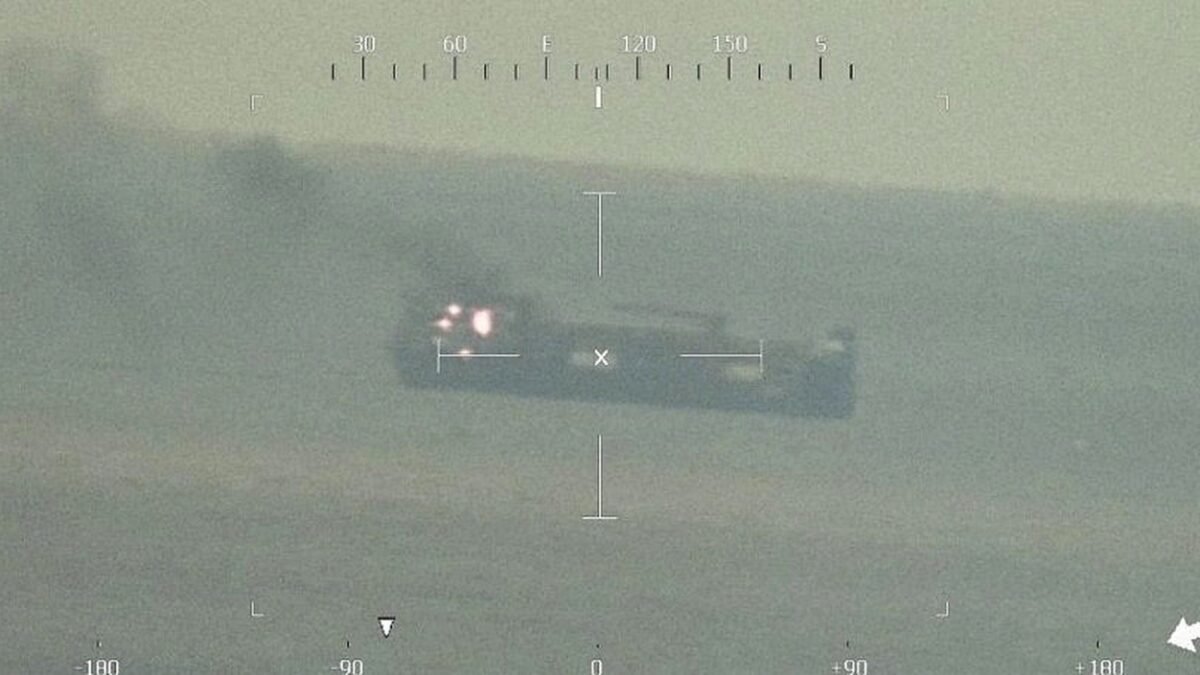
A Russian cargo ship bound for the Baltic exclave of Kaliningrad was struck by two drones in the Gulf of Finland on Saturday morning, catching fire and drifting into Finnish territorial waters, according to Russian and Finnish authorities. The incident, the latest attack on Russian shipping in the Baltic Sea, forced Finland to close air and sea traffic in the eastern gulf, put its Border Guard in charge of a maritime rescue operation, and prompted a separate suspected airspace violation by a Russian helicopter off the Finnish coast.
The vessel, identified by Estonian authorities as the roll-on roll-off cargo ship Sparta II, was sailing from St Petersburg to Kaliningrad when it was hit in international waters in the eastern Gulf of Finland, west of Gogland Island, known in Finnish as Suursaari. By Saturday afternoon the burning ship was drifting in Finnish waters off the town of Loviisa, its crew still on board and fighting the fire, while Finnish rescue units stood by and prepared for possible environmental damage. No casualties had been reported, and no government or organisation had claimed responsibility for the attack.
The strike was confirmed independently from both sides of the confrontation. The governor of Russia’s Leningrad region, Aleksandr Drozdenko, said the ship had been attacked by two unmanned aerial vehicles in neutral waters about three nautical miles from Russia’s border, and that the crew was being evacuated while the damage was assessed. Finland’s Defence Forces said they had detected the drone attack on Saturday morning in international waters west of Suursaari, and the Finnish Border Guard said the damaged vessel had caught fire and drifted into Finnish territorial waters. Finland said it had informed its allies about the incident.
Prime Minister Petteri Orpo, writing on X, said the war was spilling over into Finland’s neighbouring areas. “Finnish authorities are handling the situation in the Gulf of Finland, where a drone strike has hit a Russian merchant vessel. Ukraine has the right to fight against the aggressor,” he said, according to Reuters. His words stopped short of attributing the strike to Ukraine, and Kyiv had not commented on the incident by Saturday evening.
What happened on Saturday morning
The first alarm came to Estonia. According to Estonia’s Police and Border Guard Board, its rescue coordination centre received a report of a fire aboard the Russian cargo vessel Sparta II at 9:35 a.m. local time on Saturday, with preliminary information indicating there had been explosions on board. The ship was then about 11 nautical miles north of Estonia’s Vaindloo Island, in an international shipping lane inside Russia’s search-and-rescue zone, having sailed from St Petersburg.
Governor Drozdenko, writing on the messaging app Max, said two drones had struck the vessel three nautical miles from Russia’s border. He said the crew was being evacuated and the extent of the damage was being assessed. He also said 80 drones had been shot down over the Leningrad region during the night, and later lifted a drone threat warning for the region. That figure has not been independently verified.
Finland’s Defence Forces confirmed that they had detected the drone attack in international waters west of Suursaari in the eastern Gulf of Finland. The Finnish Border Guard said the damaged ship was on fire and had drifted from international waters into its territorial waters. “The situation poses no danger to other maritime traffic,” the Border Guard said in a statement. “Preparations for potential rescue operations are being made in cooperation with other authorities in Finland and internationally.”
The geography of the incident explains why three countries were involved within hours. The Gulf of Finland is a narrow arm of the Baltic Sea, squeezed between Finland to the north and Estonia to the south, both members of NATO, and leading east to St Petersburg. The attack took place in international waters, but only a short distance from Russian, Finnish and Estonian waters alike. The ship drifted north out of Estonia’s exclusive economic zone at around 10 a.m., according to Estonian officials, and then into Finnish territorial waters, where Finland took charge of the rescue.
Estonia said it was monitoring the situation in cooperation with its Finnish counterparts. “We will respond if Russia requests international assistance,” Andres Tiik, the duty officer of Estonia’s Police and Border Guard Board, said, according to the Defence Blog. Estonia also warned residents of its north-eastern counties of a possible drone threat.
A burning ship adrift in Finnish waters
By Saturday afternoon the Sparta II was lying in Finnish territorial waters on the open sea south of Loviisa, a town on Finland’s southern coast about 90 kilometres east of Helsinki. The Finnish Border Guard said in an update at around 3 p.m. local time that it was leading maritime rescue and environmental damage control operations on the vessel, that rescue units were on site, and that Russian maritime rescue authorities had been contacted.
“Rescue units are on-site. The crew has not been forced to abandon the ship, and no environmental damage has been detected. The Border Guard is prepared to evacuate personnel and assist in firefighting efforts,” the Border Guard said, according to Euronews. A restricted area had been established around the vessel for safety, while the agency said the situation did not pose a danger to other maritime traffic.
The picture had changed during the day. In the morning, Governor Drozdenko had said the crew was being evacuated. By the afternoon, the Border Guard said the crew had not been forced to abandon ship and was handling firefighting on board, while the Border Guard led the rescue operation and considered possible evacuation arrangements. The fire had not yet been brought under control by Saturday afternoon, the Border Guard’s commander, Ilja Iljin, told Yle, Finland’s national broadcaster.
No injuries had been reported, and no crew number had been given by Saturday evening. Nor had any pollution been detected, although the Border Guard said it was preparing for potential environmental damage control within Finland’s area of responsibility. The ship’s cargo remained unknown. Iljin told Yle that the vessel was known to have links with Russia’s armed forces, but that it could not be confirmed whether military equipment was on board. He said the cargo was not known, so the risk of an explosion could not be assessed. There were no plans at present to bring the vessel to Finland, he added.
Russian state news agency Tass, citing a single unnamed source, said the vessel was transporting paints and coatings. That claim could not be independently verified, and it sat uneasily with what is known about the ship’s history, which is set out below.
Finland also closed parts of the eastern gulf to traffic. Temporary restrictions on aviation and maritime traffic in the eastern Gulf of Finland were introduced early on Saturday, lifted at 7:43 a.m., and then reinstated at approximately 9:30 a.m., according to the Helsinki Times. The Finnish Defence Forces described the measures as precautions intended to protect civilians and allow authorities to respond if drones needed to be intercepted. The Finnish maritime traffic authority, Fintraffic, also warned that a maritime area off Kotka had been closed following the incident.
A Russian helicopter in Finnish airspace
Hours after the attack, Finland said a Russian helicopter was suspected of violating its airspace. The Finnish Defence Ministry said the suspected violation took place off Loviisa at 12:34 p.m. on Saturday, with the aircraft penetrating 4.1 kilometres into Finnish territory at its deepest point. The Border Guard is investigating the suspected airspace violation.
Defence Minister Antti Häkkänen said the suspected violation might be related to rescue or monitoring operations involving the damaged cargo ship. The ministry did not identify the type of helicopter, and Russia had not commented on the suspected incursion by Saturday evening.
The suspected airspace violation added a second layer to an already tense day. Finland has recorded a series of suspected Russian airspace violations in the Gulf of Finland in recent years, including a suspected military aircraft incursion in June 2024 near Loviisa itself. Saturday’s incident, if confirmed, would be the first to be directly connected to a rescue operation for a Russian vessel in Finnish waters.
The ship: Sparta II and Russia’s military supply line
The Sparta II is not an ordinary merchant vessel. It is a Russian-flagged roll-on roll-off cargo ship, built in 2000, operated by Oboronlogistika, a shipping company that works for Russia’s Ministry of Defence and is the sole provider of transport services for the ministry, including the movement of troops and the delivery of goods to occupied Crimea, according to the OpenSanctions database.
The United States imposed sanctions on the Sparta II in May 2022, as a vessel affiliated with Oboronlogistika, under its Russia-related sanctions programme. The European Union imposed sanctions on the vessel in April 2026, and Ukraine imposed sanctions on it in May 2026. Canada and Switzerland have also imposed sanctions on the vessel, according to OpenSanctions.
Ukrainian military intelligence, whose findings are carried by the OpenSanctions database, says the ship has been implicated in the transportation of weapons, including from Syria to Russia through the Bosporus and Dardanelles straits. In August 2022, it reportedly carried S-300 air defence systems from Syria to the Russian port of Novorossiysk, likely for use in the war against Ukraine. Satellite imagery analysed by Reuters in August 2022 linked the vessel to that shipment. After the fall of the Assad regime, the ship was also involved in transporting military equipment from Russia’s naval base at Tartus in Syria to Libya, according to Ukrainian military intelligence.
Since November 2022, the Sparta II has worked the Ust-Luga to Baltiysk to Kaliningrad container line, carrying containers, rolling equipment and general cargo to Russia’s Baltic exclave, bypassing land transit through European Union countries. Kaliningrad, sandwiched between Poland and Lithuania on the Baltic coast, depends on sea and rail links through or around EU and NATO territory for much of its supply, which is why the route matters to Moscow and why the ship’s movements are watched closely in the region.
The governor of Kaliningrad, Alexei Besprozvannykh, said the incident posed no threat to supplies to the region. That may be true in the short term, since the Sparta II is one vessel on one route, but the attack demonstrated that the sea link to Kaliningrad is no longer safe from the war that Russia started in Ukraine.
What the ship was carrying on Saturday is not known, and the question matters. If it was carrying military cargo, the strike fits a pattern of Ukrainian attacks on Russia’s military logistics. If it was carrying civilian goods, the attack raises sharper questions about the targeting of merchant shipping. The Border Guard commander said the possibility of military equipment being on board could not be ruled out. The single unnamed-source claim carried by Tass, that the vessel was carrying paints and coatings, has not been confirmed by any other source.
What Finland, Russia and Estonia said
The official reactions on Saturday told their own story about how the war is now viewed in the Baltic. Finland, which joined NATO in April 2023 after decades of military non-alignment, treated the incident as a rescue operation first and a security incident second, while making clear where its sympathies lay. Prime Minister Orpo’s statement that Ukraine has the right to fight against the aggressor was unusually direct for a head of government whose country’s rescue services were dealing with a burning Russian ship in its own waters.
Finland’s Defence Ministry said the military had detected the drone attack, that it had informed its allies, and that the restrictions on air and sea traffic were a precaution. The Border Guard, which led the response, kept its statements factual: the ship was on fire, it had drifted into Finnish waters, rescue units were on site, no environmental damage had been detected, and the crew had not been forced to abandon ship.
Russia’s public statements came from regional officials rather than from Moscow. Governor Drozdenko announced the attack on a messaging app, Governor Besprozvannykh reassured Kaliningrad about supplies, and the federal government had not issued a statement by Saturday evening. The absence of a federal response was notable, given that a Russian-flagged vessel had been struck and set on fire in waters close to NATO territory, and that the ship belonged to a company working for the Defence Ministry.
Estonia, which identified the vessel and passed on the first fire report, kept its role practical: monitoring the situation with Finland and ready to respond if Russia asked for international assistance. The Estonian position underlined how the Baltic states now handle incidents involving Russian shipping, with quiet coordination between neighbours rather than public confrontation.
Ukraine, for its part, said nothing. Kyiv has neither confirmed nor denied involvement in the strike, and no Ukrainian official had commented by Saturday evening. That silence is consistent with Ukraine’s practice in its long-range campaign against Russian targets, where it often leaves attribution to others.
A widening war at sea
The attack on the Sparta II is the latest in a rapid expansion of the war at sea, and it is not an isolated incident. Ukraine and Russia have attacked each other’s shipping throughout the war, mostly in the Black Sea, but the campaign has spread in recent weeks to the Baltic, the Mediterranean approaches, and the Gulf of Finland itself.
Earlier this month, Finland’s military said it had detected a strike on a Russian warship in the Gulf of Finland, which Ukraine took credit for, according to Al Jazeera. Helsinki said it had raised concerns about striking in the area with Kyiv afterwards. Ukraine’s Security Service announced on 12 November that it had struck the Russian warship Naro-Fominsk during a large-scale drone operation targeting Ust-Luga, a Russian oil export port on the Gulf of Finland. The Sparta II attack, nine days later and in the same waters, suggests that warning did not end the campaign.
In the Black Sea, the campaign has intensified sharply. At least six vessels have been struck since 13 November, according to the maritime security firm Ambrey, in what it described as an escalating campaign, and two tankers, the BETUL 8 and the GAS HUSKY, sank in mid-November. Thirty-one seafarers were rescued from those incidents. The attacks have targeted vessels linked to Russian oil exports, and they have raised insurance costs and forced shipping companies to reconsider routes that were considered safe only months ago.
The pattern is not confined to the Black Sea and the Baltic. In the Strait of Hormuz, tankers have been struck repeatedly in recent days, with two more incidents reported on Saturday, as the conflict between the United States and Iran plays out on the shipping lanes. The world’s shipping chokepoints are becoming arenas of war, and the Sparta II incident shows that the Baltic, long considered a relatively calm sea, is now one of them.
The incident also follows a week of escalation on land. Russian missiles landed in Poland earlier in the week, an event that Warsaw denounced as a deliberate provocation. The Sparta II attack, coming days later and in waters bordered by two NATO members, will be read in European capitals as part of the same pattern: a war that is spilling beyond Ukraine’s borders, into the territory and waters of its neighbours.
For Finland, the incident is a test of its new role as a NATO member on Russia’s north-western border. Finland shares a 1,340-kilometre border with Russia, the longest of any EU member, and the Gulf of Finland is its maritime front line. Since joining NATO in April 2023, Finland has taken on a far more visible security role, and Saturday’s events, a burning Russian ship in its waters and a suspected Russian helicopter in its airspace, brought that role into sharp focus.
Analysis: Why It Matters
The attack on the Sparta II matters for reasons that go well beyond a single burning ship. It marks the arrival of the war at sea in the Baltic, it exposes the vulnerability of Russia’s link to Kaliningrad, it puts Finland in the middle of a conflict it did not start, and it raises questions about the rules of a war that is increasingly being fought against commercial shipping.
First, the Baltic is no longer a backwater of the war. For most of the conflict, the naval war was fought in the Black Sea, where Ukraine’s drones and missiles sank or damaged Russian warships and forced the Black Sea Fleet to retreat from Sevastopol. The Baltic, by contrast, was quiet. That has changed in the space of a few weeks. A Russian warship was struck at Ust-Luga, a Russian cargo ship was struck in the Gulf of Finland, and Finland has had to close air and sea traffic in the gulf twice in a single day. The Baltic is now a theatre of the war, and the countries around it, Finland, Estonia, Latvia, Lithuania, Poland, Germany, Denmark, Sweden and Russia itself, will have to plan accordingly.
Second, the target matters. The Sparta II is not a random merchant ship. It is a sanctioned vessel, owned by a company that works for the Russian Defence Ministry, with a documented history of carrying weapons from Syria to Russia. If Ukraine chose this target deliberately, it was attacking a link in Russia’s military supply chain, and it was doing so in a way that was designed to be noticed: in international waters, in daylight, in the narrow gulf that leads to St Petersburg, and on a route that supplies Kaliningrad. The message, whether intended or not, is that no part of Russia’s military logistics is safe, not even in the Baltic.
Third, the incident puts Finland in a difficult position, and Finland’s response shows how it intends to handle it. The Border Guard took charge of the rescue, coordinated with Russian maritime rescue authorities, and prepared for environmental damage, all while the Prime Minister said plainly that Ukraine has the right to fight the aggressor. That is a careful balance: humanitarian responsibility for a burning ship in Finnish waters, combined with political clarity about who started the war. It is the posture of a NATO member that has lived next to Russia for a century and knows that it must manage the relationship even while it condemns the invasion.
Fourth, the suspected helicopter incursion is a reminder that the incident could easily have escalated. A Russian military aircraft entering Finnish airspace, even for a few kilometres and even in connection with a rescue operation, is a serious matter for a NATO member. Finland has investigated every suspected violation carefully and publicly, and the Border Guard is investigating this one. But the combination of a drone strike, a burning ship, a rescue operation and an airspace violation, all in the same few hours and in the same small patch of sea, shows how quickly a single attack can generate a crisis.
Fifth, the environmental risk is real and should not be underestimated. The Gulf of Finland is a shallow, semi-enclosed sea, and a burning ship carrying unknown cargo, possibly including military equipment or fuel, is a pollution risk for Finland, Estonia and Russia alike. The Border Guard said no environmental damage had been detected by Saturday afternoon, but the fire was not under control, and the risk of an explosion could not be assessed because the cargo was unknown. A spill in the gulf would affect fisheries, wildlife and coastal communities in three countries, and it would be a reminder that the costs of the war at sea are not only military.
Sixth, the incident raises questions about the rules of the war at sea that have no easy answers. Ukraine has the right, under the laws of war, to attack military targets, including vessels carrying military cargo. But the line between a military target and a merchant ship is not always clear, and the Sparta II’s cargo on Saturday is unknown. If the ship was carrying civilian goods, the attack would be harder to justify. If it was carrying military equipment, the attack would be a legitimate military operation. The answer depends on facts that are not yet public, and the debate will continue until they are.
Finally, the silence from Moscow and Kyiv is itself significant. Russia’s federal government did not rush to condemn the attack, and Ukraine did not rush to claim it. That restraint may reflect a desire on both sides to avoid escalation, or it may simply reflect the fog of a developing incident. But it also means that the most important question, who launched the drones, remains unanswered, and that the incident will be interpreted in different ways by different audiences until it is answered.
What to watch next
Several things will determine how this incident develops in the coming days. The first is the fate of the Sparta II itself. The fire was not under control on Saturday afternoon, the crew was still on board, and the Border Guard had no plans to bring the vessel to Finland. Whether the fire is extinguished, whether the ship is towed, and whether it resumes its voyage to Kaliningrad will be the first test of how the incident ends.
The second is attribution. If Ukraine claims the attack, or if evidence emerges linking it to Ukrainian forces, the incident will be seen as a deliberate escalation of the campaign against Russian shipping in the Baltic. If no one claims it, the mystery will deepen, and speculation will fill the gap. Either way, the question of who launched the drones, and from where, will shape the political response.
The third is Russia’s response. Moscow has not yet responded at the federal level, and its reaction will matter. A measured response, focused on the rescue and the investigation, would suggest a desire to contain the incident. A sharp response, including accusations against Ukraine or NATO, would suggest escalation. The suspected helicopter incursion, if confirmed, will also be part of that response, and Finland will expect an explanation.
The fourth is NATO’s response. Finland said it had informed its allies, and the alliance will be watching closely. The Baltic is now a NATO lake in all but name, with Finland and Sweden having joined the alliance, and an attack on shipping in its waters is a matter of alliance concern, even if the vessel was Russian. Whether NATO issues a statement, or whether the incident is handled bilaterally by Finland, will be a measure of how seriously the alliance takes the spillover of the war into its waters.
The fifth is the environmental situation. The Border Guard said no pollution had been detected, but the fire was still burning and the cargo was unknown. A spill, or an explosion, would turn a security incident into an environmental emergency, and it would affect three countries’ coastlines. The rescue operation, and the environmental monitoring that goes with it, will continue for days.
The sixth is the wider campaign. The attack on the Sparta II came nine days after the strike on the Naro-Fominsk at Ust-Luga, and in the same week as attacks on shipping in the Black Sea and the Strait of Hormuz. Whether this is a coordinated campaign against Russian and Iranian-linked shipping, or a series of separate incidents, will become clearer as more details emerge. What is already clear is that the war at sea is spreading, and that the Baltic, the Black Sea and the Gulf are now connected by a single pattern of attacks on merchant shipping.
The Sparta II is still burning in Finnish waters. The war that set it on fire is still spreading. And the countries around the Baltic, who hoped the war would stay in Ukraine, are learning that it will not.
Sources
Reuters — Russia says cargo vessel struck by drones, Finland says it is on fire in its waters
Al Jazeera — Russia says Kaliningrad-bound ship struck by drones in Gulf of Finland
Helsinki Times — Russian cargo ship on fire after drone attack, drifts into Finnish waters
OpenSanctions — Sparta II vessel record
Defence Blog — Russia says drones hit Kaliningrad-bound ship in Gulf of Finland

About the Author — Abdul Mannan
Related Articles
Zelensky Calls Crimean Bridge Strikes a ‘Fair Response’ as UK’s Streeting Brands Putin a ‘Cold-Blooded Killer’ in Kyiv
Volodymyr Zelensky has defended Ukraine's strikes on the Crimean Bridge as a 'fair response' to 109 Russian attacks…
UN ‘Killer Robot’ Talks End in a Two-Year Promise as States Agree to Draft Rules by 2028 — Without Binding Them
After five days of talks in Geneva that ran past 4 a.m., 128 states agreed to spend two…

FBI Most Wanted Drug Lord ‘El Chapo Isidro’ Captured in Mexico After Gun Battle in Sinaloa
Mexican special forces captured FBI Ten Most Wanted fugitive Fausto Isidro Meza-Flores, known as 'El Chapo Isidro', in…