
UN ‘Killer Robot’ Talks End in a Two-Year Promise as States Agree to Draft Rules by 2028 — Without Binding Them

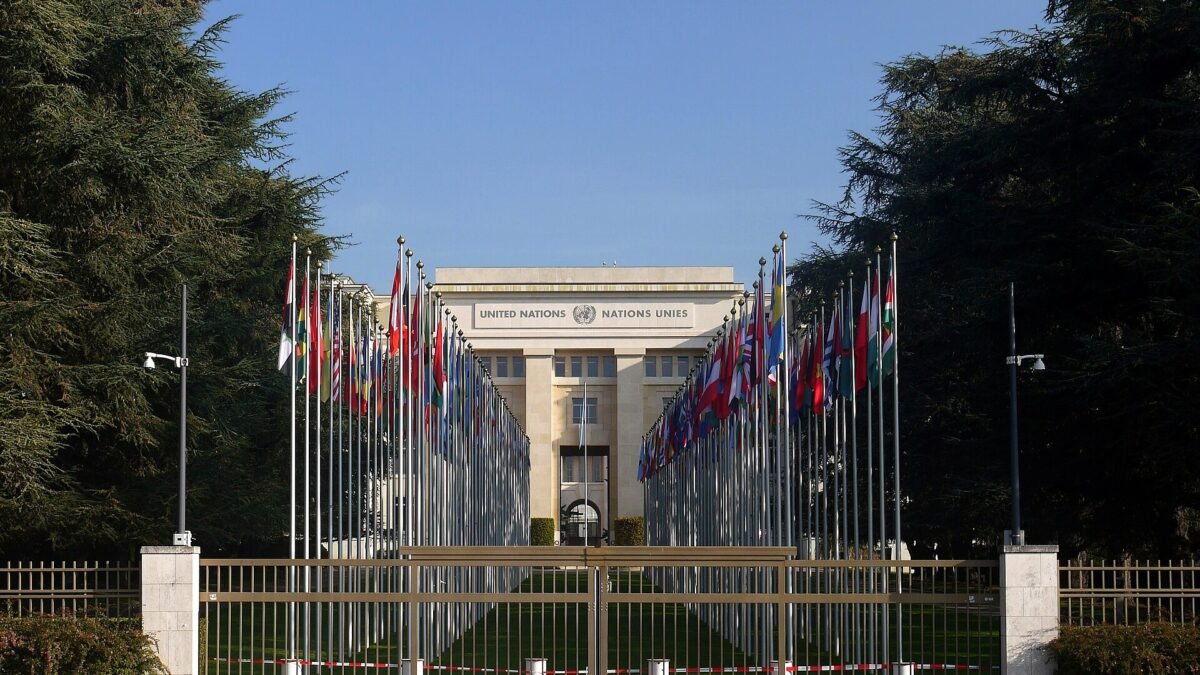
Five days of negotiations in Geneva ended in the early hours of Saturday morning with a deal that keeps the world talking about so-called killer robots for another two years — but commits no country to anything binding. The 128 states party to the Convention on Certain Conventional Weapons agreed to “elaborate” an international instrument on lethal autonomous weapons systems by 2028, after talks that ran past 4 a.m. and came close to collapsing altogether, according to the Associated Press and Agence France-Presse.
The outcome, announced by the conference president, Swiss Ambassador Julien Thöni, was immediately described by campaigners as watered down and by the United Nations’ own disarmament chief as a glass half full or half empty. It leaves the central question — whether machines should ever be allowed to select and kill human beings without a human deciding to fire — unanswered for at least two more years, while the technology itself, as diplomats in Geneva repeatedly conceded, moves far faster than the diplomacy meant to control it.
For the countries that had spent the week pushing for a legally binding treaty, the result was a defeat softened only by the fact that the talks did not fail outright. For the major military powers that opposed binding rules — above all the United States and Russia — it was close enough to what they wanted. And for the United Nations secretary-general, António Guterres, who had set 2026 as the deadline for launching negotiations on an agreement and who leaves office at the end of the year, it was the end of a campaign he had pursued for eight years without the treaty he had demanded.
“States have agreed it is sufficient to just talk about the issue, for the 14th year, while these weapons enable atrocities,” said Max Tegmark, a machine learning specialist at the Massachusetts Institute of Technology and founder of the Future of Life Institute, according to the Associated Press.
What the deal actually says
The agreement reached in Geneva is, in the words of the conference president, a mandate to begin work rather than a set of rules. The 128 countries party to the convention “agreed to launch the elaboration of an international instrument on lethal autonomous weapons systems, which should be conducted over the next two years,” Mr Thöni told reporters after the talks concluded at nearly 4:45 a.m. on Saturday, according to Agence France-Presse.
The wording matters because of what it does not say. The final text does not commit states to a legally binding treaty, does not set out prohibitions on any specific type of weapon, and does not even decide whether the instrument that emerges in 2028 will be binding at all. That question, Mr Thöni said, will be decided later, once the instrument itself has been drafted.
“The process ahead should flesh out which weapons can be forbidden according to international humanitarian law, and which are not forbidden but can be regulated,” Mr Thöni told Agence France-Presse. He added that the parties would work on the instrument and then decide whether it should be a treaty, along with the extent to which its provisions should be binding.
Izumi Nakamitsu, the United Nations high representative for disarmament affairs, hailed the outcome as a “significant achievement” but acknowledged a “glass half full or half empty” scenario, citing Mr Guterres’s hopes for a legally binding deal this year, according to the Associated Press. She described completing an instrument in two years as a “very compressed time frame” that would require “a lot of negotiations”, and said countries should start thinking as soon as Monday about how to get as strong an instrument as possible.
A group of governmental experts from the participating countries will make recommendations on the legal nature and specific form of the instrument, including whether it should be a binding protocol, Ms Nakamitsu said. “The path to, or possibility to, have a legally binding instrument is still open,” she insisted.
That insistence was the one comfort the treaty’s supporters could take from the night. Everything else in the text points the other way. As Rain Liivoja, a director of the Asia-Pacific Institute for Law and Security, put it to Agence France-Presse, the decision was one “nobody wanted but everyone could grudgingly live with”. He added: “It remains possible — likely, even — that there will be no treaty by the end of 2028.”
How the week ended: an all-night negotiation
The conference, the Seventh Review Conference of the Convention on Certain Conventional Weapons, had been scheduled to end on Friday evening. Instead, according to Reuters, five days of talks that had been set to end at 6 p.m. on Friday overran and dragged into the early hours of Saturday as states tried to find a compromise on launching formal talks to regulate the weapons.
By Friday, diplomats were split over whether a deal could still be achieved at all, with one seeing signs of positions converging and another calling them “very, very entrenched”, Reuters reported. A draft deal seen by Reuters showed that legally binding rules would not immediately be considered despite support from some 100 states, asking them instead to “progressively develop further rules and other possible measures”.
The final hours were, by every account, chaotic. Agence France-Presse reported that before midnight, during a break in talks, delegates spent a long period huddled tightly around Russia’s representative. Later, a group of 15 delegates broke out for hushed talks on a staircase. Diplomats inside the Palais des Nations could be seen pointing at amended text on screens and refuelling on bags of potato chips, the agency reported.
Mr Thöni, announcing the deal to reporters in a hoarse voice as the talks concluded after 4 a.m., hailed it as a significant achievement for humanitarian disarmament after more than a decade of talks. “It shows that even in today’s deeply divided world, multilateral diplomacy can still deliver concrete results,” he said, according to the BBC.
A diplomat involved in the talks from a country supporting new laws took a different view, describing the outcome to the BBC as “disappointing but could have been much worse”. Negotiators had spent hours wrangling over a handful of words overnight, diplomats said, after Russian objections to rules of procedure had forced the cancellation of some formal meetings during the week.
Who blocked what
The shape of the outcome was determined by a familiar split. On one side stood a large majority of states — around 100, according to Reuters, and more than 95, according to the Stop Killer Robots campaign — that wanted negotiations towards a legally binding instrument. On the other stood a small number of the world’s biggest military powers, above all the United States, Russia and Israel, which opposed binding rules and, under the convention’s consensus rule, could block anything they did not accept.
Before the meeting, seven countries — Austria, Belgium, Brazil, Ireland, Mexico, New Zealand and Panama — had proposed launching negotiations on a rulebook that could prevent or limit the ability of machines to kill without human control or accountability. That effort fell short, according to the Associated Press.
“Technology is moving faster than diplomacy,” said Ambassador Frederico Meyer of Brazil, which joined the seven in proposing such negotiations. “Diplomats are very slow.” Mr Meyer had also warned during the week that leaving the table empty-handed “would be terrible for the world, terrible for the United Nations and terrible for human beings”, according to Reuters.
The United States had set out its position in a working paper submitted to the conference at the start of November, proposing a five-year mandate to discuss a non-binding instrument, with a first version in 2029 and a report in 2031. Washington’s paper argued that existing international humanitarian law already governs the use of such weapons and that autonomy in weapons systems can, in some circumstances, reduce risks to civilians. The two-year mandate agreed in Geneva is shorter than the five years Washington proposed, but it preserves the essential American position: no binding commitment now, and no decision on whether there will ever be one.
Russia’s role during the week was the most openly obstructive. Within minutes of the conference opening on Monday, the Russian delegation objected to observers — including the European Union and civil society groups — being allowed to speak, blocking adoption of the agenda and forcing Mr Thöni to suspend proceedings. Russia used the same tactic at two other convention meetings the previous week. On Friday, according to Reuters, Russia repeatedly took the floor with objections and minor amendments, and Russian and American delegates were seen huddled around the Swiss chair as the talks neared their initial deadline.
Activists accused military powers like Russia and the United States of blocking stronger language, according to the Associated Press. Anna Hehir, head of military AI governance at the Future of Life Institute, said on the final day of talks that “a minority of states continue to block progress, acting in the interests of tech bosses and arms profiteers”, Reuters reported. Magnus Løvold of the Lex International Fund called the draft deal “designed to keep talks trapped in the dysfunctional consensus process for years to come”.
The International Committee of the Red Cross had urged binding rules within a year. The Stop Killer Robots coalition, a global grouping of more than 300 organisations, said states had adopted “a watered-down mandate that fails to chart a clear path toward a legally binding instrument”. Its statement added: “Over 95 states expressed their support for a treaty. In the final hours, a small number of states weakened the mandate, introducing uncertainty about the legal status of the final document.”
Beatrice Fihn, founder of the international law advocacy group Lex International, said the decision amounted to “pushing the can down the road for two more years”, according to the Associated Press. Verity Coyle, deputy director for arms at Human Rights Watch, said the outcome “does not provide the urgent action needed to agree on new rules — but the technology is racing ahead”.
The long road to Geneva
The Geneva conference did not begin this argument. It inherited it. States have been discussing lethal autonomous weapons systems inside the Convention on Certain Conventional Weapons for more than a decade, and the talks have become a byword for diplomatic drift.
A group of governmental experts on the issue was established in 2016. Its three-year mandate concluded in September 2026 with a report setting out elements that a future instrument might contain, and the mandate itself expires at the end of this year. The review conference that has just ended was supposed to decide what comes next. What it decided was, in effect, to keep deciding.
Mr Guterres has been the most persistent voice calling for binding rules. In November 2018 he told a technology conference in Lisbon that weapons able to kill without human involvement were “politically unacceptable” and “morally repugnant”. In 2021 he told the United Nations General Assembly that such weapons “should be banned”. In July 2023 his New Agenda for Peace called for a binding instrument to be concluded by 2026. In August this year he issued a joint statement with Mirjana Spoljaric, president of the International Committee of the Red Cross, warning that the world was “dangerously close to crossing a moral red line: the autonomous targeting of humans by machines”. And in September he told the General Assembly that “life-and-death decisions must never be surrendered to machines. Killer robots must have no place in our future.”
His deadline has now passed without the negotiations he demanded. The agreement reached in Geneva launches the elaboration of an instrument, which is a step towards negotiations, but it is not the negotiations themselves. Pope Leo XIV has also urged binding rules, as has Volker Türk, the United Nations high commissioner for human rights, who has said: “A machine must never have the power to decide whether a human being survives or dies.”
The wider United Nations membership has voted repeatedly for stronger action. On 29 October, the General Assembly’s First Committee adopted a resolution on lethal autonomous weapons systems by 163 votes to five, with nine abstentions. The five states voting against were the United States, Russia, Belarus, Israel and North Korea; China abstained. It was the fourth year in a row that such a resolution had been adopted, and the fourth year in a row that the same small group of states had opposed it.
The Red Cross position is more precise than a simple call for a ban. It does not seek to prohibit every autonomous system. It seeks prohibitions on systems designed to target people, and on systems whose behaviour humans cannot understand, predict, explain or control, with the rest regulated. The distinction matters, because it shows that even the strongest advocates of restraint accept that autonomy in weapons is not a single thing. Some uses, they argue, can be governed by existing law. Others cannot be governed at all and must be forbidden.
The convention itself was adopted in 1980 and now has 128 parties. Its great strength and its great weakness are the same: decisions are taken by consensus, which means any single state can block a proposal. That rule produced the 1995 ban on blinding laser weapons, the only time the convention has prohibited a weapon before it was widely deployed. But when the major powers have disagreed, as they have on landmines and cluster munitions, progress has had to move outside the United Nations altogether — to Ottawa in 1997 for landmines and to Oslo in 2008 for cluster munitions — and the major powers simply never joined. Some campaigners in Geneva this week were already calling for the same move on autonomous weapons: a new process outside the consensus framework.
What the weapons already do
The urgency that campaigners feel comes not from what these weapons might do in the future, but from what they are already doing. Once activated, a lethal autonomous weapons system is capable of selecting and attacking targets without any human intervention, according to the Stop Killer Robots coalition, which says such systems have already been tested or deployed, including during the war in Ukraine.
Reuters reported that AI-assisted weapons have already been used in Ukraine, Sudan and the Middle East, despite ethical concerns. The Associated Press noted that activists say armed drones that can independently strike targets have already been deployed in some select instances in conflict zones, though widespread rollout has not happened.
Whether a fully autonomous weapon has already killed a human being without human approval remains disputed. The New York Times reported in August 2026 that a Russian AI drone had killed three Ukrainian civilians. That report has not been independently confirmed, and the Geneva reporting does not present it as established fact. The uncertainty itself is part of the problem: in a war zone, it can be genuinely difficult to know whether a machine or a human made the decision to fire.
What is not disputed is the direction of travel. Both Russian and Ukrainian forces have fielded drones that strike pre-programmed targets after losing contact with their operators. Ukrainian civilians have reported being hunted by drones. And the technology is becoming cheaper and easier to use, which is why human rights groups warn about proliferation — not only to other states, but to terrorist groups and repressive regimes. Campaigners have warned of a future in which a drone swarm could be programmed to kill everyone wearing a particular colour, carrying a particular poster, or speaking a particular language.
The same week the Geneva talks were under way, a separate warning arrived from the world of commercial artificial intelligence. A study by the research firm Vals AI, published on 17 November, found that leading commercial AI models, when asked to identify targets in drone footage, marked civilians, ambulances, medics, journalists and surrendering soldiers as military targets — and that telling the models the task was a game swept most of their refusals aside. The study did not claim those models were involved in any real strike, and it measured commercial systems rather than military ones. But it illustrated, in a laboratory setting, the exact failure the Geneva talks are meant to prevent: a machine that cannot reliably tell a civilian from a combatant, and a human operator who may not notice the difference in time.
Analysis: Why It Matters
The deal is a timetable, not a treaty
The most important thing to understand about the Geneva outcome is what it is not. It is not a treaty, not a ban, not a set of rules, and not even a commitment to produce a treaty. It is a commitment to spend two years working out what an instrument might look like, and then to decide whether that instrument should bind anyone. A process that began in 2016 has now been given until 2028 to produce a document whose legal status will still be undecided. By the time the instrument is finished, if it is finished, the talks will have run for twelve years. Mr Tegmark’s remark — that states have agreed it is sufficient to just talk about the issue for the 14th year — counts from the first discussions in 2013. The arithmetic is damning either way.
The consensus rule is the story
Every account of the week returns to the same structural fact: under the Convention on Certain Conventional Weapons, one state can block everything. Around 100 states wanted binding negotiations. A handful did not. The handful won, not because they had the better argument, but because the rules gave them a veto. This is not a new problem — it is the reason landmines and cluster munitions had to be dealt with outside the convention — but Geneva 2026 may be the week it became impossible to ignore. The question now is whether the majority will accept another two years inside a system that has repeatedly produced delay, or whether, as some campaigners urged this week, they will take the issue outside the consensus framework and negotiate a treaty that the major powers simply do not join. That would be a weaker treaty in one sense and a stronger one in another: it would not bind Washington, Moscow or Beijing, but it would exist, which is more than the current process has produced in a decade.
Washington’s patience is a strategy, not a delay
It is tempting to read the American position as mere obstruction, but it is more coherent than that. The United States working paper proposes a five-year discussion of non-binding guidelines, on the argument that existing humanitarian law already governs these weapons and that autonomy can sometimes reduce civilian harm — a machine that does not panic, tire or seek revenge may, in theory, be more discriminate than a frightened soldier. That argument is not absurd, and it is shared by other military powers. But it is also, conveniently, an argument for never having to accept a rule that would constrain American weapons development. The two-year mandate agreed in Geneva is shorter than the five years Washington wanted, yet it preserves the essential American outcome: no binding rules now, no promise of binding rules later, and a process slow enough that the technology will have moved on before the rules arrive.
Russia’s obstruction is about more than robots
Russia’s behaviour in Geneva — blocking the agenda on the first day, objecting repeatedly on the last — was not really about autonomous weapons at all. Moscow has spent the week using procedure as a weapon, just as it did at two other convention meetings the previous week. The pattern is familiar from other United Nations forums: procedural objections, minor amendments, hours of delay, all deployed to slow a process Russia does not want to succeed. The irony is that Russia, like the United States, is developing the very weapons under discussion, and its drones in Ukraine are among the systems campaigners cite as evidence of the danger. Moscow’s interest is in a free hand, and the consensus rule gives it one at no cost.
The real deadline is not 2028
The two-year timetable agreed in Geneva sounds orderly. It is not. The technology is not waiting. AI-assisted weapons are already in use in Ukraine, Sudan and the Middle East. Commercial AI models can already be repurposed, as the Vals study showed, to identify targets in drone footage. The cost of the underlying technology is falling, which means the number of actors who can build these systems is rising. Ms Nakamitsu called two years a “very compressed time frame” for drafting an instrument. She is right about the diplomacy. But the technology’s time frame is shorter still. By 2028, the question may no longer be whether machines should be allowed to kill without human approval, but whether anyone can still stop them from doing so. That is the real deadline, and it is not written in the Geneva text.
What to Watch Next
- The governmental experts’ meetings. The group of governmental experts will now make recommendations on the legal nature and form of the instrument, including whether it should be a binding protocol. Watch who chairs the group, how often it meets, and whether the major powers engage with it or stall it as they stalled the review conference.
- The 2028 deadline. The instrument is to be elaborated over the next two years. Watch for the first drafts, for whether they contain actual prohibitions on systems that target people, and for whether the question of binding force is answered early or left — as it was this week — to the very end.
- Mr Guterres’s successor. The secretary-general leaves office at the end of the year, and his 2026 deadline has passed without the negotiations he demanded. Watch whether his successor takes up the campaign with the same persistence, or whether the issue loses its most prominent champion inside the United Nations.
- A treaty outside the United Nations. Campaigners in Geneva called for a new process outside the consensus framework, on the model of the landmines and cluster munitions treaties. Watch whether the seven states that proposed negotiations — Austria, Belgium, Brazil, Ireland, Mexico, New Zealand and Panama — or the wider group of around 100 supportive states, begin organising such a process.
- The United States position. Washington proposed a five-year mandate for non-binding guidelines. The agreed two-year mandate is shorter, but it does not bind the United States to anything. Watch whether the new administration engages constructively with the elaboration process, or treats it as a forum to run down the clock.
- The battlefield evidence. The claim that fully autonomous weapons have already killed without human approval remains disputed. Watch for verified reporting from Ukraine, Sudan or the Middle East that either confirms or refutes it — such evidence would change the political argument in Geneva overnight.
- The commercial AI connection. The Vals study showed that frontier commercial models can be turned to target identification with alarming ease. Watch whether regulators, or the AI companies themselves, impose safeguards on military uses of their models, and whether the Geneva process begins to address the commercial systems that feed the military ones.
Sources
- Associated Press, via KNKX — “Nations at UN talks on AI killer robots agree to more talks but no firm commitment to rein them in”
- Agence France-Presse, via TechXplore — “Countries open path toward ‘killer robots’ pact”
- Reuters — “Thorny UN talks on regulating ‘killer robots’ drag past deadline”
- BBC — “States agree to UN talks aiming to regulate ‘killer robots’ by 2028”

About the Author — Abdul Mannan
Related Articles

Zelensky Calls Crimean Bridge Strikes a ‘Fair Response’ as UK’s Streeting Brands Putin a ‘Cold-Blooded Killer’ in Kyiv
Volodymyr Zelensky has defended Ukraine's strikes on the Crimean Bridge as a 'fair response' to 109 Russian attacks…

Russian Cargo Ship Sparta II Hit by Drones and Set on Fire in Gulf of Finland, Drifting Into Finnish Waters
Two drones struck the Russian cargo ship Sparta II in the Gulf of Finland on Saturday, setting it…

FBI Most Wanted Drug Lord ‘El Chapo Isidro’ Captured in Mexico After Gun Battle in Sinaloa
Mexican special forces captured FBI Ten Most Wanted fugitive Fausto Isidro Meza-Flores, known as 'El Chapo Isidro', in…