
Zelensky Calls Crimean Bridge Strikes a ‘Fair Response’ as UK’s Streeting Brands Putin a ‘Cold-Blooded Killer’ in Kyiv

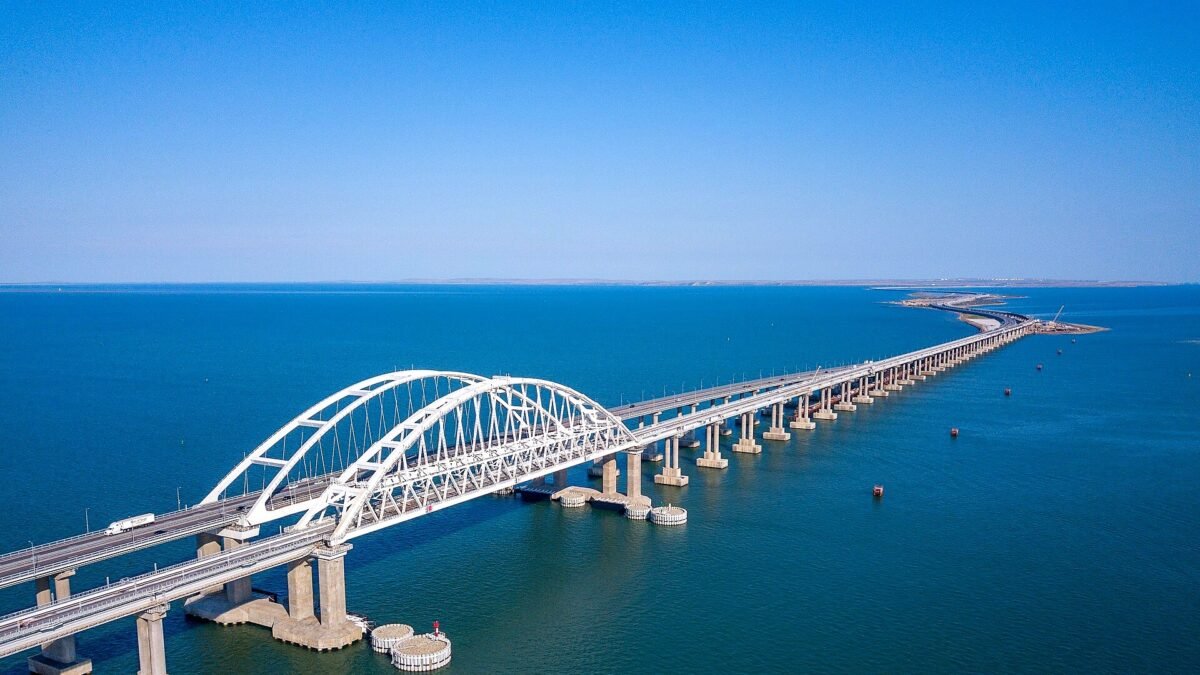
Ukrainian President Volodymyr Zelensky has defended Ukraine’s attacks on the Crimean Bridge, calling them a “fair response” to what he said were 109 separate Russian attacks on bridges in Ukraine, as Britain’s Defence Secretary Wes Streeting used a visit to Kyiv to describe Russian President Vladimir Putin as a “cold-blooded killer”.
Speaking to the BBC in the Ukrainian capital on Saturday, Mr Zelensky rejected Mr Putin’s claim that the bridge linking Russia to occupied Crimea was for civilian use only, and pointed to images circulating online of Russian tanks and other military hardware crossing it as a supply route. “There are facts, not just the words of Putin. We can see,” he said. “If Putin used the internet, he could see that.”
The Ukrainian president was speaking ahead of a meeting with Mr Streeting, who told him he had come to Kyiv to show that Europe remained united in its support for Ukraine. “The more Putin tries to divide us, the more resolute we become,” the defence secretary said.
The exchange came on a day of grim news from the front lines of the war. On Friday evening, Russian missiles struck Mr Zelensky’s home city of Kryvyi Rih, killing a seven-year-old boy and a 20-year-old woman and wounding around 60 people, according to local officials. The attack, and the diplomatic flurry around it, underlined how the war in Ukraine has entered a new and dangerous phase, with strikes on infrastructure, spillover into a Nato member state, and a peace process in which Europe is fighting for a seat at the table.
The bridge at the centre of the war
This week’s combined missile and drone strikes by Ukrainian forces destroyed the central road section of the Crimean Bridge, collapsing part of it together with one of the two support arches into the sea and rendering the structure unusable for road traffic, according to the BBC. The operation, carried out on 17 November, was the most destructive attack on the crossing since the start of the full-scale invasion, and Ukrainian officials say it will take Russia a long time to put right.
Ukraine’s Defence Minister Yevhenii Khmara said during a briefing in Kyiv that it could take several months to a year to remove the collapsed section of the bridge, according to the Kyiv Independent. The fallen structure has also obstructed the passage of vessels beneath the bridge, forcing Russian authorities to examine how to clear the wreckage from the Kerch Strait.
Mr Zelensky described the strike as a complex, multi-stage operation that also involved destroying Russian weapons used against Ukraine. He said the bridge had been a legitimate target because Russia had used it to move armour and supplies into occupied Crimea and onward to the front lines in southern Ukraine, and because Moscow had repeatedly struck Ukrainian bridges of its own.
“Not one, not two — 109 attacks,” Mr Zelensky said, referring to Russian strikes on Ukrainian bridges. “That’s why it’s an absolutely fair response.”
He also warned that the intense Russian attacks on Ukraine that have followed the strikes on the Crimean Bridge were themselves a message. “It is only a signal that Vladimir Putin does not want to stop. He wants a reason to escalate,” he said.
The bridge, also known as the Kerch Bridge, is a 19-kilometre road and rail crossing over the Kerch Strait, linking Russia’s Taman Peninsula with the Kerch Peninsula in Crimea. It was built after Russia annexed Crimea in 2014, with construction beginning in February 2016. The road bridge was opened in May 2018, when Mr Putin drove a lorry across it at the head of a convoy, and the rail bridge followed in December 2019. At a cost of about 3.7 billion dollars, it was the longest bridge in Europe and a personal prestige project for the Russian president, who presented it as physical proof that Crimea was permanently Russian.
For Ukraine, it has always been both a military target and a symbol. The crossing carries fuel, ammunition and troops into Crimea, from where they are moved on to Russian forces in the south of Ukraine. Kyiv has attacked it repeatedly: in October 2022, a truck bomb brought down sections of the road bridge and set a fuel train ablaze on the rail bridge; in July 2023, naval drones collapsed another road section, killing two civilians in a car on the bridge; and in June 2025, Ukraine’s security service detonated underwater explosives against the bridge’s submerged supports. Each time, Russia repaired the damage and traffic resumed. This time, Ukrainian officials say, the destruction of the main arch span is on a different scale.
A child killed in Kryvyi Rih
While Mr Zelensky was making his case in Kyiv, the human cost of the war was being counted in his home city. On Friday evening, two ballistic missiles struck the centre of Kryvyi Rih, in the Dnipropetrovsk region of central Ukraine, hitting a busy area near a restaurant, according to local officials.
A seven-year-old boy and a 20-year-old woman were killed in the attack, Oleksandr Vilkul, the head of the city administration, wrote on the messaging app Telegram. The boy later died in hospital after suffering a head injury, according to the Associated Press, and local officials said he had been in a playground at the time, according to the BBC. The woman was a 20-year-old paramedic who was killed while responding to the first strike, the Associated Press reported.
Around 60 people were wounded, including six children, according to Oleksandr Hanzha, head of the regional military administration. As of Saturday morning, 28 people remained in hospital, including a three-year-old girl, and five of them were in intensive care, according to CNN. Local officials described the attack as a “triple-tap” strike, in which rescuers rushing to the scene of the first explosion were hit by follow-up attacks. “It was a tragic evening and a tragic night for our city,” Mr Vilkul said.
The attack fell on 20 November, which Ukraine marks as Children’s Day, a detail that local officials and Ukrainian media noted with bitterness. The local broadcasting outlet Rudana named the seven-year-old boy as Tikhon, describing him as kind, quick-witted and talented.
Ukraine’s state emergency service said 11 people were also injured in the north-eastern Kharkiv region and one person in Rivne, in the north-west, according to the BBC, as Russian attacks continued across the country on Friday evening and overnight.
The Kryvyi Rih strike was part of a wider wave of Russian retaliation that followed the attack on the Crimean Bridge. Earlier in the week, Russian missiles and drones struck Kyiv, killing five people and damaging three bridges in the capital, and cutting water and heating supplies. The pattern — a Ukrainian strike on a high-value Russian asset, followed within hours by heavy Russian bombardment of Ukrainian cities — has become a grim rhythm of this phase of the war.
Streeting’s message from Kyiv
Mr Streeting’s visit to Kyiv on Saturday carried a deliberately defiant tone. The defence secretary arrived after spending Friday in Poland, meeting British soldiers taking part in Exercise Koalicja, a drill preparing troops from the so-called Coalition of the Willing for a possible deployment to post-war Ukraine.
His trip to Poland came a day after two Russian missiles and a suspected drone came down on Polish territory on Friday morning, with one of the missiles landing around 22 miles from the military exercise in south-east Poland and the others closer to the Ukrainian border, according to the Press Association. Mr Streeting described the incident as an “outrageous provocation” and said the timing seemed “more than a coincidence”.
“It’s no good Putin turning up to international summits, walking up the red carpet and talking the language of peace, if in the days that follow we see heavy bombardment, particularly of civilian infrastructure,” he told the BBC. “So I think in Europe we know exactly who we’re dealing with in Putin — he is a cold-blooded killer.”
He added: “Putin has absolutely no business playing the victim. He is the aggressor in this war. He provoked an illegal invasion of Ukraine. And all of us, right throughout the world, need to judge Putin not on his words, but on his actions.”
Asked about Nato’s response to the missiles landing in Poland, Mr Streeting said the best course was to “do more for Ukraine” so that it could defend itself. “The message we need to send to the Kremlin, the deterrence we need, is for Putin — and those around him — to understand that the more they try to deter Europe from supporting Ukraine, the more we will step up,” he said. “There can be absolutely no suggestion that these provocations, and the state-sponsored terrorism that Putin is waging throughout Europe, will be rewarded by weakness on our continent.”
Mr Zelensky thanked Mr Streeting for the visit, which fell on 21 November, Ukraine’s Day of Dignity and Freedom, the public holiday marking the start of the pro-European protests in 2004 and 2013. “Thank you for this visit on the Day of Dignity and Freedom, of all days,” he wrote on social media, adding that Russia was “launching brutal, massive strikes every day”.
The Ukrainian leader also used the meeting to press Britain for help in finding anti-ballistic missile weapons to protect Ukrainian cities against Russian strikes. “The UK does not have its own Patriot missiles, but it has strong ties across Europe and around the world that can help find the anti-ballistic missiles we need. We are counting on this,” he said.
The Berlin talks and the peace process
Mr Streeting’s visit came after a week of intense diplomacy that has left Europe uneasy about its place in the effort to end the war. On Thursday, European leaders met in Berlin alongside United States envoys to discuss Ukraine, hours after Mr Putin held trilateral talks in Shenzhen, China, with US President Donald Trump and Chinese President Xi Jinping — the first such meeting of the three leaders.
Jared Kushner, Mr Trump’s son-in-law and one of the two US envoys in Berlin, said the US president, who had dialled into the meeting from Air Force One, wanted to make a deal with Moscow “with Europe by his side”. But Mr Zelensky said he had been “sceptical” ahead of the latest round of talks, when US envoys claimed that Russia was prepared to make compromises to end the war. “I thought [Putin] would find reason to escalate,” he said.
European leaders have insisted that they will not be sidelined. “Europe has a clear and consistent and united negotiating position,” the British Prime Minister, Andy Burnham, said, according to the BBC, while the German Chancellor, Friedrich Merz, said Moscow’s “maximalist demands are not realistic”. Mr Putin has so far rejected any European role in the US-led peace talks, but earlier this week he invited European representatives to Moscow, saying he wanted to clarify “what Europe will bring to these talks”.
The diplomatic uncertainty is compounded by events at sea and in the air. In a separate development on Saturday, Finland said it had “detected a drone strike on a Russian merchant vessel” in the eastern Gulf of Finland, in an international maritime area. The Finnish defence ministry said the vessel was damaged, without giving further details, and added that temporary restrictions on aviation and maritime areas in the eastern Gulf of Finland had been reinstated for safety reasons. Russia has not publicly commented on the issue.
The backdrop to all of this is a war now in its fifth year, with Russia’s full-scale invasion having begun in February 2022. The front lines in eastern and southern Ukraine have moved only slowly for months, but the war of long-range strikes — on energy infrastructure, on logistics, on cities — has intensified sharply, and both sides are now hitting targets that were once considered off-limits or too difficult to reach.
Analysis: a bridge, a doctrine and a test for Europe
The destruction of the Crimean Bridge’s main arch span matters for three reasons, and each of them reaches beyond the bridge itself.
First, it is a military blow with practical consequences. The bridge was the most direct route for moving heavy equipment, fuel and troops from Russia into Crimea, and from there to the southern front. Rail still runs on a parallel structure, and Russia has built up alternative land routes through occupied territory, so the loss of the road bridge will not by itself cut off the peninsula. But the damage is of a different order from the earlier attacks: an arch span lying in the strait is not a hole in a deck that can be patched in weeks, and the Ukrainian defence minister’s estimate of months to a year to clear the wreckage suggests the crossing will be degraded for a long time. Every tonne of supply that must now travel a longer, slower route is a tonne that arrives later, and in a war of artillery and attrition, lateness is a form of loss.
Second, the strike is a statement about the rules of this war, and Mr Zelensky’s defence of it was really a statement about who gets to set them. Mr Putin has presented the bridge as a civilian structure and its attackers as terrorists; Mr Zelensky’s answer — 109 Russian attacks on Ukrainian bridges, and publicly available video of tanks crossing the Crimean Bridge — is an argument that the bridge was a military asset and that Ukraine was responding in kind. This is not a new argument in war, but the way Mr Zelensky made it, in a direct interview rather than through a ministry statement, and on the same day that a British cabinet minister stood beside him and called Mr Putin a “cold-blooded killer”, gives it unusual weight. Kyiv is no longer asking the world to accept that its strikes are lawful. It is insisting on it, in public, and daring Moscow to dispute the evidence.
Third, and most importantly, the week has become a test of Europe’s place in the diplomacy that is supposed to end the war. The sequence of events tells its own story: a trilateral summit in Shenzhen from which Europe was absent, a meeting in Berlin at which American envoys spoke of a deal “with Europe by his side”, Russian missiles landing in Poland during a Coalition of the Willing exercise, and a British defence secretary flying to Kyiv to say that the answer to provocation is to “do more for Ukraine”. Europe’s leaders have responded with unusual bluntness — Mr Burnham on a united negotiating position, Mr Merz on Moscow’s unrealistic demands, Mr Streeting on judging Mr Putin by his actions — because they understand what is at stake. If a settlement is negotiated over their heads, between Washington, Moscow and Beijing, Europe will be asked to guarantee a peace it did not shape, with a neighbour it does not trust. The bridge, in that sense, is the least of it: the real question is whether Europe is a party to the peace or merely its underwriter.
There is also a darker reading of the week, and Mr Zelensky gave voice to it himself. His warning that the Russian bombardment after the bridge strikes was “a signal that Vladimir Putin does not want to stop” and that Mr Putin “wants a reason to escalate” reflects a fear in Kyiv that every Ukrainian success will be met with a Russian escalation designed to make the success look Pyrrhic. The strike on Kryvyi Rih, on his home city, on Children’s Day, with follow-up attacks aimed at the rescuers, was calculated to deliver exactly that message. The “triple-tap” pattern — strike, wait for the rescuers, strike again — is not a tactic of a military that is running out of ideas. It is a tactic of a military that wants the other side, and its supporters, to feel that every blow will be answered in blood.
That is why Mr Streeting’s language matters. Calling a foreign leader a “cold-blooded killer” is not the normal vocabulary of a defence secretary on a diplomatic visit, and it was plainly deliberate. It was meant to close off the space in which Mr Putin can be treated as a difficult but legitimate negotiating partner, and to frame the choice for European publics in moral rather than merely strategic terms. Whether that framing survives contact with the peace process — where someone, eventually, will have to sit across a table from Moscow — is an open question. But for now, London’s message is that there will be no softening, and no reward for escalation.
For Ukraine, the calculation is just as stark. The bridge strike demonstrates a capability — long-range, precise, repeatable — that Kyiv will want to keep demonstrating, because each demonstration strengthens its hand in any negotiation. But each demonstration also invites the retaliation that fell on Kryvyi Rih, and the retaliation falls on civilians, not on the people who order the strikes. Mr Zelensky’s appeal for anti-ballistic missile defences is, in that light, not a shopping list but a plea: if Ukraine is to keep fighting this kind of war, it needs the means to protect the cities that will pay the price.
Why it matters
This story matters because it captures the war in Ukraine at a moment of transition. The fighting is no longer confined to the trenches of the east. It now reaches across the Black Sea, into the Kerch Strait, into Polish airspace and into the diplomatic rooms of Berlin and Shenzhen. The bridge that Mr Putin drove across in 2018 as a symbol of permanence now lies partly in the sea, and the assumption that some targets were too hard, too symbolic or too escalatory to hit has been abandoned by both sides.
It matters, too, because of what it reveals about the peace process. The United States is driving a negotiation in which Europe fears it is a spectator; Russia is signalling that it will escalate rather than concede; and Ukraine is demonstrating, with the bridge, that it still has cards to play. The coming weeks will show whether the destruction of the bridge’s arch span becomes a turning point — a demonstration that Ukraine can impose costs that force Moscow to negotiate seriously — or simply another round in a cycle of strike and retaliation that leaves more children dead in cities like Kryvyi Rih.
The immediate signs are not encouraging. Russia has not commented on the merchant vessel in the Gulf of Finland, has not acknowledged the scale of the bridge damage, and has shown no sign of softening its demands. The United States has not yet said what it will do about the missiles that landed in Poland, or about the reports that its own diplomacy is proceeding without Europe. And Ukraine, for all its defiance, is still asking its friends for the missiles that would let its people sleep through the night.
What to watch next
Several things will show which way this is heading. The first is whether Russia manages to restore any road traffic across the Crimean Bridge, and how long the wreckage blocks shipping through the Kerch Strait. The second is whether the United States and its European allies agree on a joint response to the missiles that landed in Poland, or whether Nato treats the incident as an accident of a war next door. The third is what emerges from the next round of talks, and whether Europe is given a formal seat at the table or left to endorse a deal struck by others. The fourth is the pace of Russian strikes on Ukrainian cities, and whether the pattern of retaliation after the bridge attack continues or subsides. And the fifth is whether Ukraine receives the anti-ballistic missile systems Mr Zelensky asked for — the most concrete test of whether Europe’s words about doing more will be matched by deeds.
Sources
BBC — Zelensky says Crimean Bridge strikes ‘fair response’ as he meets UK’s Streeting

About the Author — Abdul Mannan
Related Articles
UN ‘Killer Robot’ Talks End in a Two-Year Promise as States Agree to Draft Rules by 2028 — Without Binding Them
After five days of talks in Geneva that ran past 4 a.m., 128 states agreed to spend two…

Russian Cargo Ship Sparta II Hit by Drones and Set on Fire in Gulf of Finland, Drifting Into Finnish Waters
Two drones struck the Russian cargo ship Sparta II in the Gulf of Finland on Saturday, setting it…

FBI Most Wanted Drug Lord ‘El Chapo Isidro’ Captured in Mexico After Gun Battle in Sinaloa
Mexican special forces captured FBI Ten Most Wanted fugitive Fausto Isidro Meza-Flores, known as 'El Chapo Isidro', in…