
Flower Hidden for 100 Million Years Inside a Kansas Rock Is the Oldest Palm Flower Ever Found

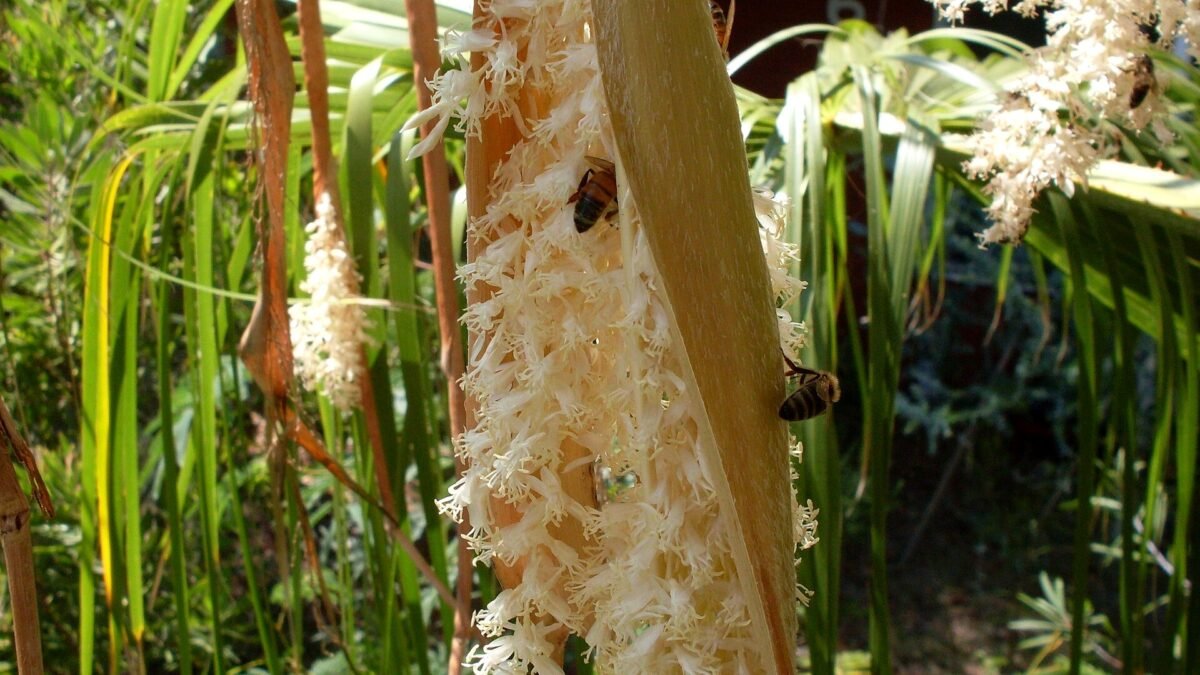
A flower smaller than a grain of rice, sealed inside a lump of Kansas sandstone for around 100 million years and then overlooked in a museum drawer for more than a century, has turned out to be the oldest palm flower ever found — and the earliest clear example of the flower plan shared by a fifth of all flowering plants alive today.
The fossil, named Tomlinsoniella pedicellata, was described on 23 November 2026 by researchers from the United States and the United Kingdom in the American Journal of Botany. It measures just 1.5 millimetres tall and 1.2 millimetres across, yet its anatomy is so complete that scientists could read its family history from it: three sepals, three petals, six pollen-bearing stamens arranged in two sets of three, and three separate seed-bearing carpels, all laid out in five concentric rings of three.
That arrangement — parts in threes, repeated in five whorls — is the signature blueprint of the monocots, the great plant group that includes palms, grasses, orchids, lilies, tulips, bananas and the cereals that feed humanity. According to the University of California, Santa Barbara, which announced the discovery, Tomlinsoniella is the oldest fossil flower yet found to show that pattern clearly, and the earliest known fossil evidence of the fan palm family, pushing that group’s appearance in the geological record back by nearly 20 million years.
The discovery was an accident. Steven Manchester, a paleobotanist at the Florida Museum of Natural History, had borrowed the rock from the Smithsonian’s National Museum of Natural History to study a different fossil flower exposed on its surface, a species called Dakotanthus cordiformis. He put the specimen through a micro-CT scanner, an X-ray instrument that builds a three-dimensional image of a sample’s interior slice by slice, in the same way a medical scanner images the inside of a body. While examining the scan, he noticed a second floral shape, completely entombed within the stone.
“To find a fossil flower as perfect as this one emerging unexpectedly from this rock is an incredible thrill,” said William Baker, a co-author of the study and senior research leader in plant systematics at the Royal Botanic Gardens, Kew, in London. “This ancient flower seems so familiar and modern to us that we would not be surprised to see this plant alive today.”
A flower that is not there at all
The most remarkable thing about Tomlinsoniella is that the flower itself no longer exists. What Manchester found was a hole in the shape of a flower.
Around 100 million years ago, in the middle of the Cretaceous period, the flower fell into wet sand rich in clay. The clay closed around it and hardened, entombing the bloom in fine detail. Then the flower rotted away, leaving behind a cavity that copied its form exactly — a fossil preserved in negative, like a mould left behind when the object itself has gone.
Such “negative” fossils have long frustrated paleobotanists. A hollow in a rock is difficult to study by eye, and breaking the specimen open would destroy the very thing it contains. Micro-computed tomography changed that. By scanning the rock and then digitally inverting the image, the researchers could turn the empty mould back into a solid, positive model of the original flower and examine every part of it without touching the stone.
“This fossil was a void in the rock, left behind after its organic remains decayed, which faithfully replicated the external shape of the flower in negative,” said Bruce Tiffney, the study’s lead author and professor emeritus of earth science and biology at the University of California, Santa Barbara. “Such ‘negative’ fossils have previously been hard to interpret, but the advent of micro-computed tomography has allowed us to image them and then invert the image to create a positive matching the original organ.”
Manchester shared the scan images with Tiffney and with Walter Judd, a botanist at the University of Minnesota, at the weekly online meeting the three hold to discuss unusual fossil plants. All three agreed at once on what they were looking at: a classic monocot flower. “Every part is repeated in threes and the parts occur in five concentric whorls,” Tiffney explained.
One detail then narrowed the identification further. The flower’s three carpels — the female parts that would have held the seeds — were separate from one another rather than fused together. Free carpels are found in very few living monocot lineages, and the overall shape of the fossil pointed in one direction: a palm. The team turned to the world’s leading palm specialists, Baker and John Dransfield, both at Kew, who agreed that the plant most likely belonged to the fan palm subfamily, the group that includes the California and Mexican fan palms still common in southern California today.
The researchers are careful about the limits of a single specimen. It is possible, they say, that Tomlinsoniella belonged to an extinct lineage that independently evolved a flower very like a fan palm’s. But on the balance of the evidence, they consider it far more likely that the plant was a genuine early member of the living fan palm group. If that identification stands, it is the earliest fossil evidence of the fan palm subfamily ever found.
A rock collected when the West was still wild
The stone that hid the flower is itself a piece of scientific history. It comes from the Dakota Formation, a band of sandstone running through Kansas, Nebraska, Iowa and Minnesota that is famous among paleobotanists for the fossil leaves preserved in its rocks. The formation dates from the late Albian to the early Cenomanian stages of the Cretaceous, around 100 million years ago, when the place that is now Kansas stood on the shoreline of a vast shallow sea — the Western Interior Seaway — that split North America in two and stretched across what is today the Great Plains.
The specimen was collected in central Kansas in the 1870s to 1890s by Leo Lesquereux, a Swiss-born pioneer of American fossil-plant research who published the first descriptions of the Dakota Formation’s flora. His specimens have been held ever since in the Division of Paleobotany at the Smithsonian National Museum of Natural History in Washington, D.C., where generations of scientists have studied the leaves and fruits visible on their surfaces — never suspecting that a second, smaller flower lay hidden inside one of them.
The new flower’s scientific name honours that long chain of work. The genus Tomlinsoniella and the species pedicellata — a reference to the slender stalk, or pedicel, on which the flower was borne — were formally established in the paper by Tiffney, Judd, Baker, Dransfield and Manchester. The single known specimen, the holotype, is catalogued as USNM 50025a.
“This is the magic of collaboration reaching across 130 years,” Tiffney said. It took one researcher to collect the rock in the nineteenth century, another to scan it in the twenty-first, two more to recognise what the scan showed, and two palm specialists to confirm the identification.
Why a millimetre of flower matters so much
To understand why scientists are excited by a flower the size of a rice grain, it helps to know what monocots are — and how little is known about where they came from.
Flowering plants, or angiosperms, fall into two great groups. Monocots produce seeds containing a single seedling leaf; dicots produce two. Monocots account for roughly 20 per cent of all known flowering plants — around 70,000 living species, according to the researchers — and they include many of the plants humanity depends on most: wheat, rice, maize and other cereals, bananas, yams, sugar cane, and also palms, grasses, lilies, tulips, daffodils and orchids.
Genetic evidence from the DNA of living plants suggests that monocots originated in the Early Cretaceous, more than 100 million years ago. But the fossil record has refused to confirm that date. Very few monocot fossils have ever been found in rocks of mid-Cretaceous age or older, leaving scientists unsure when the group really appeared, how quickly it diversified, and what its earliest flowers looked like.
Tomlinsoniella does not settle the question of when flowering plants first evolved — the researchers are explicit that the timing of their origins remains one of biology’s unsolved mysteries. What it does provide is the first hard evidence that the classic monocot flower plan was already fully formed 100 million years ago, in a plant growing on a Cretaceous shoreline while dinosaurs still walked the Earth. A cross-section of the fossil, the researchers say, could easily be mistaken for a diagram of a monocot flower in a modern botany textbook.
That matters because the plan itself may be part of the reason monocots succeeded so spectacularly. The same basic arrangement — three outer sepals, three petals, six stamens, three carpels — underlies the flowers of lilies in a garden, grasses in a meadow, palms on a boulevard and rice in a paddy field. Finding it intact and unmistakable at 100 million years shows that the design was settled early and then carried, with variations, through the rise of the group to its present dominance.
The fossil also rewrites the history of palms in particular. Palms have long been a focus of research at Kew, where Baker and Dransfield work, and the fan palm subfamily had no fossil record anything like this old. Pushing its appearance back by nearly 20 million years means fan palms were already established while the great interior seaway still covered the American Midwest — far earlier, and in a far cooler and more northerly setting, than the palms of today’s tropics and subtropics might suggest.
The museum drawer as a time machine
Beyond the flower itself, the discovery is a demonstration of something scientists have been saying for years: the world’s natural history museums are full of discoveries that have not happened yet.
The Lesquereux collection at the Smithsonian was gathered for the fossils visible on the surfaces of its rocks. For more than 130 years, nobody had any reason to look inside them, and no tool that could do so without destroying them. Micro-CT scanning supplied that tool, and it is now being applied to collections around the world — not only to rocks, but to amber, to herbarium sheets, to pinned insects and to pickled specimens — revealing structures that the original collectors could never have seen.
The same logic applies to the Dakota Formation itself. Its fossil leaves have been studied since the nineteenth century, yet the formation’s tiny flowers — mesofossils, as paleobotanists call them — are only now being found, because they are measured in millimetres and hidden inside the rock rather than displayed on its face. Tomlinsoniella is the first mesofossil evidence of monocots in the Dakota Formation, and the researchers expect it will not be the last: the same scanning techniques can now be turned on hundreds of other Lesquereux specimens, and on similar collections elsewhere, each of which may hold another flower, another insect, or another clue to the Cretaceous world.
There is also a quiet lesson in the way the discovery happened. It was not the product of a grand expedition or a new field season, but of a researcher looking at a borrowed rock with a new instrument, noticing something odd, and bringing it to two colleagues at a regular weekly meeting. The most expensive part of the work was the scanner; the specimen itself had been sitting in a drawer since the age of steam trains.
Analysis: Why It Matters
It is easy to read a story like this as a curiosity — a tiny flower, a clever scan, a new Latin name — and move on. That would miss why it deserves a second look. Tomlinsoniella pedicellata matters for three reasons that reach well beyond paleobotany, and each of them says something about how science actually advances.
First, it closes a gap between two kinds of evidence that have been in tension for years. Genetic clocks built from the DNA of living plants have long implied that monocots are older than their fossils suggest. Fossil hunters, meanwhile, could point to the rocks and say: show us one. For decades, neither side could win the argument, because the fossils were not there to be found — or, as it turns out, because they were there all along and nobody could see them. A single millimetre of flower does not end the debate, but it moves the fossil evidence decisively in the direction the DNA has been pointing, and it does so with a specimen whose anatomy is unambiguous rather than arguable. When a long-standing mismatch between genetics and fossils narrows, the whole timeline of plant evolution gets firmer, and every estimate built on that timeline — when grasses spread, when palms diversified, when flowering plants took over the planet — becomes a little more trustworthy.
Second, the discovery is a reminder that the limiting factor in science is often not the lack of material but the lack of a way to look at it. The Smithsonian has held this rock since the 1890s. Nothing about the specimen changed in those 130 years; what changed was the instrument. Micro-CT scanning, borrowed from medicine and materials science, turned an opaque lump of sandstone into a transparent window, and digital inversion turned an empty mould into a flower. The same pattern is repeating across the sciences: old ice cores re-read with new chemistry, old sky photographs re-examined with new software, old museum specimens re-scanned with new imaging. The past, it turns out, is not fully explored — it is only fully collected. The returns on that collected past may be enormous, and they cost a fraction of a new expedition, because the fieldwork was already done by people who died a century ago.
Third, there is a human point that the researchers themselves keep returning to. This was not a lone genius moment. It was a chain: a Swiss immigrant collecting rocks on the Kansas prairie in the 1870s; a museum keeping them safe through wars and budget cuts; a Florida scientist borrowing one to look at something else entirely; two colleagues on a weekly video call recognising what the scan showed; two palm experts in London confirming it. No single link in that chain could have produced the result alone, and the chain stretched across 130 years and three countries. Science is often described as standing on the shoulders of giants; here it is more literal and more ordinary than that — standing on the careful, unglamorous work of collectors, curators and colleagues, any one of whom could have been the reason the flower was found or the reason it was lost.
What should readers watch for next? The authors say plainly that more analysis is needed to pin down exactly where Tomlinsoniella sits on the plant family tree, and that work is now under way. The more immediate question is what else is hiding in the same drawers. If one borrowed rock contained two fossil flowers — one on its surface and one sealed inside — then the hundreds of other Lesquereux specimens in Washington, and similar nineteenth-century collections in London, Paris and Berlin, may hold many more. The next such discovery may already be sitting in a museum, waiting for someone to scan it. The flower that rewrites the history of palms was found by accident; the lesson of the story is that accidents like this can now be manufactured, deliberately, by pointing new instruments at old rocks.
There is a final, simpler reason to pause over this flower. It bloomed for a few days, 100 million years ago, on the shore of a sea that no longer exists, on a continent that looked nothing like it does today. It fell into the sand, rotted, and vanished — and yet, because the sand kept its shape, we can hold a picture of it in our minds today and recognise it instantly: three sepals, three petals, six stamens, three carpels, a pattern any gardener knows from a lily. A hundred million years is a long time for a design to survive unchanged. That it did is a measure of how good the design was — and how much of the living world around us, from a palm on a street corner to the wheat in a loaf of bread, descends from flowers very much like this one.
Sources
- Tiffney, Judd, Baker, Dransfield & Manchester, “A mid-Cretaceous monocot flower from the Dakota Sandstone of Kansas and its potential implications for the fossil record of palms”, American Journal of Botany (2026)
- University of California, Santa Barbara, “Overlooked fossil palm flower shines new light on the evolution of flowering plants”, 23 November 2026
- Phys.org, “Hidden for 100 million years: X-rays reveal an ancient flower from the age of dinosaurs”, 23 November 2026
- PubMed abstract, “A mid-Cretaceous monocot flower from the Dakota Sandstone of Kansas and its potential implications for the fossil record of palms”

About the Author — Abdul Mannan
Related Articles

Scientists Propose a Hidden Earth-Sized Planet Beyond Neptune That Could Explain the Solar System’s Strangest Orbits
Astronomers have proposed a second hidden planet beyond Neptune — an Earth-sized world nicknamed Planet X2 whose gravity…

Astronomers Watch a Giant Star Swallow Its Companion in Andromeda in the First-Ever Observed Stellar Merger
For the first time, astronomers have watched a giant star swallow its smaller companion whole — a seven-year…

Cryptography Trick Finds a Pulsar Spinning 261 Times a Second in 15 Years of NASA Fermi Data
A method borrowed from cryptography found the millisecond pulsar PSR J1622-7204 in 15 years of NASA Fermi data…