
Astronomers Watch a Giant Star Swallow Its Companion in Andromeda in the First-Ever Observed Stellar Merger

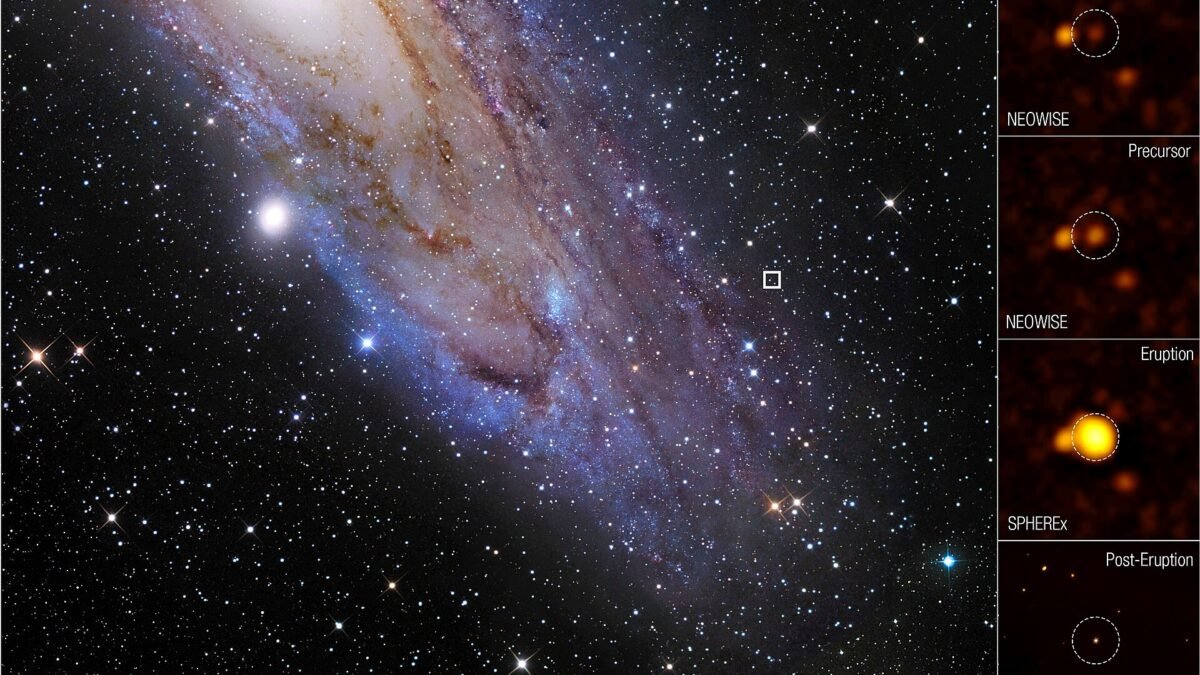
For the first time in the history of astronomy, scientists have watched a giant star swallow its smaller companion whole — from the first suspicious flicker, through a seven-year death spiral, to the brilliant eruption that marked the end of a two-star system. The event, nicknamed Bao, took place on the outskirts of the Andromeda galaxy, some 2.5 million light-years from Earth, and its story was published in the journal Nature on 18 November 2026, according to NASA.
What makes Bao extraordinary is not only what happened, but how it was seen. Astronomers almost never catch stellar mergers as they unfold, because the events are impossible to predict and over in a cosmic blink. This time, a team led by Viraj Karambelkar, a NASA Hubble Fellow at Columbia University in New York, spotted trouble brewing in 2023, kept watching, and was ready when the system finally exploded in October 2025. The James Webb Space Telescope then observed the wreckage just 47 days after the eruption peaked — the fastest follow-up of an event of this kind ever achieved.
“Stellar mergers are very, very difficult to observe in real time because they are hard to predict,” Karambelkar said in a statement released by NASA. “However, we noticed something unusual was going on in 2023 and continued to monitor the system to see what it would do. Then, in 2025, it erupted! Webb observed Bao only 47 days after the stars’ eruption peaked, the earliest ever follow-up of an event like this. The telescope’s data helped us characterize what the system looked like before, during, and immediately after the merger, which is absolutely mind-blowing.”
The result is a reconstruction of a stellar death that is, in the words of one independent astronomer, unusually complete. “We were able to see all different phases of this process — we were able to see the quiescent system, we were able to see the moment the stars touched each other, we were able to see the inspiral, and we were able to see the big outburst in 2025,” Karambelkar told New Scientist. “So we now know how this process works far better than we ever had before.”
A Seven-Year Spiral, Watched in Real Time
Before their transformation, the two stars had spent thousands of years circling each other in the calm manner of an ordinary binary pair. That long peace ended when the larger star swelled into its giant phase and its smaller companion drifted into its outer layers. From that first contact, the end came with startling speed: the pair completed only seven orbits — about seven years — before becoming one star. Other stellar mergers known to science, involving two smaller stars, took thousands of orbits to finish the same journey.
The system first drew attention in February 2023, when the team noticed an unusual variable star in data from NASA’s retired NEOWISE infrared mission. Records going back to 1989 showed that the object had shone at a steady brightness until 2018, when it began to brighten — the first sign that something inside the system was changing. By September 2024, the Wide-field Infrared Transient Explorer, known as WINTER, at Palomar Observatory in California showed that Bao was not only brightening but also throwing off dust. In July 2025, NASA’s SPHEREx mission happened to catch the star fading rapidly in visible light while growing brighter in infrared light during a routine sky survey — a classic signature of a star wrapping itself in dust.
Then came the eruption. On 17 October 2025, the Zwicky Transient Facility detected the stars rapidly brightening and heating up, and the outburst, formally catalogued as AT 2025abao, was under way. “One day, its brightness started rising and within a week, it peaked!” said co-author Nadia Blagorodnova, an associate professor at the University of Barcelona, according to NASA. The Himalayan Chandra Telescope in India captured visible-light spectra later that month, and in November 2025 the team received rapid observations from NASA’s now-retired Neil Gehrels Swift Observatory and from NOIRLab’s Gemini North telescope in Hawaii. Spain’s Gran Telescopio CANARIAS observed the source twice, a day after Webb’s visit and again in January 2026, while Gemini North kept watching from November 2025 through February 2026.
Webb’s own contribution came on 24 December 2025, when the telescope spent three hours studying the system with its mid-infrared instrument as part of a Director’s Discretionary Time programme — observing time set aside for urgent, unmissable events. It was the final piece of evidence the team needed. By matching Webb’s mid-infrared data, which traced dust shed by the giant star over centuries, against their computer simulations, the researchers concluded that the two stars had indeed merged.
The Two Stars: Big Bao and Little Bao
The modelling also gave astronomers their first estimate of the masses involved, and the contrast between the two partners could hardly be starker. Before the eruption, the primary star — nicknamed Big Bao — was seven times as massive as the Sun, about 350 times the Sun’s radius, and some 18,000 times brighter. “It was an absolute beast of a star, completely outshining its companion in the data,” said Karel Temmink, a doctoral student at Radboud University in the Netherlands who led the simulations, according to NASA.
Its companion, Little Bao, was a far more modest object: probably about 0.7 times the mass of the Sun, slightly smaller in radius and fainter — a star a little lighter than our own Sun, orbiting a bloated giant hundreds of times its size. The modelling showed there might have been leftover energy for Little Bao to escape the encounter. Further analysis determined that it did not. Dragged into Big Bao’s core, it was destroyed. “Their encounter was almost like a bomb exploding inside a living star,” said co-author Kishalay De, an assistant professor at Columbia University, according to NASA.
The eruption threw off roughly a tenth to a fifth of the Sun’s mass of material, according to reports on the study, and the merged star that remains has been nicknamed simply Bao — a single star that NASA describes as potentially “rejuvenated” by the merger. What that new star looks like today, and how its extra bulk settles, only future observations will reveal. For now, dust thrown off in the eruption hides the remnant from direct view, and it is likely to stay hidden for years.
How the Telescopes Caught It
The reason Bao could be reconstructed at all is that so many telescopes, in space and on the ground, happened to be looking — some by design, some by luck. NEOWISE supplied the long baseline, showing a steady star until 2018 and the first signs of trouble in 2023. WINTER caught the brightening and the dust in 2024. SPHEREx, scanning the sky on an unrelated survey, recorded the fade in visible light and the rise in infrared in July 2025. The Zwicky Transient Facility sounded the alarm when the eruption began. Swift, Gemini North, the Himalayan Chandra Telescope, the Gran Telescopio CANARIAS and NASA’s Infrared Telescope Facility all added pieces, in ultraviolet, visible, near-infrared and mid-infrared light — a large sweep of the electromagnetic spectrum.
The team had even published a first paper on the system just before it erupted in 2025, a measure of how closely they had been tracking it. That preparation is what turned a fleeting explosion into a dataset spanning decades: archival images reaching back to 1989, years of survey data, and a Webb observation taken before the dust from the eruption had time to destroy the older dust shed by the giant over centuries. It is that older dust, glowing in the mid-infrared, that let the simulations pin down what had happened.
What Webb Proved
Webb’s data did more than confirm a merger. It allowed the team to measure something astronomers had previously only estimated: how efficiently a common envelope event ejects mass. When a companion star plunges into a giant’s outer layers, the two end up sharing a single cloud of gas — the common envelope. Friction robs the companion of orbital energy, the envelope is heated and thrown off, and the stars either merge or emerge as a tight pair. How much energy goes into ejecting the gas, and how much is wasted, decides which outcome occurs, and until now that efficiency had never been measured directly from telescope data.
“While Webb’s data proved the stars merged, a merger wasn’t the only possible outcome for this system,” NASA’s account of the discovery notes. In other systems, both stars survive the process — shedding a great deal of mass along the way, but remaining independent in tight orbits. Over time, such surviving pairs can transform into neutron stars and black holes, explode as supernovae, produce ripples in space-time known as gravitational waves, and create millisecond pulsars. Whether a given pair merges or survives is one of the central questions in the study of how stars live and die, and Bao is the first case in which the answer was watched as it happened rather than deduced centuries or millennia after the fact.
The event belongs to a class of outbursts astronomers call luminous red novae — explosions thought to come from two stars merging, brighter than an ordinary nova but far dimmer than a supernova. The best-known earlier example, V1309 Scorpii, flared in 2008 and was later recognised as a stellar merger. Bao is the first luminous red nova to be followed from years before its eruption through the explosion itself and into its aftermath, with the full toolkit of modern astronomy brought to bear.
The One Open Question
For all the richness of the evidence, the story carries an honest caveat, and the researchers themselves have been open about it. The merger is an interpretation drawn from fitting models to the light of the system — the companion star was never seen directly, and the dust now hiding the remnant means the final state cannot yet be checked by looking at it.
A separate modelling study, accepted for publication in The Astrophysical Journal Letters, reaches a different conclusion about the same object, arguing that the companion may have survived the encounter and could still be orbiting inside the giant’s envelope. Karambelkar has said that a surviving tight pair cannot yet be ruled out, and independent astronomers quoted in coverage of the study agree that further observations will be needed to confirm conclusively what the merger left behind.
That uncertainty does not weaken the result so much as define it. The Columbia-led team’s case — the seven-year brightening, the dust, the eruption, and the Webb data matched by simulations — is the stronger one today, and it has passed peer review in Nature. But science at the frontier is often a matter of the best explanation available until the sky offers a better look, and Bao’s dust will keep its secret for a while yet. The disagreement is also a reminder of how the field works: a claim this large is tested immediately, in public, by rival teams with their own models, and the argument itself sharpens the science.
Why Astronomers Care: The Common Envelope
The common envelope phase is one of the most important and least observed chapters in the lives of stars. As stars age, many of them swell into giants, and any close companion can find itself swallowed by the expanding outer layers. The process decides the fate of binary systems across the universe: whether they merge into a single, rejuvenated star, or survive as a tight pair that may one day produce gravitational waves, a supernova, or a millisecond pulsar. New Scientist has reported that experts estimate nearly a third of all stars go through a common envelope phase at some point in their lives.
Yet common envelopes are notoriously hard to observe. They unfold over months to years, which is fast by astronomical standards, and at any given moment only a few stars in a galaxy are in this phase. Jason Nordhaus, an astrophysicist at the Rochester Institute of Technology who did not take part in the work, wrote in a commentary accompanying the Nature study that the brevity of the phase and the small number of systems passing through it at any one time are what make direct observations so rare. Bao is the first time astronomers have caught the whole sequence — the quiet system, the first contact, the spiral inward and the final outburst — in a single event.
That completeness is what gives the discovery its wider value. Reverse-engineering a merger that happened long ago means guessing at the starting conditions. Watching one happen means measuring them. The efficiency of mass ejection that Bao’s data yielded will now feed into the models astronomers use to predict how binary stars evolve, which pairs will merge and which will survive, and how often the universe should produce the gravitational-wave sources and exotic remnants that telescopes like the Laser Interferometer Gravitational-Wave Observatory now detect.
Analysis: Why Watching It Happen Matters
There is a temptation to treat Bao as a curiosity — a distant light show, pretty and remote. That would miss what the discovery actually changes. Astronomy is, for the most part, a science of aftermaths. Stars live for millions or billions of years, and the events that reshape them are over in moments; by the time anyone notices, the evidence is cold. The field has learned to work backwards, inferring vanished causes from present-day ruins, the way a detective reconstructs a crime from a cold scene. Bao is different. It is the rare case in which the detectives were already in the room, watching, when the crime happened — and then called in the most powerful telescope ever built less than seven weeks later.
That shift, from reconstruction to observation, is the real story here. The seven-year spiral is the detail that makes it possible. Other known mergers took thousands of orbits, which means their warning signs would have stretched across centuries — far too long for any human observing programme to follow. Bao’s companion fell inward in just seven orbits, fast enough that a team that noticed something odd in 2023 could still be watching, funded and ready, when the sky obliged in 2025. It was luck, but it was prepared luck: the team had been monitoring the system for two years before it erupted, and had a paper out before the explosion. Serendipity favoured the watchful, as it usually does in science.
The discovery also exposes something about the state of modern astronomy. No single telescope could have told this story. It took a retired infrared surveyor, a robotic transient hunter, a space telescope that happened to be scanning the right patch of sky, ground-based giants in Hawaii, India and the Canary Islands, and Webb, the flagship observatory, answering a call for urgent time. The result is a portrait assembled from a dozen instruments across the electromagnetic spectrum, each contributing a fragment no other could supply. That is how astronomy increasingly works: not as a series of lone discoveries by lone telescopes, but as a network that catches events together.
There is also a humility in the caveat that deserves attention. The rival model, the dust that hides the remnant, the admission that a surviving pair cannot yet be ruled out — these are not footnotes to be hurried past. They are the mechanism by which a spectacular claim earns its standing. A merger that ended in a single rejuvenated star is the best explanation of the evidence today; it is not yet the only explanation, and the researchers know it. The willingness to publish with that uncertainty stated openly, and to let rival teams test the conclusion in public, is precisely what separates a scientific result from a spectacle.
Finally, Bao arrives at a hinge moment for the field. NASA notes that the discovery comes just as the agency’s recently launched Nancy Grace Roman Space Telescope is about to begin vast, publicly available surveys of the sky, including a Galactic Bulge Time-Domain Survey that will yield huge numbers of new transient events. “There’s going to be a large influx of similar discoveries just ahead,” Karambelkar said, according to NASA. If Roman finds more systems like Bao — and astronomers expect it will — then the first observed stellar merger will soon have company, and the physics learned from this one event will be tested against many more. The next Bao may already be brightening, quietly, in some survey’s data, waiting for someone to notice.
What Happens Next
The immediate future of Bao is, for now, a waiting game. The dust thrown off by the eruption hides the remnant, and it will likely remain hidden for years, according to Science News. In the meantime, Karambelkar has said the team can work to catch more of these systems even before they erupt — the same strategy that made Bao possible in the first place: find the brightening stars, watch them, and be ready.
Further observations, once the dust clears, should settle the open question of whether the two stars truly merged into one or survived as a tight pair. Either answer would be valuable. A confirmed merger would validate the first direct measurement of common envelope efficiency; a surviving pair would show that even a plunge as violent as Bao’s can end in a binary, and would sharpen the models in a different direction. The sky, as ever, will have the last word — and this time, for once, astronomers were watching when it spoke.
Sources
- NASA — NASA Data Clinches First-of-Its-Kind Stellar Merger
- Nature — Karambelkar et al., “An inspiral of a star inside a common envelope with its giant companion”, Nature 659, 628–633 (2026)
- Columbia University — Columbia Researchers Spot First-of-Its-Kind Stellar Merger
- Smithsonian Magazine — For the First Time, Astronomers Witnessed a Giant Star Gobble Up Its Smaller Stellar Companion

About the Author — Abdul Mannan
Related Articles
Cryptography Trick Finds a Pulsar Spinning 261 Times a Second in 15 Years of NASA Fermi Data
A method borrowed from cryptography found the millisecond pulsar PSR J1622-7204 in 15 years of NASA Fermi data…
Japan’s Fugaku Supercomputer Breach Widens: 430 Stolen Keys Confirmed as RIKEN Treats 4,222 Users’ Data as Leaked
RIKEN confirms intruders stole 430 credentials — including 233 SSH private keys with no passphrase — from Japan's…

Astronomers Find a Triple Star System 28 Light-Years Away That ‘Should Not Exist’
Astronomers hunting for planets around a red dwarf 28 light-years away found a triple star system with two…