
Pakistan’s First Astronaut Heads Home as Shenzhou-23 Undocks from Tiangong Station

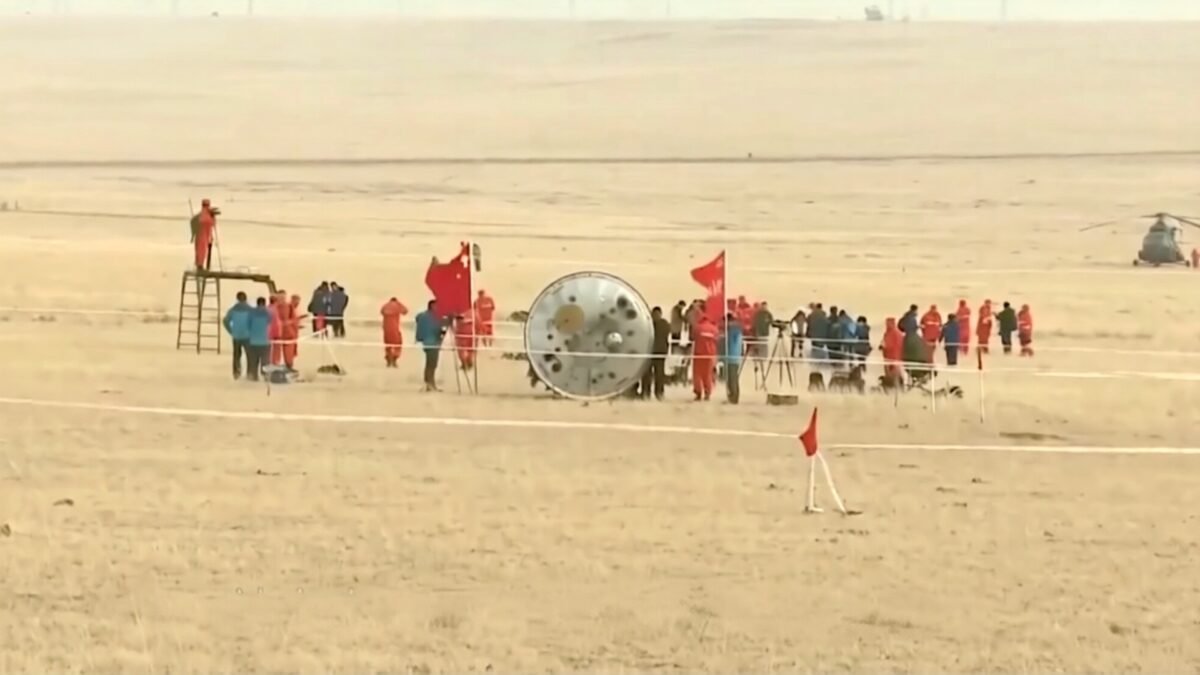
Pakistan’s first astronaut, Muhammad Zeeshan Ali, has begun his journey back to Earth after about five days aboard China’s Tiangong space station, closing a short but historic visit that made him the first foreign astronaut ever to set foot on the Chinese station. According to Reuters, citing China’s state news agency Xinhua, the Shenzhou-23 spacecraft carrying Ali and two Chinese astronauts undocked from Tiangong on Sunday at 11:42 p.m. Beijing time (8:42 p.m. Pakistan time) and began its return to Earth.
Ali is travelling home alongside Shenzhou-23 crew members Zhang Zhiyuan, who is commanding the return mission, and Lai Ka-ying, the first astronaut from Hong Kong and China’s fourth female space traveller. The return capsule was due to conduct a controlled re-entry and touch down at the Dongfeng Landing Site in Inner Mongolia, northern China, about five and a half hours after undocking, under China’s three-orbit autonomous fast-return profile. That put the expected landing at about 2 a.m. Pakistan time on Monday, 30 November. According to Pakistan’s space agency SUPARCO, whose mission dashboard was cited by Pakistani outlet FactFile, the landing was scheduled for 2:00 a.m. Pakistan time. Independent spaceflight analyst Andrew Jones, working from airspace closure notices, estimated a landing window of 21:06 to 21:36 UTC on Sunday, which corresponds to 2:06 to 2:36 a.m. Pakistan time on Monday.
Ali arrived at the station on 25 November aboard the Shenzhou-24 spacecraft, in a mission that Reuters described as China’s first crewed spaceflight with a foreign cosmonaut. Though his stay was much shorter than the roughly six-month rotation served by a Chinese astronaut, it has been cause for huge celebration in Pakistan, where his flight was followed closely from launch to docking and back.
As a payload specialist, Ali was tasked with four joint China-Pakistan experiments in life sciences and materials science while in orbit, according to Reuters. The science he carried out, however, will outlast his short stay. According to the Global Times, three of the four experiments will remain mounted outside the station for about a year: a graphene radiation-shield composite, a self-healing carbon-fibre composite, and 32 quinoa seed samples supplied by the University of Agriculture Faisalabad. Only a cyanobacteria experiment stays indoors, in the Wentian module’s life-ecology cabinet. The samples left outside will be exposed to the harsh environment of space for a full year before they are retrieved, and their condition will be compared with control samples kept on the ground.
The handover and the crew left behind
Before the return journey began, the Shenzhou-23 and Shenzhou-24 crews held an in-orbit handover ceremony aboard Tiangong on Saturday, 28 November, according to the China Manned Space Agency (CMSA). The ceremony, the ninth such in-orbit handover in China’s crewed space programme, formally transferred control of the station to the incoming crew. Xinhua reported that the returning astronauts had finished all their scheduled tasks and that the Dongfeng landing site and all the systems involved were completing final preparations to welcome them home.
Not everyone is coming home. Shenzhou-23 commander Zhu Yangzhu, who has already spent six months in orbit, will remain aboard Tiangong for another six months to complete China’s first year-long spaceflight experiment, serving alongside the Shenzhou-24 crew. It was Zhu’s seat that made Ali’s visit possible: the Pakistani astronaut flew up on Shenzhou-24 and is returning on the older Shenzhou-23 spacecraft, a seat swap that is standard practice during crew rotations on the station.
Zhu will now work alongside Shenzhou-24 commander Tang Hongbo, 51, and flight engineer Wu Yi, 39. Tang is one of China’s most experienced astronauts, having flown on Shenzhou-12 and Shenzhou-17, and he is the first astronaut to visit Tiangong three times. Wu Yi is on his first spaceflight. Together, the three will carry the station through the next phase of its operations, including the year-long experiments left behind by the Pakistani mission.
A five-day mission years in the making
Ali’s journey began on Tuesday, 25 November, when the Shenzhou-24 spacecraft lifted off from the Jiuquan Satellite Launch Center in the Gobi Desert atop a Long March-2F rocket at 8:18 a.m. Beijing time (5:18 a.m. Pakistan time). About three and a half hours later, the spacecraft docked with the front port of the Tianhe core module, the heart of the Tiangong station, after a rapid autonomous rendezvous.
The 40-year-old Pakistan Air Force Wing Commander was selected for the mission through a three-stage process agreed under a February 2025 agreement between the China Manned Space Agency and Pakistan’s Space and Upper Atmosphere Research Commission (SUPARCO). Ali and his backup, Khurram Dawood, arrived in Beijing in April for training at the Astronaut Center of China, where they studied the station’s systems, learned to work in Mandarin, and prepared for the experiments they would carry out. Halal space food was prepared for the mission, and Chinese and English manuals were used during training.
The four Pakistani experiments flown on the mission were selected by Chinese institutions from more than 300 proposals submitted through SUPARCO, covering biotechnology, food security and climate change research. One of them, a photosynthetic microorganisms experiment, was highlighted by Chinese state television. The programme was presented in both countries as a scientific partnership rather than a symbolic gesture: Pakistan supplied the research questions and the samples, and China supplied the ride, the laboratory and the training.
Back on the ground, the mission was followed at the highest level in Pakistan. Prime Minister Shehbaz Sharif and Field Marshal Asim Munir held a live video call with Ali from SUPARCO headquarters in Islamabad, with the Chinese ambassador present, according to TechTimes. At SUPARCO’s headquarters, crowds watched the launch on large screens, and the agency ran a public mission dashboard tracking the flight.
Why the return matters as much as the launch
A launch is a spectacle. A return is a test. For a crewed spaceflight, the journey home is the most dangerous part of the mission: the capsule must survive the heat of re-entry, deploy its parachutes at precisely the right moment, fire its braking rockets in the final seconds, and land upright in a remote desert, where recovery helicopters and ground teams must reach it quickly. China’s crewed programme has brought every Shenzhou crew home safely since Yang Liwei’s first flight in 2003, and the Shenzhou-23 return was expected to follow the same well-rehearsed pattern, with the Dongfeng site conducting its final full-system search, rescue and recovery drill in the days before the landing.
For Pakistan, the return closes the first chapter of a story that began decades ago. SUPARCO was founded in 1961, only four years after the Soviet Union launched Sputnik, and Pakistan launched its first satellite, Badr-1, in 1990. But for most of that history the country’s space programme worked at a remove from human spaceflight. In May 2024, Pakistan’s ICUBE-Q lunar CubeSat rode to the Moon aboard China’s Chang’e-6 mission, and in October 2023 Namira Salim became the first Pakistani to reach space, travelling 87.4 kilometres above Earth on a Virgin Galactic suborbital flight. Ali’s flight is different from both: he is the first Pakistani to enter Earth orbit, and the first to live and work aboard a space station.
The distinction matters. A suborbital hop lasts minutes. A five-day stay on a station means living in microgravity, running experiments, following a work schedule set by mission control, and handing over to the next crew. It is a small taste of what a working space programme looks like, and it is the experience Pakistan would need to build on if it ever wants a longer presence in orbit.
Analysis: What Pakistan gains, and what it still lacks
The most important question about Ali’s flight is not whether it happened — it did, and it was executed cleanly — but what Pakistan does with it next. A five-day visiting mission is, by design, a beginning, not an end. The science carried on the flight was real but modest: four experiments, three of which will spend a year exposed to space before anyone can read the results. The deeper value lies elsewhere, in the training, the institutional links and the precedent.
Consider what the mission required of Pakistan. SUPARCO had to select and prepare candidates, design experiments that could survive launch and work in orbit, and coordinate with Chinese mission control in real time. Ali had to learn to operate in Mandarin, live aboard a foreign station, and carry out a scientific programme designed jointly by two countries. Those are capabilities that do not expire when the capsule lands. They sit inside SUPARCO now, and they can be used again — if the funding and the political will follow.
That is the open question. Pakistan has no independent launch vehicle and no crewed spacecraft of its own, and it will not have either in the near future. Every future Pakistani astronaut will, for now, have to fly on someone else’s rocket. The February 2025 agreement with China gives Pakistan a route into orbit, but the terms of that route — how often Pakistanis fly, how long they stay, who owns the data from the experiments, and how much of the science is done in Pakistan — are not public. According to the Global Times, the samples left outside Tiangong will be imaged in orbit and retrieved after a year, but it has not been made public whether Pakistan will receive raw data or only summarised results. For a country investing in a space programme, that distinction is the difference between building knowledge and borrowing prestige.
There is also the question of who flies next. Khurram Dawood trained alongside Ali as his backup, and he is the obvious candidate for a second flight. A longer mission — a full six-month rotation, rather than a five-day visit — would be the natural next step, and it would let a Pakistani astronaut take part in the station’s regular scientific programme rather than a short, pre-packaged set of experiments. Nothing has been announced, and nothing should be assumed. But the logic of the programme points in that direction: China has now shown it can host a foreign astronaut, and Pakistan has now shown it can produce one.
Why It Matters: China’s open door, and the politics of who gets in
For China, Ali’s flight is a milestone of a different kind. Tiangong was built after China was effectively excluded from the International Space Station, and Beijing has presented it from the start as a station open to the world. Ali is the first foreign astronaut to visit it, and his flight is the proof of that promise. The choice of Pakistan as the first partner was not accidental: the two countries describe their relationship as an “all-weather” partnership, and the space agreement sits alongside deep cooperation in defence, infrastructure and technology.
The timing is also significant. The Shenzhou-23 return comes as the United States and China compete openly over the future of human spaceflight, with Washington’s Artemis programme aiming to return astronauts to the Moon and Beijing laying out its own plan to land astronauts on the Moon before 2030. In that contest, the ability to bring partners along matters. The International Space Station has hosted astronauts from dozens of countries; Tiangong, until last week, had hosted only Chinese citizens. Ali’s flight begins to change that balance, and other countries will be watching to see who follows.
There is a narrower point, too. The Shenzhou-23 mission is the eleventh crewed mission to Tiangong, and the Shenzhou-24 flight was the 41st flight mission of China’s crewed space programme. Twenty-seven Chinese astronauts from eleven crews have visited the station. The programme’s record is one of steady, incremental expansion: a station assembled piece by piece, crews rotated every six months, and now, for the first time, a foreign guest. The year-long stay that Zhu Yangzhu is now undertaking is another step in the same direction, testing whether the station and its crews can sustain the longer missions that a lunar programme will demand.
For Pakistan’s public, the flight has already done something no policy paper could: it has put a Pakistani face on a story about science and national capability, at a time when the country’s news is dominated by politics and economic strain. The images of Ali waving before launch, and of the two crews meeting aboard Tiangong, were carried widely in Pakistan. The return, in the early hours of a Monday morning, will be watched in the same spirit. The test will be whether the attention survives the landing, and whether the mission becomes the start of a programme rather than a single celebrated week.
What to watch next
The immediate next step is the landing itself, and the first images of the three astronauts emerging from the capsule at Dongfeng. After that, Ali’s return to Pakistan will be the next public moment, and it will be worth watching what he says about the mission and what role he is given afterwards. A trained astronaut with orbital experience is a rare national asset, and the way Pakistan uses him — in public engagement, in training, or in planning the next flight — will say a lot about how seriously the programme is taken.
The science will take longer. The graphene, carbon-fibre and quinoa samples left outside Tiangong will not be retrieved for about a year, and their results will arrive later still. The cyanobacteria experiment, conducted inside the station, may produce results sooner. When they come, they should be judged on their scientific merit, not on the flag attached to them.
Longer term, the questions are structural. Will Pakistan negotiate a second flight, and will it be longer than five days? Will Dawood, or another candidate, get the chance Ali had? Will Pakistan invest in the ground infrastructure — experiment design, data analysis, astronaut training — that would let it contribute more than samples and a passenger? And will China open Tiangong to astronauts from other countries, making Ali the first of many foreign visitors rather than a one-off gesture to a close ally?
For now, the mission’s arc is complete in outline: a Pakistani astronaut went to space, lived and worked aboard a station, and came home. The capsule’s return to the Inner Mongolian desert closes the flight. What it opens is a question Pakistan will have to answer for itself.
Sources
- Reuters — China’s Shenzhou-23 spacecraft carrying Pakistani astronaut begins journey back to earth
- Xinhua via People’s Daily Online — Shenzhou-23, Shenzhou-24 astronauts complete in-orbit handover
- SpacePolicyOnline — Shenzhou-23 returns with Pakistani astronaut (landing window estimate)
- TechTimes — Pakistan’s Zeeshan Ali leaves Tiangong soon; three of four experiments stay outside one year
- FactFile — Pakistani astronaut return confirmed for November 30 (SUPARCO mission schedule)

About the Author — Abdul Mannan
Related Articles
Hera Reveals Stadium-Sized Crater on Asteroid Dimorphos Left by NASA’s DART Impact
Four years after a NASA spacecraft deliberately slammed into a small asteroid to test whether humanity could push…
ESO Warns a Million SpaceX Satellites Would Fundamentally Alter the Night Sky for Everyone
The European Southern Observatory says the FCC's approval of one million SpaceX data-centre satellites would fundamentally alter the…
Los Angeles Just Told Google: Our Children Are Not Your Product
Los Angeles Unified quietly switched off Google's AI Overview on school devices, becoming the largest district in America…