
Hera Reveals Stadium-Sized Crater on Asteroid Dimorphos Left by NASA’s DART Impact

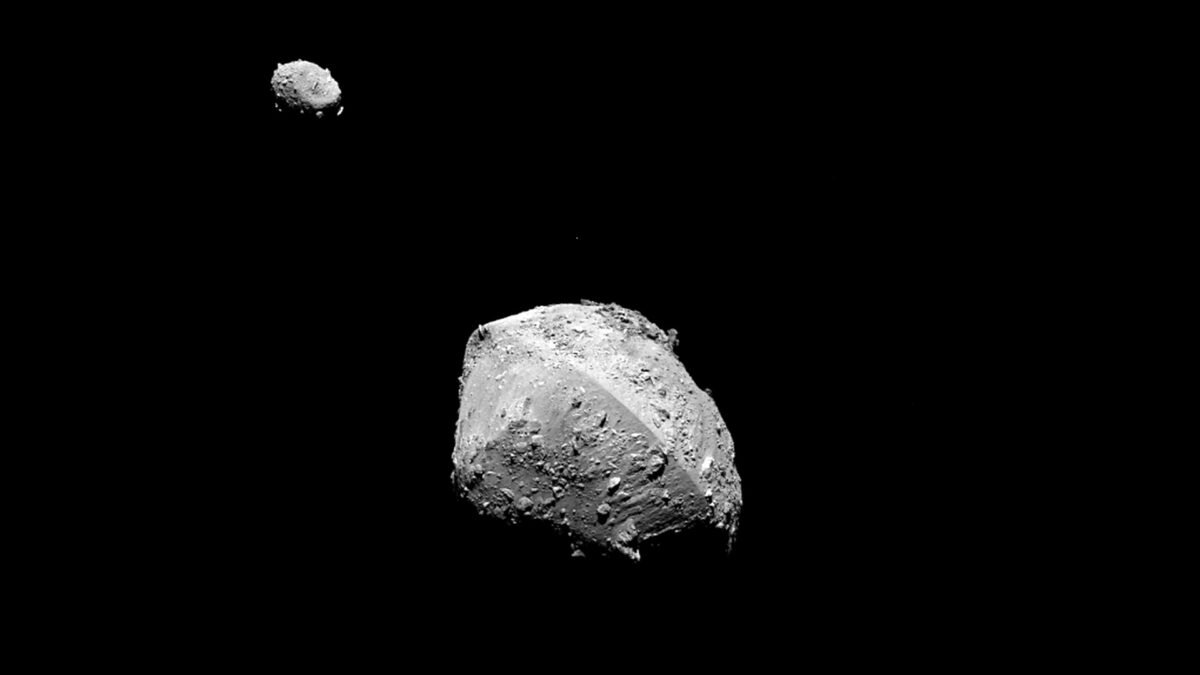
Four years after a NASA spacecraft deliberately slammed into a small asteroid to test whether humanity could push a dangerous space rock off course, the European Space Agency has finally shown the world what the blow did. The pictures, released on 25 November 2026, reveal a battered little world that no longer looks or moves the way it did before the impact: one whole face has been flattened into a crater the size of a sports stadium, the asteroid is tumbling chaotically through space, and it is surrounded by hundreds of boulders that nobody expected to find there.
The images come from ESA’s Hera spacecraft, which arrived at the asteroid pair in early November after a journey of more than two years. They were unveiled at a press briefing in the dinosaur hall of Berlin’s Museum für Naturkunde, a setting the mission team chose deliberately, as ESA’s Hera mission manager Ian Carnelli explained, because an asteroid impact 66 million years ago changed the course of life on Earth. “Today, for the first time in history, humanity is validating how to prevent such an event from happening again,” he said, according to ESA.
The target of the experiment is Dimorphos, a moonlet about 150 metres across that orbits a larger asteroid, Didymos, roughly 730 metres wide. On 26 September 2022, NASA’s DART spacecraft — the Double Asteroid Redirection Test — struck Dimorphos head-on at more than 22,000 kilometres per hour. Telescopes on Earth quickly measured the result: the moonlet’s orbit around Didymos had shortened by 33 minutes, far more than the roughly ten minutes scientists had predicted. But until Hera arrived, nobody knew what the impact had actually done to the asteroid itself. Now, for the first time, scientists can see the damage up close.
“Scientists debated whether Dimorphos had sustained an impact crater, changed its shape or stayed the same,” said Hera principal investigator Patrick Michel, director of research at CNRS and the Observatoire de la Côte d’Azur, in a statement released by ESA. “Much to our surprise the answer turns out to be all three at once! The face struck by DART has been flattened into an impact crater the size of a sports stadium, which extends across the asteroid’s entire width.”
A crater as wide as the asteroid itself
The headline image from Hera’s Asteroid Framing Camera, taken on 7 November 2026 from a distance of 29 kilometres, shows Dimorphos in orbit around Didymos with the wound from the 2022 impact plainly visible. Where DART’s camera had photographed a rounded, rugby-ball-shaped face covered in boulders shortly before impact, Hera now sees a vast hollow scooped out of the moonlet, so wide that it spans almost the whole side that was struck. Inside the crater, scientists can make out striking structures, including an elongated, cigar-shaped feature near its centre and a central mound, although the current image resolution of about three metres per pixel leaves the finer details unclear for now.
“What DART saw was a rounded face, but now, where that rounded face was, well, it’s a big crater,” said Sabina Raducan, a planetary scientist at the International Space Science Institute in Bern and the Free University of Brussels, at the Berlin briefing, according to Sky & Telescope. “It’s a big crater that is almost as large as the body itself, which is really, really spectacular.” Raducan, who studies impact cratering, added: “It’s hard to describe in words all the excitement to actually finally see what happened. And, as a cratering person, I can also say it’s beautiful.”
The rest of Dimorphos, by contrast, looks much as it did before. The boulder fields covering the regions that DART did not strike appear unchanged in Hera’s images, and the larger asteroid Didymos seems untouched by the whole affair: its boulder fields and the pronounced ridge running along its equator look just as they did in 2022. The damage, in other words, is concentrated exactly where the spacecraft hit — but it is far more extensive than many researchers had dared to hope or fear.
The comparison images released alongside the new photographs make the transformation stark. On the left, DART’s final view of Dimorphos moments before impact; on the right, Hera’s recent view from a similar angle. The rounded moonlet has, in effect, had a slice taken out of it. As Raducan put it to The New York Times, according to a report carried by Donga Science: “It just looked like a lump. But it was a lump with a piece missing.”
Dimorphos is now tumbling wildly
The second great surprise is what the impact did to the way Dimorphos moves. Before DART arrived, the moonlet rotated in step with its orbit, turning exactly once per revolution so that the same long axis always pointed towards Didymos — the same kind of tidally locked arrangement that keeps one face of our own Moon permanently turned towards Earth. That orderly arrangement is gone.
“In addition, as Hera returned more images, it became clear that the DART impact has left Dimorphos tumbling wildly in its orbit,” said Michael Kueppers, ESA’s Hera mission scientist, according to ESA. Raducan described the motion in vivid terms at the briefing: “Now [the rotation] is very chaotic — we call it ‘tumbling.’ Just imagine … a barrel that you throw down the stairs … basically that’s what Dimorphos does right now around Didymos, just rolling.”
The tumbling complicates Hera’s work, because the science team cannot yet predict which face of the moonlet will be turned towards the spacecraft when it takes a photograph. But the scientists insist they do not mind. “First of all, the fact that it’s tumbling is amazing,” Raducan said, according to Sky & Telescope. “It actually helps because you get to see every side of it, regardless of what the trajectory of Hera is.” Over the coming months, as Hera moves closer, the team expects to build up a complete picture of the reshaped moonlet from every angle.
The chaotic spin is itself an important scientific result. It shows that a kinetic impact — the technical term for ramming a spacecraft into an asteroid — does far more than nudge the target’s orbit. It can fundamentally change the target’s rotation, and that matters for anyone trying to predict where a deflected asteroid will go. A tumbling body responds differently to sunlight and gravity than a steadily rotating one, and those small differences add up over years of travel through space. Understanding them is part of what Hera was sent to do.
Hundreds of unexpected boulders
The third surprise, and perhaps the most startling of all, is that Dimorphos and Didymos are no longer alone. Hera has found the binary pair surrounded by hundreds of previously unknown boulders, each a few metres across, drifting in orbit around the two asteroids. A composite image assembled from eleven long-exposure photographs taken by Hera’s HyperScout-H instrument on 3 November shows their paths as dotted trails circling the pair, with the asteroids themselves removed from the frame to make the swarm easier to see.
“So we have the approximately 700-metre asteroid in the middle, the 150-metre asteroid Dimorphos, and now over 100 football-sized to washing-machine-sized boulders in that same space,” said Naomi Murdoch, a Hera team scientist at the Institut Supérieur de l’Aéronautique et de l’Espace in France, at the Berlin briefing, according to Sky & Telescope. “We changed how Dimorphos looks, we changed how Dimorphos moves, and we observed for the first time lots of new companions in the system that we weren’t expecting,” she added, summarising the mission’s findings so far.
The obvious explanation is that the boulders are debris thrown off Dimorphos by the DART impact, some of which escaped into space — Earth-based telescopes watched a plume of ejected material stream away from the asteroid like a comet’s tail in the days after the collision — while some fell back onto the surface and some settled into orbit around the pair. But the scientists are careful not to claim more than the evidence supports. Some of the boulders may have been orbiting the pair all along, unnoticed, because DART swept past too fast to see them. “DART was moving very, very fast, six kilometres a second. We only see [the boulders] in multiple images and long exposures. So we’ll probably never know!” Raducan said, according to Sky & Telescope. Others may have been knocked off Didymos itself by secondary impacts of Dimorphos debris.
Whatever their origin, the boulders are a practical problem as well as a scientific bonus. Hera and its two small companion spacecraft will be flying through the swarm in the coming months, and a collision with a rock several metres across could damage or destroy a spacecraft. “That was really a big shock,” said Heli Greus, ESA’s Hera product assurance and safety manager, according to Sky & Telescope. “Nobody expected this … because of course we believed the scientists who tell us it’s just two rocks.” Her remark drew laughter from the scientists on the panel. “It wasn’t just two rocks, and of course now we know that there are these big rocks, smaller and bigger ones, which actually could be dangerous for Hera and also for the CubeSats.”
The CubeSats face the greatest risk. Their planned flight paths pass about two to three kilometres from the asteroid pair, while the boulder swarm spreads out to seven or ten kilometres. “These rings of asteroids or boulders spread out to 7 or 10 kilometers. So we are right in the middle of it,” said Claudia Balossi, the Juventas CubeSat system engineer, according to Sky & Telescope. The team says it planned for the unexpected, and the CubeSats’ trajectories can be adjusted as mission control learns more about where the boulders are.
What Hera does next
The images released on 25 November are only the beginning of Hera’s investigation, not its conclusion. The spacecraft, about the size of a small car, is currently flying about 25 to 30 kilometres from the two asteroids, using its thrusters to hold rectangular orbits around them at an average speed of just 12 centimetres per second — slower than a person walks. From that distance, its Asteroid Framing Camera resolves details down to about three metres per pixel.
In December, Hera is scheduled to close in to around 13 kilometres from the pair, returning progressively sharper images and making the measurements needed to calculate Dimorphos’s mass. That number is the missing piece of the DART experiment: knowing the mass will let scientists work out exactly how efficiently the impact transferred its momentum to the asteroid, and therefore how big a spacecraft — or how many — would be needed to deflect a real threat of a given size.
In January 2027, Hera plans to release its two shoebox-sized CubeSats. The Luxembourg-led Juventas carries the smallest radar instrument ever flown in space and will probe the interior of Dimorphos for the first time, before eventually attempting a landing on the asteroid. The Italian-led Milani will prospect the asteroids’ surface materials and the dust around them. Working together, the three spacecraft will form a pioneering exploration system around two asteroids, gathering complementary measurements of the DART impact’s aftermath.
Hera carries three instruments of its own for the survey: the monochrome Asteroid Framing Camera, which took the headline images; HyperScout-H, a hyperspectral camera that observes in 25 separate colours at once and maps the composition of the asteroids’ surfaces; and the Thermal Infrared Imager, known as TIRI, supplied by the Japanese space agency JAXA, which measures surface temperatures. Together they will map the crater and both asteroids in detail, down to a resolution of ten centimetres in the closest passes, and build three-dimensional models of how the impact reshaped Dimorphos.
The mission is a substantial European undertaking. Hera cost about €360 million, according to Physics World, and was built by a consortium of 18 ESA member states led by OHB in Bremen, Germany. Germany is the largest financial contributor, providing about €130 million — roughly 37 per cent of the total — according to the German Aerospace Center, DLR, which also leads the science team for the Asteroid Framing Camera. Hera was launched on 7 October 2024 from Cape Canaveral in Florida, and it reached its target in early November 2026 after a journey of just over two years. ESA announced the first glimpse of the asteroid system on 5 November, and unveiled the detailed images three weeks later.
Why the DART test mattered
To understand why so much effort and money has gone into studying a 150-metre rock nearly 200 million kilometres from Earth, it helps to remember what asteroids have done to this planet before. The most famous example is the Chicxulub impact 66 million years ago, when an asteroid up to 15 kilometres across struck what is now Mexico and brought the age of the dinosaurs to an end. That is the catastrophe planetary defence exists to prevent.
Smaller impacts are far more common and still dangerous. On 15 February 2013, an asteroid about 20 metres across entered the atmosphere near the Russian city of Chelyabinsk. Most of it vaporised, but the shockwave from its breakup at an altitude of about 30 kilometres shattered windows across the region and injured roughly 1,500 people, according to DLR. Objects of that size arrive with little or no warning, and astronomers are still cataloguing the population of near-Earth objects: more than 42,000 are currently known, and fortunately none of them is on a collision course with Earth, according to DLR. But new ones are discovered all the time, and the inventory of the smallest, hardest-to-spot objects is far from complete.
That is the gap DART and Hera are designed to close. The two missions form the Asteroid Impact and Deflection Assessment, a joint NASA–ESA collaboration. NASA’s part was to prove that a spacecraft impact could change an asteroid’s orbit. ESA’s part is to find out precisely what the impact did, so that the technique can be turned from a one-off demonstration into a reliable tool. As Ian Carnelli put it, according to ESA: “NASA’s DART mission demonstrated that we can change an asteroid’s orbit. Hera is now revealing what happened to the asteroid itself. By combining these two missions, humanity is taking a decisive step towards making asteroid deflection a reliable tool for protecting our planet.”
ESA’s director-general, Josef Aschbacher, described the effort as “international collaboration at its best”, according to ESA, with NASA demonstrating the deflection and ESA providing the detailed scientific investigation, alongside contributions from international partners including Japan’s JAXA. “Together, we are transforming a successful experiment into the scientific knowledge needed to develop a reliable planetary defence capability,” he said. “Hera demonstrates Europe’s contribution to an endeavour that ultimately benefits all of humankind.”
The work does not stop with Dimorphos. ESA is also developing a mission called Ramses, in cooperation with JAXA, to investigate the asteroid Apophis during its exceptionally close — but entirely safe — flyby of Earth on Friday 13 April 2029. Apophis, about 350 metres across, will pass roughly 32,000 kilometres above Earth’s surface, closer than satellites in geostationary orbit, and the gravitational forces of the encounter may alter its rotation, surface or internal structure. Ramses will watch those effects from nearby. “Hera is helping us understand the consequences of deliberately striking an asteroid,” said Holger Krag, head of ESA’s Space Safety programme, according to ESA. “Ramses will investigate how an asteroid responds to the gravitational influence of a planet. Together, these missions will significantly expand the scientific knowledge available to planetary defence.”
Analysis: Why It Matters
The first thing to grasp about the Hera images is that they answer a question that has hung over planetary defence since the night DART struck Dimorphos: did we move an asteroid, or did we merely break one? The orbital change measured from Earth in 2022 — 33 minutes, three times the predicted shift — was encouraging, but it was also ambiguous. A spacecraft that buries itself in a loosely packed rubble pile and throws off a huge cloud of debris can produce a large orbital shift without leaving a neat crater, and the physics of that process is much harder to model than a clean impact on solid rock. What Hera has now shown is that the truth is messier and more interesting than either simple picture: DART carved a genuine, stadium-sized crater, flattened a whole face of the moonlet, and yet left the rest of the body largely untouched. The asteroid is simultaneously transformed and intact, which is exactly the phrase Patrick Michel used — all three outcomes at once.
That matters because the next time humanity needs this technique, there will be no dress rehearsal. A real deflection mission will have one shot, against an asteroid whose internal structure is unknown, and the people running it will have to decide how much warning time they need, how heavy the impactor must be, and how many spacecraft to send. Every one of those decisions depends on a number called the momentum enhancement factor — essentially, how much extra push an impact gets from the debris it throws off. Hera’s measurement of Dimorphos’s mass, combined with the size of the crater and the volume of ejected material, will pin that number down for the first time on a real asteroid rather than in a computer simulation or a laboratory experiment. If the factor turns out to be large, smaller and cheaper impactors could do the job; if it is small, deflection missions will need to be bigger, earlier, or both. Either answer is valuable, but only a mission like Hera can provide it.
The tumbling is the second reason these images matter beyond their drama. A moonlet that once turned serenely in step with its orbit now rolls chaotically, like a barrel thrown down a flight of stairs. That is not a curiosity; it is a warning about the limits of prediction. Planetary defence is ultimately an exercise in forecasting: astronomers find a threatening asteroid years in advance, calculate its orbit, and work out how much to change it so that it misses Earth. Those calculations assume the target behaves in a reasonably predictable way. A body that tumbles unpredictably responds to sunlight unevenly, and over years that uneven push can shift its path by more than the deflection itself. The lesson of Dimorphos is that changing an asteroid’s orbit also changes its rotation, and future deflection plans will have to account for that coupling rather than treating the asteroid as a passive billiard ball.
The boulder swarm carries a third lesson, and it cuts in two directions. On the scientific side, it is a gift: more than a hundred new objects to study, each a fragment of Dimorphos’s interior now flying free, offering clues about what the moonlet is made of and how it is put together. On the operational side, it is a hazard that nobody planned for. The fact that experienced mission planners were surprised — “nobody expected this,” as the mission’s own safety manager admitted — is a reminder that the space around a freshly struck asteroid is a debris field, not empty sky. Any future mission that follows an impactor to the same target, whether to observe the result or to strike again, will have to fly through that field. Hera is learning, in real time, how to navigate it, and the CubeSats’ adjusted trajectories will be the first test of debris-aware flight planning around an asteroid. That knowledge will be part of the mission’s legacy just as surely as the crater measurements.
There is also a wider, quieter point to take from the week’s events. The DART–Hera story is one of the few large scientific enterprises of recent years that has unfolded exactly as its planners intended, across two space agencies, three continents and four years, without a crisis or a scandal. NASA hit the target; ESA arrived on schedule and sent back the pictures; Japan contributed an instrument; eighteen European countries built the spacecraft. In a period when international cooperation in space is under strain from geopolitical rivalry and budget pressure, a €360 million mission that does precisely what it promised is worth noting. It is also worth noting what it cost in context: roughly the price of a single large passenger aircraft, spent over several years, to answer a question about whether humanity can protect itself from a threat that has already ended one dominant form of life on this planet.
Finally, the images carry a value that no measurement can capture. For four years, the DART impact existed mostly as numbers — a 33-minute orbital change, a plume of dust seen through telescopes, a point of light that dimmed and brightened. Now it exists as a place: a grey, battered moonlet with a flattened face, tumbling slowly around its companion against the blackness, trailed by a swarm of rocks it never had before. That is what a planetary defence test looks like when you go and look at it. The next steps are unglamorous but essential: closer approaches, mass measurements, radar soundings of the interior, and the careful, patient work of turning pictures into numbers that engineers can trust. If that work succeeds, the next time astronomers find an asteroid on a collision course with Earth, humanity will not be guessing about what to do. It will know — because a small spacecraft once flew 200 million kilometres to check.
What to watch next is straightforward. In December, Hera will close to about 13 kilometres from the asteroid pair, and the images should sharpen from three metres per pixel to about one, revealing the crater’s interior structure in far greater detail. In January 2027, the Juventas and Milani CubeSats will separate and begin their own close approaches, with Juventas eventually attempting to land on Dimorphos and sound its interior with radar. Each step will refine the picture of what DART did — and each step will be watched closely by the scientists who may one day have to do it for real.
Sources
- European Space Agency — “Hera reveals stadium-sized asteroid crater from spacecraft impact” (25 November 2026)
- German Aerospace Center (DLR) — “Asteroid defence – Hera spacecraft reaches its destination” (25 November 2026)
- Sky & Telescope — “Hera’s Images of Smashed Asteroid Moon Dimorphos, Unveiled” (25 November 2026)
- CNN — “New images reveal stadium-size crater left by humanity’s first planetary defense test” (25 November 2026)
- Physics World — “Close-up images reveal giant DART impact crater on asteroid Dimorphos” (25 November 2026)

About the Author — Abdul Mannan
Related Articles
ESO Warns a Million SpaceX Satellites Would Fundamentally Alter the Night Sky for Everyone
The European Southern Observatory says the FCC's approval of one million SpaceX data-centre satellites would fundamentally alter the…
Los Angeles Just Told Google: Our Children Are Not Your Product
Los Angeles Unified quietly switched off Google's AI Overview on school devices, becoming the largest district in America…

Africa’s Coastal Cities Are Sinking, Satellites Reveal — Seven Million People at Flood Risk by 2050
Satellite radar shows Africa's coastal cities are sinking faster than global models assumed, putting more than seven million…