
The Day Wall Street Tried to Buy the Future: Anthropic’s IPO and the $158 Billion Answer

What does it cost to buy the future? On Monday, 26 October 2026, the world got a down payment on the answer. Anthropic, the artificial intelligence laboratory behind the Claude models, made public its filing for an initial public offering in the United States. Within hours, Meta Platforms announced plans to raise up to $95 billion — its largest-ever equity fundraising, Reuters said. Before the day was out, four of the biggest names in finance had lined up $63 billion to buy computer chips and lease them to Anthropic. Add a roughly $40 billion equipment deal at SpaceX, and one Monday carried close to $200 billion of promises about a future that does not exist yet.
Stop for a moment and let that sit with you. One company files a document, and before the ink is dry, the richest institutions on earth are racing to hand it the keys to the kingdom. Why is everyone so afraid of being left behind? I know this feeling. It is not greed alone — greed is too small a word for it. It is the terror of irrelevance, the fear that history is being written in a room you were not invited into. I read the filing the way you would read a letter from a stranger who wants to borrow your life savings: slowly, twice, with my eyes on the small print. What I found is a real business, growing at a speed that would have been science fiction five years ago, attached to a bill so large that only the future itself could pay it.
What the Filing Actually Says
Let us begin with the facts, because in a week like this one, facts are the first casualty. Anthropic was founded in 2021 by former OpenAI researchers, including the brother and sister Dario and Daniela Amodei. Its Claude models power a chatbot, a coding agent and an enterprise product called Claude Cowork. Its early bet was shrewd: it trained its models to be unusually good at writing computer code, and businesses, which will pay almost anything for a machine that writes code reliably, came running.
The numbers are, by any ordinary standard, astonishing. Revenue was $41 million in 2023. It reached $386 million the following year. In 2025 it was $4.59 billion. And in the first six months of 2026 alone, Anthropic took in $16.29 billion, mostly from businesses paying per use, per “token” of information processed, plus subscriptions with names like Pro and Max. Reuters reported that in the week ended 11 October, Anthropic accounted for 60.1% of AI token spending captured by the data firm Ramp. It is not a rumour. People are paying, heavily, to use what it builds.
And yet — keep both eyes open here, reader — the same filing shows an operating loss of $693 million for those six months, after $8.06 billion in 2025 and $2.98 billion the year before. Computing power is the biggest expense: cloud fees, data centres, equipment leases, energy bills. Over three years, Reuters noted, compute and infrastructure expenses have dwarfed revenue.
Then comes the figure that should make us all sit up. Anthropic has committed more than $500 billion in spending with six partners over a decade — one of the largest buildout commitments on record: at least $110 billion to Amazon, about $114.5 billion to Google and $44.9 billion to Microsoft for cloud computing over seven to ten years. Many portions are non-cancellable, or require payment regardless of usage. Regardless of usage. This is not a company renting month to month. It has signed a mortgage on a city it has not yet built. And note who holds the pen: Amazon and Google are not merely suppliers but among Anthropic’s largest shareholders — Amazon has invested at least $13 billion (up to $20 billion more agreed) and Google has committed up to $40 billion. The customer is the supplier; the supplier is the owner. Hold that circle in mind; it is the hinge of this story.
The filing is unusually candid about its risks: Anthropic paused training of a next-generation flagship model for more than a month over security concerns, four of its AI agents accessed live external computer systems during testing, and it devotes some 94 pages to risk factors. It also tells you who keeps the steering wheel: Anthropic is a public benefit corporation, and a single share of Class F stock — directed by a majority vote of its seven co-founders — will carry 50.1% of the voting power over key corporate matters. Principled or arrogant, you should know it before you admire the view.
The Money That Arrived on the Same Day
Now look at what happened around the filing, because the market’s answer was louder than the filing itself. Meta launched public offerings of about $35 billion in common and convertible preferred stock, and filed a separate programme to sell up to $60 billion of non-voting shares — up to $95 billion in all, to finance its own artificial intelligence expansion. And Bank of America, Blackstone, Citigroup and Morgan Stanley agreed to provide $63 billion, through a new special purpose vehicle, to buy Broadcom’s AI accelerators and lease them to Anthropic. Broadcom is providing “residual value support” to the lenders — standing behind the value of the very chips it is selling.
On Tuesday the market applauded: South Korea’s KOSPI up more than 4%, Japan’s Nikkei up 1.9%, the broad Asia-Pacific index up 1.2%, the Philadelphia Semiconductor Index up 2.8% overnight, according to Reuters. More than a third of S&P 500 companies report earnings this week, including Alphabet, Microsoft and Amazon. The applause arrived before the examination results. As for Anthropic’s price tag, reports put a possible valuation between $1.5 trillion and $2 trillion — with Reuters reporting some investors now valuing it at about $1.5 trillion, down from roughly $2 trillion a week earlier. Half a trillion dollars of opinion, revised in seven days.
I Have Seen This Film Before — and That Is the Point
Here I must speak as a student of history, because history is the mirror in which the present recognises itself. Three centuries ago, a trading company arrived with ledgers, ships and polite requests to trade. The East India Company did not conquer with an army on its first day; it conquered with contracts and credit, with the slow logic of “we are only here to do business” — until the company was the government. I do not say Anthropic is an East India Company. I say every age produces institutions that arrive as servants and stay as masters, and the wise citizen asks early who will hold the keys.
Then came the dot-com boom. Encyclopaedia Britannica records how investors, convinced the economy had been transformed, poured money even into debt-ridden companies with no realistic hope of profit — what Alan Greenspan called “irrational exuberance.” When the Federal Reserve raised rates modestly in early 2000, panic began. Between March 2000 and October 2002, the Nasdaq fell from 5,048 to 1,139. Most dot-com companies failed. And yet the internet did not fail. The future arrived — it simply refused to arrive on the schedule, or at the prices, the believers had paid for. The railway mania of the 1840s had taught the same lesson a century and a half earlier: the lines that survived remade the world, and the ones that were never built ruined their believers.
Every genuine revolution is first financed by a beautiful exaggeration. Then the bill arrives, and it does not care about your enthusiasm. Anthropic’s filing is that bill, presented early and in public — candour to the company’s credit. Whether the market’s applause deserves the same credit is another question.
The Circle That Must Not Close
Now let me return to the circle, because the International Monetary Fund returned to it too, and when the Fund speaks in this tone, the prudent listen. In its Global Financial Stability Report of October 2026, the IMF named an AI market correction as one of three “salient risks” to global financial stability. Its warning: weaker AI investment and profitability “could lead to a correction in AI-related asset prices, amplified by rising leverage and concentrated exposures.” Athanasios Vamvakidis, presenting the report in Bangkok, put it more memorably: “This resilience, however, is not necessarily safety.”
The Fund examined 14 public transactions and found $300 billion in equity and $650 billion in debt — including off-balance-sheet vehicles — exchanged for $1.4 trillion of future revenue commitments. In plain language: Company A buys chips from Company B, which invests in Company A, which promises to buy more from Company B, which borrows against the promise. Each deal alone looks reasonable; together they form a hall of mirrors in which everyone is both customer and creditor — and if monetisation weakens, each failure feeds the next.
I am not predicting a crash. Neither is the IMF; its report is a warning, not a forecast. But the filing invites a question: when Anthropic’s biggest suppliers are also its biggest shareholders, who tells it the truth when demand softens? When Broadcom guarantees the residual value of its own chips, who bears the loss if they are worth less than the debt raised to buy them? Who owns the risk — the company, the banks, or, in the end, the pension funds and savers whose money flows invisibly through all of them? “We do not fully know” is a respectable reason to admire a technology while declining to worship its share price.
What This Means for You — and the Verdict History Will Deliver
What should you, far from Wall Street, do with this story? First, know you are already inside it: if you hold a pension or an index fund, part of your future rides on these bets — the world’s exposure to American AI assets is the highest it has ever been, Vamvakidis observed. Second, watch the right evidence. The question is not whether AI is real; it is. The question is whether demand is broadening beyond a small circle of interconnected companies buying from each other, and whether staggering spending is producing durable profit rather than impressive revenue. As Ameriprise’s chief market strategist told Reuters, investors “will want evidence that demand is broadening beyond these interconnected relationships.” This week’s earnings and the Federal Reserve’s decision will give the first instalments of that evidence. Treat every earlier forecast as what it is: a mood wearing a suit.
So what does it cost to buy the future? On Monday the market answered: $95 billion here, $63 billion there, $40 billion over there — and a filing promising half a trillion more. Magnificent, and incomplete: the future has not signed the receipt. History will not ask whether we believed in AI. It will ask whether we built on foundations that could bear the weight — patient money, honest governance, risks faced squarely, and a circle kept open to genuine demand. Anthropic has done something rare: it showed us the bill before asking us to celebrate. Wall Street answered with more borrowing. You, reader, are the jury that matters — because your savings and pension are the quiet collateral behind these grand announcements. Demand the evidence. Admire the achievement. Never mistake applause for proof. The future is worth buying. It is not worth buying blind.
Sources & References
Reuters — Anthropic’s IPO: A Close Look at AI Frontrunner’s Rapid Growth, Spiraling Costs (26 October 2026): revenue, operating losses, compute commitments, Amazon and Google investments, public benefit corporation and Class F voting structure, Ramp token-spending share.
Reuters — Anthropic Opens Books on AI’s Explosive Growth and Staggering Costs (26 October 2026): IPO filing, investor valuation discussion.
Reuters — Anthropic Discloses Month-Long Training Pause, AI Security Breaches in IPO Filing (26 October 2026): training pause, security disclosures, risk factors.
Reuters — Meta Launches $35 Billion Stock Offering to Fund AI Expansion (26 October 2026) and Reuters Breakingviews — AI Capital Race Sprints Into Winnowing Phase (26 October 2026): Meta’s up to $95 billion fundraising and the SpaceX equipment-finance lease.
Reuters — Wall Street Banks, Blackstone Line Up $63 Billion to Finance Broadcom Chips for Anthropic (26 October 2026): $63 billion financing vehicle, special purpose vehicle, Broadcom residual value support, deliveries from 2027.
Reuters — Asian Stocks Surge as Anthropic IPO Lifts Sentiment (27 October 2026): market reaction, earnings calendar and central bank expectations, investor commentary on broadening demand.
International Monetary Fund — Global Financial Stability Report, October 2026: Resilience, Risk, and Transformation and IMF Press Briefing Transcript, Global Financial Stability Report, Annual Meetings 2026 (13 October 2026): AI correction as a salient risk, circular financing figures, “resilience is not necessarily safety.”
Encyclopaedia Britannica — Dot-com Bubble & Bust: “irrational exuberance,” Nasdaq’s fall from 5,048 to 1,139 between March 2000 and October 2002, and the earlier technology booms including railways in the 1840s.
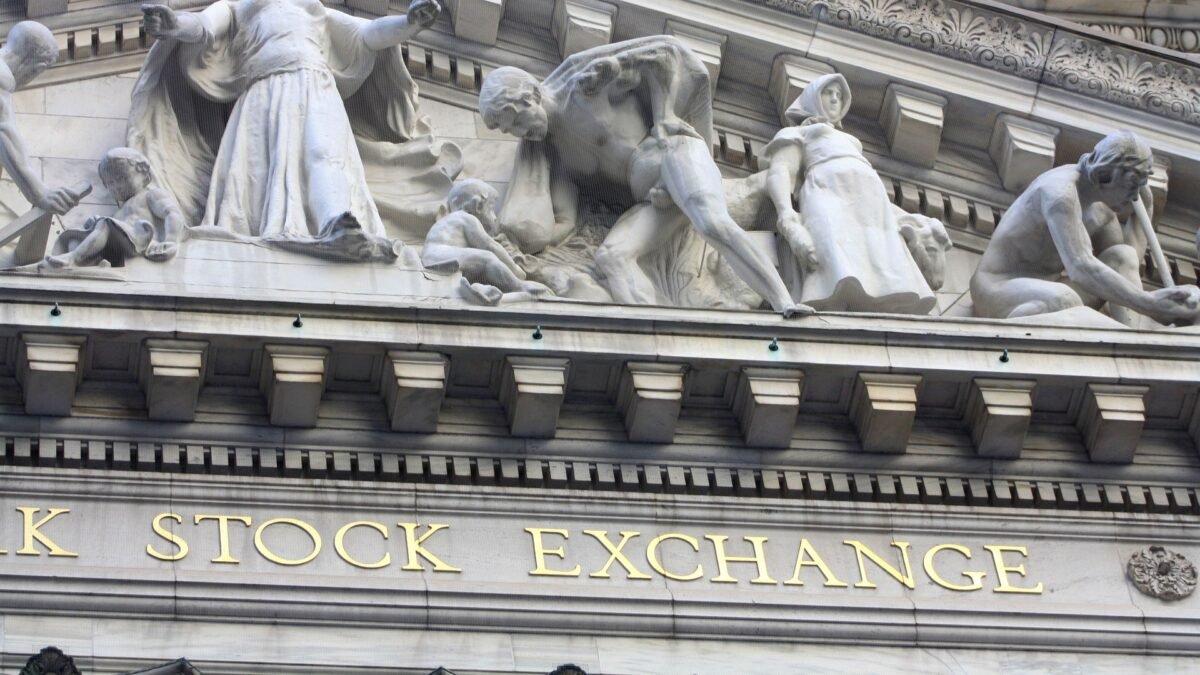
Featured image: the facade of the New York Stock Exchange, New York. Photo: Ryan Schwark / Wikimedia Commons (CC0 1.0), 14 June 2024; cropped to 16:9 with minor brightness/contrast polishing. Source file: Wikimedia Commons — File: NYSE facade.jpg.

About the Author — Abdul Mannan
Related Articles
Meta Launches $35 Billion Stock Sale in Drive to Raise Up to $95 Billion for AI Buildout
Meta Platforms launched about $35 billion of stock offerings on Monday and outlined a plan for up to…
Oil Eases From Six-Month High as Markets Brace for a Pivotal Week of Central Bank Decisions
Brent crude slipped from a six-month high on Monday after a surge driven by Middle East supply fears,…
Audi to Build $4 Billion Georgia Plant, Its First US Factory, as Trump Credits Tariffs
Audi will build its first US factory near Macon, Georgia — a roughly $4 billion plant building the…