
Asian Markets Tumble as Tariff Threats and AI Doubts End the Nvidia Relief Rally

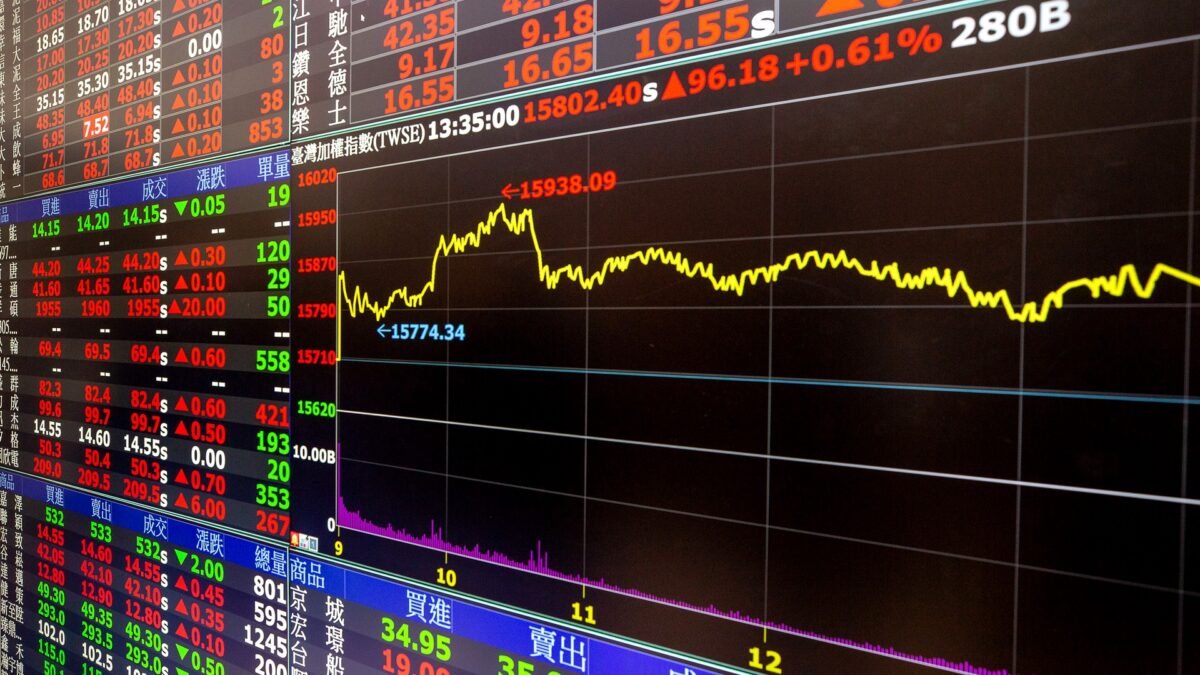
Asian stock markets tumbled on Wednesday as fresh tariff threats from Washington and fading faith in the artificial intelligence rally struck at the same time, hammering the chip-heavy markets of South Korea, Taiwan and Japan and ending the brief relief rally that followed Jensen Huang’s return as chief executive of Nvidia.
MSCI’s broadest index of Asia-Pacific shares outside Japan was down 2.3 per cent in early trading, according to Reuters, led by a drop of as much as 5.3 per cent in South Korean shares and a 5.1 per cent decline at the worst point in Taiwan. Japan’s Nikkei 225 fell as much as 2.9 per cent, while futures on the S&P 500 were 0.3 per cent lower.
Losses deepened as the session wore on. According to The Wall Street Journal, South Korea’s Kospi closed 5.9 per cent lower, with chip heavyweights SK Hynix shedding 9.8 per cent and Samsung Electronics losing 9.1 per cent. Taiwan’s Taiex pared some of its losses but was still 6.0 per cent lower, Japan’s Nikkei finished 2.9 per cent down, Hong Kong’s Hang Seng slipped 0.25 per cent and China’s Shanghai Composite fell 1.45 per cent.
The sell-off had two clear triggers. The first was trade. Media reports said the Trump administration was preparing to release the findings of a trade investigation that could pave the way for new tariff measures, and risk appetite weakened immediately. The second was doubt about the AI trade itself: the euphoria that greeted Huang’s return to Nvidia at the start of the week had faded within a day, and investors began asking once again whether the vast sums being poured into AI infrastructure can ever earn their keep.
Wall Street sets the tone
Asian markets took their cue from an uneven session on Wall Street overnight. According to Reuters, the S&P 500 fell 0.5 per cent and the technology-heavy Nasdaq Composite dropped 1.5 per cent, while the small-cap Russell 2000 gained 0.6 per cent and the Dow Jones Industrial Average rallied 0.9 per cent.
“Wall Street pared its Monday advance as sobriety returned to the market and a focus returned to fundamentals,” Kyle Rodda, a senior market analyst at Capital.com in Melbourne, told Reuters.
Nvidia surrendered some of the gains it had made after Huang’s return as chief executive earlier in the week, falling 5.9 per cent on Tuesday, according to Reuters. Anthropic, the AI company that made a record debut on the Nasdaq last week, fell 6.5 per cent to below its initial public offering price.
There was one bright spot in the American session. Data showed that United States consumer confidence increased by more than expected in November, touching its highest level in nearly two years, according to Reuters. The Conference Board said its consumer confidence index rose to 103.3 this month from 91.9 in October, according to Dow Jones. Dell also reported better-than-expected earnings on surging demand for AI servers, and its shares rose 4.1 per cent in after-hours trading, according to Reuters.
Dell said on Tuesday that quarterly revenue had more than doubled to a record $54.94 billion, with revenue from AI-optimised servers up 291 per cent to $22.03 billion and an order backlog of $132.3 billion. The result was a reminder that, for all the anxiety about AI valuations, the companies actually selling the hardware are still reporting extraordinary demand.
The tariff threat returns
The more immediate cause of Wednesday’s slide was the return of tariffs to the centre of market attention. The Office of the United States Trade Representative is preparing to release the findings of a probe into alleged excess industrial capacity among 16 major US trading partners, including China and the European Union, three people with knowledge of the matter told Reuters on Tuesday.
“The re-emergence of tariffs from the USTR has been met with a collective sigh from investors,” Chris Weston, head of research at Pepperstone Group in Melbourne, told Reuters. “Much like the US debt ceiling, which is also making an unwelcome comeback onto the radar, traders appear reluctant to commit significant capital on the headlines alone.”
According to Reuters, the results of the investigation were expected as soon as Tuesday afternoon, and the Trade Representative’s office is expected to propose new duties that would stack on top of tariffs already imposed during President Donald Trump’s second term. The Wall Street Journal reported earlier that the probe’s findings could be unveiled as soon as this week.
The duties would partly replace the tariffs struck down by the US Supreme Court in February, when the court ruled that the president’s global tariffs imposed under a national emergencies law were illegal. After that ruling, Trump imposed a 10 per cent tariff for 150 days under Section 122 of the Trade Act of 1974, according to Reuters. The Section 301 investigation is the administration’s chosen route to rebuild its tariff regime on firmer legal ground.
The 16 economies covered by the probe are China, India, Japan, South Korea, Mexico, Vietnam, Taiwan, Thailand, Malaysia, Indonesia, Switzerland, Norway, Singapore, Bangladesh and Cambodia, along with the European Union, according to Reuters. Canada, the second-largest US trading partner, was not included.
It is not yet clear what tariff rates would be proposed. According to Reuters, one trade lawyer said the administration could propose high rates of 15 to 25 per cent on imports from countries deemed to have excess capacity in various sectors. Other reports said the administration was expected to honour caps already negotiated with Washington: 15 per cent for goods from the European Union, Japan and South Korea, 19 per cent for Malaysia, and 20 per cent for China, holding as long as the US-China trade truce due to expire on 10 January is extended.
The investigation was launched on 11 March under Section 301 of the Trade Act of 1974, which allows the president to impose tariffs if an investigation finds unfair trade practices that burden or restrict US commerce. According to the Trade Representative’s office, the probe covers sectors including steel, aluminium, cars, batteries, semiconductors, solar modules, ships, electronics, chemicals, machinery and robotics. The office has said the excess capacity and over-production leads to persistent trade imbalances, undermines investment in domestic manufacturing and threatens American jobs.
The office’s notice cited the automotive sector in China and Japan, and said a growing number of companies were unprofitable or unable to meet interest payments from their operations. It said that despite China’s electric vehicle capacity outstripping national demand, the country’s top EV maker, BYD, was building factories in Uzbekistan, Thailand, Brazil, Hungary and Turkey and was expected to expand capacity in Europe, where existing automotive plants are operating at only 55 per cent of capacity. The office also cited large US trade surpluses in Germany and Ireland as evidence of excess capacity in the European Union, and said Singapore had excess global capacity in semiconductors despite running a trade deficit with the United States.
Any new duties would stack on top of levies of 10 to 12.5 per cent that followed a separate forced-labour investigation covering all 16 economies in the overcapacity probe, according to reports. That investigation, launched in March, led in June to proposed tariffs of 10 to 12.5 per cent against 60 economies over the failure to impose and enforce bans on goods produced with forced labour. As of Tuesday, the Trade Representative’s docket for the overcapacity investigation showed no determination or tariff schedule, according to reports, which is one reason markets reacted to the headlines rather than to any published rates.
Lin Li, MUFG’s Asian head of global markets research, said in a note that the possible tariff increases were likely weighing on sentiment, because the proposed duties could lift the effective US tariff rate back towards the levels seen before February’s court ruling.
Doubts about the AI boom
The second force behind Wednesday’s falls was a renewed bout of doubt about the artificial intelligence trade, which has driven global markets for much of the past two years. The relief rally that followed Huang’s reinstatement as Nvidia’s chief executive lasted barely a day.
President Trump pushed for Huang’s reappointment as Nvidia’s chief executive, The Wall Street Journal reported, raising questions about the US government’s role in propping up the AI boom. There were also signs that Huang’s determination to accelerate Nvidia’s growth had led to hasty data-centre development deals and sales to China-affiliated companies in Singapore that could yet be probed by regulators, according to the Journal.
“Huang’s return does not change our view that the revenue hurdle to justify the scale of AI investment is unrealistic,” Joe Maher, a markets economist at Capital Economics, told Dow Jones, adding that a major equity bust was still in store.
The warning captures the central question hanging over the market. Trillions of dollars are being committed to data centres, chips and power infrastructure on the assumption that AI will generate revenues large enough to justify the spending. Dell’s record quarter shows the hardware sellers are thriving. But investors are increasingly asking whether the companies buying the hardware will ever see a return, and whether the boom is being sustained by circular deals and political support rather than by genuine demand.
That anxiety has made markets unusually jumpy. Taiwan’s stocks have been volatile in recent sessions, according to The Wall Street Journal, sliding into bear-market territory on AI demand concerns and the Nvidia saga, only to bounce back sharply on government support and relief rallies. Wednesday’s fall was the latest violent swing in that pattern.
The metals market told the same story. Copper and tin prices fell sharply on Tuesday, giving up all of the previous session’s gains as the fizzling AI rally weighed on industrial metals, while aluminium sank to a 13-month low, according to Reuters. Copper had been one of the biggest beneficiaries of the AI build-out, because data centres need vast amounts of the metal for power and cooling. When faith in the build-out wobbles, copper falls with it.
Chip stocks bear the brunt
The damage was concentrated exactly where the AI trade lives: in the chipmakers of South Korea, Taiwan and Japan. South Korea’s Kospi declined 4.7 per cent in early trading, according to Dow Jones, with chip heavyweights SK Hynix shedding 7.5 per cent and Samsung Electronics losing 8.0 per cent. The Korea Exchange briefly suspended trading on Kospi constituents after futures linked to the index fell more than 5 per cent.
Japan’s Nikkei Stock Average declined 3.15 per cent, according to Dow Jones, with chip stocks Kioxia and Advantest each sliding more than 10 per cent. Taiwan’s Taiex dropped 8.2 per cent, weighed down by an 8.3 per cent fall in chipmaker TSMC, the world’s largest contract chip manufacturer and the company at the heart of the AI supply chain.
China’s Shanghai Composite fell 1.0 per cent, while Hong Kong’s Hang Seng Index defied the falling trend to rise 1.0 per cent in early trading, according to Dow Jones. Australian shares slid 0.9 per cent and the Australian dollar strengthened 0.2 per cent after data showed consumer prices climbed by more than expected in October, as fuel and clothing jumped.
The annualised trimmed mean measure of inflation in Australia, the Reserve Bank’s preferred gauge, was 3.8 per cent, according to Reuters, which means inflation is still running well above target and ramps up pressure on the Reserve Bank of Australia, which has already raised rates by 125 basis points this year.
Oil, gold and crypto
The selling spread beyond equities. In commodities, Brent crude opened 0.5 per cent lower at $90.97 in Asia, according to Reuters, after a choppy session on Tuesday in which crude prices settled more than 2 per cent higher as new attacks were reported on vessels in and around the Strait of Hormuz. Front-month West Texas Intermediate crude futures declined 1.35 per cent to $80.94 a barrel, while front-month Brent dropped 1.2 per cent to $90.30 a barrel, according to Dow Jones.
Gold edged higher but remained around more-than-one-year lows, with spot prices last up 0.2 per cent at $3,564.25 a troy ounce, according to Dow Jones. The yellow metal’s near-term gains are likely to be limited, as investors could be reluctant to rebuild bullish bets into the year-end with a December Federal Reserve rate increase heavily priced in, OCBC Group Research strategist Sim Moh Siong said in a note.
In cryptocurrencies, Bitcoin fell 1 per cent to $59,257.71, while ether slid 1.1 per cent to $1,660.52, according to Reuters. The falls were modest compared with the equity rout, but they pointed in the same direction: a broad retreat from risk.
Attention now turns to US core PCE data due on Wednesday, ahead of the Thanksgiving holiday later in the week, according to Reuters. The Transportation Security Administration expects to screen nearly 17.6 million passengers from 24 to 30 November, the busiest Thanksgiving air travel period in 16 years, a sign that American consumers are still spending freely even as markets wobble.
Analysis: two shocks arrive at once
What made Wednesday’s sell-off so sharp was not either shock on its own, but the fact that both arrived together. Tariffs and AI doubts are the two great uncertainties of this market, and for most of the year investors have been able to worry about one while setting the other aside. On Wednesday they collided.
The tariff shock is, in one sense, the more predictable of the two. The Trump administration has been signalling since March that it would rebuild its tariff regime through Section 301 after the Supreme Court struck down the emergency-law tariffs in February. The investigation into 16 economies was launched in March, the forced-labour duties were proposed in June, and the administration has repeatedly said the findings were coming. What rattled markets was the timing and the scale: findings expected imminently, duties that could reach 15 to 25 per cent, and a list of targets that covers nearly every major exporter to the United States, including allies such as Japan, South Korea and the European Union.
The administration’s argument is that the targeted economies subsidise their industries, build more capacity than their own markets can absorb, and then export the surplus at prices American firms cannot match. The evidence it cites is real enough: Chinese electric vehicle capacity does exceed Chinese demand, European car plants do run at barely half their capacity, and persistent trade surpluses do suggest structural imbalances. But the remedy is a blunt instrument. Tariffs on semiconductors, cars, batteries and electronics from 16 economies would raise costs for American manufacturers and consumers too, and they would land on allies whose cooperation Washington needs on other fronts, from Ukraine to the South China Sea.
The market’s reaction also reflects a deeper fatigue. Traders have spent the year pricing and repricing tariff risk: the February court ruling, the 150-day Section 122 stopgap, the Shenzhen summit and the trade truce with China, the forced-labour duties in June. Each development has been treated as the final word, and each has been followed by another. As Chris Weston of Pepperstone put it, the re-emergence of tariffs has been met with “a collective sigh” — not panic, but a weary reluctance to commit capital on the headlines alone.
The AI doubt is the more consequential of the two shocks, because it goes to the heart of the market’s valuation. The global rally of the past two years has been built on a single bet: that artificial intelligence will generate enough revenue to justify the hundreds of billions of dollars being spent on chips, data centres and power. Dell’s record quarter shows the spending is real. What is not yet proven is the return.
Capital Economics’ warning that “the revenue hurdle to justify the scale of AI investment is unrealistic” is not a fringe view. It is the question that every serious investor in the sector is now asking, and it is why the market has become so sensitive to news about Nvidia. When the world’s most important AI company loses its chief executive, its shares collapse; when he returns, they soar; when he returns and the rally fades within a day, the market reads it as evidence that the euphoria itself is fragile.
The reports that Trump’s intervention secured Huang’s return, and that Nvidia’s growth drive involved hasty data-centre deals and sales to China-affiliated companies in Singapore, add a political dimension to the doubt. If the AI boom is being propped up by government intervention, then it is vulnerable to political change. If the sales that drove the boom are now subject to regulatory scrutiny, then the revenue may not be as solid as it looked.
None of this means the AI trade is finished. Dell’s backlog of $132.3 billion in AI server orders is a fact, not a forecast, and TSMC’s order books remain full. But it does mean the market has entered a more sceptical phase, in which good news is greeted with a shrug and bad news is punished severely. That is the pattern of a market that no longer trusts its own story.
The resilience of the American consumer is the counterweight. Consumer confidence at its highest in nearly two years, a record Thanksgiving travel week, and a Dow that rose even as the Nasdaq fell all suggest that the real economy is holding up better than the market’s mood implies. The divide between the Dow’s 0.9 per cent gain and the Nasdaq’s 1.5 per cent fall on Tuesday is telling: investors are rotating out of the AI trade and into the rest of the economy, not fleeing the market altogether.
What to watch next is straightforward. First, the Trade Representative’s report itself: the findings, the proposed rates, and whether the caps already negotiated with the European Union, Japan, South Korea, Malaysia and China are honoured. Second, the US core PCE data on Wednesday, which will shape expectations for the Federal Reserve’s December decision — a rate increase is heavily priced in, and any surprise could move markets sharply in a thin Thanksgiving week. Third, whether the sell-off spreads to Europe and the United States when they open, or whether it stays confined to Asia’s chip markets. And fourth, Nvidia itself: the company’s next statements, and any regulatory word on its Singapore sales, will be read as a verdict on the whole AI trade.
Wednesday’s message from Asia was simple enough. Two of the market’s biggest assumptions — that tariffs were a settled matter, and that the AI boom could only go up — were both challenged on the same day. Markets can live with one broken assumption. Two at once is a different matter.
Sources
- Reuters — Stocks retreat as AI rebound stumbles, tariff threats loom
- Dow Jones via Morningstar — Asian Stocks Mostly Lower on AI Doubts, Tariff Jitters
- The Wall Street Journal — Asian Stocks Lower on AI Doubts, Tariff Jitters
- Reuters via Global Banking and Finance — Trump administration set to unveil new tariffs after probe on excess capacity
- Dow Jones via Morningstar — Top Markets Headlines: US consumer confidence rebounds; tariffs loom

About the Author — Abdul Mannan
Related Articles

Huawei Convicted on 10 of 12 Counts in US Criminal Trial Over Trade Secrets and Iran Sanctions
A Brooklyn jury convicted Huawei on 10 of 12 counts, including conspiracy to steal trade secrets and bank…
Capita Chief Executive Quits as Pension Failures Wipe 70% Off Shares in a Day
Capita chief executive Adolfo Hernandez has stepped down with immediate effect after the outsourcer's botched running of the…
Sanofi to Acquire Insmed for $41 Billion in Landmark Bet on Respiratory Drugs
Sanofi has agreed to buy US drugmaker Insmed for $41 billion in cash, gaining the blockbuster lung drug…