
Dow Drops 849 Points as Global Sell-Off Deepens and S&P 500 Hits Lowest Close Since July

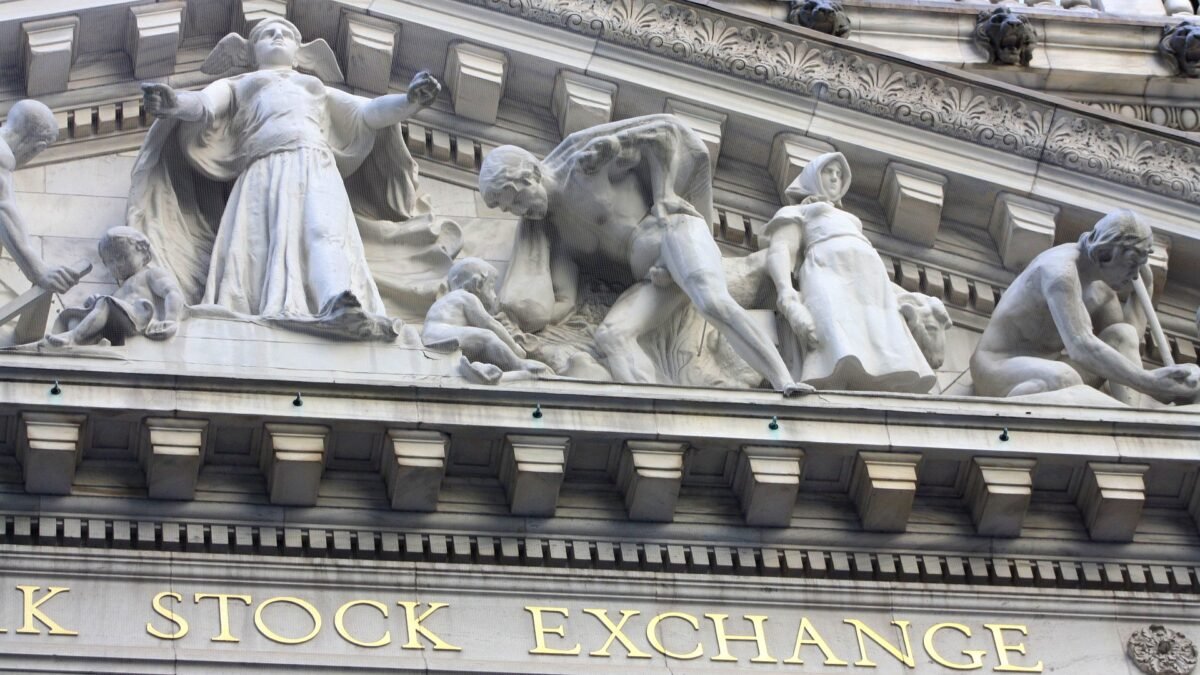
Wall Street suffered its worst day in weeks on Tuesday, 17 November 2026, as a global sell-off gathered pace ahead of Nvidia’s quarterly results and a hawkish warning from a senior Federal Reserve official pushed traders to price in further interest rate rises. The Dow Jones Industrial Average fell 848.75 points, or 1.64 per cent, to close at 50,759.42, after dropping more than 1,000 points during the session, according to Reuters. The S&P 500 slid 76.06 points, or 1.03 per cent, to 7,340.53, its lowest closing level since late July, while the Nasdaq Composite lost 181.37 points, or 0.74 per cent, to 24,328.38.
It was the fourth consecutive day of losses for the S&P 500 and the Nasdaq, their first four-session losing streak since September, according to Reuters. Every one of the 11 sectors in the S&P 500 finished lower. The scale of the decline, and the fact that it spread far beyond technology shares, suggested that something broader than a single company’s troubles was driving the selling. As one market strategist put it, the session was “not all about Nvidia”.
The losses were not confined to the United States. European shares recorded their worst day since March, according to Reuters, with the STOXX 600 down 1.70 per cent and Germany’s DAX down 2 per cent. In Asia, Japan’s Nikkei 225 fell 1.34 per cent and South Korea’s Kospi dropped 2.59 per cent. The dollar hit a fresh 19-month high, gold hovered near a one-year low, and the VIX volatility gauge, Wall Street’s fear index, jumped 11.1 per cent to 25.46.
And yet, after the closing bell, the company at the centre of the storm delivered the numbers investors had been waiting for. Nvidia reported third-quarter revenue of $115.84 billion, up 103 per cent from a year earlier and well above the $109.1 billion analysts had expected, according to LSEG data cited by Reuters. Its shares rose about 4 per cent in choppy after-hours trading. Whether that is enough to steady a market that has spent a month questioning the artificial intelligence trade is the question that will dominate trading on Wednesday.
A fourth straight day of losses
The selling began early and never really let up. The Dow fell more than 1,000 points at its worst level of the day before recovering some ground into the close, according to Reuters. The S&P 500 dropped as much as 1.73 per cent during trading, while the Nasdaq fell about 2.1 per cent at one point, touching its lowest level since April, according to CNBC.
The breadth of the decline was striking. All 11 sectors in the S&P 500 fell, with financials down 1.9 per cent and communication services down 1.3 per cent, according to Reuters. Declining stocks outnumbered advancing ones on both the New York Stock Exchange and the Nasdaq. Software and services, airlines and banking were among the weakest-performing sectors, according to Reuters.
The session extended a slide that began in early October. The S&P 500’s technology sector is now down 20 per cent since 6 October, the Philadelphia Semiconductor index is off 30 per cent, and Nvidia itself is down nearly 40 per cent, according to Reuters. What began as a wobble in the shares most exposed to artificial intelligence has become a broad reassessment of the market’s most crowded trade.
Oliver Pursche, a senior vice president at Wealthspire Advisors in New York, told Reuters that every sector in the S&P 500 was down, describing the sell-off as a reflection of broader investor anxiety rather than weakness concentrated in artificial intelligence-related shares. He said the market’s reaction reflected a combination of developments driven more by speculation than confirmed information.
Software led the rout
The sharpest pain on Tuesday was felt in software. Salesforce, the enterprise software giant, fell 9.45 per cent to close at about $194.62, making it the worst performer in the S&P 500, according to the Motley Fool. It was the stock’s biggest single-day percentage decline since May 2024 and its lowest closing level since 17 August. The shares are now more than 30 per cent below their December 2024 high and have shed 29 per cent so far this year.
Salesforce was not alone. Workday, Intuit and Adobe each fell between 4.3 per cent and 9.5 per cent, Microsoft slipped 2.3 per cent and AppLovin declined 3.9 per cent, according to Reuters. The selling hit software across the board, and it did so without any company-specific announcement from Salesforce itself. No earnings release, no change to guidance, no acquisition and no major contract announcement appeared alongside the session, according to reporting on the day.
Instead, three separate pressures converged on the sector. First, investors appeared to be rotating money out of established software names ahead of Anthropic’s expected public listing, redirecting capital towards the artificial intelligence developer whose debut is expected later this week, according to Reuters. Second, a supply-chain cyberattack disclosed on Monday struck 178 organisations whose websites run on the Optimizely web-testing platform, with Salesforce named alongside Zoom, HSBC, Equifax, CNN, the BBC, Fox News, IKEA and Air France-KLM, according to security firm Report URI. Analysts warned that the incident highlighted how software companies could prove particularly vulnerable to AI-assisted misuse.
Third, a report by Business Insider, citing internal letters to employees, said Salesforce had begun another round of workforce reductions as part of its restructuring, amid mounting scrutiny over the impact of artificial intelligence on traditional software businesses. The extent of the latest job cuts has not been identified. Salesforce had already cut 86 positions across sales, general administration, technology and product functions in California in June.
The same report said Salesforce was rolling out monthly AI token budgets for employees, broken down by job role, after some staff spent thousands of dollars a month on tokens during the prior quarter. Chief executive Marc Benioff has said Salesforce is on track to spend roughly $300 million on Anthropic tokens in 2026, with software coding as the primary internal use case. The caps mark a shift from open-ended AI access to a managed cost framework, and investors read the detail as a reminder that even the companies selling artificial intelligence are struggling to control what it costs them.
There was one bright spot for Salesforce in the day’s news. At Microsoft Ignite 2026, Salesforce and Microsoft announced Copilotforce, a new integration that brings Salesforce customer context, business processes and actions into Microsoft Copilot and other AI-powered productivity experiences. The market ignored it.
Nvidia’s beat came too late to save the session
Nvidia set the tone for the day, and the tone was nervous. The chipmaker flipped between modest gains and losses in the morning, dropped as much as 3.7 per cent, and then recovered most of the fall to close about 0.5 per cent lower at $155.46, according to Reuters. It was the company’s first earnings report since co-founder Jensen Huang resigned as chief executive on 12 November, and the first hosted by interim chief executive Colette Kress.
After the bell, Nvidia delivered a blowout quarter. Revenue reached $115.84 billion, up 103 per cent from a year earlier, adjusted earnings were $2.68 a share against $2.48 expected, and data centre revenue reached $107.6 billion, according to LSEG data cited by Reuters. The company guided fourth-quarter revenue to about $130 billion, plus or minus 3 per cent, above the roughly $125 billion consensus, while assuming no data centre chip sales from China. Shares rose in late trading.
But the results arrived against a grim backdrop. Reuters reported on Tuesday that the US Securities and Exchange Commission is investigating the company, and that the board is not weighing a return for Huang, a day after Huang said he would be “honoured” to return as chief executive. The board had already formally ruled out his return at the start of the earnings call, according to reporting on Tuesday. Huang has agreed to appear before Congress early next month.
The Nvidia saga has now pressured technology shares from Tokyo to New York for more than a week, according to Reuters. On Monday, Washington said it would further restrict China’s access to advanced AI chips, including new rules to prevent Chinese companies from remotely accessing advanced chips through data centres in third countries. China criticised the move. The restrictions, and the uncertainty over whether the enormous sums being spent on AI infrastructure will ever generate sufficient returns, have become the central question hanging over the market.
Baird investment strategist Ross Mayfield said Nvidia would likely report strong results and guidance but was unlikely to provide clear answers on the issues weighing on the stock, including leadership and the export-control investigation, according to TradingView News.
The Fed turned hawkish again
If Nvidia was the day’s drama, the Federal Reserve was its slow-burning fuse. St. Louis Fed President Alberto Musalem said on Tuesday that the economy would likely require several interest rate increases before the spring of 2027 to bring inflation back to the Fed’s 2 per cent target in a timely manner, according to Reuters. How many hikes does “several” cover? Probably four, in Musalem’s view, because current policy is as much as a full percentage point below where it should be, according to Reuters.
Markets responded immediately. According to the CME FedWatch tool, traders are pricing in a 95.4 per cent probability that the Federal Reserve will raise interest rates by 25 basis points at its December meeting, on 8 and 9 December. Expectations of further tightening have been building for weeks, and they continued to influence markets on Tuesday, according to PSG Financial Services.
The morning’s economic data did nothing to argue for rate relief. October retail sales rose 0.2 per cent, in line with forecasts, with sales excluding autos up 0.6 per cent, a firmer underlying reading that initially lifted Treasury yields, according to Reuters. Import prices rose 1.1 per cent for a second straight month. The National Association of Home Builders’ Housing Market Index fell from 29 to 25 in November, its lowest level since April 2012. The 10-year US Treasury yield fell 2 basis points to 5.10 per cent.
Stronger spending argues against a recession, but it also argues against rate relief, and at a 10-year yield near 5.10 per cent, expensive AI valuations have little room for disappointment. Wednesday brings the minutes of the Federal Reserve’s October meeting, due at 2pm Eastern, which will show how widely Musalem’s view is shared inside the committee.
Europe and Asia fell first
The sell-off began long before Wall Street opened. European shares fell on Tuesday, with Deutsche Bank leading declines as it responded to a series of media reports based on leaked documents, while tech shares slipped ahead of Nvidia’s results, according to Reuters. Europe’s STOXX 600 dropped 1.70 per cent to 651, the EURO STOXX 50 fell 2 per cent to 6,215, Germany’s DAX dropped 2 per cent to 26,076, and France’s CAC 40 declined 1.60 per cent to 8,222, its lowest level since 6 November, according to PSG Financial Services. Technology and AI infrastructure stocks led the declines, with ASML and SAP both falling nearly 6 per cent.
Deutsche Bank lost almost 6 per cent following reports of shortcomings in its handling of high-risk clients, according to PSG Financial Services. The reports, based on leaked documents, tied the German lender to clients including Russian oligarchs, US President Donald Trump and the late financier Jeffrey Epstein, according to Reuters. The bank’s chair backed its chief executive, and Mr Trump called the tax leak “illegal”, according to Reuters.
Disappointing Chinese retail data added to pressure on luxury stocks, while the European Commission lowered its 2026 growth forecast for France to 0.40 per cent, according to PSG Financial Services. In Asia, Japan’s Nikkei 225 fell 1.34 per cent to 58,860, with semiconductor and technology shares under pressure, China’s Shanghai Composite lost 0.50 per cent to 3,584.6, extending its decline to a fourth session, and Hong Kong’s Hang Seng Index fell 1 per cent to 23,508, according to PSG Financial Services. South Korea’s Kospi dropped 2.59 per cent to 4,968.48 and Australia’s S&P/ASX 200 fell 1.79 per cent to 8,883.20, according to Reuters.
China’s October retail sales increased by 0.40 per cent year on year, below expectations of 0.80 per cent, while industrial production rose 4.80 per cent, also missing forecasts, according to PSG Financial Services. The MSCI global equities benchmark lost 0.3 per cent, following sharp declines in Asian tech-focused indexes on the back of the US government’s latest curbs, according to Reuters.
Commodities, currencies and the wider mood
Crude oil edged higher on Tuesday, rebounding from a 3.20 per cent decline the previous day as escalating tensions in the Middle East supported prices, according to PSG Financial Services. Brent crude rose 1.16 per cent to $93.51 a barrel, while December West Texas Intermediate settled at $85.69 a barrel, down 0.03 per cent. Iran has intensified its warnings against US forces and commercial shipping, and the arrival of a third American aircraft carrier in the Gulf has heightened concerns about a further escalation in the region. The upside in oil prices was tempered by supply data, with the International Energy Agency expecting a surplus of around 2 million barrels per day this quarter, while Goldman Sachs has warned that the market could face a glut next year.
Gold held around $3,950 an ounce, near a one-year low, according to Reuters, while the dollar hit a fresh 19-month high before ending the day lower. US yields fell 2 to 4 basis points across the curve.
Sentiment was further dampened by a series of technology disruptions, according to PSG Financial Services. Reports of a malfunction in a classified network at the US National Security Agency weighed on the market, although CNN, citing six sources, reported that there was no evidence of a cyberattack, and officials later described the problem as routine maintenance. A software bug that disrupted Microsoft’s productivity services added to the unease. The recent string of technology outages that have hit air travel, banks and other firms has compounded concerns about the stability of US technology infrastructure, according to the Motley Fool.
Investors were also monitoring developments around Anthropic’s planned initial public offering, with reports suggesting that the AI company was guiding prospective investors to expect its shares to be priced at the upper end of the proposed range, or higher, according to PSG Financial Services. The debut, expected later this week, is being watched as a test of whether appetite for artificial intelligence assets survives the current rout.
Analysis: Why It Matters
The AI trade has stopped being a one-way bet
For most of the year, the logic of the artificial intelligence trade was simple: the companies building the infrastructure would keep growing, the companies buying it would keep spending, and the share prices would keep rising. Tuesday broke that logic in public. The S&P 500’s technology sector has now fallen 20 per cent since 6 October, the Philadelphia Semiconductor index is down 30 per cent, and Nvidia is down nearly 40 per cent, according to Reuters. Those are not the numbers of a healthy correction in a single stock. They are the numbers of a market repricing an entire thesis.
The uncomfortable question is the one investors have been avoiding: whether the enormous investments required to build data centres will ever generate sufficient returns. The hyperscalers are spending at a scale never seen before, and the returns are, so far, mostly promised rather than proven. Nvidia’s results show that the chipmaker itself is still printing money. What they do not show is whether its customers are.
Nvidia’s numbers may not be enough
Nvidia reported one of the strongest quarters in corporate history, and the market’s first reaction was relief. But relief is not the same as confidence. The company’s shares rose about 4 per cent after hours, yet the stock remains down nearly 40 per cent from its October peak, and the board has formally ruled out the return of the chief executive who built it. The leadership crisis, the SEC investigation, the export-control probe and the congressional testimony scheduled for December all remain unresolved, and none of them is a matter of quarterly revenue.
There is a deeper problem. Nvidia’s guidance assumes no data centre chip sales from China, and Washington’s restrictions on remote access to advanced chips show that the political pressure on the company is intensifying, not easing. A company can beat earnings and still be trapped between two governments. That is the position Nvidia now occupies, and it is why a $115.8 billion quarter did not stop the selling.
The Fed has changed the argument
For months, the debate in markets was about when the Federal Reserve would cut rates. That debate is over, and it ended badly for anyone holding expensive growth stocks. Musalem’s warning that the economy may need several rate increases before spring 2027, and that current policy may be as much as a full percentage point too low, reframes the entire outlook. Markets now price a near-certain rate rise in December, and the October meeting minutes due on Wednesday will show whether Musalem speaks for the committee or only for himself.
The combination is toxic for technology valuations: growth is holding up well enough to justify higher rates, while higher rates make future earnings worth less today. Retail sales rose in line with forecasts, import prices rose for a second straight month, and the housing market is at its weakest since 2012. That is not a recession. It is something markets may find harder to trade: an economy strong enough to keep rates high and weak enough in the places that matter to households.
Software is the new front line
The most revealing move of the day was not Nvidia. It was Salesforce. A 9.45 per cent fall in a company with no bad news of its own tells investors something important about how the market now thinks about software. The fear is not that artificial intelligence will fail, but that it will succeed too well, replacing the very products that software companies sell. Add a supply-chain cyberattack, a round of job cuts, and the spectacle of a company rationing its own employees’ AI tokens, and the picture is of an industry being disrupted from the inside.
Anthropic’s listing later this week will sharpen the question. If investors are rotating out of Salesforce and its peers to buy the new arrival, the message is that the market now values the disruptor more than the disrupted. That is a rational trade, but it is a brutal one for the incumbents, and it explains why the selling spread to every sector on Tuesday rather than staying confined to chips.
The rest of the world is not waiting for Wall Street
Europe’s worst day since March, Asia’s fourth straight session of declines, and a Deutsche Bank slide driven by leaked documents all point to the same conclusion: this is not an American story. The AI trade was global, the chip curbs are global, and the rate repricing is global. China’s retail sales missed forecasts, the European Commission cut France’s growth outlook, and the dollar’s 19-month high is squeezing emerging markets. When the world’s biggest market sneezes, the rest of the world still catches a cold, but on Tuesday the rest of the world was already ill.
What to Watch Next
- The minutes of the Federal Reserve’s October meeting, due on Wednesday at 2pm Eastern, will show how widely Musalem’s hawkish view is shared inside the committee, and whether a December rate rise is as certain as markets believe.
- Nvidia’s shares in regular trading on Wednesday will show whether the after-hours rally survives contact with the open, and whether the chipmaker’s beat can steady the wider technology sector.
- Anthropic’s public listing later this week will test whether appetite for artificial intelligence assets survives the current rout, and whether the rotation out of established software names continues.
- Further detail on the SEC investigation into Nvidia, and on Jensen Huang’s scheduled congressional testimony in December, will determine whether the leadership crisis deepens or begins to close.
- Washington’s new restrictions on remote access to advanced AI chips, and China’s response, will shape the next round of the technology confrontation between the two countries.
- Deutsche Bank’s response to the leaked-document reports, and any further disclosures about its handling of high-risk clients, will decide whether Tuesday’s slide was a one-day shock or the start of a longer problem.
- Oil prices and the situation in the Gulf, where a third American aircraft carrier has arrived and Iran has intensified its warnings, will determine whether energy markets add a new source of volatility to an already unsettled week.
Sources
- Reuters – Trading Day: AI trade unwind continues, but Nvidia beats (Jamie McGeever, 17 November 2026)
- PSG Financial Services – US stocks retreat as tech weakness and Fed concerns weigh (18 November 2026)
- BusinessToday – US Stocks Extend Losses As Nvidia Earnings Fail To Ease AI Concerns (18 November 2026)
- The Motley Fool – Stock Market Today, Nov. 17: Stocks Slide on AI Chip and Tech Pressures, Salesforce Plummets 9% (17 November 2026)
- IDNFinancials (Reuters) – Dow Jones, Nasdaq plunge as Nvidia draws investor scrutiny (18 November 2026)
- Zark News (Reuters) – Nvidia Beats on $116 Billion Quarter, but Stocks Fall Again as S&P Hits Lowest Close Since July (18 November 2026)

About the Author — Abdul Mannan
Related Articles
Nvidia Board Rules Out Jensen Huang’s Return as CEO After Record $115.8 Billion Quarter
Nvidia's board has formally ruled out bringing back Jensen Huang as chief executive, hours after the chipmaker reported…

Carney and Xi Widen Canada-China Trade Deal as Ottawa Cuts Its Reliance on the United States
Canada and China have agreed to cut tariffs on a further C$400 million of Canadian exports and extend…

Anthropic IPO Draws Seven Times More Orders Than Shares on Offer as Bankers Weigh Pricing Above $78
Investors have placed orders for close to seven times the shares Anthropic is selling, according to Bloomberg, as…