
Eleven Shot, Including Six Youngsters, Near Florida A&M Stadium After Homecoming Game

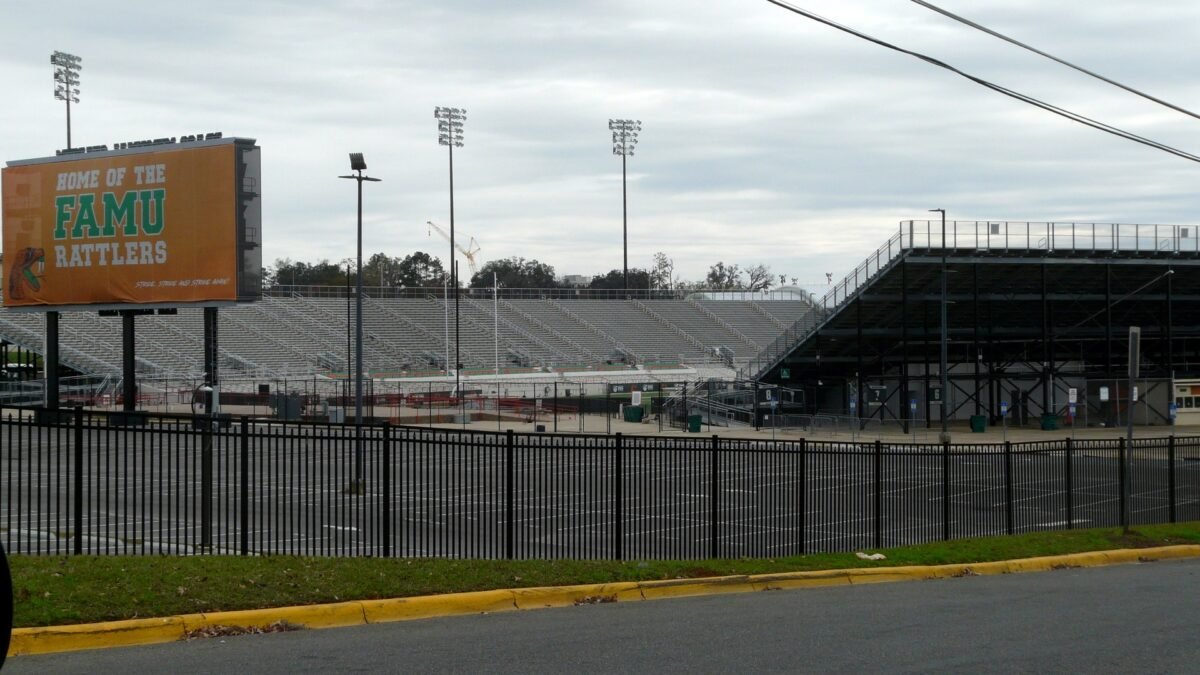
Eleven people, including six juveniles, were shot on Saturday night near Florida A&M University’s Bragg Memorial Stadium in Tallahassee, Florida, shortly after the university’s homecoming football game had ended, according to Tallahassee police.
The shooting happened just before 8 p.m. local time on Perry Street, near the stadium, as crowds were leaving the ground following Florida A&M’s 31-28 homecoming win over Arkansas-Pine Bluff. Tallahassee Police Chief Lawrence Revell told reporters at a late-night news conference that 11 people had suffered gunshot wounds, and that a 12th person, the grandmother of one of the victims, was injured while fleeing the scene.
According to USA Today, six of those shot were juveniles, the youngest just 11 years old, and one of the victims was a Florida A&M student. Police said at least three of the victims were seriously injured, including one person in critical condition, while the remaining victims were in stable condition. No deaths had been reported as of Sunday morning, and no arrests had been made.
Chief Revell said preliminary information indicated that a physical altercation between two or three individuals preceded the gunfire, and that investigators believed the shooting was an isolated incident rather than a random attack. “I stand before you tonight devastated,” Revell said, adding: “We hurt with you, and we will continue to get you the answers you so desperately want.”
According to CNN, the shooting took place just hours after the homecoming game, and it was not immediately clear whether it was directly connected to the game itself. The university sent a campus safety alert at 8:40 p.m. telling students to shelter in place and avoid the area near Bragg Stadium. Florida A&M said in a statement late on Saturday that it was aware of an incident on Perry Street, that its hearts went out to the victims, and that while the campus remained safe, people should avoid the area to allow law enforcement to conduct its investigation.
Tallahassee Mayor John Dailey described the shooting as a “truly horrific and heartbreaking tragedy” in a post on X, adding: “Tonight and in the days ahead, the FAMU family is not alone. Our entire community stands with you.” The Tallahassee Police Department’s Violent Crimes Unit is leading the investigation, with detectives, forensic teams and sergeants working through the scene overnight.
Witnesses described scenes of panic as crowds streamed out of the stadium. One student, Jayden Dubois, told local television station WCTV that he heard gunshots and saw a crowd of people running, saying he was briefly trampled before getting up and seeing a person lying on the ground. Police have appealed for witnesses and for anyone with video footage of the incident to come forward, as investigators work to identify those responsible.
Homecoming weekend, and a city on edge
Homecoming is one of the biggest weekends of the year at Florida A&M, a historically Black university founded in 1887, drawing alumni, families and students back to Tallahassee for days of parades, reunions and football. The Rattlers’ homecoming game at Bragg Memorial Stadium, a 25,500-seat ground that has hosted the team since 1957, is the centrepiece of the weekend, and Perry Street, which runs past the stadium, is typically thronged with fans, food stalls and tailgate gatherings long after the final whistle.
Saturday’s shooting was the second major shooting incident on a Tallahassee university campus in 18 months. On April 17, 2025, a gunman opened fire at nearby Florida State University, killing two people and wounding six others near the student union building, according to the Associated Press. That attack, which lasted around three minutes, saw students barricade themselves in classrooms and hide in a bowling alley in the student union’s lower level, and it remains a raw memory in a city where the two universities sit only a few miles apart.
The two attacks were very different in character. The Florida State shooting was carried out by a single gunman, a 20-year-old student, who was shot and arrested by campus police, and prosecutors later announced they would seek the death penalty. Saturday’s shooting, by contrast, appears to have grown out of a street altercation among a small group of people in a crowd, with police describing it as an isolated incident. But for students and families, the distinction may matter less than the shared experience: another Saturday, another campus community waking to news of gunfire.
Analysis: Why It Matters
A celebration turned into a crime scene
Homecoming at a historically Black university is not just a football game. It is a homecoming in the fullest sense: generations of alumni returning to the place that shaped them, families introducing children to a campus they hope those children will one day attend, and a community celebrating itself. That is precisely what makes a shooting on homecoming night so damaging. The youngest victim was 11 years old, an age that suggests children were present not as bystanders to trouble but as part of a family day out. When gunfire interrupts that kind of gathering, it does not only injure the people it hits; it rewrites the memory of the weekend for thousands of people who were there, and it makes parents think twice about bringing their children next year.
The pattern the police are trying to break
Chief Revell’s early framing of the shooting as an “isolated incident” between a small number of people is a deliberate and important message. In the first hours after a mass-casualty event, the most dangerous thing for a city is uncertainty: rumours of multiple shooters, of a threat still at large, of a campus under siege. By stating quickly that investigators believe the gunfire grew from an altercation, and by stressing that no wider threat had been identified, the police were trying to prevent panic from compounding the harm. The shelter-in-place alert, issued 40 minutes after the shooting and lifted once the area was judged safe, shows the same balancing act: warn people without frightening them more than necessary.
But the word “isolated” carries its own risk. When a shooting injures 11 people, including six children, calling it isolated can sound, to victims’ families, like a way of minimising it. The tension is real, and it is one that American police departments face after almost every mass shooting: the need to reassure the public that there is no ongoing danger, set against the need to acknowledge the scale of what has happened. The honest position is that both things are true at once. The gunfire may have been confined to one dispute on one street, and it still left 11 people with bullet wounds.
Two campuses, two warnings
Tallahassee now has the grim distinction of two campus-area mass shootings in less than two years, at its two largest universities. The Florida State attack in 2025 prompted the familiar round of debates about campus security, warning systems and gun access. Saturday’s shooting will prompt a different, and in some ways harder, set of questions, because it happened not inside a building but on a public street, at the edge of a celebration, in a crowd. There is no door to lock, no single checkpoint to strengthen, when the vulnerability is a public road full of people leaving a stadium.
That is why the investigation’s next steps matter so much. If, as police suspect, the shooting grew from an altercation among a few individuals, the answers will lie in the familiar territory of dispute resolution, weapon carrying in crowds, and the policing of large public gatherings. Universities and cities across America have spent years refining how they manage the hours after a big game, when tens of thousands of people pour onto the streets at once. Tallahassee’s experience will now be studied by others, just as Tallahassee studied Florida State’s.
What to watch next
- Arrests and charges: Police have said no one has been arrested. The first arrests, and the charges that follow, will establish whether the shooting was a spontaneous fight or something planned, and whether more than one weapon was involved.
- Victim updates: With one victim in critical condition and others seriously injured, hospitals’ updates in the coming days will determine whether the casualty count, mercifully without a death so far, stays that way.
- The university’s response: Florida A&M’s statements so far have focused on safety and sympathy. Watch for what it says about homecoming events still to come, counselling for students, and security around future games.
- Community reaction: Homecoming weekends are economic engines for Tallahassee as well as cultural ones. Local leaders, alumni groups and the mayor’s office will all be watched for how they balance reassurance with honest acknowledgement.
- The wider debate: Every American mass shooting feeds the national argument about guns, and this one, with six juvenile victims, will do so with particular force. Expect it to be cited in Florida’s ongoing debates about gun laws and public safety.
For now, the facts are these: 11 people were shot, six of them children, on a street beside a football stadium on the biggest weekend of Florida A&M’s year. No one has been arrested, no one has died, and a city that has been through this before is waiting, again, for answers.
Sources
- CNN: 11 people shot near Florida university stadium
- USA Today: 11 shot after Florida A&M homecoming game
- Reuters: Eleven shot near Florida A&M university in Tallahassee
- Associated Press (via Central Florida Public Media): 2 people were killed and at least 5 wounded in Florida State shooting, April 2025

About the Author — Abdul Mannan
Related Articles
Appeals Court Rules Trump’s Los Angeles National Guard Deployment Was Unlawful in 2-1 Decision
In a 2-1 ruling, the Ninth Circuit held that President Trump's 2025 federalisation of 4,000 California National Guard…
Trump Backs Ramaswamy’s Controversial Ohio Ad, Slams Republicans Who Condemned It
President Trump praised Vivek Ramaswamy's attack ad featuring Democratic rival Amy Acton's estranged mother as "very powerful", attacking…
Ukraine Denies Starlink Restoration Claim, Says Speed Restrictions Remain Despite Trump’s Assurances
Ukraine says speed limits on Starlink remain in place, contradicting Trump's claim that Elon Musk had restored the…