
First Winter Storm Floods 70,000 Tents in Gaza as Displaced Families Face a Harsh Winter Without Shelter

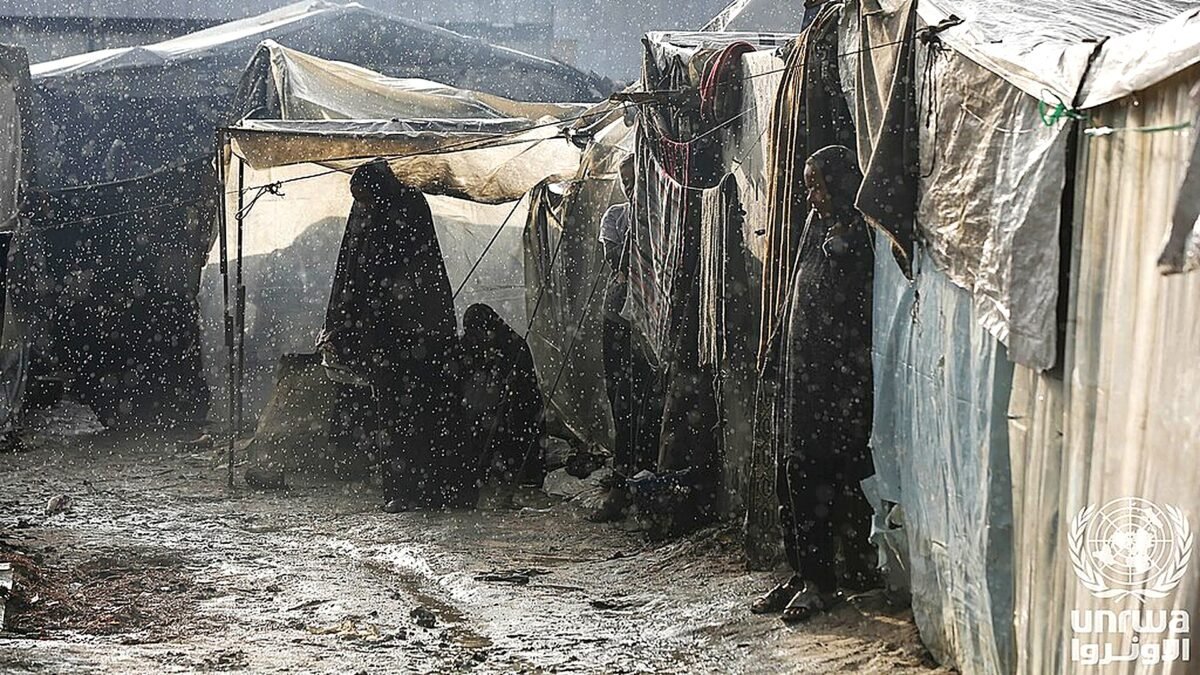
Heavy rain from the first winter storm of the season has flooded at least 70,000 tents sheltering displaced Palestinians across the Gaza Strip, according to Gaza’s Government Media Office, leaving tens of thousands of people without dry shelter and overwhelming emergency crews that say they have almost nothing left to offer. The flooding, which began on Friday night and intensified through Saturday, turned displacement camps in Gaza City, Khan Younis and Deir el-Balah into pools of mud and sewage, soaked the mattresses and blankets of families who had already lost their homes, and forced some shelter centres to empty entirely.
According to the Government Media Office, the tents were flooded within about 12 hours of the rain beginning, with initial losses estimated at about $3 million. Local authorities reported injuries but no deaths on Saturday, although walls and roofs collapsed in several places and rescuers warned that the danger was far from over. By Sunday morning, five more Palestinians had been wounded in weather-related collapses, according to reports, and the United Nations Office for the Coordination of Humanitarian Affairs (OCHA) warned that severe rainfall was placing displaced residents at “immediate risk”.
The scale of the flooding was reported by Reuters and Al Jazeera, both of which attributed the figure of 70,000 flooded tents to Gaza’s Government Media Office. The number has not been independently verified, but it is consistent with the accounts of Gaza’s civil defence agency, of Al Jazeera correspondents reporting from camps across the territory, and of the United Nations agencies that warned before the storm that almost a million displaced people were living in areas exposed to flooding.
Rain had been falling in al-Mawasi, the coastal area in southern Gaza where more than 900,000 displaced people are sheltering, since 10pm on Friday, according to Al Jazeera’s Rami Abu Taima, reporting from Khan Younis. “People woke up to find hundreds, even thousands, of tents flooded across the Gaza Strip,” he said. At Gaza City port, where thousands of families have pitched tents along the shoreline, Al Jazeera’s Ghazi al-Aloul said the tents were exposed to strong winds and rising tides. “These tents will flood first from the rain, and second from seawater,” he said.
Footage from the camps showed families wading through ankle-deep water, their mattresses and blankets drenched, and children standing barefoot in pools of mud and sewage. “Even houses can’t hold up against this rain, so how can open plastic sheeting?” said Al Jazeera’s Nour Khaled, reporting from a camp in Gaza City. She said more than 28,000 widows were among those facing the winter alone with their children.
“Forced out into the unknown”
Gaza’s civil defence agency said its crews received about 1,500 distress calls within 10 hours of the rain beginning early on Saturday, and that water levels at several shelter sites had risen by 30 to 40 centimetres. “What we feared has actually happened,” civil defence spokesman Mahmoud Basal told Al Jazeera. “A few shelter centres were completely flooded, and everyone inside them has now been forced out into the unknown.”
Basal said premature babies, the elderly and the sick were most at risk. “Those living in tents are at risk of death at any moment, and of illness at any moment,” he said. The storm also brought down buildings already damaged by bombardment. Rescuers evacuated residents of a building in the central Nuseirat area after it partially collapsed in the strong winds and rain, the civil defence agency said. In northern Gaza, the wall of another building fell because of the heavy rainfall, injuring two people, according to the Palestinian news agency Wafa. Three abandoned houses also collapsed, without causing injuries.
Raed al-Dahshan, director of civil defence in Gaza, told Al Jazeera that crews could do little once they reached flooded families. “Civil defence does not have a single tarpaulin or a single tent,” he said. “We deal only with saving lives, and that is not enough.” Municipal and civil defence officials said they could not cope with the storm because of fuel shortages and damaged equipment, and that hundreds of vehicles, including bulldozers and water pumps, had been destroyed during the war.
Gaza’s emergency committee said more than one million displaced people face a harsh winter, and that the territory urgently needs about 200,000 tents along with heating supplies. Gaza’s Civil Defence put the longer-term need even higher, saying at least 300,000 tents are needed to provide adequate shelter for displaced people affected by the weather conditions.
Hospitals hit by the storm
The storm also struck Gaza’s shattered health system. Mohammed Abu Salmiya, director of al-Shifa Medical Complex in Gaza City, told Al Jazeera that the hospital’s emergency department flooded and was out of service for about four hours. He warned of a rise in gastrointestinal, respiratory and skin infections as sewage mixed with rainwater inside tents, and said newborns were in particular danger. “We will see many deaths, in the dozens and perhaps the hundreds, among newborns who need warmth in these tents,” he said.
The warning underlines a second, slower crisis that follows the flooding itself. When tents flood, families lose not only their bedding but also the dry ground on which they cook, sleep and keep children warm. Sewage that has been sitting in damaged drainage systems mixes with the rainwater, and the cold and damp that follow bring respiratory illness, skin infections and diarrhoea. For babies born into tents, for elderly people and for the chronically ill, the risk is not the rain itself but the days and weeks of cold and wet that come after it.
More than 2,000 buildings across Gaza are at risk of collapse, according to Gaza’s Civil Defence, and about 44,000 Palestinians are living in structurally unsafe buildings, according to OCHA. The rain that flooded the tents also threatens those buildings, adding a second hazard to families who are already living in plastic sheeting.
Why the tents failed
Many of the tents now standing in water were put up in the first year of displacement and are now in their fourth year, patched and re-stitched again and again by their owners. A tent designed to last six months cannot be expected to survive four winters, and the United Nations’ migration agency, the International Organization for Migration (IOM), warned in October that only about 17 percent of winter shelter needs in Gaza had been met.
Under the ceasefire’s humanitarian protocol, the tents were supposed to be replaced with caravans, but Gaza’s authorities say the caravans have not been allowed into the territory. The International Organization for Migration said about 8,600 emergency shelter kits remained blocked because they were classified as “dual use”, and the rights group Euro-Med Human Rights Monitor reported that requests to bring in tents before winter were rejected and that prefabricated homes remain barred. These are claims made by aid groups and Gaza’s authorities; Israel has justified its restrictions by saying some equipment could be used as weapons and by accusing Hamas of diverting aid, arguments it has used throughout the war.
The flow of aid more broadly remains far below what was agreed. Mohammed Salha, director of the Palestinian NGO Network, told Al Jazeera that only 180 to 200 trucks were entering Gaza daily, far short of the 600 agreed under the ceasefire’s humanitarian protocol, and that only about 40 of those carried humanitarian aid. Gaza’s Government Media Office has said aid trucks entered Gaza at only 20.3 percent of the agreed rate in October. “We don’t want to respond after the tents flood,” Salha said, adding that 50,000 tents had been waiting on the Egyptian side of the border. “We must respond before the disaster happens.” He described international pressure on Israel to allow in more supplies as “timid”.
Before the storm, COGAT, the Israeli military body that controls aid into Gaza, said it had let in four more vacuum trucks through the International Committee of the Red Cross, bringing the total to just 12 in a month, according to Al Jazeera. COGAT did not respond to the flooding itself.
A winter of warnings
The flooding follows nearly two years of appeals from Gaza’s authorities for shelters, caravans and equipment, each of them made before a winter and each of them warning of exactly what happened this weekend. On 3 February 2025, Gaza’s Government Media Office appealed for emergency shelters and said 60,000 caravans and 200,000 tents were to enter the Strip under the ceasefire then in force. On 14 November 2025, as rain flooded displacement camps, it demanded 100,000 caravans and 250,000 tents. On 9 January 2026, it warned that more than 127,000 tents had become unusable. On 17 August, it demanded caravans, shelter supplies and reconstruction materials, saying nearly 200,000 families were living in dilapidated tents. On 30 September, it warned that 162,000 tents were worn out. On 1 November, Gaza’s Winter Emergency Committee warned that 200,000 tents were deteriorating and 7,800 were in dangerous areas, and requested caravans, waterproof shelters, drainage equipment and fuel.
The United Nations had issued its own warnings in the weeks before the storm. On 15 October, OCHA reported that approximately 950,000 displaced Palestinians were living in locations exposed to moderate or high flood risks, of whom more than 400,000 face high flood risks, and that 294,250 families require shelter assistance ahead of the rainy season. The IOM said around two million people in Gaza still need shelter assistance, that rain had already begun, and that an intensifying El Niño threatened more in the coming months. It said only around 30 percent of Gaza is now accessible to most people, that more than 4,000 buildings are at risk of collapse, and that tents in Gaza typically last only about six months. According to figures released by Gaza’s Government Media Office in August 2026, more than 2.15 million displaced Palestinians are living across the enclave, including approximately 867,000 in deteriorating tents and more than one million in shelter centres.
Gaza’s Civil Defence had warned on Thursday, before the storm arrived, that heavy rainfall and strong winds expected on Friday could endanger displaced Palestinians living in tents and temporary shelters, as well as families staying in damaged buildings at risk of collapse. The warning was issued; the storm came; and the tents flooded anyway.
The wider picture
The flooding has arrived in the middle of a ceasefire that is itself under strain. A ceasefire framework for Gaza was agreed in October 2025, and Hamas and other Palestinian groups have accepted its second phase, but fighting and restrictions on aid have continued, and the humanitarian protocol that was supposed to guarantee shelter materials and 600 trucks a day has not been implemented as agreed. In a joint statement, Hamas, Islamic Jihad, the Popular Front, the General Command, the Democratic Front, the Palestinian National Initiative, the Resistance Committees and the Democratic Reform Current in Fatah called on the mediators and guarantors to ensure that the humanitarian protocol is implemented and that at least 600 trucks enter Gaza every day, including shelter and heating materials, caravans, and civil defence and reconstruction equipment. The factions also urged the international community to press for the implementation of the rulings of the International Court of Justice, the ceasefire agreement and United Nations Security Council Resolution 2803.
The storm has also arrived while the region’s attention is elsewhere. The war between the United States, Israel and Iran, which began in February 2026, has dominated headlines for months, with American strikes on Iranian targets, a naval blockade of Iranian ports, and a new American task force announced on Saturday to restrict Iran’s land trade. In Lebanon, Israeli strikes have continued despite a ceasefire, and in Yemen the Saudi-led coalition says it has intercepted Houthi missiles aimed at Riyadh. Gaza’s flooding is a reminder that the humanitarian emergency in the territory has not paused while the region’s wars have widened, and that for the families living in tents, the most immediate threat this weekend was not a missile but the rain.
Around the world, social media users have been sharing images of the flooded camps under the hashtag #GazaIsDrowning. The images show what the figures cannot: children standing in water that reaches their ankles, mattresses floating in mud, and families trying to bail out tents with buckets while the rain keeps falling.
Analysis: Why It Matters
A disaster that was predicted in detail
The most striking thing about this weekend’s flooding is how precisely it was predicted. The warnings were not vague. They named the numbers: 950,000 people in flood-prone areas, 400,000 at high risk, 200,000 tents deteriorating, 162,000 tents worn out, 127,000 tents unusable. They named the dates: the appeals ran from February 2025 through 1 November 2026, six days before the storm. They named the solution: tents, caravans, drainage equipment, fuel, and 600 trucks a day. And they named the obstacle: the crossings were not letting the materials through at anything like the agreed rate. When a disaster is predicted this precisely and happens anyway, the question is not whether anyone knew. It is why the knowing did not turn into action, and that question belongs to everyone involved in the aid pipeline, not only to one side of it.
Seventy thousand is a count of tents, not of people
The headline figure, 70,000 flooded tents, understates the human scale of what happened. A tent in Gaza is not a camping tent for two people; it is a family’s entire home, often housing five, eight or ten people, including children, elderly relatives and the sick. Seventy thousand flooded tents therefore means hundreds of thousands of people who woke up wet, cold and without a dry place to sleep, and the figure counts only the tents that were flooded, not the families who lost their bedding, their food stores and their clothing to the water. The more useful number is the one OCHA published before the storm: nearly a million people living in places exposed to flooding, and more than 400,000 of them at high risk. That is the population for whom this storm was a warning, and for whom the next storm could be worse.
The aid bottleneck is the real story
It is tempting to treat a storm as an act of nature, and in one sense it is. But the difference between a storm and a disaster is preparation, and preparation in Gaza is a matter of trucks, tarpaulins, tents and caravans crossing a border. The figures are stark: 180 to 200 trucks a day against 600 agreed, about 40 of them carrying humanitarian aid, 8,600 shelter kits blocked as dual use, 50,000 tents waiting on the Egyptian side of the border, and only 17 percent of winter shelter needs met before the storm. Whatever one thinks of the security arguments for restricting dual-use goods, the practical result is that the people who needed shelter materials did not have them when the rain came. The civil defence director’s line, that his agency does not have “a single tarpaulin or a single tent”, is the clearest possible statement of what that bottleneck means on the ground.
The health consequences will outlast the storm
The rain will stop, but the damage it does will continue for weeks. Al-Shifa’s emergency department was out of service for four hours because it flooded, and its director’s warning about gastrointestinal, respiratory and skin infections is not speculation; it is what happens when sewage mixes with rainwater inside tents where children sleep. Newborns who need warmth, elderly people who cannot regulate their body temperature, and patients with chronic illness are the ones who will pay for the flooding in the weeks after the water drains away. The five people wounded in collapsing walls on Sunday are the visible casualties; the larger toll, if it comes, will be counted in hospital admissions and in deaths that are recorded as illness rather than as storm damage.
Winter has only just begun
This was the first winter storm of the season, not the last, and the IOM has warned that an intensifying El Niño threatens more rain in the coming months. The tents that survived this storm are now wetter, weaker and closer to collapse than they were on Friday, and the families living in them have fewer dry blankets and mattresses than they had a week ago. Every storm from now on will hit a population that is a little colder, a little wetter and a little less able to recover. That is why the next few days matter so much: whether shelter materials and caravans are allowed in now, before the next front arrives, will determine whether this weekend’s flooding is remembered as a bad storm or as the beginning of a winter of repeated disasters.
What to Watch Next
- Shelter deliveries in the coming days. Whether tents, tarpaulins, caravans and heating supplies are allowed into Gaza, and in what numbers, will show whether the flooding has changed anything about the aid pipeline. Watch in particular for the 50,000 tents reported to be waiting on the Egyptian side of the border.
- The next storm front. More rain is expected as winter sets in, and the IOM has warned of an intensifying El Niño. OCHA’s updated figures on how many people remain in flood-prone areas, and how many tents have been replaced or reinforced, will show how exposed Gaza still is.
- Health data from Gaza’s hospitals. Admissions for respiratory infections, diarrhoea and skin disease, and any reports of hypothermia among newborns and the elderly, will reveal the storm’s slower toll in the weeks after the flooding.
- The ceasefire’s humanitarian protocol. The Palestinian factions’ demand for 600 trucks a day, and the mediators’ response to it, will test whether the ceasefire framework can deliver the shelter materials it promised. Any movement on the truck numbers will be the clearest signal.
- Conditions in al-Mawasi and the coastal camps. More than 900,000 displaced people are sheltering in al-Mawasi, and more than 125,000 coastal families were reported to be at risk of having their tents swept toward the sea. How those camps cope with the next storm will be the sharpest test of Gaza’s winter readiness.
Sources
- Reuters World News Summary, via Devdiscourse (8 November 2026)
- Floods in Gaza leave tens of thousands without shelter, Al Jazeera via Barbados Gazette (8 November 2026)
- Gaza storm floods 70,000 tents in 12 hours, Maktoob Media (8 November 2026)
- Gaza tents flooded: displaced Palestinians hit by heavy rain, Shafaqna, citing Reuters (8 November 2026)
- Gaza civil defence warns heavy rains threaten nearly 950,000 displaced Palestinians, Middle East Monitor via On A Quiet Day (6 November 2026)
- Flour sacks turned flood barriers: Gaza faces another winter without safe shelter, UN News (17 October 2026)

About the Author — Abdul Mannan
Related Articles

Herzog Hands Eisenkot the Mandate to Form Israel’s Next Government in Setback for Netanyahu
President Isaac Herzog has chosen opposition leader Gadi Eisenkot to make the first attempt at forming Israel's next…

Syria Sends Military Advisers to Saudi Arabia Under New Defence Pact as Houthi War Escalates
Damascus has sent military advisers to Saudi Arabia under a defence cooperation deal signed in Riyadh, as the…

Tankers Hit Again in the Strait of Hormuz as Iran Claims Fresh Mine Strikes and Trump Turns to Qatar’s Emir
Iran claimed two more oil tankers struck mines in the Strait of Hormuz on Friday as shipping attacks…