
India Beat Pakistan 2-1 to Win Record 10th SAFF Title as Both Teams Share Guards of Honour in Dhaka

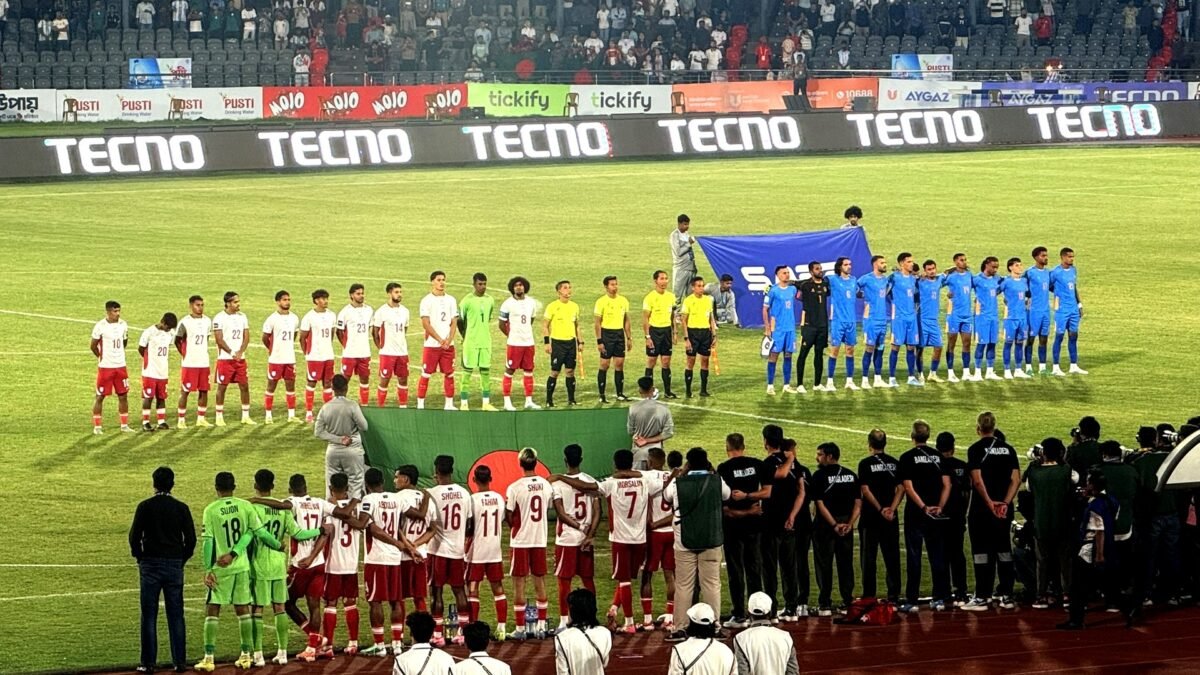
India came from behind to beat Pakistan 2-1 in the final of the SAFF Championship at the National Stadium in Dhaka on Tuesday, winning a record-extending 10th title and completing a hat-trick of three successive championships, according to reports from the match. But the result was only half the story. At the prize-giving ceremony that followed, the two teams offered each other guards of honour, a gesture of respect between sporting rivals whose meetings in cricket have lately been marked by refused handshakes and open political tension.
Champions India formed a guard of honour for runners-up Pakistan first, according to The Business Standard, and the Pakistan players then returned the gesture, lining up to applaud the Indian team. The players from both teams also shook hands and exchanged high-fives during the medal ceremony, according to reports from Dhaka. India captain Bijoy Varghese shook hands with Pakistan captain Yousuf Ijaz Butt as the two squads shared the podium.
It was, by the account of every outlet that covered it, a scene that stood in sharp contrast to the mood between the two countries in cricket. At the Asia Cup in September 2025, India’s players refused to shake hands with Pakistan after their group match in Dubai, and Pakistan lodged a protest with the Asian Cricket Council. The Indian captain again avoided a handshake with his Pakistan counterpart at the toss in the final. That row followed a four-day military conflict between the nuclear-armed neighbours in May 2025, triggered by a deadly attack on tourists in Indian-administered Kashmir, according to The Business Standard.
Ahead of the SAFF Championship, the question of whether political hostility would spill onto the football pitch was put to both coaches. Both said their teams would compete hard but had no objection to the usual courtesies after the final whistle. India coach Naushad Moosa went further. “Of course, we will do it. If needed, we will even hug them,” he had said, according to The Business Standard. On Tuesday, the two sides went further than a handshake.
Pakistan led at half-time, then the game turned
The final itself was fiercely contested, and for 45 minutes it belonged to Pakistan. Playing in their first-ever SAFF final, Pakistan were the better side in the opening half, holding 65 per cent of the ball and outshooting India nine attempts to three, according to SportsAdda, and India’s goalkeeper was forced into several saves. Pakistan had nine shots in the first 30 minutes alone, according to The Business Standard, and looked set for a shock maiden title.
Pakistan’s goal came at the end of the half. Alamgir Ghazi, who had also scored against India in the group stage, curled a shot in from the right side of the penalty area in first-half stoppage time, according to SportsAdda, putting Pakistan 1-0 ahead at the break. India’s best chance of the half had fallen to Brison Fernandes, whose shot from the edge of the box was dived on and saved by Pakistan goalkeeper Yousuf Butt.
India came out sharper after the break, and PV Vishnu hit the post early in the second half, according to SportsAdda. Then, just before the hour, the match turned on a single incident. Pakistan’s Junaid Shah went through Brison Fernandes with a rash tackle, the referee went to the video assistant referee, and came back with a straight red card, according to SportsAdda and The Business Standard. VAR was used for the first time in SAFF Championship history in the two semi-finals and the final, according to The Business Standard.
India scored within a minute of the dismissal. Suhail Ahmad Bhat levelled the score on the hour, according to SportsAdda and The Business Standard, his third goal against Pakistan in this tournament after his two in the 3-2 group-stage win on 5 November, according to SportsAdda. Pakistan dropped deep after that, and India had to find a way through, according to SportsAdda. Coach Naushad Moosa sent on Abdul Rabeeh and Irfan Yadwad in the 72nd minute, and it was a corner from Rabeeh that decided the match. Sandip Mandi, a 24-year-old East Bengal defender, rose to meet the outswinging ball and directed his header downwards; it bounced off the turf, climbed beyond Yousuf Butt and nestled in the top corner, according to SportsAdda and the IANS news agency. With two minutes of regulation time remaining, India had found the moment that would turn a troubled evening into a historic one, according to IANS.
Pakistan pushed for a late equaliser in the closing minutes, but India held on to secure the 2-1 victory and lift the trophy, according to reports from Dhaka. Khamintham Lhungdim could have made it 3-1 in stoppage time with only the goalkeeper to beat, and did not, according to SportsAdda.
A third straight title, and a 10th overall
The victory gave India a third successive SAFF Championship title, having also triumphed in 2021 and 2023, and extended their record as the competition’s most successful team, according to reports. India’s title wins now read 1993, 1997, 1999, 2005, 2009, 2011, 2015, 2021, 2023 and 2026, according to The Viral Tadka. They have now reached 14 SAFF finals in 15 appearances, according to The Business Standard, a record of dominance no other team in the region has come close to matching.
Yet this title was won in unusual circumstances. India came to Dhaka with a second-string squad, according to The Business Standard and SportsAdda. This was not India’s first team. Senior coach Khalid Jamil took the senior squad to New Zealand for two friendlies in the same window, and they lost 5-0 in Auckland and 3-0 in Christchurch, according to SportsAdda. Moosa had the players who were left. That a side assembled from the players the senior setup did not need still won the region’s biggest prize is a fact that will be quoted back at the senior team for some time.
For Pakistan, appearing in their first SAFF Championship final, it was a painful ending to a contest they had controlled for much of the opening half, according to IANS. The tournament began in 1993, and in more than three decades of trying, Pakistan had never before reached the final. Their route there was impressive in its own right. The two teams had met in their group-stage opener on 5 November, when India won 3-2, with Pakistan three goals down at half-time before scoring twice in stoppage time, according to The Business Standard. Pakistan then reached the final by beating hosts Bangladesh 1-0 in the semi-finals, with Abdul Samad scoring late, according to The Business Standard. India edged Bhutan 2-1 in their semi-final to reach the final, according to reports.
Pakistan are coached by former Peru international Nolberto Solano, according to The Business Standard, whose appointment was itself a statement of intent from a federation trying to rebuild after years of chaos. The 2026 SAFF Championship, the main men’s football competition for South Asian national teams, featured six countries and ran from 5 to 17 November in Dhaka, according to reports.
What Pakistan’s run means after years in the wilderness
To understand why Pakistan’s first final matters, it helps to know where Pakistani football has been. The Pakistan Football Federation has been suspended by FIFA three times since 2017, in 2017, 2021 and again in February 2025, over third-party interference in the federation and disputes about its constitution and elections, according to DailyLife.pk. The most recent suspension was imposed on 6 February 2025 after the PFF congress rejected constitutional amendments required by FIFA, and lifted on 2 March 2025 once the amendments were adopted, according to FIFA and The Business Standard. PFF elections followed on 27 May 2025, according to DailyLife.pk.
Each ban was lifted once FIFA’s conditions were met, but the damage accumulated. Pakistan’s national team was ranked 198th out of 211 teams in the FIFA world rankings in March 2025, according to the Azerbaijan State News Agency. The lifting of the suspension ensured Pakistan’s participation in the third round of the Asian Cup qualifiers, according to The Business Standard, and the team resumed its qualifying campaign after the ban ended, according to DailyLife.pk.
Against that background, a run to a first regional final, built on a win over the hosts in their own stadium and a first half in which Pakistan outplayed the region’s dominant team, is not a footnote. It is the first evidence in years that Pakistani football can produce something on the pitch worth talking about, rather than something in a courtroom or a FIFA circular. Solano’s side did not win the trophy, but they announced themselves as a team that can compete with the best in South Asia, and they did it in front of a Dhaka crowd that had come to see the hosts, not them.
Analysis: Why It Matters
The gesture mattered more than the result
Football finals are usually remembered for goals. This one will be remembered for what happened after the final whistle. Two teams from countries that fought a four-day war six months ago, whose cricketers refused to shake hands two months ago, stood in two lines and applauded each other. India applauded Pakistan first, and Pakistan applauded India back. That order matters: the winners honoured the losers before the losers honoured the winners, and the symmetry of it was the point.
Sport is often asked to carry more weight than it can bear, and it would be naive to claim that a guard of honour in Dhaka changes anything about the politics between India and Pakistan. It does not. But it does something smaller and more useful: it proves, in public, that the hostility is a choice made by institutions, not an inevitability written into the people who play the game. The cricketers who refused to shake hands were following a decision made above them. The footballers who applauded each other were following a different one. The contrast was visible to everyone watching, and that visibility is itself a kind of pressure. The next time a cricket captain is told not to shake hands, the footage from Dhaka will be there to be compared with it.
The red card, not the rivalry, decided the final
It is tempting to read this final as a story about India and Pakistan. On the pitch, it was a story about ten men against eleven. For 45 minutes, Pakistan were the better team by every measure that matters: possession, shots, territory, and the only goal. They had India exactly where they wanted them, defending deep and chasing the game. Then Junaid Shah’s tackle, the VAR review, and the red card changed the geometry of the match in a single minute.
That is not to say the dismissal was unjust. By every account it was a rash tackle on Brison Fernandes, and VAR, used for the first time in SAFF history, did what it was introduced to do. But the timing was brutal: India equalised within a minute, and from that moment Pakistan were defending a draw with ten men against a team that could afford to be patient. Mandi’s 88th-minute header was the inevitable product of that pressure, not a bolt from nowhere. Pakistan will rightly feel that they lost a final they were winning, and they will be right. The lesson for Solano’s team is not that they are far from India’s level, but that they are close enough for a single moment of indiscipline to cost them a trophy.
A second-string triumph that embarrasses the senior side
The most awkward fact in Indian football this week is not that the second team won the SAFF Championship. It is that the first team lost 5-0 and 3-0 in New Zealand in the same window, scoring no goals in two games. Khalid Jamil took the senior squad to play friendlies against a side ranked far above them, and the results were humiliating. Moosa took the players who were left to Dhaka and came home with a trophy.
Suhail Ahmad Bhat scored three goals against Pakistan in this tournament, including the equaliser in the final. Sandip Mandi, a 24-year-old defender, scored the winner. Neither was in the senior squad. As SportsAdda put it, both have earned a place in Jamil’s next squad, and the senior team’s coaching staff will have to explain why players who can win a regional final were not considered good enough for the team that could not score in New Zealand. The SAFF title is a regional prize, and New Zealand are a far stronger opponent than anyone India faced in Dhaka, so the comparison has its limits. But it is a comparison that will be made, loudly, and it is a fair one: the players who were trusted won, and the players who were trusted more did not.
Pakistan’s first final is the real story of the tournament
India have won ten SAFF titles. The tenth, won by a second-string side, extends a record of dominance that is now almost monotonous. Pakistan reaching their first final in 33 years is the genuinely new thing that happened in Dhaka. It is new because of what it took to get there: a federation that has been suspended three times in nine years, a national team ranked 198th in the world, a coach hired from outside to rebuild from almost nothing, and a squad that beat the hosts in a semi-final in front of the hosts’ own crowd.
The defeat will hurt, and it should. Pakistan led at half-time of a final they had never reached before, and they let it go. But the hurt is itself a sign of progress: you cannot be heartbroken about losing a final you never expected to reach. A year ago, Pakistani football’s story was a FIFA suspension and a cancelled fixture list. This week it is a 21-year-old scoring a curling goal in a final and a team that outplayed India for a half. That is a different story, and it is one worth protecting. The danger now is the familiar one: that the federation mistakes a good tournament for a solved problem, and the next suspension is already being written.
Football showed cricket what it has forgotten
The sharpest line in the coverage of this final did not come from a football writer. It came from The Business Standard’s observation that the guard of honour “stood in sharp contrast to cricket, where encounters between the two countries have become a flashpoint for political tension”. Cricket between India and Pakistan was once the great theatre of South Asian sport, a rivalry that filled stadiums and stopped two countries at once. It has become, in the last two years, a sequence of refused handshakes, protests to governing bodies, and matches played in neutral venues because the two boards cannot agree to visit each other.
Football, the poorer cousin in both countries, managed in one evening what cricket has failed to manage in two years: two teams competing ferociously for 90 minutes and then behaving like sportsmen. That is not because footballers are better people than cricketers. It is because the football fixture was allowed to be a football fixture, while the cricket fixture has been loaded with political meaning until there is no room left for the sport itself. The lesson for cricket’s administrators is not complicated. The game does not need more statements, more protests, or more careful choreography around who shakes whose hand. It needs what Dhaka had on Tuesday: a match, a result, and two teams willing to applaud each other afterwards. That is the minimum that sport owes its audience, and it is a minimum that football, for once, delivered.
What to Watch Next
- India’s senior squad: Whether Suhail Ahmad Bhat and Sandip Mandi earn call-ups to Khalid Jamil’s senior side after their performances in Dhaka, and how the senior team responds to being outshone by its own reserves.
- Pakistan’s Asian Cup qualifying campaign: Whether the form shown in Dhaka carries into the 2027 AFC Asian Cup qualifiers, where Pakistan returned to action after FIFA lifted the federation’s suspension in March 2025.
- Nolberto Solano’s future: Whether the former Peru international stays on as Pakistan coach after taking the team to its first-ever SAFF final, and what backing the PFF gives him to build on it.
- The next SAFF Championship: When and where the next edition is held, and whether Pakistan can turn a first final into a first title, with the 2026 runners-up now established as genuine contenders rather than outsiders.
- India’s regional dominance: Whether any South Asian side can break India’s hold on the tournament after a 10th title and a 14th final in 15 appearances, or whether the gap keeps widening.
- The goodwill question: Whether the sportsmanship shown in Dhaka influences the atmosphere around the next India-Pakistan cricket meeting, or whether the two sports continue to move in opposite directions.
- VAR in South Asian football: Whether the successful first use of VAR in the semi-finals and final leads to its wider adoption in the region’s domestic competitions.
Sources
- The Business Standard — India and Pakistan put rivalry aside with guards of honour after SAFF final
- SportsAdda — Pakistan went down to ten men after a VAR review, and Sandip Mandi’s late header has won India a 10th SAFF title
- IANS via Hi India — SAFF Championship: Mandi’s late goal seals India’s comeback win and historic title hat-trick
- FIFA — FIFA lifts suspension of the Pakistan Football Federation
- The Business Standard — FIFA lifts suspension on Pakistan football federation after constitutional changes
- Sportslight Media — India defeat Pakistan to clinch 10th SAFF Championship

About the Author — Abdul Mannan
Related Articles
MS Dhoni Ends 19-Year IPL Playing Career as Chennai Super Kings Name Him Team Mentor for 2027
MS Dhoni has ended his 19-year IPL playing career and will serve as Chennai Super Kings' team mentor…

Declan Rice Agrees Five-Year Arsenal Contract Until 2031 as Gunners Lock Down Title-Winning Core
Declan Rice has agreed a new five-year contract with Arsenal that will keep the England midfielder at the…
Jay Shah Re-Elected Unopposed as ICC Chair for Second Term as Board Locks In Cricket Calendar to 2035
The ICC Board has reappointed Jay Shah unopposed for a second term as chair, backing continuity as cricket…