
India Says First Phase of US Trade Deal Finalised, Enters Legal Drafting

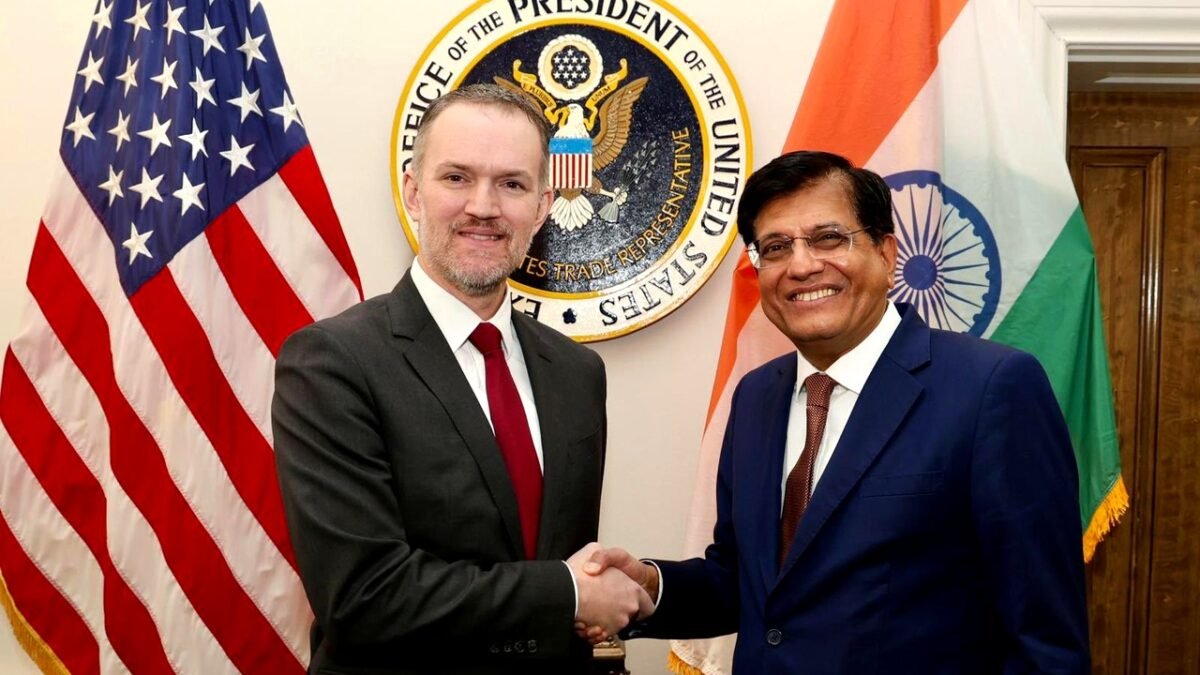
India’s Commerce and Industry Minister Piyush Goyal said on Thursday that the first tranche of the long-awaited India-United States bilateral trade agreement has been finalised and is now undergoing legal drafting, the clearest signal yet that the two countries are closing in on a deal after more than a year of tariff-driven turbulence.
Speaking at the centenary conclave of Shri Ram College of Commerce in New Delhi, Goyal said the agreement was going through what he described as “the final contours, the legal drafting”, and expressed hope that it would be wrapped up and operationalised soon, according to ANI. He attached a notable condition, however: the deal will be put into effect only once India secures what he called a “comparable advantage or competitive advantage” for its exporters over rival economies.
Goyal’s office said the minister was referring to competing exporters such as Bangladesh, Vietnam and Indonesia — countries that are also working out trade arrangements with Washington, as reported by The Hindu BusinessLine. In practical terms, New Delhi wants to ensure its exporters face tariffs no higher than those imposed on competitors in the American market, according to Reuters.
The competitive-advantage condition
The insistence on relative rather than absolute tariff levels reveals where the real negotiation now sits. India is not simply haggling with Washington over a number; it is measuring every American concession against what Hanoi, Dhaka and Jakarta may have secured or are securing in parallel talks.
Commerce Secretary Rajesh Agrawal, speaking separately to reporters, struck an upbeat note. “Probably we are in a very good zone. We anticipate closing the deal and signing the deal at the earliest possible time,” he said, according to PTI. Agrawal added that India was seeking preferential market access and greater tariff stability under the proposed agreement, according to Reuters.
Agrawal also tied the signing timetable to developments on the American side. “The trade deal has to be signed when the overall tariff structure would be formalised in the US,” he said, adding that “there is parallel work being done in the US also to get back the tariff structure and based on some of the outcomes under (Section) 301, we will progress towards signing the deal at a mutually agreed time.”
That framing is significant. Washington’s own tariff regime remains a moving target, and New Delhi is openly acknowledging that the signature cannot happen until the American side settles its internal tariff architecture — including the outcomes of Section 301 trade investigations the US Trade Representative has initiated.
Goyal’s caveat: “nothing new in that”
In remarks that received less attention than the headline, Goyal himself played down the novelty of the announcement. His comments on the deal, he said, were “exactly what he had said in the past week or three months ago. So, nothing new in that,” according to The Hindu BusinessLine’s Amiti Sen.
The remark is a piece of deliberate signalling. After months in which every Indian utterance on the trade talks has been scanned for breakthroughs, the minister appeared keen to present this as a process update — the machinery moving forward — rather than a fresh breakthrough. The US ambassador to India, Sergio Gor, has separately signalled substantial progress, saying the principal components of the agreement had been resolved and that negotiations were advancing rapidly, according to news reports citing the envoy.
How we got here
The present talks build on a framework the two governments announced in February 2026. Under that framework, the United States brought down the punitive tariff on most Indian goods from 50 per cent to 18 per cent, according to Reuters. The 50 per cent duties — comprising a 25 per cent reciprocal tariff and an additional 25 per cent penalty tied to India’s purchases of Russian oil — had been imposed in August 2025 after a previous round of talks collapsed.
Since February, however, the negotiations have run into hurdles, with officials on both sides signalling that efforts to reach a final agreement had slowed, according to Reuters. That context makes the current drafting stage meaningful: it suggests the logjam of the summer has given way to converging legal text, even if the political signature is still pending.
The bilateral relationship has had a rocky year beyond trade. Reuters has noted tensions over US President Donald Trump’s repeated claim to have brokered an India-Pakistan ceasefire, as well as a US military attack on a ship off the coast of Oman that killed three Indian seafarers. Against that backdrop, a signed first tranche would be a stabilising signal.
The trade numbers
The economic weight behind the talks is substantial. India’s goods exports to the United States rose to $42.79 billion in the April-to-August period, up from $40.39 billion a year earlier, according to Reuters. In the fiscal year 2025-26, India recorded a goods-trade surplus of nearly $34 billion with the United States.
Commerce Ministry data reported by ANI showed merchandise exports to the US grew 11.1 per cent to $50.81 billion during April-September 2026, despite tariff-related uncertainties. Imports from the US surged 26 per cent to $32.33 billion over the same period, narrowing India’s merchandise trade surplus with the US to $18.48 billion from $20.07 billion a year earlier.
The export growth is striking precisely because it happened while punitive tariffs were still being sorted out — Indian exporters have been gaining ground in the American market even without the deal. That underlying momentum may explain some of Goyal’s confidence in insisting on a competitive-advantage condition: India is negotiating from a position where its trade with America is growing anyway.
Diplomacy accelerates: Rubio’s visit
The trade developments coincide with a diplomatic push. US Secretary of State Marco Rubio will visit India and Uzbekistan from October 17 to 22, and will meet government and business leaders to discuss energy cooperation, commercial investment and broader economic ties, according to Reuters. The visit provides the next natural venue for senior-level engagement on trade, even as the negotiators work through the legal text.
Goyal also disclosed a parallel milestone: the free trade agreement between India and the European Union will be inked in December and would come into force from February or March next year, according to PTI. The EU track underscores India’s broader strategy — deepening trade architecture with multiple partners at once, which also functions as leverage in the American negotiations.
A buoyant market backdrop
The announcements landed on one of the strongest trading days of the year for Indian equities. On Thursday, the Sensex jumped 1,533.72 points, or 2.11 per cent, to close at 74,315.61, while the Nifty 50 gained 374.65 points, or 1.66 per cent, to end at 22,997.35, according to The Hindu BusinessLine’s market highlights.
The rally’s documented drivers were largely domestic: strong IT earnings — including a 32.74 per cent year-on-year profit jump at Tech Mahindra alongside a 1:1 bonus issue and an interim dividend — the record ₹30,213-crore Jio Platforms initial public offering, softer crude prices, with Brent down about 2.3 per cent to around $103.60, and a firmer rupee, which rose 12 paise to 95.05 for its fifth straight session of gains, according to the Daily Jagran and DSIJ market reports. The trade-deal news added to an already optimistic session rather than driving it alone.
Analysis: Why It Matters
The first thing to grasp about this announcement is what it is not. It is not a signed deal, it is not a complete trade agreement, and the minister himself cautioned that there was “nothing new” in it. What moved on Thursday was the machinery: negotiators have agreed on enough substance that lawyers are now drafting text. In trade diplomacy, that is a genuine threshold — lawyers do not draft text for deals that are still being argued over — but it is not the finish line.
The second thing to grasp is the cleverness, and the risk, of the competitive-advantage condition. By framing implementation around relative tariffs rather than absolute ones, India has effectively expanded the negotiation from a bilateral table to a multilateral comparison. New Delhi is telling Washington: whatever you give Vietnam or Bangladesh or Indonesia sets the floor for what you must give us. That is a strong bargaining posture, but it also outsources part of India’s deal to American negotiations with third countries over which New Delhi has no control. If Washington offers Hanoi generous terms, India benefits; if it hardens terms elsewhere, India gains relative advantage without lifting a finger. Either way, the “competitive advantage” test makes the deal’s value contingent on outcomes India does not fully control.
Third, Agrawal’s remarks about the American tariff structure being a moving target deserve careful attention. The United States is conducting its own trade actions — including Section 301 investigations — that could reshape the tariff landscape the deal would sit in. The US Senate has also passed legislation by an 86-14 vote giving the president authority to sanction buyers of Russian oil and gas, a measure that could numerically include India, according to Reuters. Trade expert Ajay Srivastava of the Global Trade Research Initiative warned that Washington could still use the threat of such duties to press New Delhi into an unequal deal. So India is finalising a tranche whose value depends partly on what American law does next — a reminder that in this negotiation, Washington’s domestic politics is as much a variable as New Delhi’s.
Fourth, the parallel EU track is the quiet subplot that may matter most. Goyal’s announcement that the India-EU free trade agreement will be signed in December gives New Delhi something it did not have a year ago: a credible alternative anchor. Every Indian negotiator sitting across from American counterparts can now point to a nearly finished European deal as the benchmark for what India considers acceptable. That is textbook diversification of trade dependence, and it strengthens India’s hand precisely when the American side is threatening new leverage through the Russia-oil sanctions bill.
Finally, the trade numbers themselves tell a story the rhetoric obscures. Indian exports to the US have been growing — up 11.1 per cent in the April-September window — even through the tariff turbulence. The American market wants Indian goods regardless of the diplomatic weather. That underlying commercial momentum is the real foundation of the deal; the legal drafting merely formalises what supply chains are already doing.
What to Watch Next
- The legal drafting itself. Tranche-by-tranche drafting has been the pattern of these talks. Watch for any signal — from Goyal’s office, Agrawal, or the US side — that the legal text is complete, because that is the precondition for a signature.
- Rubio’s October 17-22 visit. The Secretary of State’s trip to India and Uzbekistan, with meetings on energy cooperation, commercial investment and broader economic ties, is the next venue where trade could move from the technical to the political level.
- The relative-tariff test. Goyal has staked the deal’s implementation on India’s tariff treatment being at least as good as that of Vietnam, Bangladesh and Indonesia. Any new US trade arrangements with those countries will directly affect the value of the India deal.
- Washington’s tariff architecture. The outcomes of the Section 301 investigations and the fate of the Senate’s Russia-oil sanctions legislation will determine the tariff structure Agrawal says must be formalised before signing. Watch how these evolve.
- The EU parallel. The India-EU free trade agreement is expected to be signed in December and take effect in February or March 2027. Progress there will set the benchmark — and the competitive pressure — for the American track, and for the broader bilateral trade agreement beyond this first tranche.
Sources
- Reuters via The Hindu BusinessLine: “India says first phase of US trade deal finalised”
- The Hindu BusinessLine: “First tranche of US trade deal ready: Commerce Minister”
- PTI via The Hindu BusinessLine: “Legal drafting on in US trade pact; to be operationalised once we get competitive advantage: Goyal”
- ANI via LatestLY: “First Tranche of India-US Trade Deal Finalised, Undergoing Legal Drafting, Says Commerce Minister Piyush Goyal”
- The Hindu BusinessLine: “Stock Market Highlights, Oct 15: Sensex jumps over 1,500 points, Nifty nears 23,000”

About the Author — Abdul Mannan
Related Articles

$110 Oil: The New Energy Shock and the Reckoning at the Ballot Box
Brent crude touched $110 a barrel this week for the first time since May, as missiles over Saudi…
Supreme Court Quashes ₹8,415 Crore Yes Bank AT1 Bond Write-Off, Upholds 2023 Bombay High Court Ruling
India's Supreme Court on Thursday upheld the Bombay High Court's 2023 ruling quashing the ₹8,415 crore write-down of…

India’s IT Stocks Post Best Week in 18 Years as Earnings Beat Trumps AI Fears
India's IT services shares posted their biggest weekly gain in 18 years on Friday, as stronger-than-expected quarterly results…