
Israel Advances Plan for New West Bank City of 200,000 Residents as a ‘Protective Belt’ for Tel Aviv

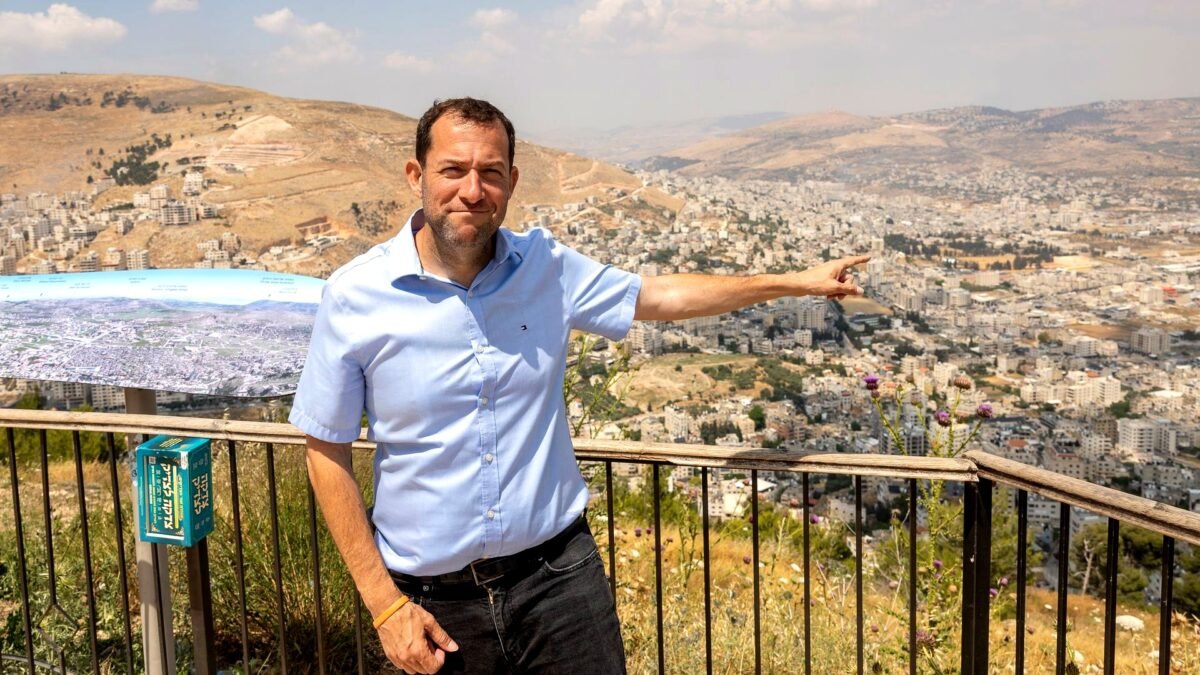
Israel’s Samaria Regional Council is advancing plans for a new city in the occupied West Bank that would house roughly 200,000 people, a project its backers describe as a defensive belt for Tel Aviv and its critics will read as one of the largest settlement expansions in the territory’s history.
The city, to be called Shira and also known as East Rosh HaAyin, would be built east of Rosh HaAyin along Highway 5, between the Israeli city inside the Green Line and the settlements of Peduel, Bruchin and Leshem, according to the Jerusalem Post and the TPS news agency, which both reported the plan on Friday.
Under the preliminary plan, the city would cover about 16,000 dunams, around 4,000 acres, and include some 60,000 housing units for more than 200,000 residents, according to the reports. It would be a mixed city of secular and religious residents, combining low-rise housing with the denser construction typical of Tel Aviv-area cities.
The project has already cleared several official hurdles. The security cabinet approved the city in December 2025, Maj. Gen. Avi Bluth, the head of the Israel Defense Forces’ Central Command, later signed an order defining its jurisdiction, and in September the Interior Ministry assigned it an official community code, according to TPS. Once funding is allocated, the planning phase is expected to take about two years.
“The city will be the protective belt of Metropolitan Tel Aviv against the October 7 threat,” Yossi Dagan, the head of the Samaria Regional Council, said, according to TPS. He called the plan “a security and strategic move of the first order” and said “Zionism and the building of the land will bring security.”
The announcement places a single urban project at the centre of the two arguments that have defined the West Bank for decades: whether Jewish settlement in the territory is a matter of national security, and whether it is lawful at all. The Palestinian leadership and most governments consider Israeli communities in the West Bank illegal under international law, a position Israel disputes. In July 2024, the International Court of Justice found in an advisory opinion that Israel’s occupation of the West Bank and East Jerusalem was unlawful and that its settlements there were illegal under international law.
The plan in detail
Shira would sit on the western edge of the Samaria hills, on the high ground that looks down towards Israel’s coastal plain. The site lies next to Highway 5, the east-west road that runs from the Tel Aviv area into the West Bank, between Rosh HaAyin, which sits inside the Green Line, and the communities of Peduel, Bruchin and Leshem.
The Samaria Regional Council has been developing the project for about two years in cooperation with the Israel Land Authority, according to the Jerusalem Post. The council says all construction would take place on state land in Area C, the part of the West Bank that is under full Israeli civil and security control under the Oslo agreements.
The council presents the city as a security measure on several grounds. It says the area suffers from illegal waste burning, which harms residents’ quality of life, as well as smuggling and unauthorised crossings into Israel. In its view, a large urban area would form a buffer between Samaria and central Israel and block the kind of infiltration by armed attackers that Israel’s defence establishment treats as a planning scenario, a so-called “second October 7”, according to TPS.
Council officials have also argued, in terms reported by the Jerusalem Post, that the city’s construction would prevent the formation of a continuous stretch of Palestinian villages between Samaria and central Israel. The proposed city is intended to create a direct geographic connection between the Samaria settlements and central Israel, the report said.
Rosh HaAyin Mayor Raz Sagi has backed the initiative. He has argued that regulated settlement development and improved infrastructure could contribute to the security of his city’s residents, and that the project could support regional economic development by improving infrastructure and strengthening connections between Rosh HaAyin and surrounding communities, according to the Jerusalem Post.
The plan has grown since it was first proposed. When Dagan and Sagi jointly called for the city in December 2025, the proposal was for a city of about 130,000 residents. The preliminary plan reported on Friday raises that to more than 200,000 residents and 60,000 housing units, a scale that would make Shira larger than many established Israeli cities.
The road so far
Shira’s progress through Israel’s bureaucracy has been steady, and it is worth setting out the sequence, because it shows how far the project has already travelled before a single home has been built.
The idea was launched publicly on 1 December 2025, when Dagan and Sagi visited a farm outpost between Peduel, Leshem, Bruchin and Alei Zahav and jointly called on the government to approve a new city on agricultural land within the Samaria council’s jurisdiction. Their stated aim was to prevent another attack similar to the 7 October 2023 Hamas assault in southern Israel.
Three weeks later, on 21 December 2025, Israel’s security cabinet approved the establishment and legalisation of 19 Jewish communities across the West Bank, including Rosh HaAyin East, as the city was then called. The decision drew condemnation from 14 countries, including France, Germany and Italy, which said it violated international law and risked fuelling instability.
In September 2026, the Interior Ministry granted official community codes to Shira and three other communities, Har Bazak, Pnei Kedem and Keren Yaar, bringing to 43 the number of communities that have received official locality codes under the current formalisation drive, according to The Jewish Edition. Finance Minister Bezalel Smotrich said at the time that Shira would “protect Rosh HaAyin and Petah Tikva from the east” and provide housing for tens of thousands of young couples and families.
The detailed preliminary plan reported on Friday is the latest step: a defined footprint, a housing target and a population figure, with a two-year planning phase to follow once funding is allocated. Dagan said the council had been working on the project for more than four years with its professional team.
A security argument, stated bluntly
Dagan has never presented Shira as ordinary urban planning. He has framed it, from the first proposal to Friday’s announcement, as a security project first and a housing project second.
“This is a security and strategic move of the highest importance for the State of Israel,” he said, according to the Jerusalem Post. “The city will serve as a significant defensive belt for the cities of Gush Dan against an October 7-style scenario originating from the Palestinian Authority.”
The argument has two parts. The first is physical: a large, populated urban area on the ridge east of Rosh HaAyin would make it harder for attackers to move undetected from the West Bank hills towards the coastal plain, where most of Israel’s population lives. The second is demographic: a continuous band of Israeli communities linking Samaria with central Israel would, in the council’s view, close a gap that it regards as a vulnerability.
The framing is not new. Israeli governments have justified settlement construction on security grounds since 1967, and the October 7 attack gave that argument fresh force in Israeli public debate. What is new is the scale at which it is being applied: not an outpost or a neighbourhood extension, but a city of 200,000 people, presented as a piece of national defence infrastructure.
Dagan himself is a prominent figure in the settlement movement and an outspoken advocate of Israeli expansion in the West Bank. He was recently barred from entering France over his activism, according to Israeli media cited by TPS.
The legal fault line
The plan sits on the opposite side of a legal line that most of the world draws in a different place from Israel. The Palestinian leadership and most governments consider Israeli settlements in the West Bank illegal under international law. Israel disputes that position, arguing that the territory’s legal status is unresolved and that Jews have a historical and legal claim to live there.
The International Court of Justice weighed in with its July 2024 advisory opinion, finding that Israel’s continued presence in the occupied Palestinian territory was unlawful, that its settlement policy violated international law, and that Israel was under an obligation to bring its presence to an end as rapidly as possible. Advisory opinions are not binding in the way a court judgment is, but they carry significant weight in international law, and the opinion has been cited repeatedly by governments and international bodies since it was issued.
That legal backdrop is why a planning announcement of this kind draws international attention far beyond its immediate geography. A city of 200,000 people is not a reversible decision. Once built, with roads, schools, hospitals and rail links, it becomes a permanent fact, and permanent facts are what make the question of the West Bank’s future harder to resolve by negotiation.
The December 2025 approvals already illustrated the diplomatic cost. Fourteen countries, including France, Germany and Italy, condemned the decision at the time. The Friday announcement is likely to draw a similar response from European governments, several of which have moved in recent years from statements of concern towards concrete measures, including sanctions on settler leaders and restrictions on trade with settlements.
The “Million in Samaria” strategy
Shira is the centrepiece of a much larger programme. It is a central part of “Million in Samaria”, a plan Dagan has promoted for several years that calls for bringing more than a million Israelis to the area by 2050 through new cities and towns, rail lines, hospitals and industrial zones.
About 540,000 Israelis now live in roughly 150 communities in the West Bank, according to figures cited by the council, or roughly 5 per cent of Israel’s population of about 10 million. The Israeli population in the West Bank grew by 10,623 in 2025, according to the council’s figures.
By the council’s estimate, the number of Jews living in Judea and Samaria could grow to as much as 1.2 million people under the programme. The broader development plan could bring up to 1.2 million additional residents to Area C, according to council officials cited by the Jerusalem Post.
The strategy is demographic as much as it is territorial. Settlements have always been, in part, a numbers argument: the more Israelis living in the West Bank, the harder it becomes, politically and practically, to remove them in any future agreement. A city of 200,000 people, with its own municipal institutions, schools and infrastructure, would be far harder to dismantle or relocate than a hilltop outpost of a few dozen families.
That is also why the infrastructure matters. The “Million in Samaria” plan is not only about homes. It includes rail lines, hospitals and industrial zones, the kind of public investment that turns a collection of settlements into a functioning region, integrated with the Israeli economy and increasingly indistinguishable, in daily life, from the towns inside the Green Line.
Analysis: Why It Matters
A city, not a settlement, and the difference matters
The most important thing about Shira is its scale. A settlement of a few hundred families can be described, by its supporters, as a community, and by its critics as an outpost. A city of 200,000 residents cannot be described as either. It would be one of the largest urban centres in the West Bank, bigger than many cities inside Israel proper, and it would arrive with the full apparatus of a municipality: a mayor, a budget, schools, clinics, roads and a planning authority of its own.
Scale changes the politics in both directions. For supporters, a city is harder to dismiss as a provocation and easier to defend as a response to a genuine housing need in central Israel, where prices are high and land is scarce. For critics, a city is harder to reverse than a settlement, and its construction would amount to a decision, taken unilaterally, about the permanent map of the territory. The argument is no longer about whether a particular hill should be built on. It is about whether a new Israeli city should exist at all on land the rest of the world regards as occupied.
The security case, and what it concedes
Dagan’s security argument deserves to be taken seriously on its own terms, because it reveals something important about how Israel’s settlement movement now justifies its project. The claim is not only that settlements are lawful or historically justified. It is that they are necessary to prevent another October 7, and that a populated buffer is a better defence than an empty one.
But the argument also concedes something its critics have long alleged. When council officials say the city would prevent “a continuous stretch of Palestinian villages between Samaria and central Israel”, they are describing, in their own words, a project designed to interrupt Palestinian geographic contiguity. That is the heart of the objection to it: not only that the city would be built on occupied land, but that its purpose includes breaking up the territory that would form a future Palestinian state.
The two readings of the same sentence cannot both be wrong. A buffer that protects Tel Aviv is, from the other side of the line, a wedge that divides the West Bank. Any honest account of Shira has to hold both descriptions at once, because both are contained in the council’s own presentation of the plan.
The law is not the only constraint, but it is a real one
It is tempting to treat the International Court of Justice’s 2024 advisory opinion as a dead letter, since Israel has not acted on it and no enforcement mechanism compels it to do so. That would be a mistake. International law constrains states less through enforcement than through the costs it imposes on their relationships: trade, diplomacy, arms sales, and the willingness of other governments to cooperate.
Those costs are already visible. Fourteen European countries condemned the December 2025 approvals. France has barred Dagan from entering the country. Britain has imposed sanctions on settler leaders and organisations. The European Union has debated, repeatedly, whether to restrict trade with settlements. None of these measures has stopped construction. But they have made it more expensive, diplomatically and economically, and a project on Shira’s scale will test how far European governments are willing to go from statements to measures that bite.
The more interesting question is whether the United States will weigh in. The Trump administration has been notably permissive towards Israeli settlement activity, and the president’s own envoys are engaged in a peace effort with Russia and Ukraine that has consumed Washington’s diplomatic attention. Silence from Washington would itself be a signal, and one the council will read as encouragement.
Demography as policy
The “Million in Samaria” plan is worth understanding as a strategy rather than a slogan. Its logic is that facts on the ground, accumulated steadily over decades, eventually become facts on the map. Each new community makes the next one easier to justify, and each round of infrastructure investment makes the whole enterprise harder to undo.
Shira fits that logic perfectly. It is not an isolated decision but the largest single step in a programme whose stated goal is to double the Jewish population of the West Bank. The council’s own figures show the direction of travel: 540,000 settlers today, growing by more than 10,000 a year, with a plan to reach 1.2 million. At that scale, the question of whether the West Bank will be part of a Palestinian state ceases to be a matter of negotiation and becomes a matter of arithmetic.
That is why the announcement matters beyond the fate of one city. It is a statement of intent about the future of the entire territory, made in the form of a planning document.
What the timeline tells us
It is also worth noting what has not happened yet. Shira has been approved, given a jurisdiction and assigned a locality code, but no homes have been built, no roads have been laid, and the two-year planning phase has not yet begun, because funding has not been allocated. Between an announcement and a city there is a long road of budgets, permits, tenders and political decisions, any of which could slow or reshape the project.
That gap matters for two reasons. First, it means the plan is still, in a real sense, reversible: a future Israeli government could freeze it, shrink it or abandon it, as previous governments have frozen or abandoned settlement plans before. Second, it means the next two years will be the decisive period, as opponents mobilise internationally and supporters push for funding. The story of Shira will not be decided by Friday’s announcement. It will be decided by what happens, quietly, in planning committees and budget negotiations over the next 24 months.
What to Watch Next
- Funding: whether the government allocates money for the two-year planning phase, and how quickly, will show how committed it is to a project that will draw international criticism.
- Planning hearings: the plan must pass through Israel’s planning authorities, where objections can be lodged. Watch for legal challenges from Palestinian landowners and Israeli human rights groups.
- International reaction: statements from the Palestinian Authority, the European Union, Britain and the United States in the coming days will set the diplomatic tone, and any move from words to measures will matter more than the words themselves.
- The scale question: whether the 60,000-home, 200,000-resident figure survives the planning process, or is scaled back under pressure, will indicate how much of the announcement is a negotiating position.
- Infrastructure decisions: rail lines and Highway 5 upgrades tied to the city would lock in its integration with central Israel. Watch for transport and utility budgets attached to the plan.
- The wider programme: Shira is one of 43 communities formalised under the current drive. Watch whether other large projects follow, and whether the “Million in Samaria” plan accelerates.
- The two-state map: any future negotiation over the West Bank will now have to account for a planned city of 200,000 people on the ridge above Tel Aviv. Watch how diplomats and negotiators describe the territory’s future in the months ahead.
Sources
- TPS news agency, “Planned City Near the Green Line Designed to Prevent Another October 7”, 20 November 2026
- TPS news agency, “Samaria Council Advances Plan for New City East of Rosh HaAyin, With 60,000 Housing Units”, 20 November 2026
- The Jerusalem Post, “New West Bank city aims to house 200,000, serve as security buffer for central Israel”, 20 November 2026 (via NewsCord)
- The Jewish Edition, “Israel Formalizes New City of Shira and Three Other Judea and Samaria Communities”, 5 September 2026

About the Author — Abdul Mannan
Related Articles
Zelensky Calls Crimean Bridge Strikes a ‘Fair Response’ as UK’s Streeting Brands Putin a ‘Cold-Blooded Killer’ in Kyiv
Volodymyr Zelensky has defended Ukraine's strikes on the Crimean Bridge as a 'fair response' to 109 Russian attacks…
UN ‘Killer Robot’ Talks End in a Two-Year Promise as States Agree to Draft Rules by 2028 — Without Binding Them
After five days of talks in Geneva that ran past 4 a.m., 128 states agreed to spend two…

Russian Cargo Ship Sparta II Hit by Drones and Set on Fire in Gulf of Finland, Drifting Into Finnish Waters
Two drones struck the Russian cargo ship Sparta II in the Gulf of Finland on Saturday, setting it…