
Riyadh’s Iconic Kingdom Centre Empties Its Offices as Houthi Attacks Rattle Saudi Capital

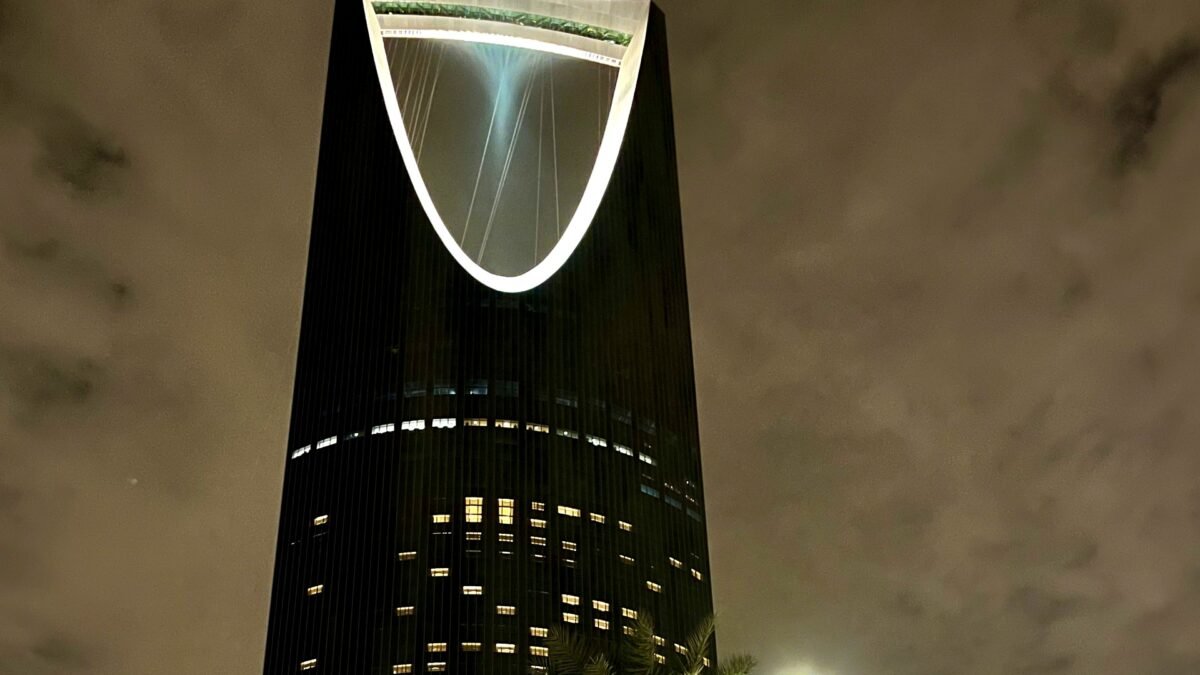
Riyadh’s Iconic Kingdom Centre Empties Its Offices as Houthi Attacks Reach the Saudi Capital
One of Saudi Arabia’s most recognisable skyscrapers has ordered office staff to work from home until further notice, a striking sign of how far Houthi missile and drone attacks have rattled the kingdom’s capital.
Management at the 99-storey Kingdom Centre, the landmark tower that dominates Riyadh’s skyline, told all office employees that remote working arrangements were mandatory with immediate effect, according to an internal email obtained by Agence France-Presse (AFP). “Please be advised that remote working arrangements are mandatory for all office employees at Kingdom Centre, effective immediately and until further notice,” the email said.
Employees were instructed not to report back to their offices. The shopping mall at the base of the tower, however, remained open to the public, according to the AFP reporting carried by Fox News Digital.
The directive came after the Saudi-led coalition said it had intercepted two drones in the Riyadh area, a third over the Eastern Province and two ballistic missiles in southern Saudi Arabia overnight, following a threat alert issued for the capital earlier in the day and shared on X.
Building management gave no specific reason for the decision, but it arrived amid a sustained wave of missile and drone attacks by Yemen’s Houthi rebels that has repeatedly disrupted life in Riyadh and other Saudi cities in recent days.
The move is notable because of who works in the tower. The Kingdom Centre’s office tenants include major international financial institutions and consultancies such as Merrill Lynch, the consulting giant McKinsey & Company and the International Monetary Fund, giving the evacuation of its desks a symbolic weight well beyond one building.
A Week of Escalating Strikes
The remote-work order followed one of the most dangerous stretches for Saudi Arabia since the Yemen war reignited in July. The security concerns trace back to a deadly attack on King Khalid International Airport on 10 October that killed 13 people and wounded more than 300 others, according to the reporting.
A second strike on the airport the following day killed one person and injured 11. Airport operations have been severely disrupted since, and schools in Riyadh have extended remote learning measures amid the continued security threats.
On Sunday, Saudi civil defence authorities said a hostile projectile struck a residential neighbourhood in the southern city of Najran, injuring six people and damaging three homes and three vehicles, according to Fox News Digital. Saudi officials said the incident was also linked to the ongoing cross-border attacks.
The same day, Maj. Gen. Turki al-Maliki, the spokesman for the Saudi-led coalition, said two Saudi military personnel were killed when an AH-6i reconnaissance helicopter crashed in the Najran region near the Yemeni border because of a technical malfunction.
The Houthis, the Iran-backed rebel group that controls Yemen’s capital Sanaa and much of the country’s north, have stepped up attacks on Saudi targets since the civil war reignited in July, striking Red Sea tankers, oil facilities, airports and now the capital itself.
WSJ: Saudi Defences Strained
According to a new analysis by The Wall Street Journal, the sustained attacks have exposed real limitations in the kingdom’s armed forces despite Saudi Arabia’s enormous defence budget and its arsenal of advanced fighters and air-defence systems supplied by the United States and others.
The Journal reported that the Saudi air-defence effort is hampered by a shortage of the interceptors needed to shoot down incoming Houthi missiles, compounded by a reluctance among key Saudi allies, including the United States, to provide direct military assistance.
The Houthis, the report said, have proved an especially resilient foe, with plentiful ground forces and indigenous missile and drone production capable of countering Saudi military strengths. The Saudis rely on fractious militias loyal to the Riyadh-backed Yemeni government for the ground fight, while Saudi jets and attack helicopters provide air support.
Saudi forces have intercepted more than 90 per cent of the Houthi missiles targeting areas protected by its US-built Patriot anti-missile systems and other air defences, a senior US official briefed on the Saudi effort told the Journal. But over half of the Houthi attacks since the war resumed have been directed at undefended locations, the official said — and drones and low-flying cruise missiles launched in waves alongside ballistic missiles have been used to try to overwhelm defences.
Guarding every potential target at once is, in practice, impossible, analysts said. The kingdom’s vital infrastructure, civilian airports and Saudi Aramco oil facilities are scattered across vast, sparsely populated deserts, and the country shares a rugged, mountainous 800-mile border with Yemen that gives Houthi mobile launchers ample cover to fire and relocate.
“What it comes down to is they just don’t have enough missiles, and because they have been attacked from Iraq in the north, from Iran in the east and now from the south, they have to divide their air-defence assets,” David Des Roches, a former Pentagon official for Arabian affairs, told the Journal.
The United States has so far confined its assistance to intelligence and other support. President Trump on Friday urged Saudi Arabia to accept military help from Israel against the Houthis, the Journal reported — a striking suggestion given that Riyadh maintains an extensive behind-the-scenes security relationship with Israel but has no formal diplomatic ties. The kingdom has not publicly responded.
Instead, Riyadh has turned to Turkey, Pakistan and several European countries for air-defence units and other military assistance, according to the Journal. Egypt on Sunday said it was prepared to provide military help, with President Abdel Fattah el-Sisi asking parliament to authorise the deployment of support if requested by Saudi Arabia — a vote Egyptian lawmakers were expected to continue deliberating on Monday.
Iran Denies Fuelling Escalation
As the attacks have intensified, the question of Iran’s role has become a diplomatic flashpoint. A day before the Kingdom Centre decision, a Saudi foreign ministry official accused Tehran of having “encouraged” the escalation — a claim Iran swiftly rejected.
“The Islamic Republic of Iran rejects any claim that Iran has played a role in Yemeni (Houthi) operations,” Iranian foreign ministry spokesman Esmaeil Baqaei said in a statement on Friday, insisting that Yemen’s armed forces act according to their own interests and assessments.
The Wall Street Journal has reported, however, that Iran has helped the Houthis mount sophisticated attacks on Saudi territory and its Yemeni allies, including assistance with targeting drone and missile attacks, as well as training, intelligence and tactical guidance.
The United States, meanwhile, widened its warnings on Sunday. The US Embassy in Jerusalem joined American diplomatic missions across the Middle East in issuing security alerts telling US citizens to exercise heightened vigilance and to prepare for possible flight cancellations and airspace closures, citing threats from Iran, its proxies and the Houthis.
The alerts pointed to recent Houthi strikes on Saudi civilian airports and critical infrastructure, and warned that the attacks could escalate beyond the kingdom. The State Department’s travel account echoed the message, urging Americans in the region to make contingency plans.
Analysis: Why It Matters
A financial landmark goes quiet
Buildings do not evacuate their desks on a whim. The Kingdom Centre is more than an office block — it is a symbol of the modern Saudi capital, and its tenants read like a who’s who of global finance and consulting. When the management of such a building decides, on the record in an internal email, that its people should not come in, the message travels far beyond Riyadh. It tells investors, executives and ordinary residents that the war is no longer a distant southern-border problem but something that now touches the commercial heart of the kingdom.
The air-defence maths does not add up
The details reported by The Wall Street Journal explain why such precautions are becoming necessary. An interception rate above 90 per cent sounds impressive — until it is placed against a country the size of Saudi Arabia, where most of the Houthis’ recent attacks have deliberately targeted undefended locations. Fixed batteries cannot be everywhere, and a rebel force with mobile launchers and deeply buried production facilities can keep firing cheaply while the defender burns through expensive interceptors. That asymmetry is precisely the vulnerability the Kingdom Centre directive acknowledges in practice.
Riyadh’s widening search for help
The most politically revealing part of the story is where Saudi Arabia is looking for support: Turkey, Pakistan, European countries — and now potentially Egypt. Washington’s assistance remains limited to intelligence, and Trump’s suggestion that Riyadh accept help from Israel went publicly unanswered, a silence that speaks to the political difficulty of formalising a security partnership with Israel while the region remains on edge. The scramble for air-defence partners is a sign that Riyadh believes the threat will not fade quickly.
The economic stakes go beyond one tower
Saudi Arabia is days away from one of its most important economic showcases: the Future Investment Initiative, the “Davos in the Desert” gathering due to run from 26 to 29 October, where global financiers and executives are expected to converge on Riyadh. The Journal has reported that executives from major banks have been deliberating over whether to attend. A capital where the signature skyscraper is sending its workers home and the airport has been struck twice is a hard place to project the confident investment narrative at the centre of Vision 2030.
An off-ramp looks harder than ever
“At some point, they are going to have to find an off-ramp, because the Houthis have this resourcefulness and capacity to respond asymmetrically in a way that can do serious damage,” Michael Ratney, a former US ambassador to Saudi Arabia and a senior adviser at the Center for Strategic and International Studies, told the Journal. But nothing in the current picture suggests an off-ramp is close. The Houthis survived a year of US airstrikes aimed at breaking their grip on the Red Sea, outlasted seven years of coalition war, and appear able to absorb punishment while continuing to strike deep inside Saudi territory. For now, the war of attrition continues — and Riyadh’s towers stay watchful.
What to Watch Next
- Egypt’s parliament is expected to continue deliberating on Monday over President el-Sisi’s request for authorisation to provide military support to Saudi Arabia.
- Whether the Kingdom Centre’s remote-work order becomes a template for other landmark buildings and multinationals in Riyadh in the coming days.
- Attendance decisions by international executives ahead of the Future Investment Initiative summit opening on 26 October.
- Any public Saudi response to President Trump’s suggestion that the kingdom accept Israeli military assistance against the Houthis.
- Further Houthi statements on targeting: the group has vowed more attacks, including against oil infrastructure, as the coalition continues its airstrikes on rebel-held areas of Yemen.
Sources
- Fox News Digital — Saudi Arabia on edge: Iconic Kingdom Centre sends workers home amid Houthi attacks (AFP reporting)
- The Wall Street Journal — Saudi Arabia’s Military Limitations Are Being Exposed by Houthi Attacks
- Twasl News — Iran rejects Saudi accusation of fuelling Houthi escalation
- JFeed — US Embassy Jerusalem Warns of Iran, Houthi Threats

About the Author — Abdul Mannan
Related Articles
Tugboat Hit by Two Projectiles Off the UAE as Attacks on Gulf Shipping Reach a Wartime Weekly High
A tugboat was struck by two projectiles off the UAE's Khor Fakkan coast as UKMTO recorded 12 attacks…
Hamas Widens Search for Hostage Remains as Egypt Sends Excavators; Trump Sets 48-Hour Watch
Hamas expanded its search for hostage remains in Gaza on Sunday as Egypt deployed excavators to Khan Younis,…
Masked Israeli Settlers Attack European Diplomatic Delegation in West Bank Village of Taybeh
European diplomats from Belgium, France and Poland came under attack by masked Israeli settlers in Taybeh on Saturday…