
Tugboat Hit by Two Projectiles Off the UAE as Attacks on Gulf Shipping Reach a Wartime Weekly High

Tug Hit Off the UAE Coast as Gulf Shipping Attacks Climb
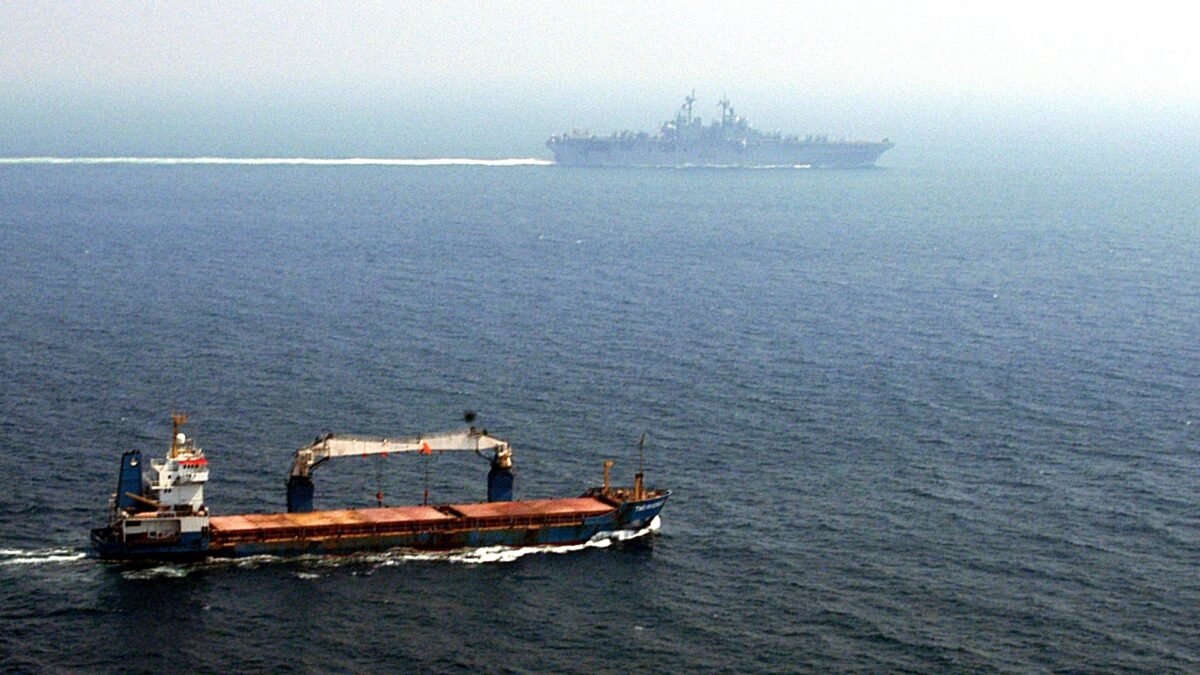
A tugboat travelling southbound in the Gulf of Oman was struck by two projectiles of unknown origin on Sunday, the British maritime security agency UKMTO reported, in the latest attack on commercial shipping near the Strait of Hormuz. The vessel sustained damage but remained underway, and one person on board suffered a minor injury, according to the agency.
The incident took place northeast of Khor Fakkan, a major container port on the United Arab Emirates’ east coast, UKMTO said in a warning issued on Sunday. The agency did not name the tug, its flag or its operator, and said the precise time of the strike had yet to be confirmed. It advised vessels transiting the area to proceed with caution and report any suspicious activity while authorities investigate.
The attack on the tug came a day after gunmen in a small boat opened fire on a liquefied natural gas tanker off the coast of Yemen. According to UKMTO, the LNG tanker was approached by a skiff carrying seven people roughly 140 nautical miles southwest of Al Mukalla on Saturday. The skiff fired two shots at the tanker; the vessel’s armed security team responded with two warning shots, forcing the small craft to change course, the agency said. No damage or boarding was reported in that encounter.
The two incidents are part of a sharply rising wave of assaults on merchant shipping in and around the Strait of Hormuz, the narrow waterway through which roughly a fifth of the world’s crude oil passes. UKMTO’s weekly assessment, issued on Friday, recorded 12 attacks on commercial vessels over the previous seven days — 10 in the strait itself, one in the Persian Gulf and one in the Gulf of Oman. Of the vessels involved, six managed to continue their journeys or reach port, one was lost, two were disabled or left without command, and the outcomes of three remained unconfirmed.
Traffic Through the Strait Remains 70 Per Cent Below Pre-War Levels
UKMTO said vessel transits through the Strait of Hormuz remain approximately 70 per cent below pre-conflict levels. Its latest weekly count recorded 125 outbound and 129 inbound transits, down from 129 outbound and 146 inbound the previous week, signalling that the fragile recovery in shipping volumes observed earlier this month has begun to falter.
The agency has now recorded 84 maritime security incidents in the Strait of Hormuz since the conflict began in late February, when the United States and Israel launched military strikes against Iran. It cautioned that the true number of attacks is likely higher, because most targeted vessels decline to report incidents formally.
The losses are real. UKMTO reported that a container ship was struck by an unidentified projectile near Ras Shaykh Masud on October 13; the attack sparked a fire aboard the vessel, which sank the following day. All crew members were evacuated, the agency said. Security analysts say October has become the busiest month for reported attacks on shipping in the strait in months, with at least 23 incidents recorded since the start of the month — nearly double the average monthly rate since the war began.
Tehran and Washington Dig In Over the Waterway
The assaults are unfolding against the backdrop of the war between the United States, Israel and Iran that began with strikes on Iranian territory on February 28. Iran has since claimed the right to regulate all traffic through the Strait of Hormuz, insisting vessels obtain permission from its armed forces before transiting. Iranian army spokesman Brigadier General Mohammad Akraminia warned shipowners on Friday that vessels attempting to use routes south of the strait — which Washington has been directing traffic toward — were entering what he called a prohibited and unsafe area, according to Iranian media.
Washington, for its part, maintains that the strait remains open. Speaking at a town hall event, US Vice President JD Vance said petrol prices would be three times as high if it were not for the US Navy keeping oil and gas moving out of the Strait of Hormuz, and accused Iran of trying to, in his words, completely choke off the world’s energy supply.
Iran’s Islamic Revolutionary Guard Corps claimed on Saturday that two supertankers carrying more than two million barrels of crude oil struck naval mines in the strait and caught fire, according to Iranian state media. The claims could not be independently confirmed. Earlier in the week, Iran’s army navy said another tanker caught fire in the Sea of Oman after straying into what it described as a prohibited area with its tracking systems switched off. UKMTO has not verified those accounts, and the identities of the vessels in question remain unclear.
The economic consequences are spreading beyond the Gulf. Shipping intelligence shows daily oil flows through the strait dropping back toward 12.6 million barrels after nearly recovering to pre-war levels at the end of September, according to trade data cited by security analysts. War-risk premiums on Gulf shipping have soared, and US officials have acknowledged that rising energy prices — petrol roughly 45 per cent above pre-war levels and diesel nearly 70 per cent higher, according to reports citing AP figures — are now a significant domestic political liability ahead of November’s midterm elections.
Analysis: Why It Matters
The strike on a humble tugboat off Khor Fakkan matters not because of the damage it caused — which was limited — but because of where it happened and what it signals. Khor Fakkan sits on the Gulf of Oman, beyond the strait itself, and has emerged as one of the alternative hubs shippers turned to as traffic through Hormuz thinned. Hitting a vessel there tells the market that there is no safe detour: the conflict’s shadow now falls on the very ports and routes that were supposed to be the workaround. When alternatives stop feeling safe, the premium on every remaining barrel rises.
The weekly UKMTO numbers also mark a tactical shift in the campaign against shipping. Ten attacks in the strait in a single week, with at least two sinkings and several vessels disabled, represents the most intense period of the maritime war so far. Security analysts quoted by AFP attribute the surge partly to the recovery of oil flows through the strait in late September: as volumes crept back toward 80 per cent of pre-war levels, Tehran gained a reason to demonstrate that it can still disrupt the recovery and impose costs on global energy markets. The attacks are, in that reading, not random harassment but calibrated economic warfare — leverage to be spent at the negotiating table.
That negotiation, however, shows little sign of movement. The two sides’ positions over the strait are now stated in directly incompatible terms: Washington insists the waterway is open under international law and escorts vessels through it, while Tehran insists the strait is closed to all traffic unless Iranian authorities grant permission. Between those two claims, commercial shipping must operate — and increasingly, it is choosing not to. A 70 per cent collapse in transits is not a disruption; it is a rerouting of the global energy map, with costs ultimately landing on consumers far from the Gulf, from American petrol stations to Asian power grids.
Perhaps the most telling figure in the UKMTO report is not the 12 confirmed attacks but the agency’s warning that the real number is higher because most attacked vessels stay silent. Shipowners have every commercial incentive to keep incidents quiet: reported attacks mean higher insurance premiums, alarmed charterers and awkward questions from flag states. The consequence is that the world’s picture of what is happening in the world’s most important oil chokepoint is systematically incomplete — policymakers are calibrating sanctions, naval deployments and diplomacy against a threat they can only partially see.
None of the parties has claimed responsibility for the weekend’s attacks, and UKMTO’s notices identify no attackers. That ambiguity is itself a feature of the current campaign: unattributed strikes let Tehran deny direct responsibility while still reaping the coercive benefit, and let Washington avoid the escalation ladder that a proven state attack would trigger. The danger is that ambiguity degrades over time. A single strike that kills a large crew or causes a major oil spill — in a strait barely 55 kilometres wide at its narrowest — could collapse the space for deniability in a day. The pattern of the last week suggests the threshold for such a catastrophe is getting closer, not further away.
What to Watch Next
- UKMTO’s next weekly assessment, which will show whether the attack tempo keeps climbing or the surge of the last two weeks was a peak.
- Any identification of the tug struck off Khor Fakkan and the LNG tanker fired on off Yemen — vessel identities will reveal whether the attackers are selecting targets deliberately.
- Independent confirmation, or the lack of it, of Iran’s claim that two supertankers struck naval mines on Saturday.
- Washington’s response to the Rubio 60-day sanctions review: whether new pressure on Iran’s oil buyers follows the waiver of the Graham Act penalties.
- Oil-price and insurance-market reactions in the coming days — war-risk premiums and crude benchmarks are the earliest gauges of how seriously markets take the escalation.
Sources
- Reuters: Tug off UAE’s Khor Fakkan struck by two projectiles, UKMTO says (via Devdiscourse)
- ANI: Tugboat struck by 2 unknown projectiles near UAE’s Khor Fakkan port, UKMTO says (via LatestLY)
- UKMTO weekly assessment: Strait of Hormuz shipping traffic remains 70% below pre-conflict levels
- UKMTO records 12 attacks on merchant ships in latest reporting period (via Interfax/LinksGraph)
- UKMTO: LNG tanker security fires warning shots after attack off Yemen (via Yemen Monitor/LinksGraph)

About the Author — Abdul Mannan
Related Articles
Hamas Widens Search for Hostage Remains as Egypt Sends Excavators; Trump Sets 48-Hour Watch
Hamas expanded its search for hostage remains in Gaza on Sunday as Egypt deployed excavators to Khan Younis,…
Masked Israeli Settlers Attack European Diplomatic Delegation in West Bank Village of Taybeh
European diplomats from Belgium, France and Poland came under attack by masked Israeli settlers in Taybeh on Saturday…
Trump Rules Out Nuclear Strike on Iran but Says US May Target Fortified ‘Pickaxe Mountain’ Nuclear Site
In a Newsmax interview, Trump said he "wouldn't use nuclear" against Iran, clarified the MOAB is conventional, and…