
Netanyahu Offers to Let Rival Eisenkot Lead First in Unity Government as Israel’s Coalition Deadlock Deepens

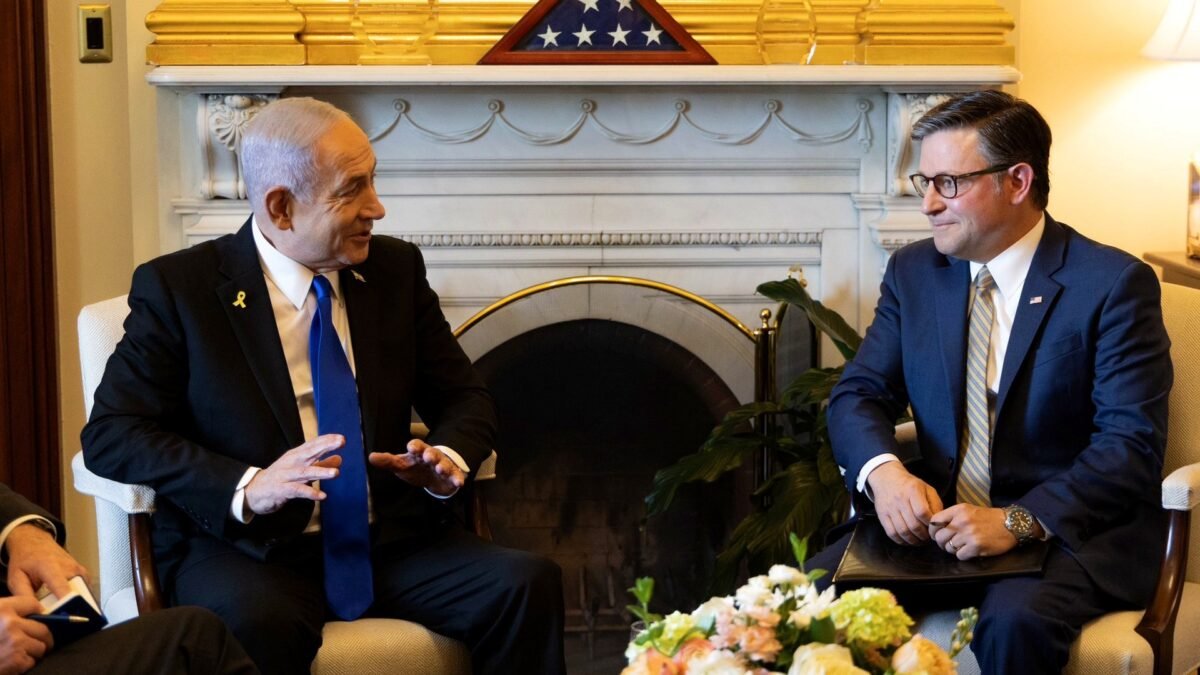
Benjamin Netanyahu has offered to let his chief political rival, Gadi Eisenkot, serve first as prime minister in a rotating unity government, in a dramatic concession from Israel’s longest-serving leader as he fights to hold on to power after an inconclusive election left the country without a governing majority.
The Israeli prime minister made the offer in a statement posted on X on Saturday evening, saying that “unity is the need of the hour” and that he was prepared to set aside his long-standing insistence that the largest party must lead any government. Under the proposal, Eisenkot would take the premiership first, while Netanyahu would serve as alternate prime minister at the start of the term. Netanyahu did not say how long Eisenkot’s initial turn would last, according to CNN.
The move comes a month after parliamentary elections on 27 October produced no clear winner. Netanyahu’s Likud party emerged as the largest in the Knesset, but his bloc fell well short of the 61 seats needed for a majority in the 120-seat parliament. Eisenkot, a former military chief who leads the centrist Yashar party, was handed the task of forming a government by President Isaac Herzog and has been steadily assembling the support that could end Netanyahu’s long hold on power.
According to Reuters, Netanyahu said in his statement that he believed he should lead the government, but that “given the magnitude of the existential threat and the possibility that a government could be formed that isn’t able to deal with this danger,” his “responsibility as a leader” required him to “put everything aside.” He said he expected Likud and Eisenkot’s Yashar party to “immediately begin genuine, sincere, and accelerated negotiations in which the other side will also be willing to make similar compromises and concessions.”
What Netanyahu actually offered
The offer reverses, at least in public, a position Netanyahu had held since the election. Likud won more votes than any other party — roughly a quarter of a million more than Eisenkot’s Yashar, according to reports of the vote count — and Netanyahu had argued that this entitled him to lead a unity government, or at least to take the first turn in any rotation. On Saturday he abandoned that claim, at least for now, and agreed that Eisenkot would go first.
What he did not do is put a time limit on the arrangement, or spell out the policy terms on which a unity government would rest. The length of Eisenkot’s first stint as prime minister, the division of ministries, and the question of who controls security and finance were all left open, to be settled in negotiation. That vagueness is one reason the offer has been greeted with deep suspicion in the opposition camp.
Netanyahu framed the concession as a matter of national security rather than political survival. In his statement, he warned of the “existential danger” of a government that depended on Arab parties for its survival, arguing that such a government would be unable to confront the threats facing Israel. He pointed to events in the Knesset since its inauguration earlier this month, including Arab lawmakers walking out during the national anthem at the swearing-in ceremony and the defeat of legislation intended to prevent the return of the bodies of attackers to their families.
He also warned, according to reports of his statement, that a government reliant on Arab support could grant Israeli citizenship to hundreds of thousands of Palestinians through family reunification, withdraw Israeli forces from security zones in Gaza, Syria and Lebanon, and ultimately pave the way for a Palestinian state backed by Iran. “We are called upon to confront immediate dangers that threaten our very existence,” he said.
Eisenkot’s answer: prove it within 24 hours
Eisenkot did not accept the offer on the spot. Instead, he invited Netanyahu and his negotiating team to sit down for “genuine and accelerated negotiations on basic guidelines and policy issues” — and gave the prime minister 24 hours to demonstrate that the offer was serious.
The former general’s scepticism is rooted in weeks of frustration. In a statement on Friday, he said that “unity is about substance and values, not about who gets which job or who goes first,” and accused Likud of refusing, over two weeks, to put a single concrete proposal on the table. He said his party had conveyed a “detailed proposal” with “significant compromise positions” a week earlier, through what he described as a secret channel, and that Netanyahu had yet to respond to it. He questioned whether Likud was ready for serious negotiations “or keep up appearances and continue to stall,” according to CNN.
Likud later said the two men had spoken by telephone and agreed to meet on Sunday morning in Herzliya, a coastal city north of Tel Aviv. The meeting is the first direct test of whether Saturday’s statement was a genuine opening or a tactical move designed to slow Eisenkot’s momentum.
Several of Eisenkot’s allies dismissed the offer outright. Yair Golan, head of the Democrats party, wrote on X: “Enough with the stunts and tricks. Netanyahu lost. It is our duty to respect the will of the voters and form a government of change and salvation.” Former prime minister Yair Lapid was blunter still, calling the proposal “yet another transparent con by a serial fraudster who has cheated every partner and broken every agreement.” Lapid proposed swearing in an Eisenkot-led government without Netanyahu first, and only then negotiating over a unity arrangement.
But the offer found an unexpected supporter in Naftali Bennett, another former prime minister, who called it the “right decision” and said it was now “forbidden” to continue discussing a government without Netanyahu. According to a source close to Netanyahu cited by CNN, Bennett was involved in behind-the-scenes discussions about the statement after holding separate talks with both the prime minister and his confidant, Ron Dermer. Bennett’s backing is a striking reversal for a politician who, in an interview with the Maariv newspaper in early October, had described Netanyahu as “the person who is destroying the state of Israel.”
The arithmetic that put Eisenkot in charge
The deadlock is, at its root, a matter of arithmetic. In the 27 October election, neither of the two main blocs secured the 61 seats needed for a majority in the 120-member Knesset. Netanyahu and his allied parties won 53 seats, while Eisenkot and his allied parties won 48, according to reports of the results. A majority of members of parliament then recommended Eisenkot for prime minister, and President Herzog gave him a 28-day mandate to form a government, which expires on 6 December.
Eisenkot has used that mandate aggressively. This week he signed coalition agreements with two partners from opposite ends of the spectrum — the right-wing Yisrael Beiteinu party and the left-wing Democrats — and he is holding talks with United Torah Judaism, an ultra-Orthodox party that supported Netanyahu for years. He has vowed to bring a new government to a parliamentary vote as early as next week, and he can request a two-week extension of his mandate, which would run until 20 December, if he needs more time.
His most straightforward path to the premiership, however, still relies on some form of support from the Arab parties, and that is precisely the vulnerability Netanyahu’s statement was designed to exploit. Eisenkot has made the declaration of Hamas as a terrorist organisation, and a commitment to dismantling it, a condition for joining his government. On Saturday night, Mansour Abbas, the Arab leader of the Raam party, appeared on Israel’s Channel 12 News and was asked about a bill, sponsored by Raam, on a state commission of inquiry into the failures around 7 October 2023, which defines Hamas as a terrorist organisation. “Hamas is a terrorist organization. Don’t you see that’s what’s written there? That’s it, event over,” Abbas said, in remarks that appeared to signal another step towards cooperation with Eisenkot.
The numbers explain why Netanyahu chose this moment to move. Eisenkot is, in the words of one report, “inching closer to a government that could oust Israel’s longest-serving leader,” and every day that passes without a deal makes a Netanyahu-free government more likely. By offering Eisenkot the first rotation, Netanyahu is attempting to insert himself into a government that would otherwise be formed without him — and to force Eisenkot to choose between a unity deal with Likud and a government that depends on parties Netanyahu has spent weeks warning voters about.
The ghost of the last rotation deal
Much of the scepticism around Netanyahu’s offer comes from the last power-sharing agreement he entered. After the 2020 elections, Netanyahu formed a unity government with his rival Benny Gantz, with Netanyahu serving first and Gantz due to take over in rotation. Instead of transferring the premiership as agreed, Netanyahu refused to pass a state budget, automatically triggering new elections and collapsing the government before Gantz could have his turn as prime minister.
That history hangs over every word of Saturday’s statement. Eisenkot’s allies have made no secret of the fact that they remember it. The 24-hour deadline Eisenkot set is, in effect, a demand that Netanyahu prove this time is different — by putting a written proposal on the table, with dates and terms, rather than a public statement that can be walked back.
It is also why Lapid’s counter-proposal — swear in an Eisenkot government first, negotiate later — carries weight in the opposition. Once Eisenkot is prime minister, the argument runs, Netanyahu would have to negotiate from a position of weakness rather than strength, and the rotation promise would be backed by the reality of power already transferred. Netanyahu, for obvious reasons, would prefer the opposite order.
A leader under pressure on several fronts
The coalition crisis is not the only pressure bearing down on Netanyahu. Days earlier, on 25 November, the judges overseeing his long-running corruption trial recommended that prosecutors drop Case 4000, in which he is accused of granting regulatory favours to a telecoms company in exchange for favourable media coverage — a development that was reported as a significant legal boost for the prime minister. But the trial, and the political divisions it has deepened, remain part of the backdrop to the coalition talks.
Meanwhile, Israel’s politics are being conducted against a region in turmoil. The war with Iran has entered its second month, with a US naval blockade of Iranian ports, tanker attacks in the Strait of Hormuz and Houthi missile and drone strikes on Saudi Arabia all continuing through the past week. At home, the questions that dominated the election campaign — the cost of the war, the shape of Gaza’s future, and who should lead the country through it — remain unresolved, and the absence of a functioning government leaves them unanswered.
Even the Palestinian political calendar is in flux. On Saturday, the foreign ministers of eight countries — Belgium, France, Norway, Poland, Luxembourg, the United Kingdom, Australia and Canada — called on the Palestinian Authority to hold elections in the first quarter of 2027. The Palestinian president had postponed the vote, which was scheduled for this year, until September 2027. The last Palestinian legislative election was held in 2006.
Analysis: a concession that reveals how weak Netanyahu’s hand has become
Strip away the language of national unity, and Saturday’s statement is best read as a measure of Netanyahu’s weakness. A prime minister who believed he could still form a government of his own would not publicly surrender the first rotation to his rival. A leader confident in his parliamentary arithmetic would not need to ask his opponent to save him from the consequences of an election he lost in all but name. Netanyahu has spent his career insisting that the largest party leads; the fact that he has now abandoned that principle, in writing, in public, tells us more about his position than anything his critics have said about him.
That does not mean the offer is insincere. Politicians in Netanyahu’s position often make their most genuine concessions when they have run out of alternatives, and a unity government would serve real interests on both sides. For Netanyahu, it offers a route back into power, a share of the premiership, and protection against a government formed explicitly to replace him. For Eisenkot, it offers the broadest possible coalition, including the largest party in the Knesset, and a government that could claim to speak for most of the country at a moment of war and economic strain. The personal cost to each man is real, but so is the prize.
The problem is trust, and it is structural rather than personal. Rotation agreements in Israeli politics have a poor record, and the most recent one collapsed precisely because the partner who went first found a way not to hand over power. Eisenkot knows this, his allies know this, and Netanyahu knows that they know it. Any agreement that emerges from the Sunday meeting will therefore have to solve a problem that no statement on X can solve: how to make a promise to transfer power credible when the person making it has broken exactly that promise before.
There are, broadly, three ways this can end. The first is a genuine unity deal, with written terms, fixed rotation dates and agreed policy guidelines — the kind of agreement Eisenkot demanded in his response on Saturday night. The second is an Eisenkot-led government without Netanyahu, built on his signed coalition deals and some form of Arab support, with Lapid’s proposal of swearing in the government first and negotiating later as its template. The third is failure: no government by 6 December, a lapsed mandate, and another election in a country that has already voted repeatedly in recent years without producing a stable majority.
Each path carries its own risks. A unity government would be broad but unwieldy, binding together parties that disagree profoundly on the war, on the future of Gaza and on the Palestinian question. An Eisenkot government dependent on Arab parties would be attacked from its first day as illegitimate by the right, exactly as Netanyahu’s statement anticipates. And a fresh election would prolong the deadlock, cost the country months of drift, and offer no guarantee of a different result. None of these outcomes is obviously better than the others, which is why the next 24 hours matter as much as they do.
What to watch is therefore narrow and concrete. First, the Sunday morning meeting in Herzliya: does Likud arrive with a written proposal, with dates and ministries attached, or with more general language about unity? Second, Eisenkot’s own deadline: he has promised a government vote as early as next week, and his mandate expires on 6 December, so the calendar is doing much of the negotiating for him. Third, the ultra-Orthodox parties and the Arab parties, whose choices will determine whether Eisenkot can govern with or without Netanyahu. And fourth, Bennett’s role: his public backing of the unity offer, after weeks of harsh criticism of Netanyahu, suggests that quiet diplomacy is already further advanced than the public statements indicate.
For Israel, the stakes go beyond who sits in the prime minister’s chair. The country is fighting a war, managing a confrontation with Iran that has already disrupted shipping, energy markets and aviation across the region, and facing international pressure over the future of Gaza. A government that cannot take decisions is a liability in those circumstances, and the longer the deadlock lasts, the greater the cost. Netanyahu’s offer may be a bluff, a genuine concession, or something in between. But the fact that he felt compelled to make it at all is, itself, the news: the longest-serving prime minister in Israel’s history is now negotiating for his political survival on terms set by his rival.
Sources
- Reuters — At risk of losing power, Netanyahu makes long-shot unity appeal to rival Eisenkot
- CNN — Running out of options, Israel’s Netanyahu offers power sharing deal to main rival Eisenkot
- The Times — Netanyahu offers to let rival lead Israel first in power-sharing deal
- New York Post — Netanyahu offers to temporarily step aside in power sharing deal with rival Eisenkot

About the Author — Abdul Mannan
Related Articles

Saudi Arabia Shoots Down Houthi Cruise Missile Aimed at Riyadh as Both Sides Strike Each Other’s Capitals
Saudi air defences intercepted a Houthi cruise missile aimed at Riyadh early on Saturday, as the kingdom and…

MSF Says Israeli Strike Killed Two of Its Staff at Gaza Clinic as Israel Claims They Were Hamas Fighters
Doctors Without Borders says two of its watchmen were killed in a direct Israeli strike on its clinic…
Erdogan Completes Ratification of Mecca Defence Pact as Pakistan, Saudi Arabia and Turkey Meet in Islamabad
Turkey's president formally approved the Mecca Joint Defence Agreement on Friday, completing ratification as defence and foreign ministers…